

Automotive Airbag Sensors Market Size and Forecast — 2026-2033
The Global Automotive Airbag Sensors Market size is estimated to be valued at USD 5.62 billion in 2026 and is expected to reach USD 9.70 billion by 2033, exhibiting a compound annual growth rate (CAGR) of 8.1% from 2026 to 2033.
Overview
Automotive airbag sensors are precision electronic components designed to detect collision impact and deploy airbags within milliseconds to protect vehicle occupants. These sensors employ accelerometers, pressure detectors, and microelectromechanical systems (MEMS) technology to measure sudden deceleration or impact forces. The data is transmitted to the airbag control unit (ACU), which determines the severity and direction of the collision before initiating deployment. Advanced sensors are capable of distinguishing between frontal, side, and rollover impacts, ensuring accurate and timely activation.
Modern designs also integrate with vehicle safety networks, such as seatbelt tensioners and crash data recorders, to enhance occupant protection. Ongoing innovation focuses on sensor miniaturization, improved sensitivity, faster data processing, and compatibility with electric and autonomous vehicle safety systems.
Key Takeaways
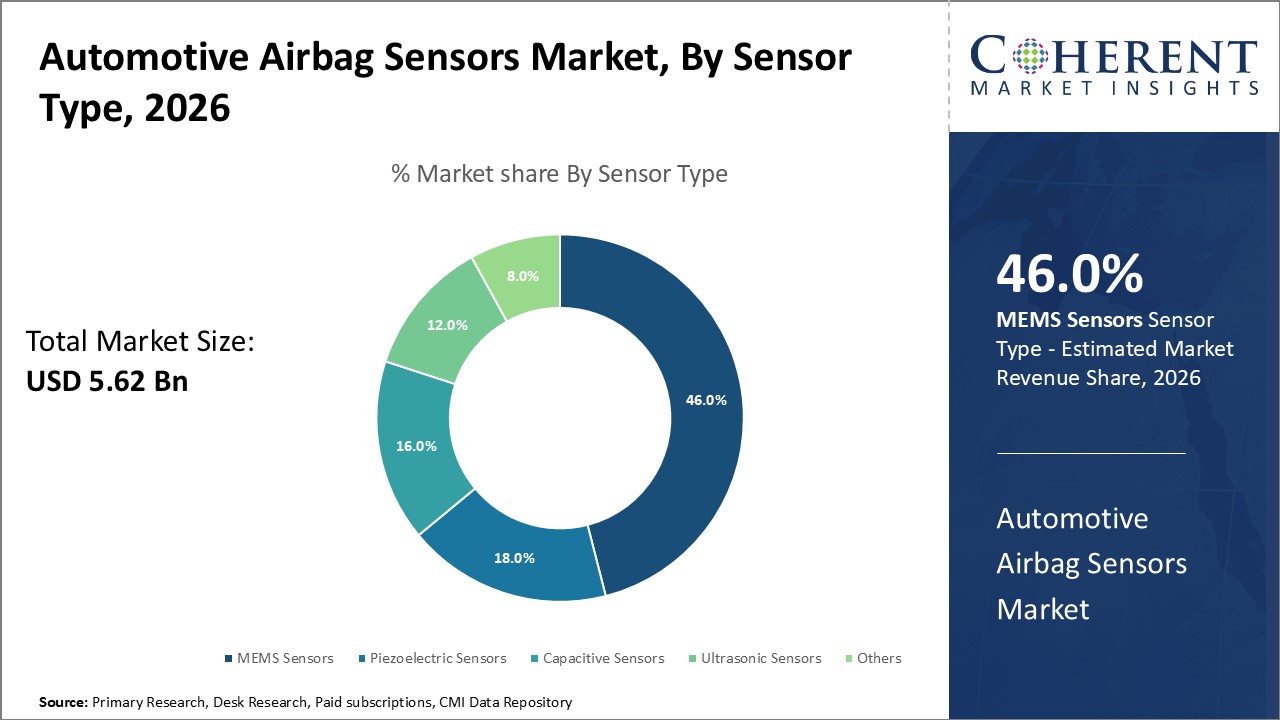
In the sensor type segment, MEMS sensors dominate the Automotive Airbag Sensors market share due to their compact size and enhanced accuracy, while piezoelectric sensors exhibit the fastest growth, powered by their application in high-precision frontal impact detection.
Among vehicle types, passenger cars hold the largest market share driven by rising safety standards globally, whereas electric vehicles represent the fastest-growing subsegment due to evolving regulatory frameworks and technological demands.
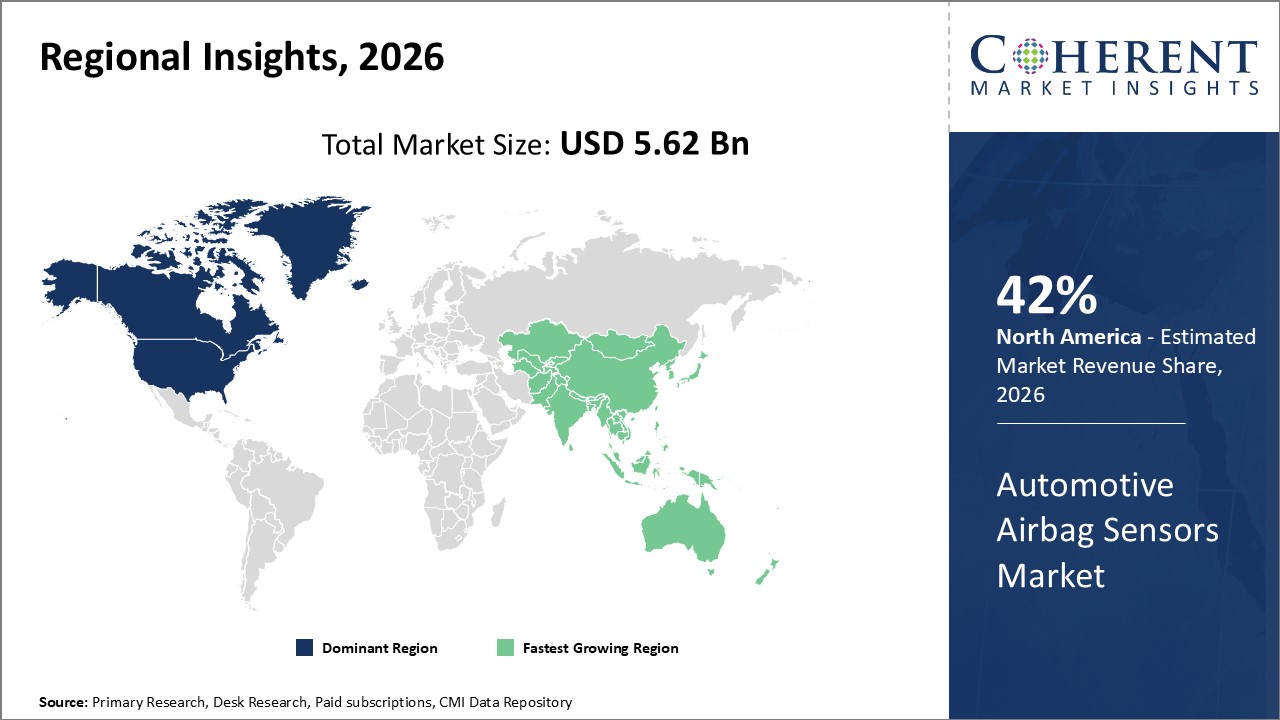
Regionally, North America leads the market share, attributed to stringent safety mandates and major OEM presence, while Asia Pacific is the fastest-growing market with a high CAGR spurred by growing automotive production and government incentives in countries like China and India.
Automotive Airbag Sensors Market Segmentation Analysis
Automotive Airbag Sensors Market Insights, By Sensor Type
MEMS Sensors dominate the market share, accounting for 45%, due to their compact design, high reliability, and cost-effectiveness. MEMS technology has witnessed continual innovation that enhances crash detection precision, driving its widespread adoption in passenger vehicles. The fastest-growing subsegment is piezoelectric sensors, propelled by their sensitivity and robustness in high-impact sensing, particularly relevant for front and side airbag deployments. Capacitive and ultrasonic sensors generally cater to niche applications, such as proximity and curtain airbag triggers, with gradual market penetration.
Automotive Airbag Sensors Market Insights, By Vehicle Type
Passenger Cars dominate the market share, driven by their sheer production volumes and regulatory safety requirements. They remain the primary platform for integration of advanced airbag sensors due to volume and stringent safety mandates. The fastest-growing segment is Electric Vehicles, reflecting their increasing market penetration and unique safety configurations requiring specially designed sensors compatible with battery packs and new vehicle architectures. Commercial vehicles continue to hold steady demand, often adopting sensors for driver and passenger protection.
Automotive Airbag Sensors Market Insights, By Application
Frontal Airbag Sensors dominate the market segment as their deployment is mandatory in most jurisdictions, reflecting the majority of sensor installations. Side Airbag Sensors represent the fastest growth segment, prompted by enhanced side-impact safety regulations adopted globally starting in 2023. Curtain Airbag Sensors also show steady growth by providing head protection in rollover and side collisions. Knee Airbag Sensors are emerging as premium safety features in passenger vehicles, often integrated with other safety systems.
Automotive Airbag Sensors Market Trends
The Automotive Airbag Sensors market is witnessing accelerating trends in AI integration and sensor fusion technology that allow for more precise crash detection and enhanced occupant safety.
For example, Bosch’s AI-enabled sensor systems introduced in late 2023 demonstrated deployment accuracy improvements by nearly 16%. Additionally, lightweight sensor materials adopted by companies like Autoliv in 2025 contribute to overall vehicle weight reduction, enhancing fuel efficiency without compromising safety.
Another notable trend is the growing customization of airbag sensor systems based on vehicle type—especially for electric and hybrid vehicles—which require adaptive sensing solutions to accommodate different impact characteristics and power architecture compatibility.
Automotive Airbag Sensors Market Insights, By Geography
North America Automotive Airbag Sensors Market Analysis and Trends
In North America, the automotive airbag sensors market holds the highest market share at 42% due to rigorous safety regulations like FMVSS, strong presence of OEMs, and rapid adoption of advanced sensor technologies. The U.S. has been a significant contributor, with regulatory updates in 2023 prompting widespread adoption of multi-axis and smart sensors, supporting a 15% market revenue increase in 2025. North America’s mature automotive ecosystem and increased government funding for vehicle safety R&D perpetuate its dominance.
Asia Pacific Automotive Airbag Sensors Market Analysis and Trends
Meanwhile, Asia Pacific exhibits the fastest growth, propelled by expanding automotive manufacturing hubs in China and India and strong governmental incentives promoting safety technology adoption. The region's CAGR surpasses 9%, bolstered by rising electric vehicle production and increasing export of sensor components. Companies like Denso and Hyundai Mobis are capitalizing on this expanding ecosystem, driving significant market penetration.
Automotive Airbag Sensors Market Outlook for Key Countries
USA Automotive Airbag Sensors Market Analysis and Trends
The USA market’s growth is primarily driven by stringent federal safety standards and robust investment in automotive safety technology development. Leading market players such as Aptiv and Bosch maintain strong partnerships with U.S. OEMs, contributing to the rollout of next-generation airbag sensors in over 75% of new car models in 2025. Additionally, government incentive programs for passenger and commercial vehicles with enhanced safety features have bolstered demand. The rise of electric vehicle production, projected to increase by over 40% in 2026, further fuels market expansion.
China Automotive Airbag Sensors Market Analysis and Trends
China’s automotive airbag sensors market is expanding rapidly due to a surge in vehicle production and government policies emphasizing safety in new vehicles. Domestic companies like Valeo and international players such as Continental have increased investments in sensor manufacturing facilities. China's increasing share of electric and hybrid vehicles, combined with upgraded national safety regulations initiated in 2023, has catalyzed market growth, representing over 30% of the Asia Pacific's automotive airbag sensors revenue in 2025.
Analyst Opinion
Advanced sensor miniaturization continues to drive market demand, with MEMS (Micro-Electro-Mechanical Systems) airbag sensors accounting for over 46% of the automotive airbag sensors market share in 2025. This trend reflects industry advancements in integrating smaller yet highly accurate sensors capable of faster deployment, significantly enhancing occupant safety.
The proliferation of electric vehicles (EVs) is creating new demand dynamics, with EV production surging by approximately 49% in 2025 compared to 2023. This surge enhances market revenue since EVs demand specialized airbag sensors compatible with unique crash profiles and battery system safety regulations.
Regional automotive regulations are pivotal micro-indicators influencing market growth. For instance, U.S. federal mandates updated in late 2023 require advanced frontal and side airbag systems in passenger vehicles, triggering a 15% growth in demand for sophisticated multi-axis sensors in North America in early 2025.
Import-export patterns signal shifting supply-chain dynamics. Asia Pacific, especially China and India, increased automotive airbag sensor exports by 22% in 2025, responding to growing demand in emerging markets, underpinning overall volume-driven market growth.
- Current Industry Events of 2026
- Market Size Estimation
- Regional Breakdown
- Competitive Landscape
- Customer Intelligence
- Segmental Analysis
- Pricing Analysis
- Key Market Drivers, Challenges & Future Trends
- Customized Insights Section
Market Scope
| Report Coverage | Details | ||
|---|---|---|---|
| Base Year: | 2025 | Market Size in 2026: | USD 5.62 billion |
| Historical Data for: | 2020 To 2024 | Forecast Period: | 2026 To 2033 |
| Forecast Period 2026 to 2033 CAGR: | 8.1% | 2033 Value Projection: | USD 9.70 billion |
| Geographies covered: |
| ||
| Segments covered: |
| ||
| Companies covered: | Aptiv PLC, Autoliv Inc., Bosch Mobility Solutions, Denso Corporation, Continental AG, Hyundai Mobis, Robert Bosch GmbH, Lear Corporation, NXP Semiconductors, Infineon Technologies AG. | ||
| Growth Drivers: |
| ||
Automotive Airbag Sensors Market Growth Factors
The increasing adoption of advanced driver-assistance systems (ADAS) synergistically fuels demand for precise airbag sensor technology, improving overall vehicision fatalities, directly supporting growth in airbag sensor integration. Government mandates globally for stricter safety standards, including the recent Euro NCAP update in 2025, which requires advanced side airbag deployments, have accelerated the penetration of sophisticated airbag sensors.
Growth in electric and hybrid vehicle production also expands the market scope, given the unique crash and safety requirements these vehicles present. 2025 saw a 52% year-over-year increase in hybrid vehicle production in the Asia Pacific alone, driving demand for specialty sensors. Lastly, increased consumer awareness around vehicle safety, supported by insurance incentive programs promoting vehicles with advanced airbag systems, has enhanced business growth opportunities.
Automotive Airbag Sensors Market Development
In April 2026, Autoliv, Inc. introduced its Bernoulli™ Airbag Module, a passenger-airbag system based on Bernoulli’s principle of fluid dynamics that enables the inflation of larger airbags via a smaller, single-stage inflator. The system is designed to meet the evolving space and safety needs of modern vehicles (especially EVs with roomier interiors), delivering quicker inflation, reduced heat generation, and cost savings of over 31% in development.
In March 2026, Hyundai Mobis unveiled a center-mounted airbag system for EVs that deploys between front-seat occupants to prevent intra-cabin collision during side-impact events. This innovation is aligned with the company’s development of advanced airbag systems for new vehicle architectures, including PBVs (purpose-built vehicles) and electric platforms.
Key Players
Leading Companies of the Market
Aptiv PLC
Autoliv Inc.
Bosch Mobility Solutions
Denso Corporation
Continental AG
Hyundai Mobis
Robert Bosch GmbH
Lear Corporation
NXP Semiconductors
Infineon Technologies AG
Several market players have focused on strategic partnerships and acquisitions to enhance their sensor technology portfolios. For example, Bosch Mobility Solutions’ collaboration with several EV manufacturers led to the development of integrated airbag and crash sensor modules, increasing their market share in North America by 6% in 2025. Similarly, Aptiv’s investments in AI-enabled sensor systems resulted in improved predictive crash analytics, supporting the launch of next-gen airbags in safety systems. For instance, in 2025, vehicles equipped with integrated ADAS reported a 18% reduction in severe coll commercial vehicles across Europe, boosting their regional market presence.
Automotive Airbag Sensors Market Future Outlook
The future of the airbag sensors will feature intelligent diagnostics, self-calibration, and real-time communication with autonomous driving systems. Sensor fusion technology will combine data from accelerometers, lidar, and cameras to optimize occupant protection in complex crash scenarios. Lightweight and miniaturized designs will align with electric vehicle architectures, while AI-enabled crash prediction algorithms will improve deployment timing. Enhanced sensor reliability under varying environmental conditions and compliance with evolving automotive safety regulations will shape product innovation. Manufacturers will also prioritize cost-effective, scalable sensor platforms that support next-generation airbag and restraint systems in both passenger and commercial vehicles.
Automotive Airbag Sensors Market Historical Analysis
Automotive airbag sensors have transitioned from mechanical switches to sophisticated MEMS-based electronic devices capable of detecting rapid deceleration and crash dynamics. Initially used for frontal impact detection, these sensors now monitor multi-directional acceleration, pressure, and vibration data to deploy airbags in milliseconds. Integration with vehicle control units improved communication speed and safety accuracy. Continuous advancements in microelectronics and signal processing enhanced sensitivity and reliability, enabling airbag systems to adapt to different impact scenarios. In parallel, the rise of advanced driver-assistance systems (ADAS) led to tighter integration between airbag sensors and broader vehicle safety networks.
Sources
Primary Research Interviews:
Automotive Safety Engineers
Sensor Design Specialists
Vehicle Electronics Manufacturers
Crash Test Analysts
Databases:
NHTSA Vehicle Safety Database
GlobalData Automotive Safety Reports
SAE International Standards
Euro NCAP Crash Data
Magazines:
Automotive World
Sensor Technology
AutoTech Review
Car Safety Magazine
Journals:
Sensors and Actuators A,
IEEE Sensors Journal
International Journal of Automotive Technology
Vehicle System Dynamics
Newspapers:
Reuters Automotive
The Detroit News
The Hindu Business Line (Auto)
Financial Times (Mobility)
Associations:
Society of Automotive Engineers (SAE)
Automotive Safety Council
International Automotive Task Force (IATF)
European Automobile Manufacturers’ Association (ACEA)
Get access to 250+ pages report
Every segment, forecast, competitor profile and data table behind the analysis above — available for instant download.
- ESOMAR Member
- ISO 9001:2015 Certified
- D-U-N-S Registered
- GDPR & CCPA Compliant
Missing comfort of reading report in your local language? Find your preferred language:
Transform your Strategy with Exclusive Trending Reports
Frequently Asked Questions
The market is dominated by industry leaders such as Aptiv PLC, Bosch Mobility Solutions, Autoliv Inc., and Continental AG, who maintain significant market share through continuous innovation and regional expansions.
The market is projected to grow from USD 5.62 billion in 2026 to USD 9.70 billion by 2033, reflecting a CAGR of 8.1%. This indicates strong market growth fueled by technological advancements and regulatory compliance.
Passenger cars continue to offer the largest opportunity based on volume and regulation, while electric vehicles present the fastest growth potential driven by unique safety requirements.
Trends indicate increasing integration of IoT and AI in sensor systems, adoption of multi-functional sensor arrays, and development of lightweight materials to meet sustainability goals, driving market growth and innovation.
The market features highly competitive global players focusing on R&D, mergers, and partnerships to enhance sensor technologies. Challenges include stringent regulatory compliance costs and supply chain disruptions impacting sensor component availability.
Leading companies employ joint ventures with OEMs, invest in AI-driven sensor technologies, and pursue geographic expansions, particularly in Asia Pacific, to capitalize on rising automotive production.