

Biopreservation Market Size and Share Analysis: (2026 - 2033)
The global biopreservation market size is expected to reach approximately USD 16,901.1 Mn in 2026 and USD 45,401.1 Mn by 2033, growing at a CAGR of 16.9% throughout the forecast period (2026-2033).
Key Takeaways from the Biopreservation Market Report
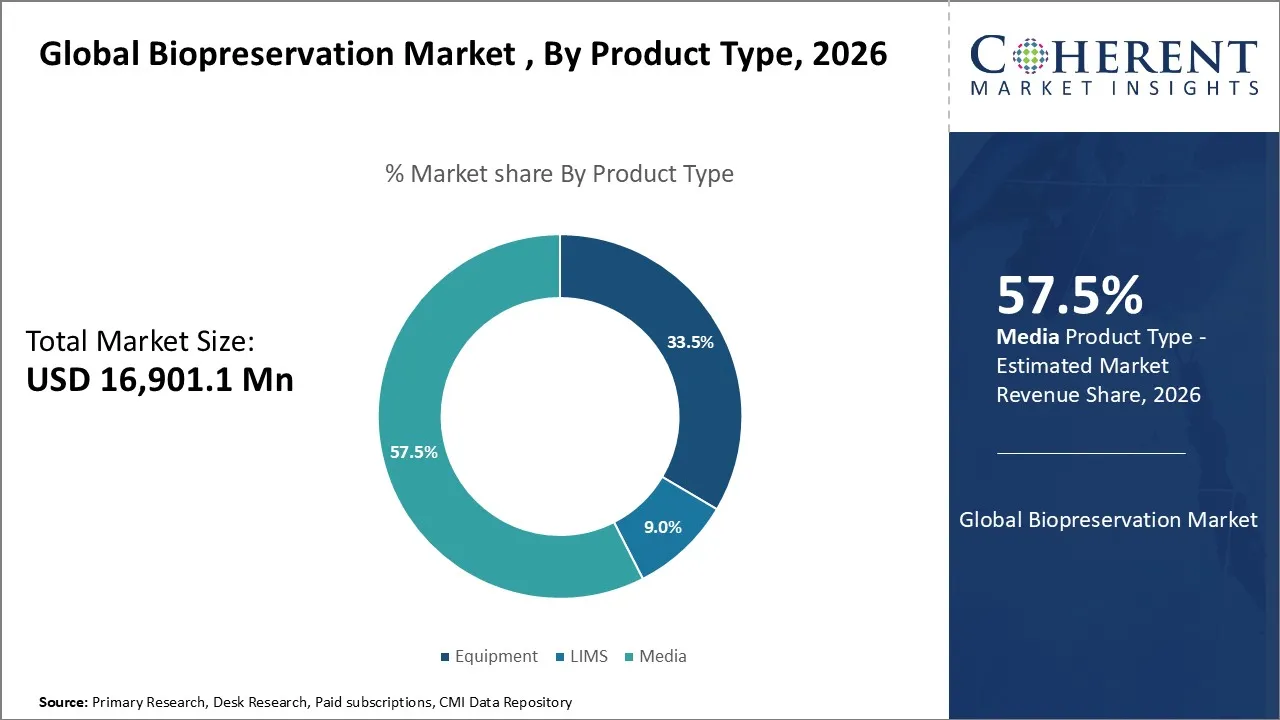
- Media main a highly sought-after product type, accounting for about 57.5 % of the biopreservation market share in 2026 as biopreservation media are consumables. Essential for viability, and widely used in regenerative medicine, drug discovery, biobanking etc.
- Biobanking is expected to remain leading application segment accounting for 44.5 % in the biopreservation market revenue in 2026, driven by workflow efficiency in pathology practice, rising adoption of remote diagnosis, and digital consultation.
- North America is projected to dominate the global biopreservation market in 2026, with a share of over 44.5 % due to strong presence of key pharmaceutical companies and advanced healthcare facilities.
Biopreservation Market Overview
Biopreservation is a used to preserve biological materials in a way that keeps them stable, viable and usable for longer period. These biological materials can include organs, tissues, cells, blood and plasma, RNA, DNA, and proteins, vaccines and other biologic samples. The main purpose of biopreservation is to prevent degradation, contamination, or loss of biological function during transport and storage. It controls pathogenic microorganisms and spoiling while preserving food quality, acting as a natural substitute for conventional preservatives. The biopreservation market has gained strategic importance due to rising demand for biobanking and biospecimen storage, growth in regenerative medicine and translational research and expanding cell and gene therapy commercialization.
Current Events and Their Impact on the Biopreservation Market
Current Event | Description and its Impact |
Regulatory Shift and Increasing Approval of New Products |
|
Increasing Government Initiatives |
|
Segmental Insights
- Current Industry Events of 2026
- Market Size Estimation
- Regional Breakdown
- Competitive Landscape
- Customer Intelligence
- Segmental Analysis
- Pricing Analysis
- Key Market Drivers, Challenges & Future Trends
- Customized Insights Section
Biopreservation Market Insights, By Product Type - Media Holds Dominant Product Type in the Market
Based on product type, media are expected to lead the market, accounting for a revenue share of 57.5% in 2026. Biopreservation media are used every time samples are stored or transported unlike equipment (one-time purchase), media require continuous replenishment generates higher and consistent revenue. Media directly affects stability, cell survival, and post-thaw recovery which is essential for successful preservation, cannot be replaced. Media has wide application across industries as it is extensively used in regenerative medicine, biobanking, drug discovery, clinical research etc., hence, broad usage increases demand in the biopreservation. Advanced therapies require high quality and specialised preservation media which drives strong demand for optimized solutions. Increasing technology advancement in media develops serum-free media and chemically defined media improves efficiency and adoption.
Biopreservation Market Insights, By Application
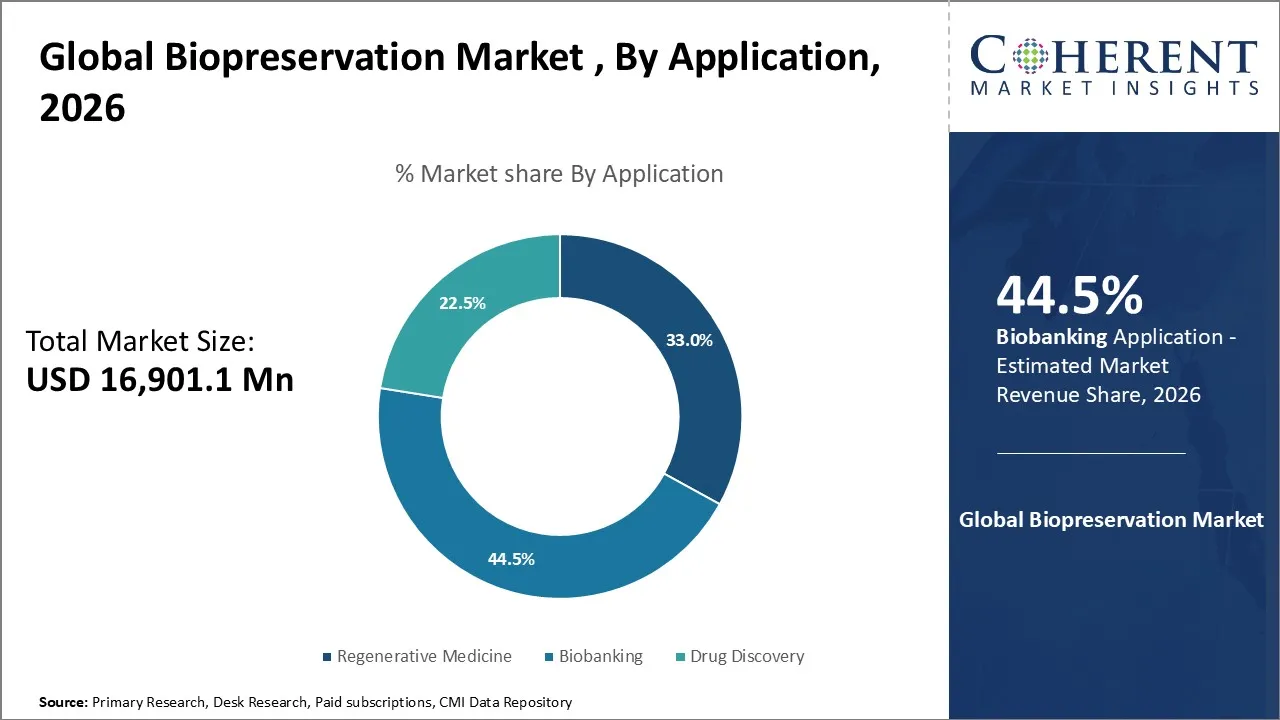
Biobanking to Remain Leading Application of Biopreservation
By application, the banking segment is slated to account for a prominent market share of 44.5% in 2026. Biobanks store huge volume of blood, tissues, DNA/RNA which requires continuous use of biopreservation solutions. Biobank support drug discovery, clinical trials, and disease research which increases demand for biopreservation equipment. The PubMed paper concludes that regions with strong research capacity have around 11–30 health research biobanks per million population. It further notes this includes about 2 large biobanks with more than 1,000 samples and 9–28 medium/small biobanks per million population. The PIB release states that this biobank will support a nationwide cohort study with data from 10,000 individuals across India, covering genomic, lifestyle, and clinical information. in genomics and precision healthcare requires long-term storage of patient-specific samples. Funding for national and regional biobanks expands infrastructure and sample storage capacity. Biobanks supply samples for research studies which continuously need preserved samples. Increased use of DNA sequencing and biomarker studies requires well-preserved samples. Biobanking dominates because it involves large-scale, long-term, and continuous storage of biological samples. The growing expansion of biobanks has significantly supported the growth of the segment in the global biopreservation market.
On July 06, 2025, India inaugurated the Phenome India “National Biobank” at CSIR-IGIB on 6 July 2025, marking the launch of a national biobank designed to support longitudinal health research in the country.
Moreover, On June 17, 2025, BioAge Labs, research institute in California, U.S. announced expansion of its platform using data from the HUNT Biobank in Norway, with molecular profiling and analysis of over 17,000 samples. While this source does not state the total number of biobanks, it is a strong scale indicator for a leading European biobank.
Regional Insights
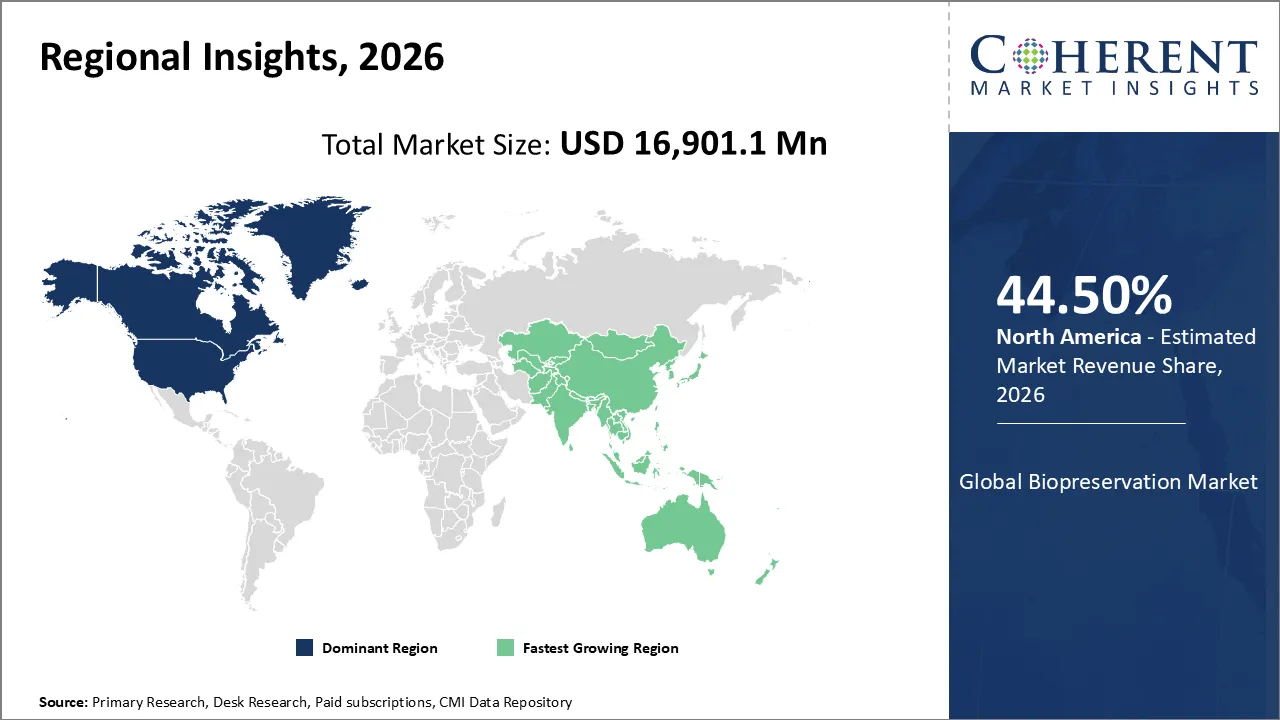
North America Remains the Market Leader in 2026
North America is expected to dominate the global biopreservation market, accounting for a share of 44.50% in 2026. North America has presence of leading global companies such as BioLife Solutions and Thermo Fisher Scientific due to which there is high demand for biopreservation in drug development and biologics. As the major companies headquartered or operating in the region there is continuous product innovation and commercialization. Well established research laboratories, biobanks and hospitals in North America supports large-scale storage and handling of biological samples. Strong funding from organizations like National Institute of Health (NIH) in U.S. and Canada drives innovation in cell therapy, genomics, and preservation technologies. Furthermore, North America leads in clinical trials and approvals of advanced therapies which increases demand for preservation of cells and tissues.
Asia Pacific Biopreservation Market Trends
Asia Pacific is expected to grow at the fastest CAGR in the biopreservation market during the forecast period. Asia Pacific is becoming a hub for clinical research and outsourced trials which requires storage and transport of biological samples. Countries like China and India are witnessing strong growth in biotech companies which indirectly increases demand for biopreservation in drug development and biologics. Increasing government initiatives and funding for development of healthcare facilities and life science research supports adoption of advanced preservation technologies. Additionally, cost advantages and the gradual adoption of advanced biopreservation technologies contribute to region’s high growth rate.
Biopreservation Market Outlook – Country-wise
U.S. Biopreservation Market Forecast
The U.S. country holds the large revenue share in the North America biopreservation market. In U.S. country, high investment in research and development drives innovation in cell therapy, genomics, and preservation technologies. U.S. is one of the highest healthcare spending countries globally which enables adoption of advanced and costly technologies. Moreover, U.S. has large number of biobanks storing blood, DNA and tissue samples creates continuous demand for biopreservation solutions. In addition, U.S. has high tech research centers and hospitals which favors rapid adoption of automation, AI and advanced cryopreservation techniques which enhances efficiency and market growth. Furthermore, favorable regulatory policies and high healthcare expenditure support the widespread adoption of biopreservation solutions.
China Biopreservation Market Trends
China is the dominant country in the Asia Pacific biopreservation market. China is a major hub for drug testing and clinical research which requires storage and transportation of biological samples. The country has strong growth of domestic biotech companies due to which there is high demand for biopreservation in biologics development and drug discovery. China has large-scale investments under national programs (e.g., “Made in China 2025”) which promotes life science research and biotech innovation. Rapid establishment of national biobanks research repositories in China drives demand for preservation media and storage systems. For instance, in April 2026, the With the World Biobanking Congress 2026 being held in Shenzhen from April 21–25, 2026 China will emerge as a major center for biopreservation and biobanking innovation. Driven by the growing need for regenerative medicine, this event, which involves ISBER, the China Medicinal Biotech Association (BBCMBA), and BGI Group, showcases the introduction and development of high-capacity robotic repositories and cell therapy storage.
Biopreservation Market News
- In February 2026, Case BioScience LLC, biotechnology company, revealed that at Advanced Therapies Week (ATW) 2026, the company will introduce CaseCryo CTG DMSO, a next-generation cryopreservation solution designed to aid in the development of clinical cell therapy. Additionally, the business will launch the CaseStor HSS Hypothermic Storage Solution, which is intended for the regulated hypothermic storage of tissues and cells. When taken as a whole, these product launches broaden CaseBioscience's biopreservation offering and demonstrate the company's continued dedication to providing superior solutions for delicate cell therapy processes.
- In February 2026, Innovation and deep science came together at BioAsia 2026's "TechBio Unleashed: AI, Automation & the Biology Revolution," where inventors Dr. Uday Saxena and co-inventor Dr. Markandey presented their company Utopia Therapeutics and its ground-breaking nutraceutical products, Nexa Gut and Nexa Sweet. The goods, which are marketed as India-first breakthroughs, would be introduced in March following FSSAI regulatory approval. Dr. Markandey emphasized that the product, which uses yeast-based enzyme technology and requires less than 10 milligrams of enzymes per bottle, was created under India's BioIT Policy Biomanufacturing Hub. As a "non-chemical nutraceutical," the team presents it as more pure than traditional processed supplements.
Market Report Scope
Biopreservation Market Report Coverage
| Report Coverage | Details | ||
|---|---|---|---|
| Base Year: | 2025 | Market Size in 2026: | USD 16,901.1 Mn |
| Historical Data for: | 2020 To 2024 | Forecast Period: | 2026 To 2033 |
| Forecast Period 2026 to 2033 CAGR: | 16.9% | 2033 Value Projection: | USD 45,401.1 Mn |
| Geographies covered: |
| ||
| Segments covered: |
| ||
| Companies covered: | BioCision, LLC, BioLife Solutions, Inc., Biomatrica, Inc., CHART MVE BIOMEDICAL, Dometic Group, Panasonic Corporation, VWR International, LLC, Thermo Fisher Scientific, Inc., Simport Scientific, ThermoGenesis Holdings, Inc., Atlanta Biologics, Lifeline Scientific, LabVantage Solutions, Inc., Hamilton Company, and Core Dynamics Ltd | ||
| Growth Drivers: |
| ||
| Restraints & Challenges: |
| ||
Biopreservation Market Drivers
Increasing Adoption of Strategic Growth Policies & Technology Advancements
Development of advanced cryopreservation techniques has enhanced the productivity and reduced errors. Automated storage systems improve efficiency and adoption. Development of advanced biopreservation media ensures better stability and reproducibility and drives higher demand for consumables. Robotic sample handling and automated cryogenic storage reduces human error and improves efficiency as well as encourages adoption by large biobanks and laboratories. Additionally, advancements in cold-chain logistics and scalable storage systems support large-scale biobanking and global sample transportation. These developments make biopreservation more cost-effective and enable its widespread adoption in regenerative medicine, drug discovery, and personalized healthcare, thereby accelerating market growth. Increasing adoption of inorganic growth policies like acquisition to develop advance technologies has estimated to drive the market growth over the forecast period.
- For instance, in March 2026, Azenta Life Sciences, a company focused on providing life sciences solutions, signed acquisition with UK Biocentre Limited, biotechnology company based in U.K., has been purchased by its wholly owned subsidiary, Azenta UK Ltd. Including up to GBP 1.8 million in contingent consideration upon reaching specific milestones, the total consideration was GBP 20.5 million, net of cash. By establishing the U.K. Biocentre as a European-wide operational hub to support pharmaceutical, biotechnology, academic, and public health clients throughout the region, the acquisition enhances Azenta's capacity to provide end-to-end lifecycle solutions in the U.K., a top hub for life science research. Our already-established biorepository in Griesheim, Germany will be supported by this significant hub, which will benefit both existing and new clients with increased automated sample storage capabilities, dependable and fully integrated sample management and processing services, and a wider European footprint to support the region.
Integration of AI and Adoption of Advanced Technologies
Integration of AI and automation improve accuracy and reduce human error. Automated systems include storage, sample labelling, and retrieval. AI minimizes manual mistakes ensures high sample integrity and reliability. AI-enabled systems can track thousands of samples in real time and optimize storage locations which increases operational efficiency in biobanks and labs. Furthermore, automation speed up freezing, thawing, and sample handling reduces turnaround time in research and clinical workflows. Automated cryogenic storage systems allow handling of millions of samples and support expansion of large-scale biobanking projects. AI integrates with LIMS systems provide insights for sample usage and storage optimization which enhances research productivity.
- For instance, in February 2026, Gemini Bioproducts, LLC ("GeminiBio"), a portfolio company of BelHealth Investment Partners, LLC ("BelHealth") and a biotechnology company, announced the introduction of aiMOSTM (Artificial Intelligence Media Optimization Service), a first-of-its-kind service that uses multi-omics data and artificial intelligence/machine learning (AI/ML) to create custom media supplements that enhance the efficiency, consistency, and scalability of cell therapy production. The goal of aiMOS, which was created in partnership with Tolemy Bio, is to assist cell therapy innovators in improving their biology, improving critical quality attributes (CQAs), increasing manufacturing efficiency, and lowering overall costs across the development and manufacturing stages of T-cell, NK-cell, TCR, and TIL.
Biopreservation Market Trends
- Advances in controlled-rate freezing, vitrification, and optimized thawing protocols are improving post-thaw cell viability, recovery consistency, and functional integrity, making biopreservation more reliable for high-value biologics, stem cells, reproductive samples, and therapy-grade materials. This technical shift is supporting wider adoption across both research and clinical workflows.
- Rising cell and gene therapy commercialization is strengthening demand for biopreservation systems, as these therapies require tightly controlled storage, handling, and transport from collection through manufacturing and final administration. As of December 9, 2025, the U.S. FDA listed 48 approved cellular and gene therapy products, highlighting the growing need for robust cryogenic preservation infrastructure.
- Expansion of large-scale biospecimen programs is increasing the requirement for long-duration storage, sample tracking, and high-integrity repository operations. The U.S. All of Us program has enrolled 848,783 participants, with 608,145 participants providing biospecimens, generating 3,959,288 primary biospecimen collections, which reflects the scale at which preservation technologies are now needed.
- Growing biobank networking and standardization is improving sample discoverability, interoperability, and long-term usability, which in turn supports demand for preservation media, automated storage systems, and digital sample-management platforms. In Europe, BBMRI-related sources describe a network of 400+ biobanks and, in another recent source, more than 700 biobanks across Europe, showing the broad institutional expansion of organized biobanking.
- Increasing investment in population-scale precision medicine infrastructure is creating long-term growth opportunities for the biopreservation market. India’s Phenome India National Biobank, launched in July 2025, is designed around a 10,000-individual cohort, demonstrating how national genomics and longitudinal health programs are expanding the need for reliable storage, preservation quality, and cold-chain support.
- Expansion of large-scale biobanks and gene banks has increased the demand for biopreservation equipment. Increasing demand for long-term storage of biospecimens strengthens market demand globally.
- Shift from simple storage to end-to-end sample management systems increases the demand for the biopreservation media and equipment. Growth of global cold-chain logistics for biologics ensures safe transportation and storage and requires biopreservation media.
- Rising demand for cell & gene therapy has estimated to create significant opportunity for the growth of the biopreservation market. Increasing approval of advanced therapies (CAR-T, stem cell therapy) has increased the demand for biopreservation equipment and media. Advanced therapies require high-quality preservation of cells and tissues which creates strong demand for advanced biopreservation solutions. Hence, due to increasing prevalence of chronic diseases and rare disease there is high demand for cell & gene therapy which indirectly drives the growth of the biopreservation market.
Analyst Opinion (Expert Opinion)
- According to expert opinion, the biopreservation market is no longer supported only by laboratory storage needs; it is increasingly tied to the industrialization of biospecimen-based research and advanced therapies. The structural evidence is clear: mature health research ecosystems typically support 11–30 health research biobanks per million population, while Europe’s BBMRI-ERIC network alone now connects 400+ biobanks across 24 National Nodes in 24 member countries. In the analyst’s view, this expanding biobank base is directly increasing demand for preservation media, ultra-low temperature storage, cryogenic systems, thawing equipment, and sample monitoring solutions, because larger biobank networks require standardized long-term preservation, traceability, and retrieval performance at scale.
- One of the strongest growth signals for the biopreservation market is the shift from experimental preservation toward high-volume, programmatic sample handling. The U.S. All of Us program has enrolled 848,783 participants, with 608,145 participants providing biospecimens, resulting in 3,959,288 primary biospecimen collections. In parallel, its published genomics release already covered 245,388 clinical-grade genome sequences, with data from more than 413,000 participants in the fifth release and a long-term goal of at least one million individuals. This scale suggests that biopreservation is becoming core research infrastructure rather than a supporting lab function, which materially improves the commercial outlook for freezers, liquid nitrogen systems, cryovials, sample tracking platforms, and cold-chain services.
- Demand is also being reinforced by the growing clinical relevance of cell and gene therapy workflows, where preservation is operationally essential rather than optional. As of December 9, 2025, the U.S. FDA listed 48 approved cellular and gene therapy products, showing that advanced therapies are moving deeper into regulated, commercial use. The analyst view is that every increase in approved therapy count raises the importance of reliable cryopreservation, controlled thawing, shipment validation, and chain-of-identity systems, because these products often depend on tightly managed storage and transport between collection centers, manufacturing sites, and treatment facilities. This makes biopreservation a strategic enabling layer for commercialization, not merely a consumables category.
- From a future-growth perspective, the market is benefiting from geographic broadening of biobank infrastructure rather than reliance on a single regional pattern. India’s Phenome India National Biobank is being built around a 10,000-individual nationwide cohort, while large Western repositories continue to deepen scale and data richness. In the analyst’s view, this indicates that the next phase of market expansion will be driven by countries and institutions building population-scale repositories linked to precision medicine, translational research, and AI-enabled diagnostics. As more programs move from sample collection to longitudinal, data-rich preservation models, the need for preservation quality, post-thaw viability, digital sample management, and cold-chain reliability is expected to rise materially across academic, clinical, and biopharmaceutical settings.
Speak to the analyst
Want personalized insights?
Take the findings above to one of our principal consultants, or have the report rebuilt around the segments, geographies and competitors you actually track.
Biopreservation Market Segmentation
- By Product Type ( Revenue, USD Mn, 2021 - 2033)
- Equipment
- Freezers
- Refrigerators
- Liquid Nitrogen Tanks
- Consumables
- LIMS
- Media
- Home-brew
- Pre-formulated
- Equipment
- By Application Insights (Revenue, USD Mn, 2021 - 2033)
- Regenerative Medicine
- Biobanking
- Drug Discovery
- By Region Insights (Revenue, USD Mn, 2021 - 2033)
- North America
- U.S.
- Canada
- Latin America
- Brazil
- Argentina
- Mexico
- Rest of Latin America
- Europe
- Germany
- U.K.
- Spain
- France
- Italy
- Russia
- Rest of Europe
- Asia Pacific
- China
- India
- Japan
- Australia
- South Korea
- ASEAN
- Rest of Asia Pacific
- Middle East & Africa
- GCC Countries
- Israel
- Rest of Middle East & Africa
- North America
- Key Players
- BioCision, LLC
- BioLife Solutions, Inc
- Biomatrica, Inc
- CHART MVE BIOMEDICAL
- Dometic Group
- Panasonic Corporation
- VWR International, LLC
- Thermo Fisher Scientific, Inc
- Simport Scientific
- ThermoGenesis Holdings, Inc
- Atlanta Biologics
- Lifeline Scientific
- LabVantage Solutions, Inc
- Hamilton Company
- Core Dynamics Ltd
Sources
Primary Research Interviews
- Interviews with histopathologists, pathologists, and digital pathology specialists to understand workflow challenges, diagnostic accuracy requirements, and the adoption of whole slide imaging in routine clinical practice.
- Insights from imaging technology providers, product managers, and R&D professionals on advancements in whole slide scanners, image management software, and the integration of AI-based pathology solutions.
- Discussions with laboratory directors, hospital administrators, and procurement managers to assess purchasing decisions, cost considerations, infrastructure requirements, and factors influencing the adoption of digital pathology systems.
- Conversations about the role of whole slide imaging in research applications, biomarker development, and precision medicine initiatives with experts in diagnostic laboratories, academic researchers, and cancer research institutes.
Databases
- PubMed — Biomedical and life sciences research studies related to biopreservation, cryopreservation, biobanking, cell storage, tissue preservation, and regenerative medicine applications.
- ClinicalTrials.gov — Clinical trial registry for studies involving cell and gene therapy, regenerative medicine, biobanking, cryopreserved samples, and biologic storage applications.
- Web of Science — Research publications on preservation technologies, cryogenic storage systems, cold-chain handling, cell viability studies, and biobanking practices.
- Scopus — Multidisciplinary scientific literature covering biopreservation methods, sample stability, preservation media, stem cell storage, and clinical research applications
Magazines
- Genetic Engineering & Biotechnology News (GEN)
- BioProcess International
- Cell & Gene
- GenomeWeb
- The Scientist
- Pharmaceutical Technology Magazine
Journals
- Cryobiology
- Transfusion
- Journal of Translational Medicine
- Biopreservation and Biobanking
- Cell and Tissue Banking
Newspapers
- The New York Times — Health and Science Section
- The Guardian — Science and Health
- The Hindu — Science and Healthcare
- Reuters — Healthcare, Biotechnology, and Life Sciences News
- The Wall Street Journal — Healthcare and Biotech
- The Economic Times — Healthcare and Biotechnology
Associations
- International Society for Biological and Environmental Repositories (ISBER)
- Alliance for Regenerative Medicine (ARM)
- International Society for Cell & Gene Therapy (ISCTs)
- Society for Cryobiology
- AABB
Public Domain Sources
- World Health Organization (WHO) — Public resources on blood storage, tissue handling, laboratory systems, and preservation standards in healthcare settings.
- National Cancer Institute (NCI) — Public guidance and resources related to biospecimen collection, storage, biobanking, and translational research infrastructure.
- National Institutes of Health (NIH) / PubMed Central — Public research papers on cryopreservation, biobanking, regenerative medicine, and preservation of biological samples.
- ClinicalTrials.gov — Publicly accessible clinical trial information related to cell therapy, tissue preservation, biobanking, and cryopreserved biologics.
- U.S. Food and Drug Administration (FDA) — Regulatory guidance, product approvals, and storage considerations for biologics, cell therapies, and preservation-related systems.
Proprietary Elements
- CMI Data Analytics Tool
- Proprietary CMI Existing Repository of Information for the Last 8 Years
Get access to 250+ pages report
Every segment, forecast, competitor profile and data table behind the analysis above — available for instant download.
- ESOMAR Member
- ISO 9001:2015 Certified
- D-U-N-S Registered
- GDPR & CCPA Compliant
Missing comfort of reading report in your local language? Find your preferred language:
Transform your Strategy with Exclusive Trending Reports
Frequently Asked Questions
The global market is estimated to be valued at USD 16,901.1 Mn in 2026.
The global Biopreservation Market value is expected to reach USD 45,401.1 Mn by 2033.
The global market is poised to exhibit a CAGR of 16.9% from 2026 to 2033
Major growth factors include increasing adoption of strategic growth policies and technology advancements and integration of AI and adoption of advanced technologies.
High-cost recovery model of biobanking are the key factors hampering growth of the global biopreservation market.
Some major companies in the BioCision, LLC, BioLife Solutions, Inc., Biomatrica, Inc., CHART MVE BIOMEDICAL, Dometic Group, Panasonic Corporation, VWR International, LLC, Thermo Fisher Scientific, Inc., Simport Scientific, ThermoGenesis Holdings, Inc., Atlanta Biologics, Lifeline Scientific, LabVantage Solutions, Inc., Hamilton Company, and Core Dynamics Ltd., among others.
North America, with 44.5% share in 2026, is expected to lead the market during the forecast period.