

BRIC Automotive Plastics Market Size and Trends - 2026 to 2033
The BRIC Automotive Plastics Market is estimated to be valued at USD 47.5 Bn in 2026 and is expected to reach USD 72.7 Bn by 2033, growing at a compound annual growth rate (CAGR) of 6.3% from 2026 to 2033.
Key Takeaways
- Based on Product Type, the Polypropylene (PP) segment is expected to lead the market with 36.20% share in 2026, owing to its lightweight properties and high durability.
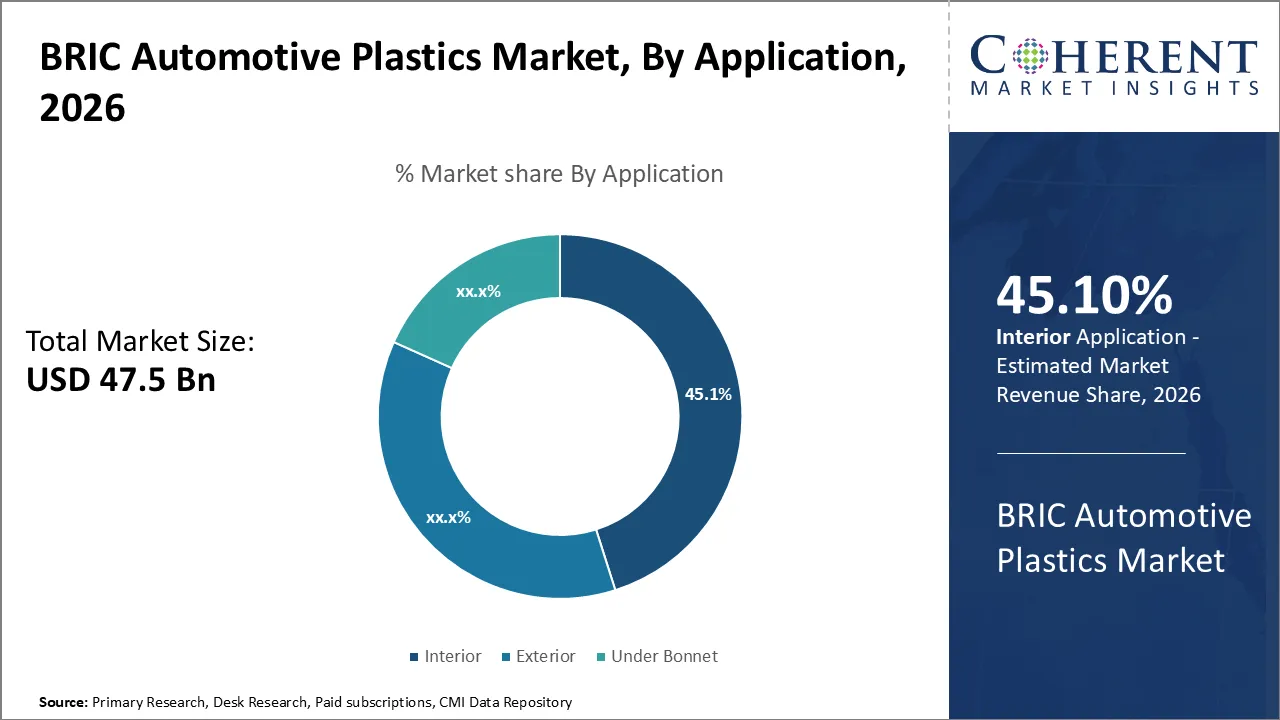
- Based on Application, the Interior segment is expected to lead the market with 45.10% share in 2026, due to growing demand for lightweight and aesthetically versatile materials.
- Based on Vehicle Type, the Passenger Vehicles segment is expected to lead the market with 69.70% share in 2026, due to rising vehicle production.
- Based on Distribution Channel, the OEM segment is expected to lead the market with 64.30% share in 2026, due to preference for standardized, quality-approved plastics in new vehicle production.
- Based on Region, China is set to lead the market with 49.50% share in 2026. While, India is anticipated to be the fastest growing region.
Market Overview
The BRIC automotive plastics market is advancing significantly with the rising applications in vehicle lightweighting and electric vehicle (EV) integration. The expanding production capabilities in China and India, coupled with tightening emission standards like India’s BS-VI and China’s EV targets, are expected to drive market growth over the forecast period.
The plastics now play a central structural and functional role in automobiles, thereby taking over from metals to optimize fuel economy and safety. The analysis of these materials is a widely practiced approach in the automotive manufacturing, material science, and aftermarket industries. The automotive plastics are utilized for interior furnishings as well as exterior panels under the hood components, supporting the accurate characterization of vehicle aerodynamics and weight distribution.
The automotive plastics industry in BRIC nations is undergoing a revolutionary phase driven by advances in engineering such as advanced detection and injection molding systems. There is also strong demand for high-performance polymers like polypropylene (PP) and polyurethane (PU). These developments have expanded the capabilities of synthetic materials beyond simple aesthetics to include critical electrical housing and battery insulation for new energy vehicles. This enhanced focus on efficiency, strength, and low-cost mass production marks a transformative phase in the regional market. This establishes the BRIC cluster as a prominent force in the global supply chain.
Current Events and their Impacts on the BRIC Automotive Plastics Market
Current Event | Description and the Impact |
Geopolitical & Trade Developments |
|
Economic & Market Dynamics |
|
Technological Innovations & Industry Trends |
|
Segmental Insights
- Current Industry Events of 2026
- Market Size Estimation
- Regional Breakdown
- Competitive Landscape
- Customer Intelligence
- Segmental Analysis
- Pricing Analysis
- Key Market Drivers, Challenges & Future Trends
- Customized Insights Section
BRIC Automotive Plastics Market Insights, By Product Type – Polypropylene (PP) Leads Due to its Lightweight Properties and High Durability
In terms of product type, the Polypropylene (PP) segment contributes the highest share of 36.20% in 2026 of the BRIC Automotive Plastics Market. The growth is due to its versatility and low production cost. This particular material offers a unique combination of high impact strength and light weight, which is a critical requirement for the production of robust automotive components. In the BRIC countries, the producers prefer this material because it can be easily molded into complex shapes for both interior and exterior parts. In addition, its resistance to harsh chemicals and high temperatures makes it an ideal choice for engine compartments and battery compartments. With the rising concern for sustainability, the recyclable properties of this plastic further enhance its position as the principal material for the future of automotive production.
For instance, in June 2024, LyondellBasell (LYB) announced plans to add a new production line at its Advanced Polymer Solutions (APS) facility in Dalian. This expansion strengthens the company's footprint in China. The new line will manufacture a variety of high-performance, high-end polypropylene compounds, primarily for the automotive industry.
BRIC Automotive Plastics Market Insights, By Application – Interior Leads Driven by Growing Demand for Lightweight and Aesthetically Versatile Materials
In terms of application, the interior segment contributes the highest share of 45.10% in 2026 of the BRIC Automotive Plastics Market. The growth is driven by growing consumer demand for comfort and luxury. Vehicle cabins in BRIC nations are now equipped with advanced dashboards, door panels, and center consoles, which rely on durable, high-quality plastics to achieve a refined premium feel. These materials allow designers to create ergonomic and aesthetically pleasing environments while sustainably minimizing the overall weight of the vehicle.
In addition, the incorporation of cutting-edge electronics and infotainment systems requires specialized plastic housings that offer both protection and style. The drive for enhancing the passenger experience ensures that interior applications continue to be the most important segment for plastic usage in the automotive industry.
BRIC Automotive Plastics Market Insights, By Vehicle Type – Passenger Vehicles Leads Due to Rising Vehicle Production
In terms of vehicle type, the passenger vehicles segment contributes the highest share of 69.70% in 2026 of the BRIC Automotive Plastics Market. The increase is due to the growing requirement for personal mobility among the rising middle class in the BRIC nations. The production of passenger cars, hatchbacks, and sport utility vehicles requires large amounts of plastic usage to ensure safety and fuel efficiency. The vehicles usually consist of a higher percentage of plastic parts compared to commercial vehicles to ensure a balance between performance and aesthetics. The fast expansion of the electric vehicle market in China and India also plays a key role, as these cars use more plastic to offset the weight of heavy battery packs. Consequently, the passenger vehicle sector remains at the forefront in driving innovation in the automotive plastics industry.
Regional Insights
China BRIC Automotive Plastics Market Analysis & Trends
China has remained the dominant country with 49.50% in 2026 of the global BRIC Automotive Plastics Market over the past decade. The country leads the automotive plastics sector as both the principal producer and consumer across the world. This dominance is intrinsically linked to its status as the global epicenter for electric vehicles. In China, plastics are no longer used only for interior trims. They are vital for battery enclosures and thermal management systems that extend driving range. The market is defined by a sophisticated supply chain that benefits from abundant raw materials and advanced injection molding technologies.
For instance, in April 2024, LyondellBasell (LYB) has partnered with Hunan Huda Aisheng Group (AISN), a major automotive supplier from China. This partnership aims to develop innovative, lightweight engine hood applications specifically for new energy vehicles (NEVs) associated with leading domestic automotive brands.
India BRIC Automotive Plastics Market Analysis & Trends
India is currently the fastest growing market within the BRIC automotive plastics. The expansion is driven by a massive increase in domestic car ownership and a growing middle class. The growth in India is fueled by recent policy shifts aimed at making the country a global manufacturing hub. The automotive plastics are essential for creating budget-friendly and fuel-efficient vehicles. There is a considerable surge in demand for lightweight components in the compact car segment.
Additionally, there is a rapidly emerging interest in recycled plastics to meet new sustainability mandates. With global automakers increasingly diversifying their production bases, the plastic industry in India is undergoing a technical upgrade from basic exterior parts to complex under-the-hood components.
For instance, in January 2026, AVRO Recycling Limited, the parent company of Avro India Limited, has announced the launch of India's largest service for recycling flexible plastic waste. The total investment amounts to USD 2.75 million, along with an additional strategic investment of USD 3.31 million.
Market Report Scope
BRIC Automotive Plastics Market Report Coverage
| Report Coverage | Details | ||
|---|---|---|---|
| Base Year: | 2025 | Market Size in 2026: | USD 47.5 Bn |
| Historical Data for: | 2020 To 2024 | Forecast Period: | 2026 To 2033 |
| Forecast Period 2026 to 2033 CAGR: | 6.3% | 2033 Value Projection: | USD 72.7 Bn |
| Geographies covered: |
| ||
| Segments covered: |
| ||
| Companies covered: | Bayer Material Science, Lyondell Basell, Dow Chemicals Company, Polyplastics Group, Sibur, China XD Plastics Company Ltd., and Saudi Basic Industries Corporation (SABIC) | ||
| Growth Drivers: |
| ||
| Restraints & Challenges: |
| ||
BRIC Automotive Plastics Market Drivers
Rising demand for fuel efficient and eco-friendly vehicles
The increasing demand for fuel-efficient and eco-friendly vehicles acts as a primary catalyst for the growth of the BRIC (Brazil, Russia, India, and China) automotive plastics market. The manufacturers pivot toward lightweighting strategies to enhance fuel economy and performance as these nations enforce stricter emission standards. Advanced polymers replace heavy metal components to reduce a vehicle's overall mass. This substitution directly lowers carbon emissions and reduces energy consumption. China and India are witnessing rapid expansion in Electric Vehicle (EV) production. The plastics are crucial for shielding battery housings and enhancing driving range in these models. In addition, a shift toward bio-based and recycled plastics supports global sustainability objectives and appeals to eco-conscious consumers in emerging markets. This blend of regulatory pressure and technological innovation drives significant market expansion throughout the region.
For instance, in May 2025, Toyoda Gosei Co., Ltd. has created a new technology designed to recycle high-quality plastic sourced from end-of-life vehicles (ELV). This innovation aims to address the increasing demand for recycled plastic in the automotive industry, particularly in light of strengthened environmental regulations.
Analyst Opinion (Expert Opinion)
The BRIC Automotive Plastics Market is positioned for sustained structural expansion, supported by rising vehicle production, material substitution trends, and regulatory emphasis on lightweight mobility solutions across Brazil, Russia, India, and China. Automotive plastics consumption in the region continues to increase as manufacturers replace conventional metal components with polymer-based alternatives to reduce vehicle weight by 10–15%, which can improve fuel efficiency by approximately 6–8% depending on vehicle configuration.
Interior applications represent the largest volume concentration, accounting for over 60% of total plastics usage in vehicles. Demand is particularly strong in dashboards, door panels, seating structures, and infotainment housings, reflecting growing consumer preference for enhanced cabin aesthetics and integrated electronics. From a material standpoint, polypropylene remains the most widely utilized polymer, contributing roughly one-fifth of total consumption due to its balance of cost efficiency, impact resistance, and design flexibility.
China leads regional demand, supported by high automotive production volumes and rapid electric vehicle adoption. India is witnessing accelerated plastics integration driven by compact vehicle manufacturing and localization initiatives. Brazil and Russia demonstrate steady demand linked to modernization of domestic production facilities. Increasing emphasis on recyclability, bio-based polymers, and advanced engineering plastics is expected to further shape material innovation and competitive differentiation within the BRIC landscape.
Speak to the analyst
Want personalized insights?
Take the findings above to one of our principal consultants, or have the report rebuilt around the segments, geographies and competitors you actually track.
BRIC Automotive Plastics Industry News
- In October 2025, Borealis has unveiled Borcycle™ GD3600SY, a polypropylene (PP) compound reinforced with glass fibers, featuring 65% post-consumer recycled (PCR) polymer content. This innovative material will initially be utilized in automotive interiors as part of a significant project in collaboration with Plastivaloire and Stellantis.
- In March 2025, The Mitsubishi Chemical Group has announced that the Global Impact Coalition (GIC) has unveiled a project aimed at establishing a supply chain for recycling plastics sourced from End-of-Life Vehicles (ELVs). This initiative is a collaboration among seven companies in the chemical and recycling sectors. They include the MCG Group, BASF, Covestro, LyondellBasell, SABIC, SUEZ, and Syensqo.
- In February 2025, JRG Automotive Industries Private Limited, a major maker of plastic parts for the automotive industry, has successfully completed the acquisition of the two-wheeler functional plastics division of Stanley Engineered Fastening India (SEFI).
- In January 2024, Sonichem's consortium has been awarded nearly USD 817,000 from Innovate UK's 'Resource Efficiency for Materials and Manufacturing' (REforMM) program. This funding will help Sonichem speed up the development of its ultrasound technology and encourage the creation of renewable, low-cost alternatives to the petrochemicals that are currently used in plastics, resins, and composites for cars.
Market Segmentation
- Product Type Insights (Revenue, USD Bn, 2026 - 2033)
- Polypropylene (PP)
- Polyurethane (PU)
- Poly carbonates (PC)
- Polyvinyl chloride (PVC)
- Acrylonitrile Butadiene Styrene (ABS)
- Others
- Application Insights (Revenue, USD Bn, 2026 - 2033)
- Interior
- Exterior
- Under Bonnet
- Vehicle Type Insights (Revenue, USD Bn, 2026 - 2033)
- Passenger Vehicles
- Commercial Vehicles
- Distribution Channel Insights (Revenue, USD Bn, 2026 - 2033)
- OEM
- Aftermarket
- Country Insights (Revenue, USD Bn, 2026 - 2033)
- Brazil
- Russia
- India
- China
- Key Players Insights
- Bayer Material Science
- Lyondell Basell
- Dow Chemicals Company
- Polyplastics Group
- Sibur
- China XD Plastics Company Ltd.
- Saudi Basic Industries Corporation (SABIC)
Sources
Primary Research Interviews
- Primary Research Interviews
- Automotive Plastic Resin Manufacturers
- Tier-1 Automotive Component Suppliers
- Automotive OEM Procurement & R&D Heads (BRIC Region)
- Injection Molding & Compounding Technology Providers
- Lightweighting & Material Engineering Consultants
- Others
Databases
- Bloomberg Terminal
- Thomson Reuters Eikon
- IHS Markit (Automotive & Materials)
- ICIS Chemical Data
- Others
Magazines
- Automotive News
- Plastics News
- Injection World Magazine
- Polymer Engineering & Science Magazine
- Sustainable Plastics Magazine
- Others
Journals
- Polymer Engineering & Science
- Journal of Applied Polymer Science
- Composites Part B: Engineering
- SAE International Journal of Materials & Manufacturing
- Materials Today: Proceedings
- Others
Newspapers
- Financial Times
- The Wall Street Journal
- Reuters
- Bloomberg News
- The Economic Times
- Others
Associations
- Society of Plastics Engineers (SPE)
- Plastindia Foundation
- China Plastics Processing Industry Association (CPPIA)
- Associação Brasileira da Indústria do Plástico (ABIPLAST)
- Automotive Component Manufacturers Association of India (ACMA)
- Others
Public Domain Sources
- International Organization of Motor Vehicle Manufacturers (OICA)
- World Bank Open Data
- Ministry of Industry and Information Technology (MIIT), China
- Ministry of Heavy Industries, Government of India
- Brazilian National Association of Motor Vehicle Manufacturers (ANFAVEA)
- Others
Proprietary Elements
- CMI Data Analytics Tool
- Proprietary CMI Existing Repository of Information for the Last 8 Years
Definition: The BRIC Automotive Plastics Market represents the combined industry for advanced polymer materials used in vehicle production within the nations of Brazil, Russia, India, and China. These emerging economies are using strong plastics like propylene and polyurethane to replace traditional metallic components, aiming to make vehicles lighter and more fuel efficient. The market is mainly driven by the fast growth of the middle class and the rising use of electric vehicles in these regions. The main uses for these materials include making interior dashboards, exterior bumpers, and various under-the-hood components. These four countries as global manufacturing leaders focus on delivering low-cost, eco-friendly plastic solutions that meet both domestic demand and worldwide environmental regulations.
Get access to 250+ pages report
Every segment, forecast, competitor profile and data table behind the analysis above — available for instant download.
- ESOMAR Member
- ISO 9001:2015 Certified
- D-U-N-S Registered
- GDPR & CCPA Compliant
Missing comfort of reading report in your local language? Find your preferred language:
Transform your Strategy with Exclusive Trending Reports
Frequently Asked Questions
The BRIC Automotive Plastics Market is estimated to be valued at USD 47.5 Bn in 2026, and is expected to reach USD 72.7 Bn by 2033.
The CAGR of the BRIC Automotive Plastics Market is projected to be 6.3% from 2026 to 2033.
Rising expansion of advanced plastics for manufacturing of automotive component by the key players across the BRIC countries is one of the major factors driving the growth of the BRIC Automotive Plastics Market.
Fluctuating prices of automotive plastics are expected to hinder market growth is one of the major factors hampering the growth of the BRIC Automotive Plastics Market.
In terms of product type, the Polypropylene (PP) segment is estimated to dominate the market revenue share in 2026.
Bayer Material Science, Lyondell Basell, Dow Chemicals Company, Polyplastics Group, Sibur, China XD Plastics Company Ltd., and Saudi Basic Industries Corporation (SABIC) are the major players.
China is expected to lead the BRIC Automotive Plastics Market in 2026.