

Polyolefin Elastomer Market Size & Forecast
Polyolefin Elastomer Market is estimated to be valued at USD 2,737.0 Mn in 2026 and is expected to reach USD 4,678.6 Mn in 2033, exhibiting a compound annual growth rate (CAGR) of 7.9% from 2026 to 2033.
Key Takeaways
- Based on Application, the Packaging segment is expected to account for the largest share of the polyolefin elastomer market in 2026, due to their excellent flexibility, toughness, and seal ability.
- Based on Region, the Asia Pacific is estimated to lead the market with a share of 33.8% in 2026. While, North America is considered as the fastest growing region during the forecast period.
Market Overview
The polyolefin elastomer market is witnessing strong demand due to its lightweight, flexible, and recyclable properties, making it ideal for automotive, packaging, and construction applications. Moreover, in the automotive sector, POEs are used for lightweight parts like bumpers and trims to reduce emissions. The packaging industry uses POEs for soft, durable, and sealable films.
Current Events and Their Impact on the Polyolefin Elastomer Market
Current Event | Description and its Impact |
Petrochemical Industry-Specific Developments |
|
Sustainability and Regulatory Pressures |
|
Price Analysis
Region | Average Price (USD per metric ton) |
North America | $2,000 – $2,300 |
Europe | $2,100 – $2,400 |
Asia Pacific | $1,700 – $2,100 |
Latin America | $1,900 – $2,200 |
Middle East & Africa | $1,800 – $2,100 |
- Current Industry Events of 2026
- Market Size Estimation
- Regional Breakdown
- Competitive Landscape
- Customer Intelligence
- Segmental Analysis
- Pricing Analysis
- Key Market Drivers, Challenges & Future Trends
- Customized Insights Section
End-User Feedback and Unmet Needs in the Polyolefin Elastomer Market
End-User Feedback
End users across industries like automotive, packaging, electronics, and consumer goods appreciate POE’s excellent flexibility, thermal resistance, and low density, which allow for lightweighting and ease of processing. In automotive applications, POEs have been praised for enabling soft-touch interior parts and sealing systems without compromising durability. Packaging companies value POE’s clarity, heat sealability, and compatibility with polyethylene.
However, despite the material’s functional advantages, some feedback includes:
- Inconsistent performance under extreme temperatures, particularly in high-heat or cold-weather environments.
- Limited availability of bio-based or recycled POEs to meet sustainability goals.
- Price sensitivity, especially in cost-competitive sectors like flexible packaging and footwear.
- Compatibility issues when blending POEs with certain resins or fillers in complex formulations.
Unmet Needs
- Sustainability There's a rising demand for recyclable and bio-based POEs to reduce environmental impact. Current availability is limited, with high costs acting as a barrier.
- Higher Temperature Grades Development of POEs that can withstand higher continuous operating temperatures is needed, especially for under-the-hood automotive applications.
- Improved Adhesion End users in multilayer packaging are seeking POEs with better adhesion to polar substrates without the need for tie layers.
- Cost Optimization Lower-cost grades that retain performance characteristics are in demand, particularly in price-sensitive applications like nonwoven hygiene products.
- Localized Supply In regions like Latin America and Southeast Asia, limited local manufacturing leads to longer lead times and higher import costs.
Segmental Insights
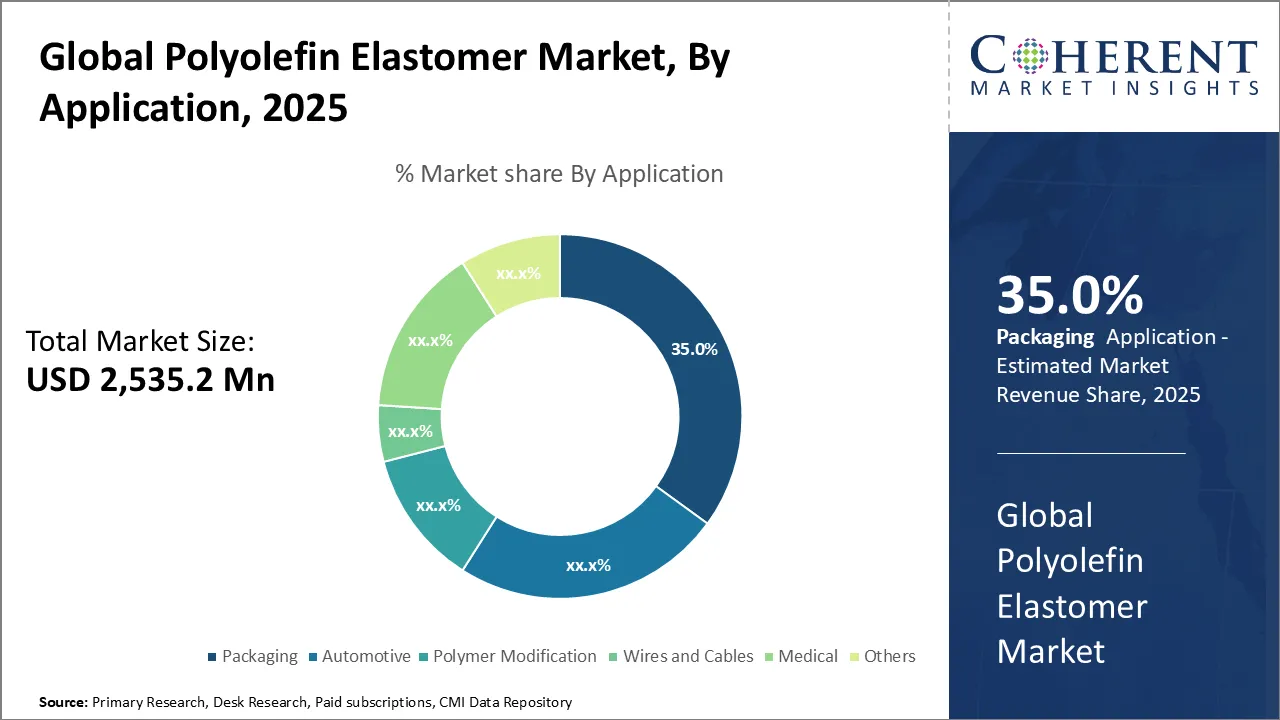
Polyolefin Elastomer Market Insights, By Application: Packaging Segment Acquires the Largest Share owing to its Excellent Flexibility and Seal ability
In terms of application, the packaging segment is expected to contribute the highest share of the market in 2026, due to their excellent flexibility, toughness, and seal ability. POEs enhance the durability and impact resistance of packaging films while maintaining softness and clarity, making them ideal for food, medical, and consumer goods packaging. Their compatibility with polyethylene and polypropylene also allows for easy blending, improving film performance without compromising recyclability.
As brands seek sustainable and high-performance materials, POEs offer a lightweight, cost-effective alternative to traditional elastomers. These advantages are significantly driving polyolefin elastomer market growth, especially in flexible and multilayer packaging applications.
In May 2023, Borealis introduced its Bornewables line of Queo™ polyolefin plastomers and elastomers, based on ISCC PLUS‑certified waste and residue feedstocks, targeting eco‑friendly flexible packaging with high sealability, compatibility, and processability. This is further proliferating the polyolefin elastomer market share.
Regional Insights
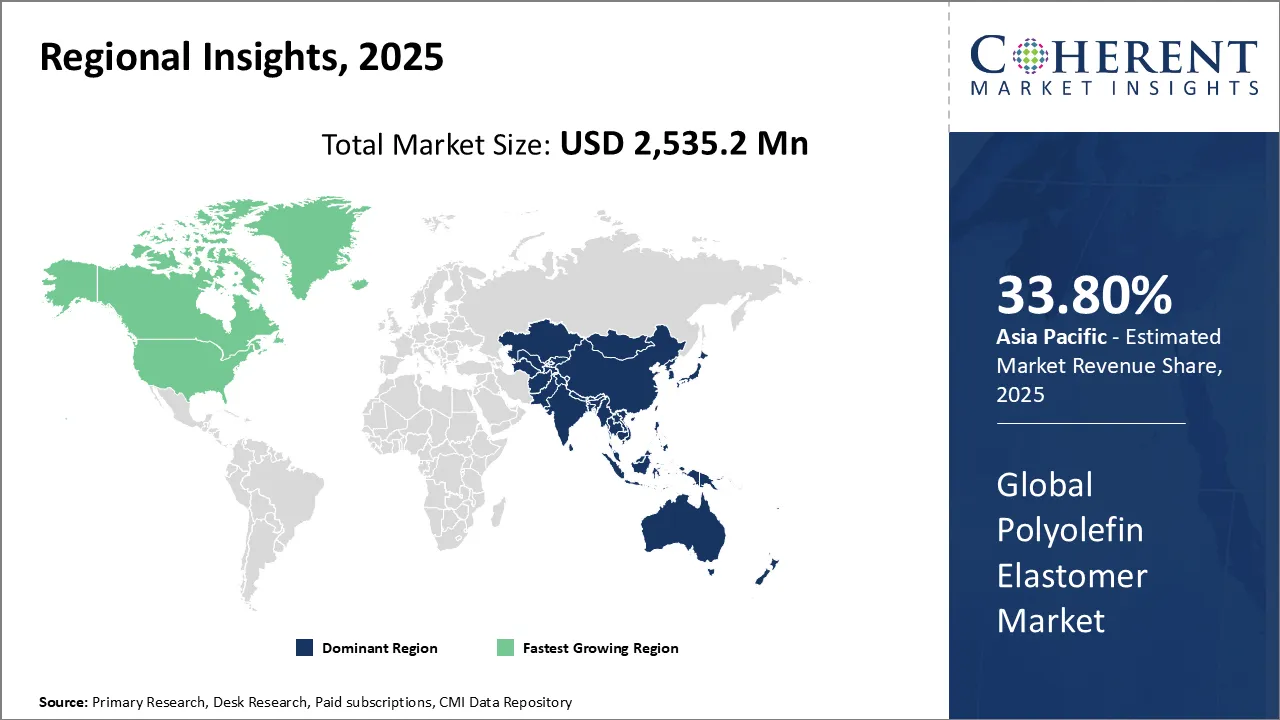
Asia Pacific Polyolefin Elastomer Market Analysis & Trends
Asia Pacific region is projected to lead the market with a 33.80% share in 2026, driven by rapid industrialization, growing automotive production, and expanding packaging needs across developing economies like China, India, and Southeast Asia. The region’s large consumer base and booming e-commerce sector are increasing the use of flexible, durable packaging materials made from POEs. In the automotive industry, POEs are favored for lightweighting components to improve fuel efficiency and reduce emissions, key priorities in countries tightening environmental standards. Additionally, many global manufacturers are expanding production facilities in Asia due to cost advantages and proximity to raw materials, further supporting regional demand.
In March 2024, Dow unveiled its new artificial leather solution in Asia, based on polyolefin elastomers (POE), targeting automotive seating applications. Developed in collaboration with China-based HIUV Materials Technology, the POE material meets stringent industry standards with ultra-soft feel, excellent color stability, and low-temperature durability, while eliminating plasticizers and heavy metals.
North America Polyolefin Elastomer Market Analysis & Trends
North America region is expected to exhibit the fastest growth in the market during forecast period, propelled to their growing application in automotive lightweighting and flexible packaging. Automakers in the U.S. and Canada are increasingly adopting POEs in interior components and under-the-hood parts to improve fuel efficiency and meet emission norms. Additionally, the region’s strong focus on sustainability has led to increased use of recyclable and low-VOC materials like POEs in consumer goods and packaging. The shift toward all-electric vehicles is also pushing demand for POE-based wire coatings and sealing solutions. Major polymer producers in North America are expanding capacity to meet this rising demand.
For instance, ExxonMobil enhanced its Vistamaxx™ polyolefin elastomer product line to support growing demand from hygiene and flexible packaging manufacturers in North America. The move aims to address customer needs for lighter, recyclable, and high-performance materials, further reflecting strong polyolefin elastomer market share across the region.
Polyolefin Elastomer Market Outlook Country-Wise
China Polyolefin Elastomer Market Trends
China is a key driver in the Polyolefin Elastomer (POE) market due to its strong manufacturing base in automotive, packaging, and electronics. POEs are increasingly used in lightweight vehicle components to improve fuel efficiency, especially in electric vehicles. The material’s flexibility and recyclability also make it ideal for sustainable packaging solutions.
For instance, Chinese EV makers like BYD and NIO are integrating POEs in interiors and under-the-hood parts, while local suppliers are boosting production to meet rising demand for recyclable, high-performance materials.
The U.S. Polyolefin Elastomer Market Trends
In the U.S., Polyolefin Elastomer (POE) demand is rising due to its use in sustainable packaging, automotive lightweighting, and durable construction materials. Packaging firms are adopting POEs in recyclable multilayer films to meet eco-friendly regulations and brand goals. In automotive and construction, POEs offer flexibility, weather resistance, and energy efficiency, making them ideal for EV components and insulation. These cross-sector applications are driving strong Polyolefin Elastomer Market across the country.
Japan Polyolefin Elastomer Market Trends
Japan drives strong Polyolefin Elastomer (POE) demand due to its advanced electronics and automotive sectors. POEs are valued for their flexibility, insulation, and low-VOC properties, key in high-performance applications. In electronics, companies like Panasonic use POEs in flexible circuits and insulation. In automotive, brands like Toyota adopt POEs for lightweight, recyclable seals and soft-touch parts. Japan’s focus on eco-friendly, durable materials further supports the polyolefin elastomer market growth.
Market Report Scope
Polyolefin Elastomer Market Report Coverage
| Report Coverage | Details | ||
|---|---|---|---|
| Base Year: | 2025 | Market Size in 2026: | USD 2,737.0 Mn |
| Historical Data for: | 2020 To 2024 | Forecast Period: | 2026 To 2033 |
| Forecast Period 2026 to 2033 CAGR: | 7.96% | 2033 Value Projection: | USD 4,678.6 Mn |
| Geographies covered: |
| ||
| Segments covered: |
| ||
| Companies covered: | Mitsui Chemical, Inc., LG Chem Ltd., RTP Company, Inc., DowDuPont Inc., PolyOne Corporation, Siloxane Aggrandize Innovative Industries, Dalmia Polymers LLP, Tricon Energy Inc., Borealis AG, and SK Global Chemical Co., Ltd. | ||
| Growth Drivers: |
| ||
| Restraints & Challenges: |
| ||
Polyolefin Elastomer Market Drivers
Increasing demand for polyolefin elastomers in the packaging industry
Polyolefin elastomer is widely used in food and goods packaging. This elastomer offers soft, flexible, and less-density materials which are used in the packaging sector. In addition, polyolefin offers several applications in closures, flexible and liners bags, seals, and pouches, which are further used for food and beverage packaging. Moreover, these elastomers are used to make plastic bags, cartons and case sealing, vacuum bags, and others. These versatile applications are key drivers of polyolefin elastomer market growth, particularly in the expanding global packaging industry where lightweight, recyclable, and high-performance materials are increasingly preferred.
Polyolefin Elastomer Market Opportunity
Future opportunities in the polyolefin elastomer market are being driven by increasing demand for lightweight, durable, and recyclable materials in automotive, packaging, and electronics sectors. As electric vehicle production surges, POEs are gaining traction for use in weather seals, gaskets, and cable insulation due to their flexibility and low weight. Additionally, the rising preference for sustainable packaging and soft-touch consumer products is creating new application areas. Innovations in bio-based and low-VOC POEs will further open doors in regulated and eco-conscious markets. These trends are expected to significantly shape the polyolefin elastomer market forecast, offering lucrative growth potential in the coming years.
Analyst Opinion (Expert Opinion)
The Polyolefin Elastomer market value is currently experiencing a transformative shift.
The rapid substitution of traditional thermoset rubbers and plastomers with POEs in automotive lightweighting efforts is particularly noteworthy. For instance, global OEMs are integrating POEs in soft-touch interior trims and impact-modified polypropylene compounds, achieving up to a 12% reduction in part weight while maintaining mechanical integrity. This is a strategic material choice not merely a cost-driven one, aligned with stricter emission norms and fuel economy mandates.
Additionally, POEs have proven indispensable in the encapsulation layers of photovoltaic modules, especially in bifacial and half-cut solar cells. The non-polar nature and superior UV resistance of POEs have led to longer module lifespans and better power retention. JinkoSolar and Canadian Solar have both transitioned major product lines to POE-based encapsulants in the last 18 months, citing improved module reliability in high-humidity regions. Notably, the POE-based encapsulant market in China alone grew by over 40% year-on-year in 2024, an indicator of the material’s accelerating acceptance in clean energy manufacturing.
On the regulatory front, POEs benefit from being fully recyclable and compliant with global food-contact norms, which makes them well-suited for sustainable packaging applications. Major FMCG brands are partnering with POE resin producers to formulate mono-material pouches and films, minimizing multi-layer composites and enhancing recyclability. This is not only an environmental win but a strategic alignment with circular economy frameworks being legislated in Europe and North America.
Speak to the analyst
Want personalized insights?
Take the findings above to one of our principal consultants, or have the report rebuilt around the segments, geographies and competitors you actually track.
Polyolefin Elastomer Industry News
- In July 2025, Rajoo Engineers launched its Lamina®è series, marking India’s first extrusion line for producing EVA/POE encapsulant sheets used in solar cell manufacturing. The line is equipped with fully automatic gravimetric feeding and energy-efficient extruders, it offers cost-effective, domestically produced encapsulants.
- In April 2025, DuPont launched its latest innovation in biopharma processing: Liveo™ Pharma TPE Ultra‑Low Temp Tubing, a sterilizable, weldable, and sealable thermoplastic elastomer tubing engineered for ultra‑cold applications.
- In November 2024, Geon Performance Solutions unveiled a new thermoplastic elastomer (TPE) and thermoplastic vulcanizate (TPV) production line at its Ramos Arizpe, Coahuila facility, following a $1.3 million investment.
- In September 2024, Dow introduced its first bio‑attributed elastomers for flooring applications, expanding its ENGAGE™ REN polyolefin elastomers (POE) portfolio. The new elastomer, produced using bio‑circular feedstocks such as used cooking oil and other biological residues, offers the same high performance as standard ENGAGE™ POEs and is ISCC PLUS‑certified under a mass‑balance approach.
Market Segmentation
- Global Polyolefin Elastomer Market, By Application (Revenue, USD Mn, 2021 - 2033)
- Packaging
- Automotive
- Polymer Modification
- Wires and Cables
- Medical
- Others
- Global Polyolefin Elastomer Market, By Region (Revenue, USD Mn, 2021 - 2033)
- North America
- U.S.
- Canada
- Latin America
- Brazil
- Argentina
- Mexico
- Rest of Latin America
- Europe
- Germany
- U.K.
- Spain
- France
- Italy
- Russia
- Rest of Europe
- Asia Pacific
- China
- India
- Japan
- Australia
- South Korea
- ASEAN
- Rest of Asia Pacific
- Middle East & Africa
- GCC Countries
- Israel
- South Africa
- Rest of Middle East & Africa
- Key Players
- Mitsui Chemical, Inc.
- LG Chem Ltd.
- RTP Company, Inc.
- DowDuPont Inc.
- PolyOne Corporation
- Siloxane Aggrandize Innovative Industries
- Dalmia Polymers LLP
- Tricon Energy Inc.
- Borealis AG
- SK Global Chemical Co., Ltd.
Sources
Primary Research Interviews from the following stakeholders
Stakeholders
- Interviews with polymer compounders, plastic product manufacturers, automotive OEMs, packaging converters, material R&D heads, regulatory compliance officers, and procurement leads in end-use industries.
Specific stakeholders
- Materials scientists and product development engineers at automotive manufacturers
- Packaging innovation managers at FMCG firms
- Sustainability officers and recyclability leads at flexible packaging companies
- Procurement managers at wire & cable manufacturers
- R&D heads at medical device manufacturers
- Processing specialists at injection molding and film extrusion plants
- Product managers at POE raw material and masterbatch suppliers
Databases
- UN Comtrade Database
- World Trade Organization (WTO) Statistics
- Eurostat – Plastics & Chemicals Trade Reports
- China Customs Data
- India’s Directorate General of Commercial Intelligence and Statistics (DGCIS)
- Korea International Trade Association (KITA)
- Japan Customs and Tariff Bureau
- U.S. Bureau of Economic Analysis – Chemicals and Plastics Sector
- Central Statistics Office (CSO), India – Industrial Production Data
Magazines
- Plastics Technology
- Modern Plastics India
- Packaging World
- Compounding World
- Injection World
- Automotive Manufacturing Solutions
- Medical Plastics News
- Wire & Cable India
Journals
- Journal of Applied Polymer Science
- Polymer Testing (Elsevier)
- Progress in Polymer Science
- Journal of Elastomers and Plastics
- Materials Today Sustainability
- Journal of Macromolecular Science
- International Journal of Polymeric Materials and Polymeric Biomaterials
Newspapers
- The Economic Times – Chemicals & Materials Section
- Business Standard – Industry Reports (Polymers & Packaging)
- The Hindu Business Line – Manufacturing & Energy
- Financial Times – Automotive & Materials Focus
- Nikkei Asia – Petrochemicals and Sustainability
- South China Morning Post – Industrial Innovation
Associations
- All India Plastics Manufacturers' Association (AIPMA)
- Society of Plastics Engineers (SPE)
- Indian Centre for Plastics in the Environment (ICPE)
- European Chemical Industry Council (Cefic)
- Japan Petrochemical Industry Association (JPCA)
- American Chemistry Council – Plastics Division
- Confederation of Indian Industry (CII) – Advanced Materials Forum
Public Domain Sources
- Ministry of Chemicals and Fertilizers, Government of India
- Central Institute of Petrochemicals Engineering & Technology (CIPET)
- U.S. International Trade Commission (USITC) – Polyolefin Trade Reports
- Ministry of Economy, Trade and Industry (METI), Japan
- European Chemicals Agency (ECHA)
- Reserve Bank of India (RBI) – Industrial Outlook Reports
- NITI Aayog – Materials and Sustainability Reports
- India Investment Grid – Polymer and Chemical Sector
Proprietary Elements
- CMI Data Analytics Tool, and Proprietary CMI Existing Repository of information for last 8 years
*Definition: Polyolefin Elastomers (POE) are referred to as olefin-based polymers. They are derived from the copolymerization of different monomers including polypropylene, polyethylene, and butane. It offers several properties such as toughness, low-temperature ductility, thermal stability, excellent elasticity, and UV resistance.
Get access to 250+ pages report
Every segment, forecast, competitor profile and data table behind the analysis above — available for instant download.
- ESOMAR Member
- ISO 9001:2015 Certified
- D-U-N-S Registered
- GDPR & CCPA Compliant
Missing comfort of reading report in your local language? Find your preferred language:
Transform your Strategy with Exclusive Trending Reports
Frequently Asked Questions
The Polyolefin Elastomer Market is estimated to be valued at USD 2,737.0 Mn in 2026, and is expected to reach USD 4,678.6 Mn by 2033.
The CAGR of the Polyolefin Elastomer Market is projected to be 7.9% from 2026 to 2033.
Increasing demand for polyolefin elastomers in the packaging industry is driving the growth of the global polyolefin elastomer industry.
Recycling polyolefin elastomer is one of the trends in the market.
The side effects of polyolefin elastomer on the environment is hampering the market growth.
The market includes Mitsui Chemical, Inc., LG Chem Ltd., RTP Company, Inc., DowDuPont Inc., PolyOne Corporation, Siloxane Aggrandize Innovative Industries, Dalmia Polymers LLP, Tricon Energy Inc., Borealis AG, and SK Global Chemical Co., Ltd.
The market is estimated to be valued at USD 2,026.2 Mn in terms of revenue in 2026.