

Cell-Based Assay Market Size and Forecast — 2026-2033
The Global Cell-Based Assay Market size is estimated to be valued at USD 7.60 billion in 2026 and is expected to reach USD 16.48 billion by 2033, exhibiting a compound annual growth rate (CAGR) of 11.7% from 2026 to 2033.
Overview
Cell-based assays are laboratory techniques that use live cells to evaluate the biological activity, toxicity, or mechanism of action of a compound. Unlike biochemical assays, which rely on isolated molecules, these systems preserve cellular complexity, allowing researchers to observe how drugs, biologics, or other agents influence signaling pathways, proliferation, apoptosis, or gene expression in a physiological context.
Modern cell-based assay products come in several forms, including consumables such as cell lines, culture plates, and reagents, as well as instruments like high-content imaging systems, microplate readers, and automated liquid handlers. Advances in three-dimensional cell cultures, organoids, and microfluidic “organ-on-a-chip” systems have enhanced predictive accuracy, making assays more reflective of in vivo conditions.
Key Takeaways
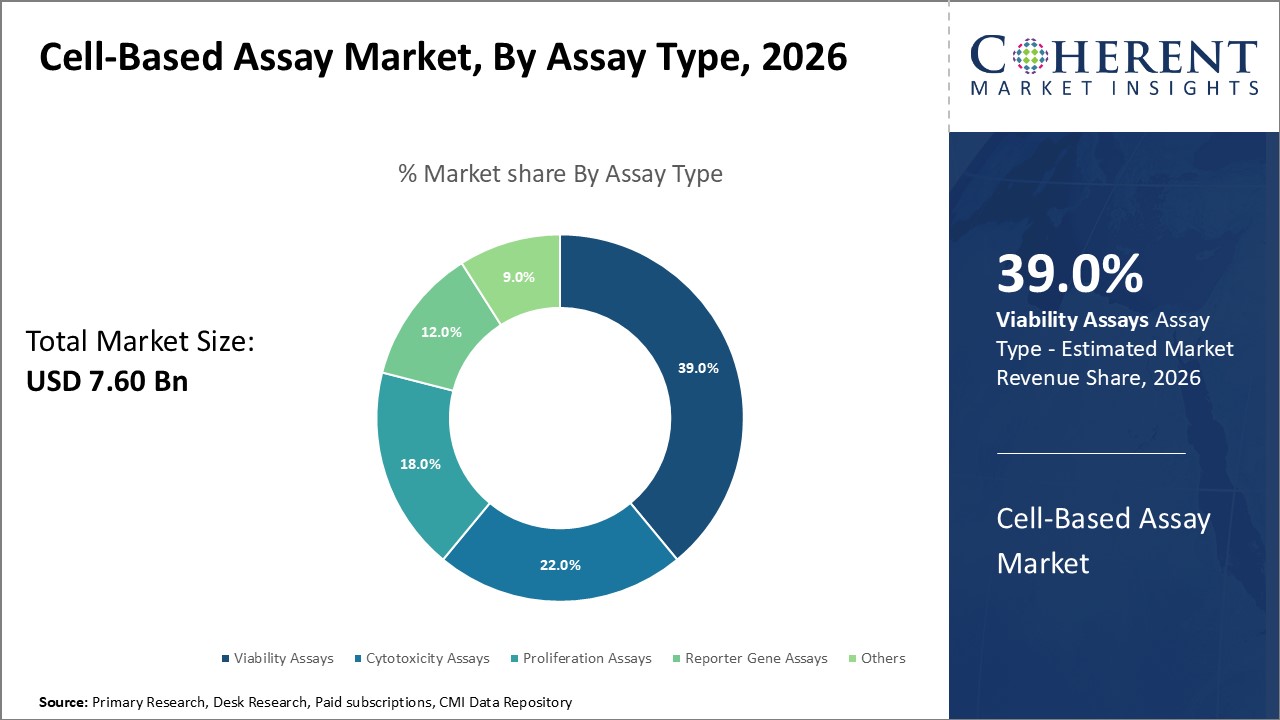
The Viability Assays segment dominates market share due to its extensive use in drug screening workflows, accounting for nearly 39% of the total market revenue.
Drug Discovery applications lead the segmental market due to their critical role in pipeline progression, driving innovation and business growth.
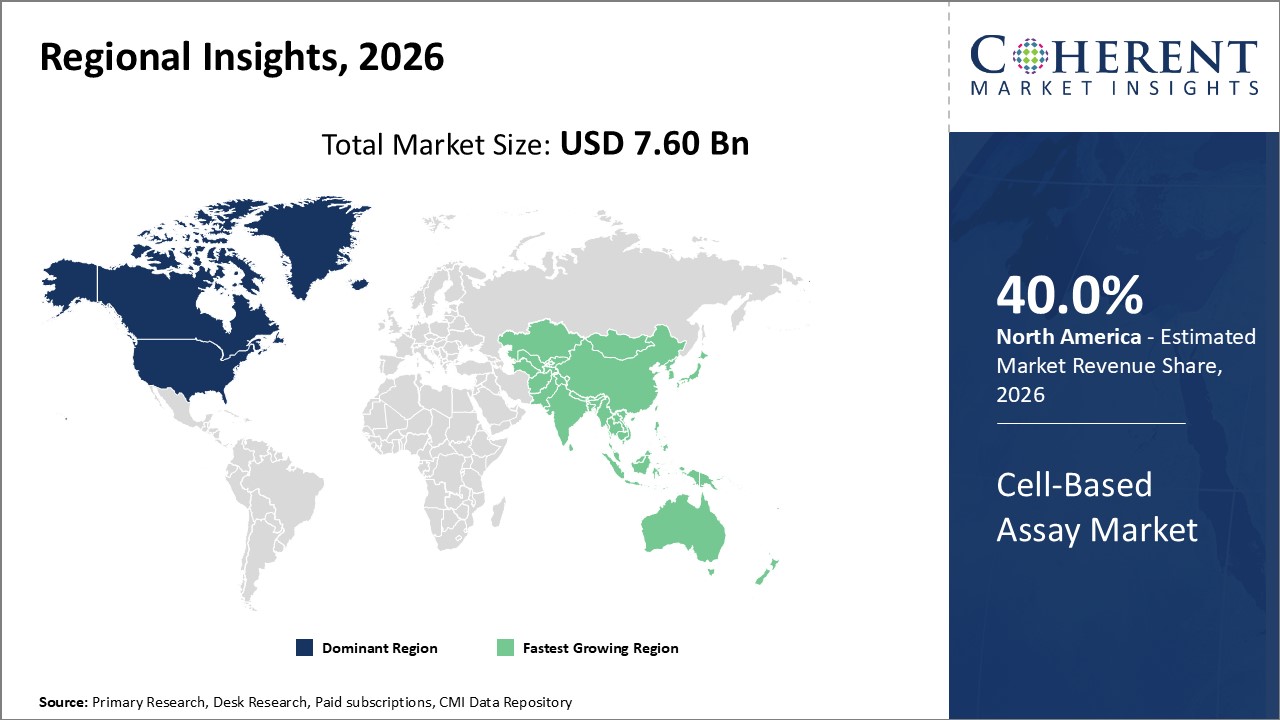
Geographically, North America remains the dominant region owing to the presence of major market companies, advanced healthcare infrastructure, and favorable regulatory policies, capturing over 40% of the industry share.
Meanwhile, the Asia Pacific is the fastest-growing region with a CAGR exceeding 14%, benefiting from increased government support, expanding R&D facilities, and rising demand for biopharmaceutical innovation.
Cell-Based Assay Market Segmentation Analysis
Cell-Based Assay Market Insights, By Assay Type
In terms of Assay Type, the Viability Assays dominate the market share with 39%. Viability assays are indispensable due to their ability to quickly and accurately assess cell health in response to compound exposure, making them critical in early drug discovery stages. The rapid adaptability of these assays to high-throughput screening systems further propels their dominance. Cytotoxicity assays are the fastest-growing subsegment, reflecting the increasing focus on safety and toxicology in pharmaceutical pipelines; their evolution incorporates multiplexed formats assessing multiple cellular parameters simultaneously.
Cell-Based Assay Market Insights, By Application
Drug Discovery leads due to the essential role of cell-based assays in facilitating early-stage compound screening and target validation. The segment’s strength lies in enabling rapid assessment of pharmacological effects, which accelerates pipeline progression. Toxicity Testing shows strong growth, reflecting heightened regulatory demands for alternative safety testing mechanisms; innovations in predictive toxicology assays have increased their adoption in both pharmaceutical and cosmetic sectors.
Cell-Based Assay Market Insights, By End-User
Pharmaceutical & Biotechnology Companies hold the largest share, driven by sustained investment in drug development requiring advanced cellular assays. The ability of these companies to integrate high-throughput and automated assay systems to facilitate screening pipelines sustains their demand dominance. Contract Research Organizations (CROs) represent the fastest-growing subsegment, attributed to outsourcing trends in pharma R&D for cost efficiency and scalability.
Cell-Based Assay Market Trends
Recent years have witnessed a paradigm shift in the Cell-Based Assay market, propelled by the integration of innovative assay platforms with digital tools.
The rise of 3D cell-based assays and organ-on-a-chip technology, as seen with collaborations between biotech firms and academic labs in 2026, has improved physiological relevance in drug testing.
AI-assisted image analysis has enhanced throughput, exemplified by data from major pharmaceutical firms reporting a 20-31% reduction in screening timelines.
Additionally, sustainability concerns have increased interest in reducing animal testing, bolstering demand for cell-based in vitro assay methods globally.
Cell-Based Assay Market Insights, By Geography
North America Cell-Based Assay Market Analysis and Trends
In North America, the dominance in the Cell-Based Assay market is attributed to a robust ecosystem of biopharmaceutical research companies, abundant funding, and supportive regulatory guidelines. The U.S. accounts for over 75% of the region’s market share, powered by the presence of key market players and extensive clinical research activities.
Asia Pacific Cell-Based Assay Market Analysis and Trends
Meanwhile, the Asia Pacific exhibits the fastest growth, with a CAGR exceeding 14%, fueled by the rapid expansion of biopharma R&D hubs in China and India. Government initiatives to promote biotech innovation and increase healthcare infrastructure investments are core growth enablers.
Cell-Based Assay Market Outlook for Key Countries
USA Cell-Based Assay Market Analysis and Trends
The U.S. market is the most significant contributor to the global cell-based assay industry. In 2025, over 50% of global pharmaceutical R&D budgets for in vitro testing were allocated within the U.S., supporting a continuously expanding customer base for assay providers. Major players headquartered in the U.S. have pioneered assay automation and multiplexing technologies, solidifying their market dominance through innovation and strategic acquisitions.
China Cell-Based Assay Market Analysis and Trends
China’s cell-based assay market is rapidly evolving with increased domestic R&D spending and growing demand from biosimilar drug manufacturers. Chinese biotech firms, supported by government grants exceeding USD 5 billion in 2025, are adopting advanced assay platforms, fostering market growth. Collaborations between local CROs and international vendors have enhanced technology transfer and accelerated assay adoption.
Analyst Opinion
The surge in demand for personalized medicine is a key factor influencing the market growth, as cell-based assays enable precise profiling of patient-specific drug responses. In 2025, over 61% of new molecular entities evaluated by leading pharmaceutical companies employed cell-based assay systems, cementing their role in targeted therapy development.
Technological advancements in high-content screening (HCS) platforms have significantly increased data throughput and resolution. The integration of AI-driven image analysis tools in 2026 improved screening efficiency by approximately 31%, resulting in reduced time-to-market for new therapeutics.
Rising investments in drug safety and toxicity assays by regulatory bodies like the FDA emphasize the need for reliable cell-based assays. Reports from 2025 indicate a 25% growth in demand for cytotoxicity testing assays across North America and Europe, driven by stricter compliance requirements.
Expansion of biopharmaceutical R&D in the Asia Pacific is accelerating market demand. Countries like China and India accounted for over 20% of global assay revenue in 2026, propelled by increased government funding and rapid adoption of cell-based diagnostic techniques.
- Current Industry Events of 2026
- Market Size Estimation
- Regional Breakdown
- Competitive Landscape
- Customer Intelligence
- Segmental Analysis
- Pricing Analysis
- Key Market Drivers, Challenges & Future Trends
- Customized Insights Section
Market Scope
| Report Coverage | Details | ||
|---|---|---|---|
| Base Year: | 2025 | Market Size in 2026: | USD 7.60 billion |
| Historical Data for: | 2020 To 2024 | Forecast Period: | 2026 To 2033 |
| Forecast Period 2026 to 2033 CAGR: | 11.7% | 2033 Value Projection: | USD 16.48 billion |
| Geographies covered: |
| ||
| Segments covered: |
| ||
| Companies covered: | Thermo Fisher Scientific, Merck KGaA, PerkinElmer Inc., Bio-Rad Laboratories, Danaher Corporation, Agilent Technologies, Lonza Group, GE Healthcare, Biocompare, Promega Corporation, Sartorius AG, and Cell Signaling Technology. | ||
| Growth Drivers: |
| ||
Cell-Based Assay Market Growth Factors
Increasing R&D expenditure by pharmaceutical companies continues to drive demand for reliable and scalable cell-based assay solutions. In 2025, global pharmaceutical R&D spending crossed USD 210 billion, with around 18% allocated specifically to preclinical assay development. The growing focus on reducing drug attrition rates through early-stage toxicity testing reinforces the market revenue potential for toxicology-related assays. Rapid advancements in assay automation and miniaturization technologies have lowered operational costs and increased throughput, facilitating adoption among mid-sized biotech firms. Additionally, initiatives promoting alternative testing methods to animal experiments, led by agencies such as the European Medicines Agency, are creating sustained demand for human cell-based in vitro assays.
Cell-Based Assay Market Development
In July 2026, Quanterix announced the launch of two new phosphorylated tau assays, p-Tau 205 and p-Tau 212, for use on its HD-X and SR-X biomarker detection platforms. These assays were introduced during the Alzheimer’s Association International Conference (AAIC) and are designed to advance early detection and monitoring of Alzheimer’s disease. The company highlighted that the assays expand its neurology portfolio and enable researchers to track disease progression with higher sensitivity.
In August 2026, INDIGO Biosciences introduced a portfolio of Stable Reporter Cell Lines, providing standardized cellular models to improve reproducibility in regulated bioassays. These cell lines were specifically engineered to address challenges in manufacturing quality control and regulatory submissions, where consistent and validated data is critical. By offering ready-to-use reporter systems, the launch helps drug developers streamline assay workflows and reduce variability.
Key Players
Leading Companies of the Market
Thermo Fisher Scientific
Merck KGaA
PerkinElmer Inc.
Bio-Rad Laboratories
Danaher Corporation
Agilent Technologies
Lonza Group,
GE Healthcare
Biocompare
Promega Corporation
Sartorius AG
Cell Signaling Technology.
Thermo Fisher Scientific’s strategy to expand its product portfolio by acquiring niche assay developers led to a 13% increase in its market share in 2025. Merck KGaA focused on collaborations with biotech startups to develop novel assay platforms, resulting in enhanced innovation pipelines and revenue growth of over 16% in 2026.
Cell-Based Assay Market Future Outlook
The demand for cell-based assays is expected to strengthen as the life sciences industry places greater emphasis on predictive, human-relevant models. Growth will be fueled by the integration of artificial intelligence and advanced analytics with imaging platforms, enabling deeper insights from complex data. Increasing reliance on personalized medicine, cell and gene therapies, and biologics development will further elevate the role of these assays in safety, efficacy, and mechanism-of-action studies. Innovations in 3D culture technologies, microfluidics, and label-free detection methods are likely to shape the next generation of assays, while partnerships between technology developers, pharmaceutical companies, and research organizations will continue to drive broader adoption and innovation.
Cell-Based Assay Market Historical Analysis
Cell-based assays have evolved from being primarily research tools to becoming a core part of drug discovery and development. Over the past several years, the field shifted from traditional two-dimensional cultures to more advanced three-dimensional models such as spheroids, organoids, and organ-on-a-chip platforms. These systems provided more accurate biological relevance, leading to better predictions of clinical outcomes. Advances in high-throughput screening, high-content imaging, and assay automation significantly expanded their use across pharmaceutical companies, biotechnology firms, and academic laboratories.
Sources
Primary Research Interviews
Cell Biologists
Pharmacologists
Drug Discovery Scientists
Toxicologists
Databases:
World Health Organization (WHO) Database
U.S. Food and Drug Administration (FDA) Database
European Medicines Agency (EMA) Database
ClinicalTrials.gov
Magazines:
Genetic Engineering & Biotechnology News (GEN)
BioCentury
Fierce Biotech
Drug Discovery Today
Journals:
SLAS Discovery (Journal of Biomolecular Screening)
Assay and Drug Development Technologies
Analytical Biochemistry
Cytometry Part A
Newspapers:
The Hindu (Health)
Times of India (Health & Wellness)
The Guardian (Science & Health)
The New York Times (Health)
Associations:
Society for Laboratory Automation and Screening (SLAS)
American Society for Cell Biology (ASCB)
Biotechnology Innovation Organization (BIO)
European Federation of Pharmaceutical Industries and Associations (EFPIA)
Get access to 250+ pages report
Every segment, forecast, competitor profile and data table behind the analysis above — available for instant download.
- ESOMAR Member
- ISO 9001:2015 Certified
- D-U-N-S Registered
- GDPR & CCPA Compliant
Missing comfort of reading report in your local language? Find your preferred language:
Transform your Strategy with Exclusive Trending Reports
Frequently Asked Questions
The market is dominated by key players such as Thermo Fisher Scientific, Merck KGaA, and PerkinElmer Inc., who collectively hold significant market share due to their diversified assay portfolios and strategic collaborations.
The market size is projected to reach USD 16.48 billion by 2033, growing at a CAGR of 11.7% from 2026, driven by technological advancements and increasing demand in pharmaceutical R&D.
Pharmaceutical and Biotechnology companies represent the largest growth opportunity, primarily due to their extensive R&D activities and need for efficient drug discovery and toxicity testing.
Emerging trends include greater adoption of 3D cell culture models, AI integration for assay data analysis, and lab-on-a-chip technologies, which will collectively redefine assay accuracy and throughput.
The competitive landscape is marked by innovation-driven strategies, with companies investing heavily in new assay technologies and collaborations. Challenges include standardization of assay protocols and balancing cost-efficiency with data fidelity.
Strategic partnerships, product portfolio expansion, and penetration into emerging markets like Asia Pacific are common strategies employed to enhance market presence and business growth.