

Stem Cell Assay Market Size and Forecast — 2026 - 2033
The Global Stem Cell Assay Market size is estimated to be valued at USD 1.8 billion in 2026 and is expected to reach USD 4.2 billion by 2033, exhibiting a compound annual growth rate (CAGR) of 13.2% from 2026 to 2033.
Overview
The stem cell assay market is expanding due to increasing demand for advanced drug discovery, regenerative medicine, and personalized therapy research. Rising prevalence of chronic and degenerative diseases drives the need for reliable in vitro models to assess stem cell differentiation, toxicity, and efficacy. Technological advancements in high-throughput screening, 3D culture systems, and automated imaging improve assay accuracy, reproducibility, and speed. Pharmaceutical and biotechnology companies increasingly adopt stem cell-based assays for preclinical testing and organoid development. Additionally, government funding, supportive research policies, and collaborations between academic institutions and industry players are fueling innovation and adoption of stem cell assay platforms globally.
Key Takeaways
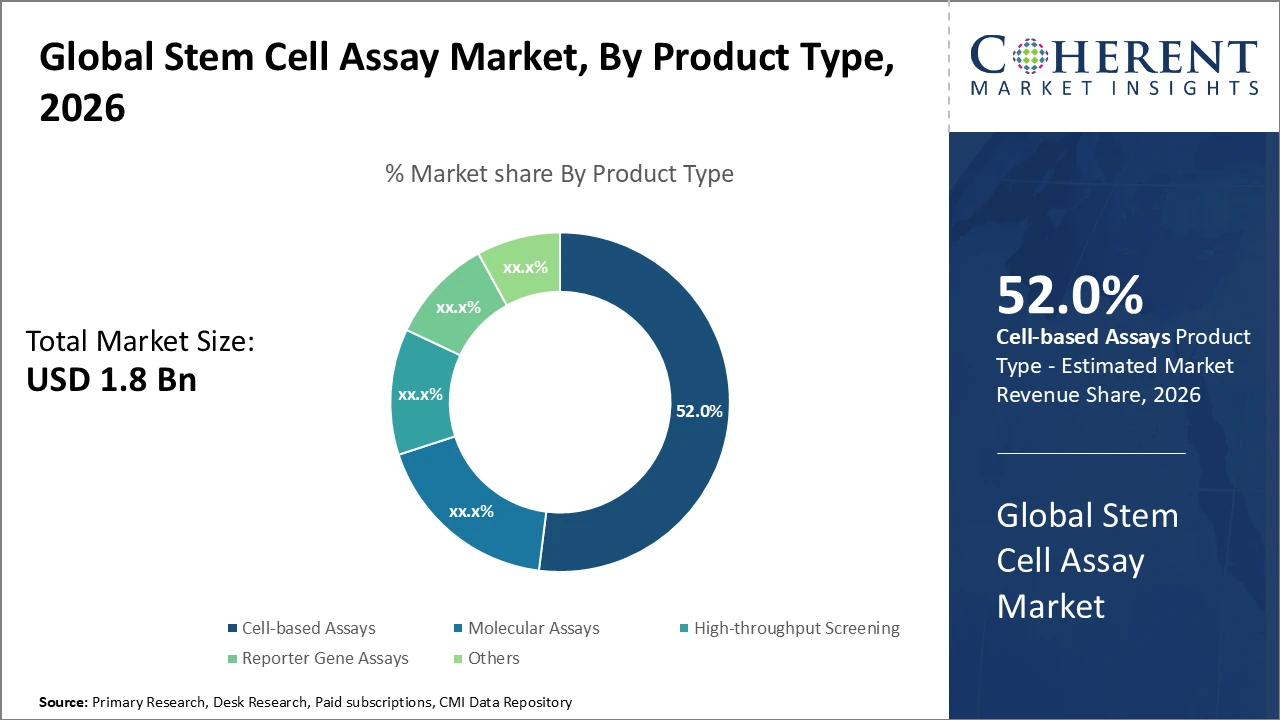
Cell-based assays dominate the stem cell assay market with more than 52% market share due to their widespread use in disease modeling, toxicity testing, and drug discovery applications.
High-throughput screening assays are the fastest-growing segment, supported by advancements in automation technologies and AI-driven analytical platforms.
Drug discovery represents the largest application segment because of increasing utilization of stem cell assays in early-stage screening and pharmaceutical research.
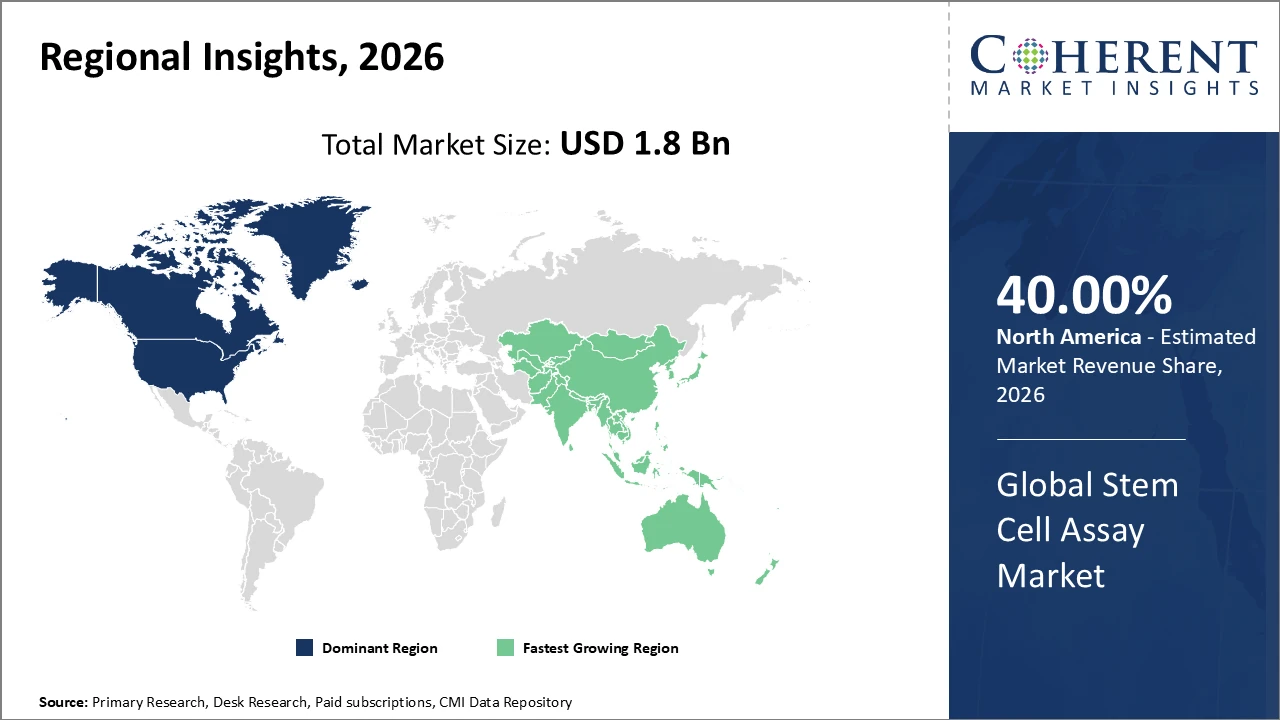
North America accounts for approximately 40% of total market revenue, driven by advanced pharmaceutical infrastructure, strong research funding, and government support for biotechnology innovation.
Asia Pacific is projected to witness the fastest CAGR due to rising biotechnology investments, expanding regenerative medicine research, and favorable trade policies in countries such as China and India.
Stem Cell Assay Market Segmentation Analysis
Stem Cell Assay Market Insights, By Product Type
Cell-based assays dominate the stem cell assay market because they provide highly relevant biological insights for disease modeling, toxicity testing, and drug discovery applications. Their ability to mimic real cellular behavior makes them essential in regenerative medicine and pharmaceutical research. High-throughput screening assays are the fastest-growing subsegment due to increasing adoption of automation technologies and AI-enhanced data analytics that support large-scale compound screening with improved efficiency. Molecular assays offer detailed genetic and proteomic analysis but maintain a smaller market share because of higher costs and technical complexity. Reporter gene assays are mainly utilized in specialized research settings to monitor targeted cellular responses and signaling activities.
Stem Cell Assay Market Insights, By Application
Drug discovery dominates the stem cell assay market because pharmaceutical and biotechnology companies increasingly rely on stem cell assays for early-stage drug candidate profiling, toxicity evaluation, and therapeutic safety assessment. These assays help reduce drug development failures and improve research efficiency. Toxicology screening is the fastest-growing application segment as regulatory agencies increasingly encourage the use of stem cell-based in vitro models to reduce dependence on animal testing. Regenerative medicine research also contributes significantly to market growth through expanding clinical trials involving stem cell-derived therapies. Disease modeling remains essential for studying neurodegenerative, genetic, and chronic disorders, while additional applications include personalized medicine and developmental biology research.
Stem Cell Assay Market Insights, By End User
Pharmaceutical and biotechnology companies dominate the stem cell assay market due to extensive investments in research, drug development, and regenerative medicine programs that require advanced assay platforms for screening and analysis. These organizations rely heavily on stem cell assays to improve therapeutic development efficiency and safety evaluation. Contract research organizations are the fastest-growing end-user segment as outsourcing trends increase demand for specialized and cost-effective assay services. Academic and research institutes continue contributing significantly through basic stem cell and disease research, although with comparatively lower revenue impact. Hospitals and diagnostic laboratories are gradually adopting stem cell assays for clinical applications and personalized medicine, while government and nonprofit organizations support specialized biomedical research initiatives.
Stem Cell Assay Market Trends
The stem cell assay market is increasingly integrating digital technologies to improve assay throughput, automation, and advanced data analytics capabilities.
In 2026, several market participants introduced AI-supported assay software platforms that improved screening accuracy by nearly 35% in pharmaceutical and biotechnology research applications.
Microfluidics technology is gaining significant adoption because it reduces sample volume requirements while improving assay precision and efficiency.
The incorporation of 3D cellular models into stem cell assays is enhancing physiological relevance and supporting more accurate disease modeling and drug testing processes.
Major pharmaceutical research centers accelerated adoption of advanced 3D assay formats during 2025 to improve therapeutic screening and regenerative medicine research outcomes.
Increasing focus on patient-specific stem cells for personalized drug screening is helping accelerate clinical translation timelines and precision medicine development.
Stem Cell Assay Market Insights, By Geography
North America Stem Cell Assay Market Analysis and Trends
North America dominates the stem cell assay market due to strong biotechnology infrastructure, significant government funding for life sciences research, and early adoption of advanced analytical technologies. The region also benefits from the strong presence of pharmaceutical and biotechnology companies utilizing stem cell assays for drug discovery and regenerative medicine. Supportive regulatory frameworks and innovation-focused research ecosystems continue strengthening North America’s market leadership and revenue growth.
Asia Pacific Stem Cell Assay Market Analysis and Trends
The Asia Pacific stem cell assay market is experiencing the fastest growth, with a CAGR exceeding 15%, driven by expanding biotechnology ecosystems in China, India, and Japan. Favorable government initiatives supporting regenerative medicine, biotechnology innovation, and stem cell research are significantly accelerating regional market expansion. The growing presence of domestic biotechnology companies and rising imports of advanced assay components are further strengthening industry development. China plays a particularly important role through policies such as the 14th Five-Year Plan, which emphasizes biotechnology advancement, pharmaceutical innovation, and precision medicine research across the country.
Stem Cell Assay Market Outlook for Key Countries
USA Stem Cell Assay Market Analysis and Trends
The United States stem cell assay market is driven by advanced technological innovation and strong adoption among pharmaceutical and biotechnology companies. The country contributes nearly 40% of the global market share, supported by leading companies such as Thermo Fishe Scientific and Danaher Corporationthat continue expanding automated assay platforms and advanced analytical solutions. Investments exceeding USD 500 million in academic institutions and commercial stem cell research hubs have accelerated drug discovery and regenerative medicine research activities. In addition, favorable regulatory frameworks supporting clinical translation of stem cell therapies continue strengthening the market’s long-term growth trajectory and innovation landscape.
Germany Stem Cell Assay Market Analysis and Trends
Germany’s stem cell assay market is experiencing strong growth due to rising investments in regenerative medicine, biotechnology research, and advanced cell therapy development. The country benefits from a well-established pharmaceutical and life sciences industry along with strict regulatory standards that increase demand for validated and reproducible stem cell assay solutions. Kits and reagents currently dominate the market, while automated instruments and high-throughput screening technologies are witnessing rapid adoption. Increasing use of 3D cell culture systems, AI-based cell analysis, and organoid research is shaping industry trends. Germany is also emerging as a leading European hub for stem cell research and translational medicine innovation.
Analyst Opinion
High-throughput stem cell assays are increasingly used in pharmaceutical drug discovery, with induced pluripotent stem cell (iPSC)-based screening programs rising by nearly 25% during 2025.
Production capacity expansion in biotechnology hubs such as the United States and China boosted assay throughput capabilities by approximately 30% between 2024 and 2026.
Contract research organizations are expanding stem cell assay services to support scalable drug discovery, toxicity testing, and regenerative medicine research activities.
Subscription-based and pay-per-use pricing models improved accessibility to assay platforms, contributing to nearly 18% growth in modular assay kit adoption during 2026.
Asia Pacific recorded nearly 12% year-over-year growth in imports of assay reagents and consumables, driven by rising biotechnology research demand in India, Japan, and South Korea.
- Current Industry Events of 2026
- Market Size Estimation
- Regional Breakdown
- Competitive Landscape
- Customer Intelligence
- Segmental Analysis
- Pricing Analysis
- Key Market Drivers, Challenges & Future Trends
- Customized Insights Section
Market Scope
| Report Coverage | Details | ||
|---|---|---|---|
| Base Year: | 2025 | Market Size in 2026: | USD 1.8 billion |
| Historical Data for: | 2020 To 2024 | Forecast Period: | 2026 To 2033 |
| Forecast Period 2026 to 2033 CAGR: | 13.2% | 2033 Value Projection: | USD 4.2 billion |
| Geographies covered: |
| ||
| Segments covered: |
| ||
| Companies covered: | Thermo Fisher Scientific, Merck KGaA, Danaher Corporation, Lonza Group AG, Bio-Rad Laboratories, Abcam Plc, Qiagen NV, Takara Bio Inc., Roche Diagnostics, Promega Corporation | ||
| Growth Drivers: |
| ||
Stem Cell Assay Market Growth Factors
The stem cell assay market is growing rapidly due to continuous advancements in stem cell biology, assay technologies, and scalable screening platforms that improve research precision and efficiency. Pharmaceutical companies are increasing R&D spending to accelerate drug development, with a 2026 industry survey reporting nearly 28% growth in stem cell assay adoption for early toxicity profiling. Government funding initiatives supporting regenerative medicine and biotechnology research across North America and Europe are further strengthening market infrastructure and innovation. Rising prevalence of chronic diseases, including cancer and neurodegenerative disorders, is increasing demand for disease modeling applications. Additionally, expanding outsourcing activities among contract research organizations contributed to a 15% rise in stem cell assay service revenues during 2025.
Stem Cell Assay Market Development
In March 2026, Eurofins Viracor launched the ExPeCT anti-CD19 (obe-cel) CAR T-cell assay, enabling clinicians to monitor CAR T-cell therapy with validated accuracy and rapid turnaround.
Key Players
Leading Companies of the Market
Thermo Fisher Scientific
Merck KGaA
Danaher Corporation
Lonza Group AG
Bio-Rad Laboratories
Abcam Plc
Qiagen NV
Takara Bio Inc.
Roche Diagnostics
Promega Corporation
Several leading companies in the stem cell assay market are pursuing strategic partnerships and expansion initiatives to strengthen their technology capabilities and global presence. Danaher Corporation enhanced its cell analytics portfolio through the acquisition of a high-performance stem cell assay platform in 2025, contributing to nearly 20% growth in its related business segment during the following year. Similarly, Thermo Fisher Scientific expanded its operations across the Asia Pacific region by establishing new manufacturing facilities in Singapore, which helped the company increase its regional market share by approximately 15% by 2026. These initiatives demonstrate strong emphasis on innovation, regional expansion, and technology-driven market growth strategies.
Stem Cell Assay Market Future Outlook
The stem cell assay market is expected to witness strong growth over the coming years due to rising investments in regenerative medicine, personalized therapies, and advanced drug discovery research. Increasing adoption of induced pluripotent stem cells (iPSCs), organoids, and 3D cell culture technologies will continue driving demand for advanced assay platforms and automated analysis systems. Pharmaceutical and biotechnology companies are increasingly utilizing stem cell assays for toxicity testing, disease modeling, and therapy development. Technological advancements such as AI-driven cell analysis, high-throughput screening, and microfluidic platforms are expected to further accelerate market expansion. Growing global clinical research activities and precision medicine initiatives will also support long-term industry growth.
Stem Cell Assay Market Historical Analysis
The stem cell assay market has evolved significantly over the past two decades alongside advancements in regenerative medicine, biotechnology, and cell-based research. Early market growth was driven by increasing use of stem cells in drug discovery, toxicity testing, and disease modeling applications. Over time, technological innovations such as high-throughput screening, flow cytometry, automated imaging systems, and 3D cell culture techniques improved assay accuracy and efficiency. Rising investments from pharmaceutical companies, academic institutions, and government organizations further accelerated market expansion globally. North America and Europe historically dominated the market because of advanced research infrastructure, while Asia Pacific emerged as a rapidly growing region due to increasing biotechnology investments.
Sources
Primary Research Interviews:
Stem cell researchers, regenerative medicine specialists, and biotechnology scientists involved in stem cell assay development and therapeutic research.
Laboratory directors, pharmaceutical R&D managers, and clinical research professionals utilizing stem cell assays for drug discovery and toxicity testing.
Product managers, assay technology developers, and regulatory consultants from companies developing stem cell analysis platforms, reagents, and automated screening systems.
Magazines:
Genetic Engineering & Biotechnology News – Updates on stem cell technologies, regenerative medicine, and assay innovations.
The Scientist – Insights into cell biology research, laboratory technologies, and stem cell applications.
BioPharm International – Coverage of biopharmaceutical research, cell-based assays, and biotechnology advancements.
Journals:
Stem Cell Research & Therapy – Research on stem cell technologies, regenerative medicine, and assay methodologies.
Cell Stem Cell – Studies on stem cell biology, differentiation, and advanced assay applications.
Nature Biotechnology – Research on biotechnology innovations, high-throughput screening, and stem cell analysis systems.
Newspapers:
Reuters – Biotechnology investments, stem cell research developments, and regulatory updates.
Bloomberg – Corporate strategies, funding activities, and financial performance of biotechnology and life sciences companies.
The Financial Times – Global healthcare innovation, regenerative medicine investments, and biotechnology market trends.
Associations:
International Society for Stem Cell Research – Stem cell research guidelines, conferences, and scientific advancements.
American Association for Cancer Research – Research updates related to stem cell therapies and oncology applications.
European Society for Gene and Cell Therapy – Developments in regenerative medicine, cell therapy standards, and stem cell technologies.
Get access to 250+ pages report
Every segment, forecast, competitor profile and data table behind the analysis above — available for instant download.
- ESOMAR Member
- ISO 9001:2015 Certified
- D-U-N-S Registered
- GDPR & CCPA Compliant
Missing comfort of reading report in your local language? Find your preferred language:
Transform your Strategy with Exclusive Trending Reports
Frequently Asked Questions
The dominant companies include Thermo Fisher Scientific, Merck KGaA, Danaher Corporation, and Qiagen NV, which maintain strong market positions through technological innovation and global expansion strategies.
The Stem Cell Assay Market is projected to grow from USD 1.8 billion in 2026 to USD 4.2 billion by 2033, exhibiting a CAGR of 13.2% during the forecast period.
Pharmaceutical and biotechnology companies represent the largest growth opportunity due to increasing investments in drug discovery, toxicity screening, regenerative medicine, and personalized therapy development.
Future market trends will focus on automation, AI-integrated assay platforms, personalized medicine applications, miniaturization technologies, and advanced high-throughput screening systems that improve research speed and efficiency.
The market is highly competitive with companies emphasizing innovation, strategic collaborations, and advanced assay development. Major challenges include assay standardization complexities, high research costs, and evolving regulatory requirements.
Common strategies include strategic collaborations, acquisitions, regional expansion, investment in automated assay technologies, and the introduction of modular and scalable stem cell assay platforms.