

Latin America Insulin Vials Market Size and Share Analysis- 2026 To 2033
The Latin America Insulin Vials Market size is anticipated to grow at a CAGR of 8.5% with USD 1,540 Mn in 2026 and is expected to reach USD 2,720 Mn in 2033. The primary drivers are defined by increasing diabetes prevalence, expanding public insulin procurement, hospital-based diabetes management, endocrinology access, and use of human insulin and analogue insulin therapies across Latin America. Some of the other factors include rising Type 1 and Type 2 diabetes diagnosis, stronger retail pharmacy networks, government reimbursement programs, cold-chain distribution improvement, chronic disease screening, and demand from public hospitals, clinics, and tender-based supply channels, where vials remain preferred for multi-dose affordability and institutional dispensing. According to IDF, South and Central America had 35 Mn adults with diabetes in 2024, supporting vial demand.
Key Takeaways
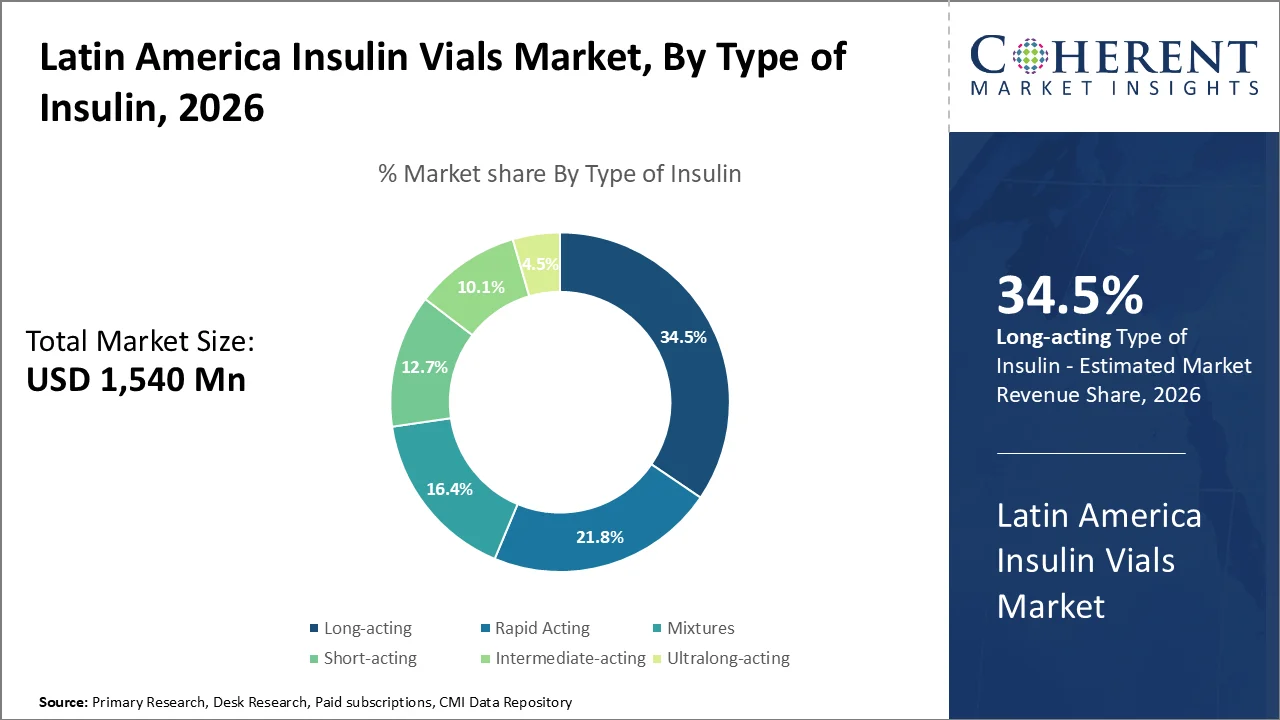
- The long-acting segment is likely to dominate the market with 34.5% in 2026. The segment’s growth is owing to once-daily basal glucose control and better patient adherence. Basal (long-acting) insulin accounts for approximately 79% of the Brazil’s total insulin market.
- The type 2 diabetes segment is likely to dominate the market with 78.2% in 2026. The segment’s growth is owing to rising obesity, aging population, and sedentary lifestyles. The diabetes prevalence in Brazil was 10.2%, representing around 20 Mn people.
- The 100 units/ml segment is set to lead with 91.5% in 2026. The segment’s growth is owing to the standard use in vials, lower cost, wide physician familiarity, and compatibility with conventional syringes.
- The hospital pharmacies segment is set to lead with 46.8% in 2026. The segment’s growth is owing to the prescription-based insulin initiation, hospital-linked diabetes care, and public procurement support across major Latin American healthcare systems.
- Brazil is expected to acquire the prominent share of 36.5% in 2026. The country’s growth is owing to the large diabetes patient base and universal healthcare access. IDF estimates 16.6 Mn adults with diabetes in Brazil in 2024.
Segmental Insights
Why is Long-acting Segment Acquiring the Largest Share?
On the basis of insulin, the long-acting segment is projected to account for the largest Latin America Insulin Vials Market share of 34.5% in 2026. The segment’s growth is owing to the rising need for stable basal glucose control among patients requiring daily insulin therapy, especially in Brazil and Mexico.
Mexico’s National Institute of Public Health reported that diagnosed and undiagnosed diabetes reached 18.3% in 2022, expanding the treated population needing basal insulin support.
In Brazil, the Ministry of Health reported adult diabetes prevalence rose 135% between 2006 and 2024, from 5.5% to 12.9%, strengthening demand for long-duration insulin vials through public and private channels across regional hospitals and clinics.
- Current Industry Events of 2026
- Market Size Estimation
- Regional Breakdown
- Competitive Landscape
- Customer Intelligence
- Segmental Analysis
- Pricing Analysis
- Key Market Drivers, Challenges & Future Trends
- Customized Insights Section
Type 2 Diabetes hold the Largest Market Share
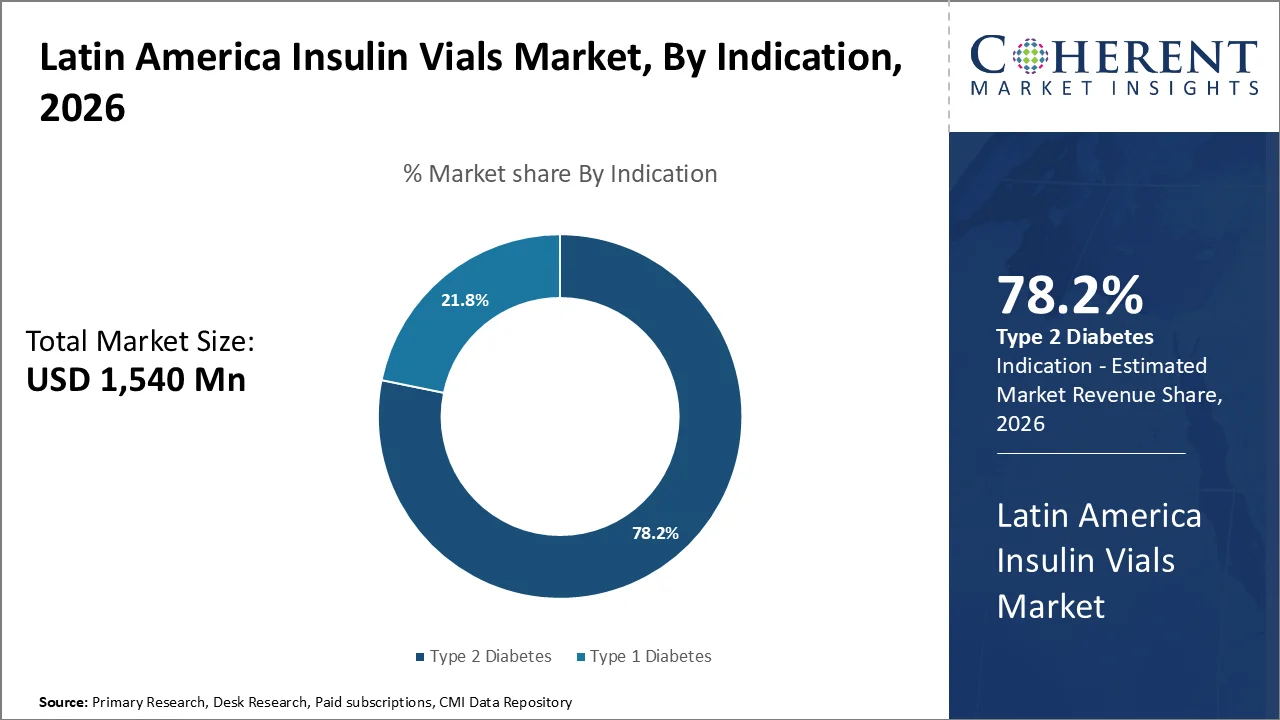
On the basis of indication, the type 2 diabetes segment lead with a major 78.2% share in 2026. The segment’s growth is owing to the high treated-patient pool across Latin America, where insulin vials remain essential for dose titration, hospital dispensing, and public-program procurement.
CDC states that Type 2 diabetes accounts for about 90% to 95% of all diagnosed diabetes cases, directly expanding demand for affordable basal and regular insulin vial formats across Latin America.
Mexico’s ENSANUT 2023 further reported 18.4% type 2 diabetes prevalence among adults, with 12.4% diagnosed and 6.0% undiagnosed, showing a large therapy-escalation base.
Market Drivers
Rising Innovations in Local Insulin Manufacturing are Transforming the Latin America Insulin Vials Market in Brazil
Brazil is becoming a key innovation center for insulin vial supply in Latin America due to domestic production, technology transfer, and public-sector supply security initiatives. Brazil’s Ministry of Health states that SUS offers comprehensive diabetes care from diagnosis to treatment and provides four types of insulin, including human NPH, regular insulin, rapid-acting analogues, and long-acting analogues. This strengthens insulin vial demand across primary healthcare units, hospitals, and state distribution systems.
In April 2025, Brazil’s Ministry of Health formalized a Productive Development Partnership for insulin glargine which involved Bio-Manguinhos/Fiocruz, Biomm, and Gan & Lee. The project planned production and delivery of nearly 20 million insulin glargine vials in 2025 to serve the SUS patients with both type 1 as well as type 2 diabetes. The development is expected to improve domestic supply resilience and reduce dependence on the imported insulin products.
Expanding Insulin Vial Access is Driving Growth in the Latin America Market
The Latin America insulin vials market is growing as public health systems expand access to affordable diabetes treatment and improve insulin supply for underserved populations. Rising diabetes prevalence, dependence on injectable insulin in hospitals, and donor-backed supply programs are increasing demand for vial-based insulin across the region.
In April 2026, Direct Relief delivered around 52,000 insulin vials and more than 2.1 million needles and syringes to Ecuador’s Ministry of Public Health. The shipment, supported by Novo Nordisk and embecta, was distributed through Ecuador’s public health system and was expected to provide one month of insulin access for 14% of Ecuadorian people living with diabetes.
The development strengthens the vial-based insulin availability in public hospitals and health facilities, thereby improving treatment continuity for underserved patients and supporting the higher institutional demand for insulin vials across Latin America.
Current Events and Their Impact on the Latin America Insulin Vials Market
Current Event | Description and its Impact |
Brazil SUS Insulin Glargine Transition and Domestic Insulin Production Push
|
|
PAHO Strategic Fund and Diabetes Care Strengthening Across the Americas |
|
Latin America Insulin Vials Market Trends
- Rising diabetes diagnosis across Latin America increases dependence on insulin vials, especially among cost-sensitive patients.
- Growing preference for basal and rapid-acting insulin supports wider use of vial-based products in hospital treatment settings.
- Public healthcare procurement programs improve insulin vial access through government hospitals and centralized supply chains.
- High disease burden continues to support long-term insulin demand. In South and Central America, diabetes-related healthcare expenditure reached USD 81 billion in 2024, reflecting the economic pressure of diabetes management. The region also recorded 224,000 diabetes-related deaths, highlighting the need for better glycemic control and continuous insulin access. Around 797,000 people live with type 1 diabetes in the region, directly supporting demand for insulin-based therapy.
- Rising metabolic risk among adults and pregnancy-related hyperglycemia strengthens the treatment pool. IDF estimates that 1 in 6 live births in South and Central America are affected by hyperglycemia in pregnancy. Mexico’s ENSANUT 2022 also reported total diabetes prevalence of 18.3%, supporting higher insulin usage across outpatient and hospital channels.
Regional Insights
Brazil Dominates Owing to the Centralized Insulin Procurement
Brazil accounts for 36.5% of the market share in 2026. The country’s growth is owing to the large public diabetes treatment base, centralized insulin procurement, and expanding domestic supply security.
Brazil’s Ministry of Health reports that SUS purchases human regular insulin 100 IU/ml and NPH insulin 100 IU/ml in vials and cartridges, then distributes them to state and municipal health warehouses for patients with diabetes. Official Vigitel surveillance also shows diagnosed diabetes among adults in Brazil rose to 9.8% in 2023, sustaining prescription demand.
In February 2026, the Ministry began a gradual SUS transition from NPH to insulin glargine in four states, initially covering more than 50,000 people. The key development is Brazil’s productive-development partnership involving Wockhardt, Funed, and Biomm to manufacture NPH and regular insulin in vials and cartridges, targeting 8 million units by 2026.
Mexico Insulin Vials Market Trends
Mexico is expected to witness strong growth in Latin America Insulin Vials Market over the forecast period. The growth is owing to the large diabetes treatment base, expanding public diagnosis activity, and continued reliance on injectable insulin in public-care settings.
ENSANUT 2022 reported total diabetes prevalence of about 14.6 million people, creating steady demand for vial-based basal and mealtime insulin through hospitals and public pharmacies. ENSANUT Continua 2022 also indicated increased insulin use for diabetes control across two public health subsystems. This highlights continued scope for public formulary expansion and broader access to insulin vial therapies in Mexico.
A key development came when COFEPRIS included a biocomparable insulin glargine in its therapeutic-extension authorizations for adults and pediatric patients with type 1 and type 2 diabetes, supporting broader affordable long-acting insulin availability across urban and rural Mexico settings.
Who are the Major Companies in Latin America Insulin Vials Industry
Some of the major key players in Latin America Insulin Vials Market are Sanofi S.A, Novo Nordisk A/S, and Eli Lilly and Company.
Key News
- In May 2026, Mexico announced over MX$21 billion in pharmaceutical and healthcare investments to strengthen domestic manufacturing and supply chains. Sanofi plans to invest over MX$2 billion in a new insulin manufacturing facility with technology transfer to support Mexico’s domestic insulin requirements and boosting demand for insulin vials.
- In November 2024, Russia’s Deputy Prime Minister Dmitriy Chernyshenko approved the final preparation stage for insulin production at Venezuela’s ESPROMED BIO site under GEROPHARM technology. Commercial production is planned for 2025, with products expected to reach patients in 2026. The project is likely to strengthen regional vial-based insulin supply and support long-term market growth.
Market Report Scope
Latin America Insulin Vials Market Report Coverage
| Report Coverage | Details | ||
|---|---|---|---|
| Base Year: | 2025 | Market Size in 2026: | USD 1,540 Mn |
| Historical Data for: | 2020 To 2024 | Forecast Period: | 2026 To 2033 |
| Forecast Period 2026 to 2033 CAGR: | 8.5% | 2033 Value Projection: | USD 2,720 Mn |
| Geographies covered: |
| ||
| Segments covered: |
| ||
| Companies covered: | Sanofi S.A, Novo Nordisk A/S, and Eli Lilly and Company | ||
| Growth Drivers: |
| ||
| Restraints & Challenges: |
| ||
Analyst Opinion
- The Latin America insulin vials demand is fundamentally driven by rising diabetes treatment need. In South and Central America, diabetes cases are projected to increase 46% by 2050, reaching 52 million adults, supporting sustained demand for affordable insulin formats.
- The market is not growing only because of product preference — it is growing because insulin remains essential for diabetes management. In the Americas, 112 million adults live with diabetes, but only 58% of people aged 30 and older receive treatment, creating a large access gap.
- Insulin vials continue to hold strong relevance in Latin America due to affordability and public-sector usability. Studies show vials are cheaper than cartridges and prefilled pens for human insulin, making them important for hospitals, public tenders, and cost-sensitive patients.
Speak to the analyst
Want personalized insights?
Take the findings above to one of our principal consultants, or have the report rebuilt around the segments, geographies and competitors you actually track.
Market Segmentation
- By Type of Insulin (Revenue, USD Mn, 2021-2033)
- Rapid Acting
- Short-acting
- Intermediate-acting
- Long-acting
- Ultralong-acting
- Mixtures
- By Indication (Revenue, USD Mn, 2021-2033)
- Type 1 Diabetes
- Type 2 Diabetes
- By Concentration (Revenue, USD Mn, 2021-2033)
- 100 units/ml
- 300 units/ml
- Others (Others include 200 units/ml and 500 units/ml)
- By Distribution Channel (Revenue, USD Mn, 2021-2033)
- Hospital Pharmacies
- Retail Pharmacies
- Online Pharmacies
- By Region (Revenue, USD Mn, 2021-2033)
- Brazil
- Mexico
- Argentina
- Colombia
- Peru
- Venezuela
- Chile
- Ecuador
- Rest of Latin America
Sources
Primary Research Interviews
- Endocrinologists and diabetologists
- Hospital pharmacists and pharmacy procurement heads
- Diabetes care specialists and diabetes educators
- Public hospital administrators
- Retail pharmacy chain managers
- Pharmaceutical wholesalers and cold-chain distributors
- Insulin vial manufacturers and medical affairs managers
- Public healthcare procurement officials
- Key opinion leaders (KOLs) in diabetes and endocrinology
Databases
- World Health Organization (WHO)
- Pan American Health Organization (PAHO)
- International Diabetes Federation (IDF) Diabetes Atlas
- World Bank Health Data
- Organisation for Economic Co-operation and Development (OECD)
- National Health Ministry Databases across Latin America
- ClinicalTrials.gov
- WHO International Clinical Trials Registry Platform (ICTRP)
- National medicine price and reimbursement databases
Magazines
- Diabetes Care News
- Pharmaceutical Technology
- PharmaBoardroom
- BioPharma Dive
- Medical Device Network
- Latin America Reports – Healthcare Section
Journals
- Diabetes Care
- The Lancet Diabetes & Endocrinology
- Diabetes Research and Clinical Practice
- Diabetologia
- Journal of Diabetes Science and Technology
- BMJ Open Diabetes Research & Care
- Pan American Journal of Public Health
Newspapers
- Reuters
- The New York Times
- The Wall Street Journal
- Financial Times
- Valor Econômico
- El País
- AméricaEconomía
Associations
- International Diabetes Federation (IDF)
- Latin American Diabetes Association (ALAD)
- Brazilian Diabetes Society
- Mexican Diabetes Federation
- Argentine Diabetes Society
- Colombian Diabetes Association
- Chilean Diabetes Society
- American Diabetes Association
Public Domain Sources
- Company Annual Reports and Investor Presentations
- Government Health Ministry Publications
- Public Procurement and Tender Documents
- National Diabetes Program Reports
- Essential Medicines Lists
- Medicine Pricing and Reimbursement Publications
- Clinical Trial Registries such as ClinicalTrials.gov and WHO ICTRP
- Import–Export Databases for Pharmaceutical Products
Proprietary Elements
- CMI Data Analytics Tool
- Proprietary CMI Existing Repository of Information for Last 10 Years
Get access to 250+ pages report
Every segment, forecast, competitor profile and data table behind the analysis above — available for instant download.
- ESOMAR Member
- ISO 9001:2015 Certified
- D-U-N-S Registered
- GDPR & CCPA Compliant
Missing comfort of reading report in your local language? Find your preferred language:
Transform your Strategy with Exclusive Trending Reports
Frequently Asked Questions
The Latin America Insulin Vials Market is expected to reach USD 2,720 Mn in 2033.
Major players operating in the global Latin America Insulin Vials Market include Sanofi S.A, Novo Nordisk A/S, and Eli Lilly and Company.
The high out-of-pocket costs, complex supply chain logistics, and limited healthcare infrastructure in rural areas are the key factors hampering growth of the market.
The rising diabetes prevalence, widespread affordability of traditional human insulin, and expanding government healthcare subsidies is boosting the demand for Latin America Insulin Vials.
The Latin America Insulin Vials Market is anticipated to grow at a CAGR of 8.5% between 2026 and 2033.
Brazil is expected to account for a largest market share in the global Latin America Insulin Vials Market over the forecast period.
The Latin America insulin vials market includes human and analogue insulin products supplied in vial format for diabetes treatment. It covers rapid-acting, short-acting, intermediate-acting, long-acting, ultralong-acting, and premixed insulin vials distributed through hospitals, retail pharmacies, and online pharmacies.