

Complete Blood Count Device Market Size and Share Analysis - Growth Trends and Forecasts (2026 - 2033)
The Complete Blood Count Device Market is estimated to be valued at USD 4.45 Bn in 2026 and expected to reach USD 7.85 Bn by 2033, witnessing a CAGR of 8.1% over the forecast period (2026-2033). This market is primarily driven by the increasing prevalence of blood disorders and rising demand for rapid diagnostic testing across hospitals and laboratories.
Key Takeaways
- Based on Product Type, the 5-Part Analyzer is accounted for approximately 46% of the market share in 2026.
- Based on Modality, the stationery segment is expected to lead the market with 62% share in 2026.
- Based on Test Type, the white blood cell (WBC) segment is expected to lead the market with 34% share in 2026.
- Based on End User, the hospitals segment is projected to account for 55% share of the market in 2026.
- Based on Region, the North America acquires the largest share of 39%.
Market Overview
The market for complete blood count device represents a key segment in the in-vitro diagnostics (IVD) industry. This important segment consists of devices used to analyze the various components of blood including red blood cells (RBCs), white blood cells (WBCs), hemoglobin level, hematocrit percentage, and platelet count. Hospitals, diagnostic laboratories, research Institutions, and blood banks commonly utilize complete blood count devices to perform routine health screenings and to diagnose diseases.
Complete blood count devices typically employ various technology such as electrical impedance, laser-based detection, and flow cytometry technology, to provide a rapid and precise evaluation of blood samples. Because these devices are designed to aid clinicians in diagnosing conditions such as anemia, infection, leukemia, inflammatory disease, and immune disorders, they are invaluable tools for clinicians.
Current Events and their Impacts
Current Event | Description and its Impact |
AI-Enabled Hematology Analyzer Launch (2025) |
|
Expansion of Preventive Health Screening Programs |
|
Growth of Point-of-Care Diagnostics |
|
Laboratory Automation Initiatives |
|
Role of Artificial Intelligence in CBC Devices
A growing presence of AI in the market for complete blood count devices is contributing to the diagnostic accuracy and efficiency of laboratory operations. AI algorithms allow for the automatic identification of abnormal cell morphology and will alleviate the need for manual review by the laboratory techs. Predictive analytics that utilize AI have also introduced the possibility for hematology analyzers to assist providers in identifying potential disease states prior to clinical diagnosis, thereby enhancing the quality of care delivered to patients.
In April 2025, Sysmex launched an AI-enabled hematology analyzer capable of detecting abnormal cell populations using machine learning algorithms.
- Current Industry Events of 2026
- Market Size Estimation
- Regional Breakdown
- Competitive Landscape
- Customer Intelligence
- Segmental Analysis
- Pricing Analysis
- Key Market Drivers, Challenges & Future Trends
- Customized Insights Section
Segmental Insights
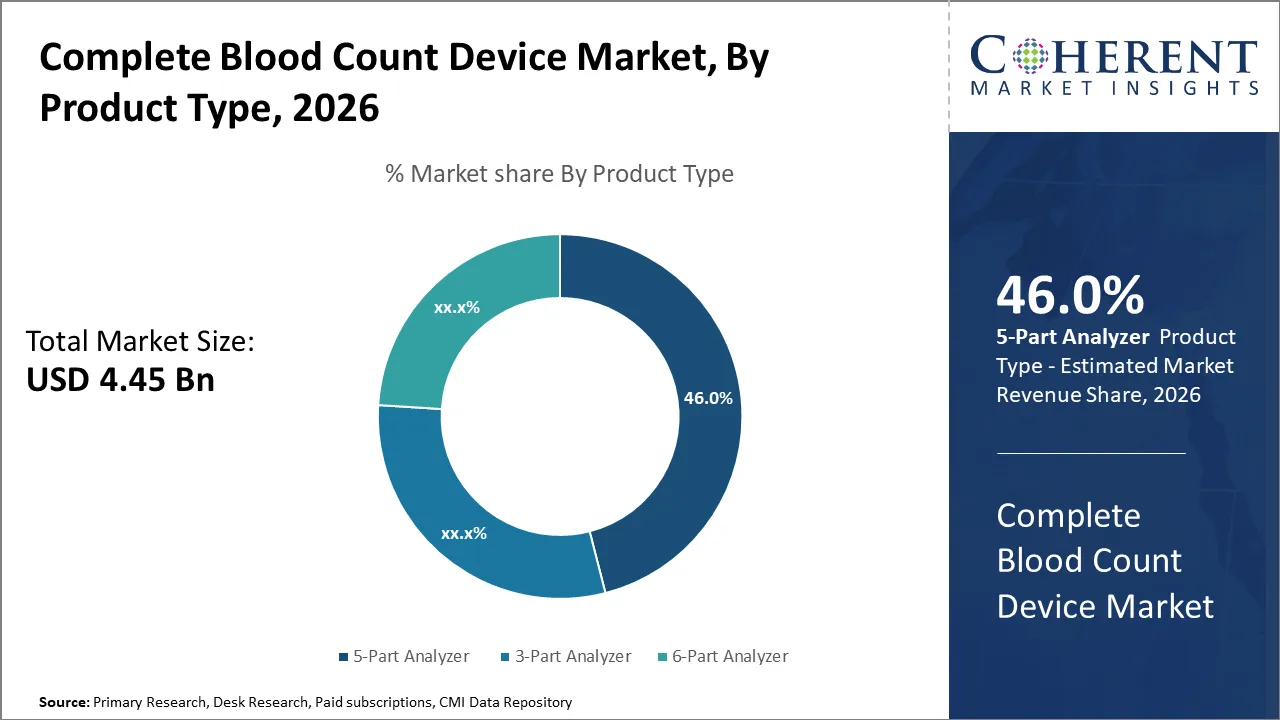
Complete Blood Count Device Market Insights, By Product Type - 5-Part Analyzer is the Dominating segment
The 5-part Analyzer segment accounted for approximately 46% of the global complete blood count device market share in 2026. Due to its advanced ability to differentiate five types of white blood cells, enabling more accurate diagnosis of infections, leukemia, and inflammatory conditions. Hospitals and diagnostics laboratories prefer these analyzers for their high precision and comprehensive hematology testing capabilities. For instance, large hospital laboratories commonly deploy 5-part hematology analyzers for high-volume routine CBC testing and advanced blood cell differentiation.
Complete Blood Count Device Market Insights, By Modality - Stationery segment is the Dominating segment
In 2026, the stationery device segment dominated the complete blood count device market with about 62% of the total market share due to their higher throughput and detailed analysis of blood compared to portable devices. Stationery devices can be found in most centralized hospital laboratories and diagnostic centers because they routinely process large volumes of blood samples on a daily basis. For instance, high-capacity stationery hematology analyzers installed in tertiary hospitals can process hundreds of blood samples per hour.
Complete Blood Count Device Market Insights, By Test Type - White Blood Cell (WBC) count segment is the Dominating segment
The white blood cell count segment accounted for approximately 34% of the market in 2026. White blood cells testing, which includes the count of neutrophils, eosinophils and basophils, was a large share of the global market because WBC testing is important for the detection of infection, immune disorder and inflammatory disease. The intensity and routine frequency of WBC testing as part of CBC testing support physicians in diagnosing and obtaining pertinent information regarding the status of a patient’s total health. For instance, doctors frequently order WBC count tests to detect bacterial infections or immune system abnormalities in patients.
In January 2024, a Rutgers researcher, through his spinoff company, led a team that developed and tested a device capable of quickly counting white blood cells from a single drop of blood, similar to how glucometers measure blood sugar levels.
Complete Blood Count Device Market Insights, By End User - the hospital segment is the Dominating segment
The hospital segment holds around 55% of the global market share in 2026, as hospital laboratories are performing the most diagnostic tests. Hospital laboratories routinely performed CBC tests to assist with determining the diagnosis for a patient, continued evaluations of a patient’s medical condition and for determining pre-surgical evaluations. For instance, emergency departments routinely conduct CBC tests to assess infections, anemia or internal bleeding in critical patients.
Regional Insights
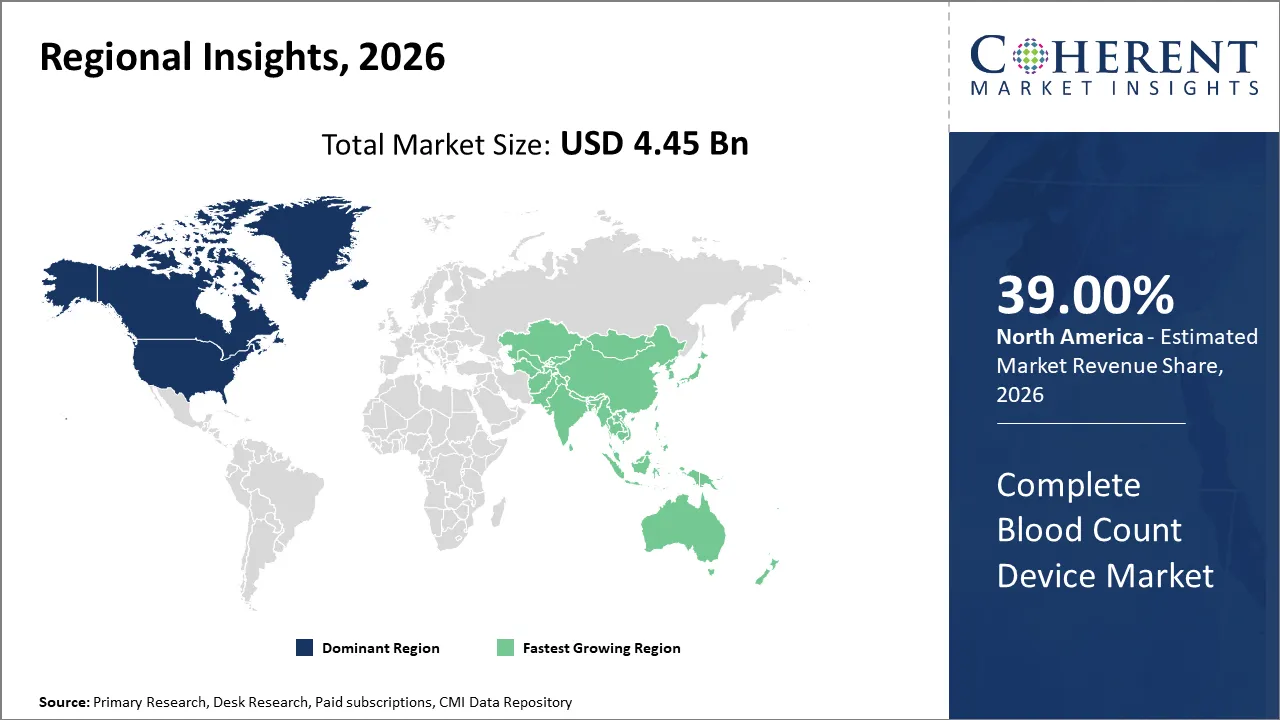
Complete Blood Count Device Market Outlook: Region-wise
North America Remains at the Epicenter of Market
The North America leads the total blood count device market because of its sophisticated healthcare system, large number of diagnostics performed and wide acceptance of automated hematology analyzers. The presence of prominent diagnostic companies, favorable reimbursement practices and established clinical laboratories continues to aid to the widespread use of total blood count testing devices within hospitals and diagnostic labs.
- The US accounts for the largest proportion of North America’s total blood count device sales with extensive hospital laboratory networks, and increasing demand for routine blood diagnostics. The presence of top tier diagnostic companies, including Sysmex, Beckman Coulter, Abbott have positively influenced the adoption of automated hematological analyzers.
Asia Pacific remains the Fastest-Growing Region of Market
The Complete Blood Count Device Market is expected to grow rapidly in Asia Pacific with continued growth in healthcare infrastructure, increased awareness of diagnostic services and increased investments in modernizing hospitals and laboratories. As the number of cases of Anemia and infectious diseases increase, the demand for blood tests also continue to grow within the region.
- With a rapidly expanding healthcare infrastructure, China is leading growth market due to multiple governmental initiatives encouraging the implementation of routine health screenings, increasing the number of hospital laboratories and growth in the adoption of fully automated hematology analyzers will ultimately accelerate growth in the CBC device market.
- India is experiencing significant growth in the complete Blood Count Device market primarily driven by the construction of chain private diagnostic laboratories and increasing government healthcare funding. Increasing the number of people receiving preventative health check-ups as well as the implementation of nationwide public programs, such as Ayushman Bharat, has led to increased demand for CBC diagnostic devices in the Hospital and Laboratory segments.
Market Report Scope
Complete Blood Count Device Market Report Coverage
| Report Coverage | Details | ||
|---|---|---|---|
| Base Year: | 2025 | Market Size in 2026: | USD 4.45 Bn |
| Historical Data for: | 2020 To 2024 | Forecast Period: | 2026 To 2033 |
| Forecast Period 2026 to 2033 CAGR: | 8.1% | 2033 Value Projection: | USD 7.85 Bn |
| Geographies covered: |
| ||
| Segments covered: |
| ||
| Companies covered: | Abott Laboratories, bioMérieux SA, Danaher Corporation, Siemens Healthineers, Bio-Rad Laboratories, Inc., PerkinElmer, Inc., Sysmex Asia Pacific Pte Ltd, Becton, Dickinson and Company, Sight Diagnostics, Horiba, and Nihon Kohden Corporation | ||
| Growth Drivers: |
| ||
| Restraints & Challenges: |
| ||
Market Dynamics
Complete Blood Count Device Market Driver
Rising Prevalence of Blood Disorders
As hematological disorders become more common, from anemia to leukemia to thrombocytopenia, there will be much greater need for testing equipment. CBC testing devices are relied upon by medical professionals for both initial diagnosis and ongoing monitoring, so they are an essential piece of equipment in both hospitals and medical laboratories.
Growth in Diagnostic Laboratory Automation
The use of automated diagnostic equipment is becoming prevalent in many years of healthcare, due to a desire to increase efficiency and decrease risk of error from human operators. Automated CBC analyzers allow laboratories to process large quantities of blood samples with high levels of diagnostic accuracy, which helps improve testing volume.
Complete Blood Count Device Market Opportunity
Expansion of Point-of-Care Diagnostics
The increasing need for the ability for fast diagnostics at hospitals and remote healthcare facilities has resulted in a growing demand for portable CBC devices that are able to deliver results quickly. Point-of-Care devices allow healthcare professionals to test patients and get their results in less time than if they had sent samples to a laboratory.
Increasing Healthcare Investments in Emerging Economies
Emerging market providers like India, China and Brazil are spending considerable resources to develop their healthcare infrastructure. The growth of hospitals, diagnostic centers and laboratory networks continues to provide new avenues for growth for the manufacturers of CBC devices.
Analyst Opinion (Expert Opinion)
The complete blood count device market is projected to continue to grow steadily as more diagnostic tests are being done, and technology for hematology analyzers continues to advance. According to experts, the landscape for hematology diagnostics will change significantly in the next decade due to automation of devices, integration with artificial intelligence and portable, point-of-care testing devices. Businesses that produce AI-enabled hematology analyzers and develop affordable point-of-care testing solutions will be positioned to be more competitive in the future.
Speak to the analyst
Want personalized insights?
Take the findings above to one of our principal consultants, or have the report rebuilt around the segments, geographies and competitors you actually track.
Complete Blood Count Device Market News
- In June 2025, Sysmex XR-Series Automated Hematology Analyzer received U.S. FDA clearance, enabling the company to expand its next-generation CBC testing systems in the U. S. market and strengthen its hematology diagnostics portfolio.
Market Segmentation
- By Product type
- 3-Part Analyzer
- 5-Part Analyzer
- 6-Part Analyzer
- By Modality
- Portable
- Stationary
- By Test Type
- White Blood Cell Count (WBC or leukocyte count)
- WBC Differential Count
- Red Blood Cell Count (RBC or erythrocyte count)
- Hematocrit (Hct)
- Hemoglobin (Hbg)
- Platelet Count
- Mean Platelet Volume (MPV)
- Mean Corpuscular Hemoglobin (MCH)
- Others
- By End User
- Hospitals
- Diagnostic Laboratories
- Research Institutes
- Others
- By Region
- North America
- U.S.
- Canada
- Latin America
- Brazil
- Mexico
- Argentina
- Rest of Latin America
- Europe
- Germany
- U.K.
- France
- Italy
- Spain
- Russia
- Rest of Europe
- Asia-Pacific
- China
- India
- Japan
- Australia
- South Korea
- ASEAN
- Rest of Asia Pacific
- Middle East
- GCC
- Israel
- Rest of Middle East
- Africa
- South Africa
- Central Africa
- North Africa
- North America
- Key Players
- Abott Laboratories
- bioMérieux SA
- Danaher Corporation
- Siemens Healthineers
- Bio-Rad Laboratories, Inc.
- PerkinElmer, Inc.
- Sysmex Asia Pacific Pte Ltd
- Becton
- Dickinson and Company
- Sight Diagnostics
- Horiba
- Nihon Kohden Corporation
Sources
Primary Research Interviews
- Laboratory managers, hematologists, clinical pathologists, hospital procurement managers, diagnostic laboratory technicians, and medical device manufacturers.
Databases
- World Health Organization
- Centers for Disease Control and Prevention
- U.S. Food and Drug Administration
- European Medicines Agency
- National Institutes of Health
Magazines
- Medical Laboratory Observer
- Clinical Lab Products
- Healthcare IT News
- MedTech Outlook
Journals
- American Journal of Clinical Pathology
- Journal of Clinical Laboratory Analysis
- Clinical Chemistry
- International Journal of Laboratory Hematology.
Newspapers
- The New York Times
- The Guardian
- The Wall Street Journal
- The Washington Post
Associations
- American Society for Clinical Pathology
- International Society for Laboratory Hematology
- American Association for Clinical Chemistry
- Clinical and Forensic Testing Association
Public Domain Sources
- Annual reports of diagnostic device manufacturers
- Government health department publications
- Regulatory authority reports
- Clinical trial registries
- Hospital laboratory statistics.
Proprietary Elements
- CMI Data Analytics Tool, Proprietary CMI Existing Repository of information for last 8 years.
Get access to 250+ pages report
Every segment, forecast, competitor profile and data table behind the analysis above — available for instant download.
- ESOMAR Member
- ISO 9001:2015 Certified
- D-U-N-S Registered
- GDPR & CCPA Compliant
Missing comfort of reading report in your local language? Find your preferred language:
Transform your Strategy with Exclusive Trending Reports
Frequently Asked Questions
A complete blood count device is a Diagnostic instrument used to measure and analyze blood components such as red blood cells, white blood cells platelets, hemoglobin and hematocrit levels.
Key growth factors include increasing prevalence of blood disorders, growing demand for early disease detection, and technology advancements in automated hematology analyzers.
The Complete Blood Count Device Market is estimated to be valued at USD 4.45 Billion in 2026 and expected to reach USD 7.85 Billion by 2033, witnessing a CAGR of 8.1% over the forecast period (2026-2033)
The 5-Part analyzer segment dominates the market due to its advanced diagnostic capabilities and widespread adoption in hospitals and diagnostic laboratories.
Hospitals hold the largest Market share because the perform high volumes of routine CBC testing for patient diagnosis and monitoring.
AI is improving diagnostic accuracy by enabling automated detection of abnormal blood cells and reducing manual review requirements in laboratory workflows.