

Specialty Injectable Market Size and Forecast — 2026-2033
Specialty injectable market is estimated to be valued at USD 69.01 Bn in 2026 and is expected to reach USD 136.20 Bn by 2033, exhibiting a compound annual growth rate (CAGR) of 10.2% from 2026 to 2033.
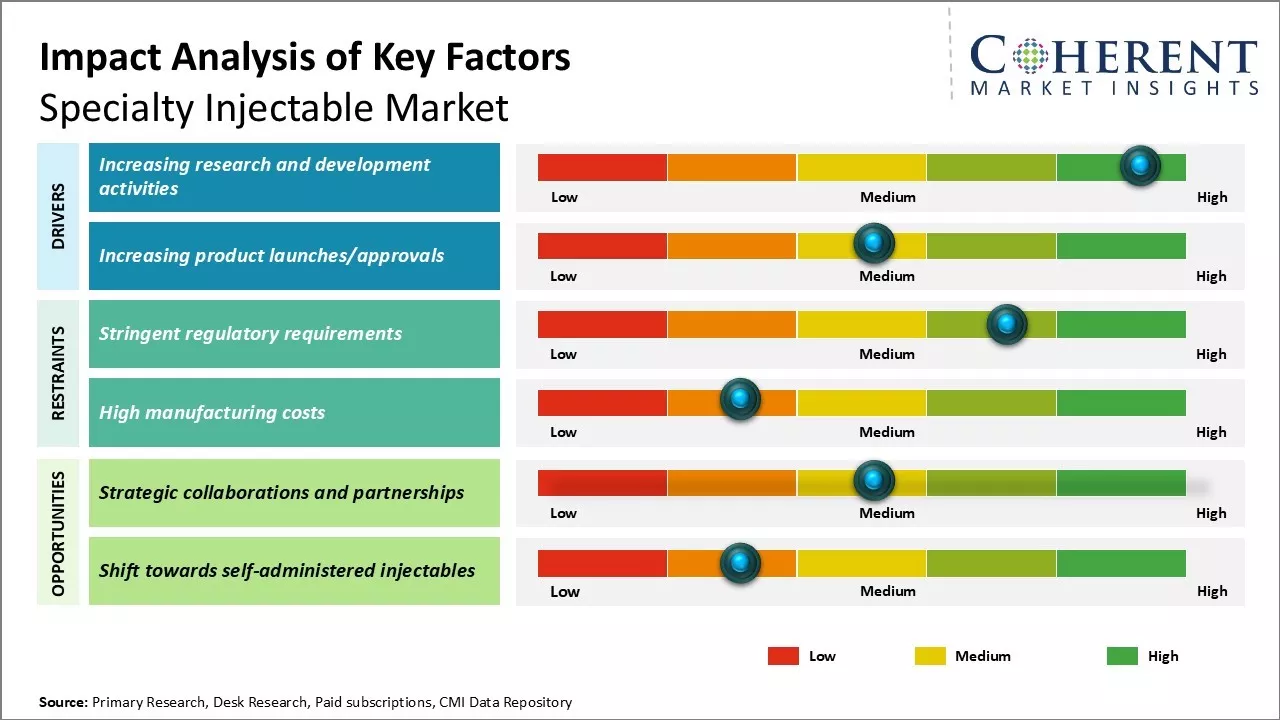
Specialty injectable market has been witnessing positive growth trends due to rising prevalence of chronic diseases along with increasing demand for self-injectable pharmaceutical products. Growth in biologics drug delivery and increasing demand for targeted drug delivery systems can also aid the market expansion. Patent expiration of major biologic drugs also presents opportunities for biosimilar products, and this drives the market growth. Complex manufacturing process and robust regulatory procedures incur significant costs, posing challenges to market players.
Insights, By Drug Type
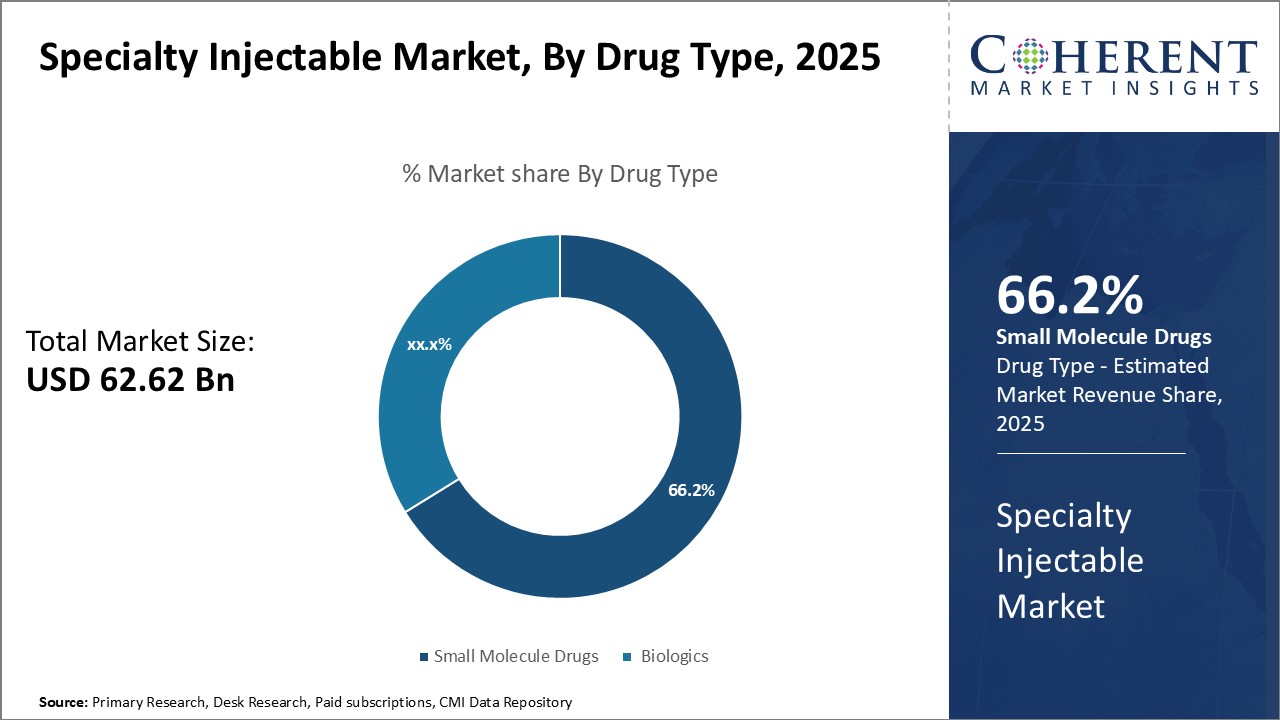
Insights, By Drug Type- Growth of Biosimilars Pushes Small Molecule Drugs Segment
In terms of drug type, small molecule drugs segment is estimated to contribute the highest market share of 66.6% in 2026, owing to growth of biosimilars. Small molecule drugs offer cost savings as compared to biologics and have well-established manufacturing processes. The development and approval of lower-cost biosimilars has boosted the small molecule drugs segment.
Insights, By Application
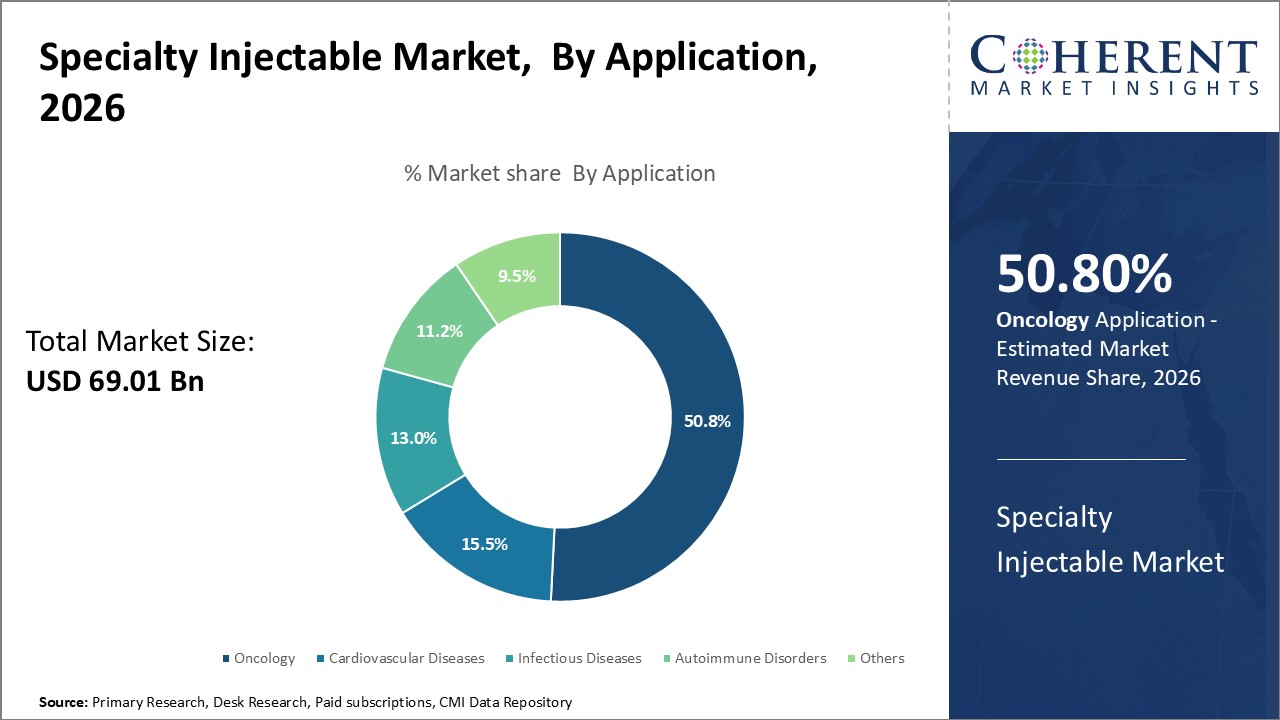
Insights, By Application- Rising Cancer Incidence Fuels Oncology Applications
In terms of application, oncology segment is estimated to contribute the highest market share of 50.8% in 2026, due to rising global incidence of cancer and growing reliance on targeted drug therapies. In 2021, according to the WHO, cancer is among the leading causes of death worldwide with nearly 10 million deaths in 2020.
Insights, By Distribution Channel
Insights, By Distribution Channel- Role of Hospitals in Complex Therapies Boosts Hospital Pharmacies
In terms of distribution channel, hospital pharmacies segment is estimated to contribute the highest market share of 55.7% in 2026, due to growing role of hospitals in administering complex specialty injectable medications. Expanding armamentarium of innovative injectable drugs and emphasis on precision medicine drives greater complexity in administrations.
Regional Insights
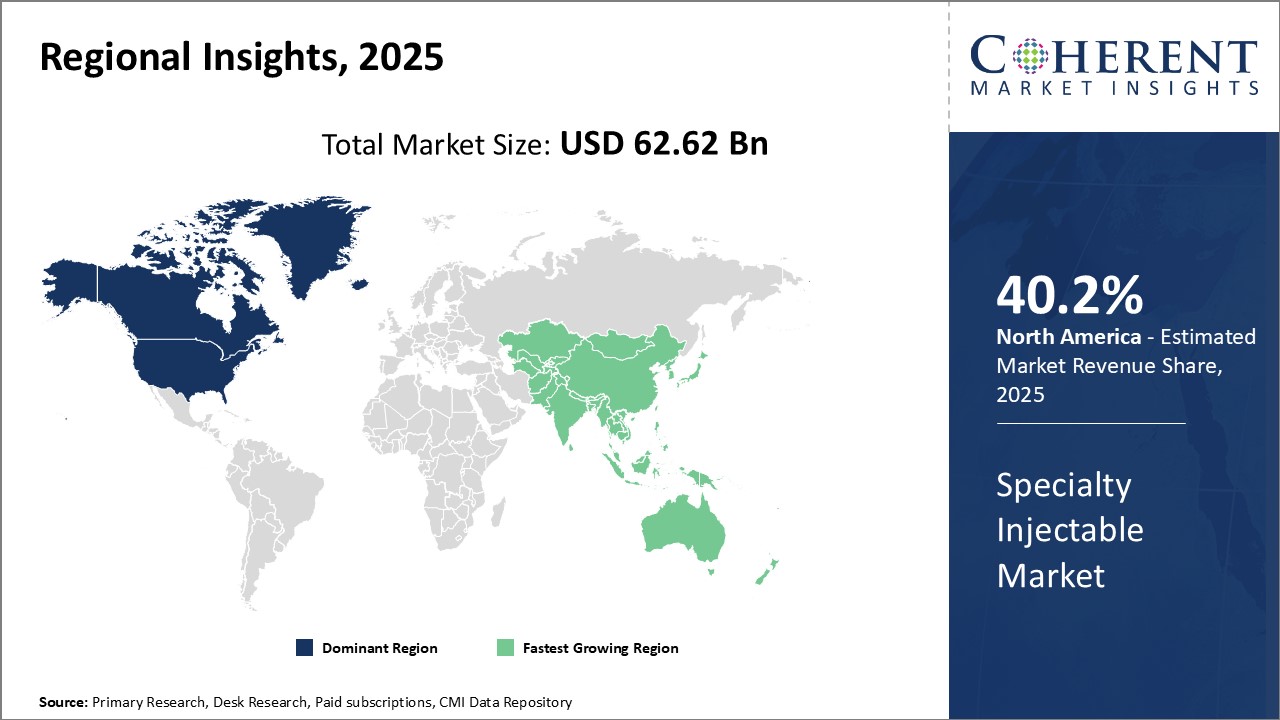
Dominating Region- North America
North America is expected to dominate the specialty injectable industry, with an estimated market share of 40.2% in 2026, due to strong presence of leading pharmaceutical companies, widespread healthcare infrastructure, and favorable government policies that encourage research and development.
Fastest-Growing Region- Asia Pacific
Asia Pacific region exhibits the fastest growth in specialty injectable industry, with an estimated market share of 19.2% in 2026, due to large patient population, rising healthcare expenditure, and increasing focus on quality healthcare.
Specialty Injectable Market Outlook for Key Countries
Investments for drug development in the U.S.
Specialty injectable industry in the U.S. is thriving due to substantial investments in innovative drug formulations. Leading companies like Pfizer, Inc. dominate this sector, utilizing their extensive product portfolios to meet diverse healthcare needs and rapidly adapt to emerging trends, thus, driving growth and enhancing patient outcomes.
Rising Demand for Specialty Medications in Canada
Canada specialty injectable industry growth is driven by growing need for specialty medications to treat chronic, rare, and complex conditions such as cancer, hepatitis C, and autoimmune disorders. Canada's aging demographic contributes to higher prevalence of health issues that require specialty medications, thus, boosting demand for injectable therapies.
Government initiatives in China
China's specialty injectable industry is experiencing robust growth due to government initiatives aimed at modernizing the healthcare system. Local leaders are enhancing their capabilities to meet the rising demand for innovative therapies, ensuring improved access and affordability of specialty injectables for patients across the nation.
Japan’s increasing research and development activities
Continuous innovations in injectable formulations and delivery systems are enhancing treatment outcomes, making specialty injectable more appealing to healthcare providers and patients alike. Regulatory bodies are increasingly supportive of innovative injectable formulations, streamlining approval processes for new delivery systems and formulations.
Favorable population demographics in India
India's specialty injectable industry can witness growth due to favorable population demographics and initiatives to enhance local manufacturing. Dr. Reddy's Laboratories Ltd. is a key market playeraiming to leverage these trends to meet increasing healthcare demands and improve access to innovative injectable therapies across the country.
Market Players, Key Development, and Competitive Intelligence
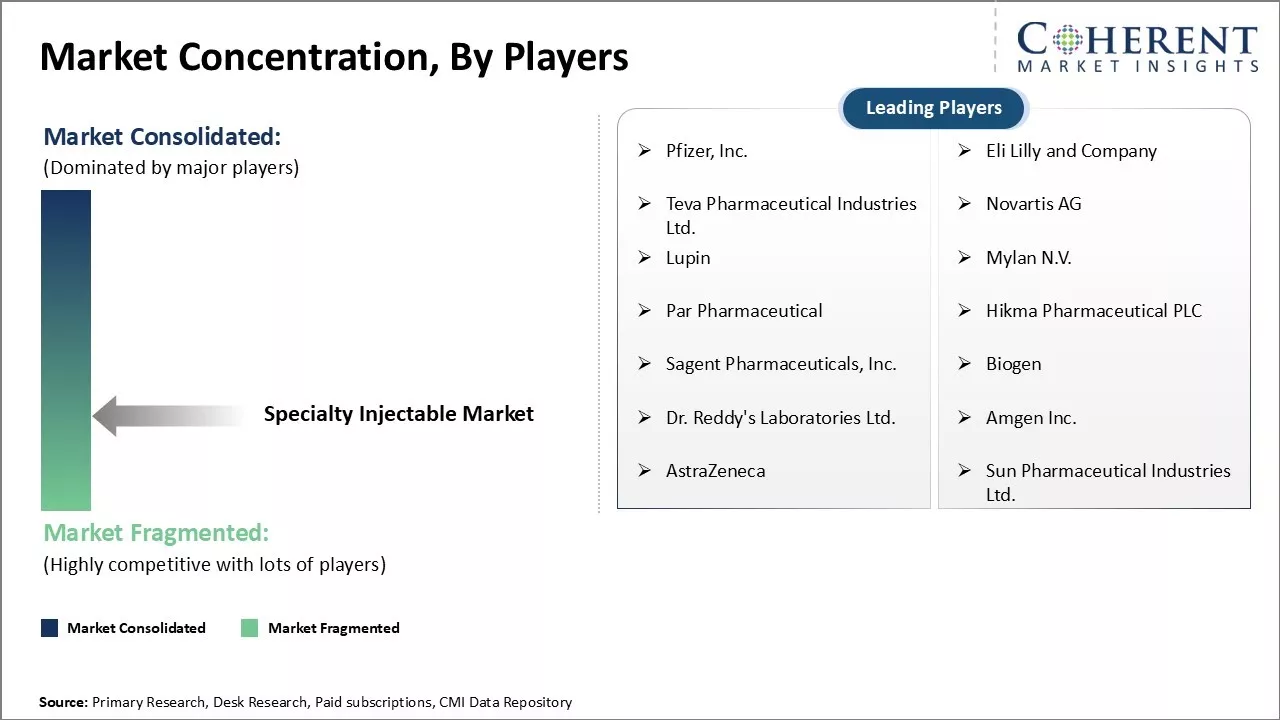
Top Strategies Followed by Specialty Injectable Market Players
- Established players focus extensively on R&D to innovate new products. Leaders like Pfizer, Inc. invest over 10% of annual revenue in research and development. This helps them develop specialty injectables with improved efficacy. These also form strategic partnerships for technology and knowledge sharing. By leveraging partnerships, Pfizer, Inc. not only accelerates the development of novel therapies but also gains access to cutting-edge technologies and scientific expertise that can further enhance their product offerings
- Mid-level players adopt cost-effective strategies to reach price-sensitive segments. Sagent Pharmaceuticals, Inc. focuses on efficient manufacturing processes to provide affordable biologics. These collaborate with generic manufacturer for biosimilars commercialization. The strategic approach enables them to capture market share in a competitive landscape where cost is a significant factor for healthcare providers and patients alike.
- Small players leverage niche specialization. Small players exclusively develop injectables for rare diseases. These gain expertise in narrow therapeutic areas to address unmet needs.
Emerging Startups in the Specialty Injectable Market
- In field of innovative technologies, startup companies develop intelligent injector systems integrated with biosensors and AI. These "smart pens" analyze dose delivery in real-time and optimize treatment based on patient health data.
- For sustainable solutions, startup companies produce recyclable prefilled syringes using plant-based polymers. Their injectables packaging is derived from agricultural waste, reducing plastic usage. Startup designs injectable formulations incorporating biobased solvents and excipients. This lowers manufacturing carbon footprint versus traditional processes.
- Startups also fill niche market gaps. Startup companies create water-free gel formulations for injecting thick biologics usually requiring dilution. This expands treatment access in remote areas.
- Current Industry Events of 2026
- Market Size Estimation
- Regional Breakdown
- Competitive Landscape
- Customer Intelligence
- Segmental Analysis
- Pricing Analysis
- Key Market Drivers, Challenges & Future Trends
- Customized Insights Section
Market Report Scope
Specialty Injectable Market Report Coverage
| Report Coverage | Details | ||
|---|---|---|---|
| Base Year: | 2025 | Market Size in 2026: | USD 69.01 Bn |
| Historical Data for: | 2020 To 2024 | Forecast Period: | 2026 To 2033 |
| Forecast Period 2026 to 2033 CAGR: | 10.2% | 2033 Value Projection: | USD 136.20 Bn |
| Geographies covered: |
| ||
| Segments covered: |
| ||
| Companies covered: | Pfizer, Inc., Eli Lilly and Company, Teva Pharmaceutical Industries Ltd., Novartis AG, Lupin, Mylan N.V., Par Pharmaceutical, Hikma Pharmaceutical PLC, Sagent Pharmaceuticals, Inc., Biogen, Dr. Reddy's Laboratories Ltd., Amgen Inc., AstraZeneca, Sun Pharmaceutical Industries Ltd. | ||
| Growth Drivers: |
| ||
| Restraints & Challenges: |
| ||
Market Dynamics
Market Driver - Increasing product launches/approvals
Increasing product launches/approvals can drive the market growth over the forecast period. For instance, on April 16, 2024, Amneal Pharmaceuticals, Inc., a pharmaceutical company, announced the launch of PEMRYDI RTU, the first and only ready-to-use presentation of pemetrexed for injection. This product does not require reconstitution, dilution, or refrigeration, which is different than other versions of pemetrexed for injection.
Market Challenge - Stringent regulatory requirements
Regulatory authorities like the U.S. Food and Drug Administration and European Medicine Agency meticulously oversee every phase of drug development and manufacturing. Obtaining approvals involves extensive clinical testing and documentation of quality, safety, and efficacy. Additional requirements, such as post-marketing surveillance, increase compliance burdens, necessitating significant investments that heighten costs and financial risks. Lengthy review periods and uncertain approval outcomes further complicate timelines, making compliance issues potentially detrimental to timely market entry and operational continuity.
Market Opportunity - Strategic collaborations and partnerships
Strategic collaborations and partnerships are anticipated to significantly enhance growth opportunities for key players in the specialty injectable market. These alliances can facilitate expanded market access and improved capabilities, driving lucrative growth in this sector as demand for specialty injectable drugs continues to rise due to increasing chronic diseases and advancements in healthcare technologies.
Analyst Opinion (Expert Opinion)
Key Takeaways from Analyst
Specialty injectable industry can witness robust growth due to rising prevalence of chronic diseases. As population continue to age globally, conditions like cancer, diabetes and autoimmune disorders requiring complex drug therapies will boost demand for injectable.
Biosimilars may pose a threat to branded drugs by losing patent protection. Regulatory delays in biosimilar approvals and lack of interchangeability continue limiting biosimilar uptake.
North America currently dominates the market, owing to the concentration of major pharmaceutical players and availability of advanced healthcare facilities. However, Asia Pacific is expected to emerge as the fastest growing regional market with nations like China and India improving access to healthcare.
Speak to the analyst
Want personalized insights?
Take the findings above to one of our principal consultants, or have the report rebuilt around the segments, geographies and competitors you actually track.
Market Segmentation
- By Drug Type Insights (Revenue, USD, 2021 - 2033)
- Small Molecule Drugs
- Biologics
- By Application Insights (Revenue, USD, 2021 - 2033)
- Oncology
- Cardiovascular Diseases
- Infectious Diseases
- Autoimmune Disorders
- Others
- By Distribution Channel Insights (Revenue, USD, 2021 - 2033)
- Hospital Pharmacies
- Retail Pharmacies
- Online Pharmacies
- Regional Insights (Revenue, USD, 2021 - 2033)
- North America
- U.S.
- Canada
- Latin America
- Brazil
- Argentina
- Mexico
- Rest of Latin America
- Europe
- Germany
- U.K.
- Spain
- France
- Italy
- Russia
- Rest of Europe
- Asia Pacific
- China
- India
- Japan
- Australia
- South Korea
- ASEAN
- Rest of Asia Pacific
- Middle East
- GCC Countries
- Israel
- Rest of Middle East
- Africa
- South Africa
- North Africa
- Central Africa
- North America
- Key Players Insights
- Pfizer, Inc.
- Eli Lilly and Company
- Teva Pharmaceutical Industries Ltd.
- Novartis AG
- Lupin
- Mylan N.V.
- Par Pharmaceutical
- Hikma Pharmaceutical PLC
- Sagent Pharmaceuticals, Inc.
- Biogen
- Reddy's Laboratories Ltd.
- Amgen Inc.
- AstraZeneca
- Sun Pharmaceutical Industries Ltd.
Key Stakeholders
What growth in specialty injectable industry mean for different stakeholders?
Specialty injectable industry has multiple players with varied designations and offers multiple opportunities based on their scope of operations.
Key Pharmaceutical Stakeholder | Opportunities Due to Specialty Injectable Industry Growth |
Retail Pharmacies | Expansion of product offerings to include new drugs and personalized medicine solutions, enhancing customer care and market reach. |
Chemical Suppliers | Growth in demand for specialty chemicals used in drug synthesis, including organic intermediates, catalysts, and reagents. |
Pharmaceutical Companies | Expansion of product pipelines with new drug discoveries, biologics, and biosimilars, capitalizing on growing global healthcare needs. |
Contract Research Organizations (CROs) | Increased outsourcing of clinical trials and drug development, offering opportunities for growth and long-term partnerships. |
Contract Manufacturing Organizations (CMOs) | Growing demand for scalable manufacturing solutions, including biologics production and complex drug formulations. |
Diagnostic Equipment Manufacturers | Expanded markets for diagnostic tools and devices that support personalized medicine and early disease detection. |
Healthcare Providers | New treatment options and innovative therapies, improving patient care and expanding healthcare services. |
Get access to 250+ pages report
Every segment, forecast, competitor profile and data table behind the analysis above — available for instant download.
- ESOMAR Member
- ISO 9001:2015 Certified
- D-U-N-S Registered
- GDPR & CCPA Compliant
Missing comfort of reading report in your local language? Find your preferred language:
Transform your Strategy with Exclusive Trending Reports
Frequently Asked Questions
The Specialty Injectable Market is estimated to be valued at USD 69.01 Bn in 2026, and is expected to reach USD 136.20 Bn by 2033.
The CAGR of the Specialty Injectable Market is projected to be 10.2% from 2026 to 2033.
Increasing research and development activities and increasing product launches/approvals are the major factors driving the growth of specialty injectable market.
Stringent regulatory requirements and high manufacturing costs are the major factors hampering the growth of specialty injectable market.
In terms of drug type, small molecule drugs segment is estimated to dominate the market in 2026.
Pfizer, Inc., Eli Lilly and Company, Teva Pharmaceutical Industries Ltd., Novartis AG, Lupin, Mylan N.V., Par Pharmaceutical, Hikma Pharmaceutical PLC, Sagent Pharmaceuticals, Inc., Biogen, Dr. Reddy's Laboratories Ltd., Amgen Inc., AstraZeneca, Sun Pharmaceutical Industries Ltd. are the major players.
North America is expected to lead the specialty injectable market in 2026.