

Morphine, Buprenorphine, and Other Drugs Market Size and Share Analysis - 2026 To 2033
The Morphine, Buprenorphine, and other drugs market is anticipated to grow at a CAGR of 6.2% with USD 9.94 Bn in 2026 and is expected to reach USD 13.97 Bn in 2033. Driven by escalating demand for effective pain management solutions, expanding applications in opioid use disorder (OUD) treatment (Globally, more than 36 million people suffered from opioid dependence in 2021, and over 12 million people died from opioid related disorders), and growing awareness of palliative care, this market has demonstrated considerable resilience and adaptability in the face of evolving regulatory environments and shifting socioeconomic dynamics.
Key Takeaways
- Morphine is expected to account the largest share of 30% in 2026, it is the universal hospital standard for severe pain treatment, while other opioids are either more specialized, newer, or limited in clinical use. In Europe, about 513,000 people are in opioid agonist treatment, about 56% with methadone, 34,5% with buprenorphine, 2,6% with slow-release morphine, 0.3% with diamorphine, about 7% with other drugs.
- Pain management will dominate with 60% in 2026, opioids are primarily used in hospitals for treating severe acute and chronic pain, which has a much larger patient base than addiction treatment programs. Nearly 25% of Americans experience chronic pain.
- Oral will dominate with 65% in 2026, because it is the most convenient, widely prescribed, and extensively used route in outpatient and chronic pain management settings. About 22% of chronic pain patients used prescription opioids in the past 3 months, mostly oral formulations.
- Retail Pharmacies will dominate with 60% in 2026, because most medications are consumed outside hospitals through outpatient prescriptions and long-term therapy refills, making community access the largest driver of demand.
- North America is expected to acquire the dominant share of 46% in 2026, because it has the highest surgical volume, strongest prescription usage, advanced healthcare systems, and the largest treated chronic pain population globally. U.S. surgical procedure volumes totaled over 92.3 million in 2024 across 12 major medtech categories.
Segmental Insights
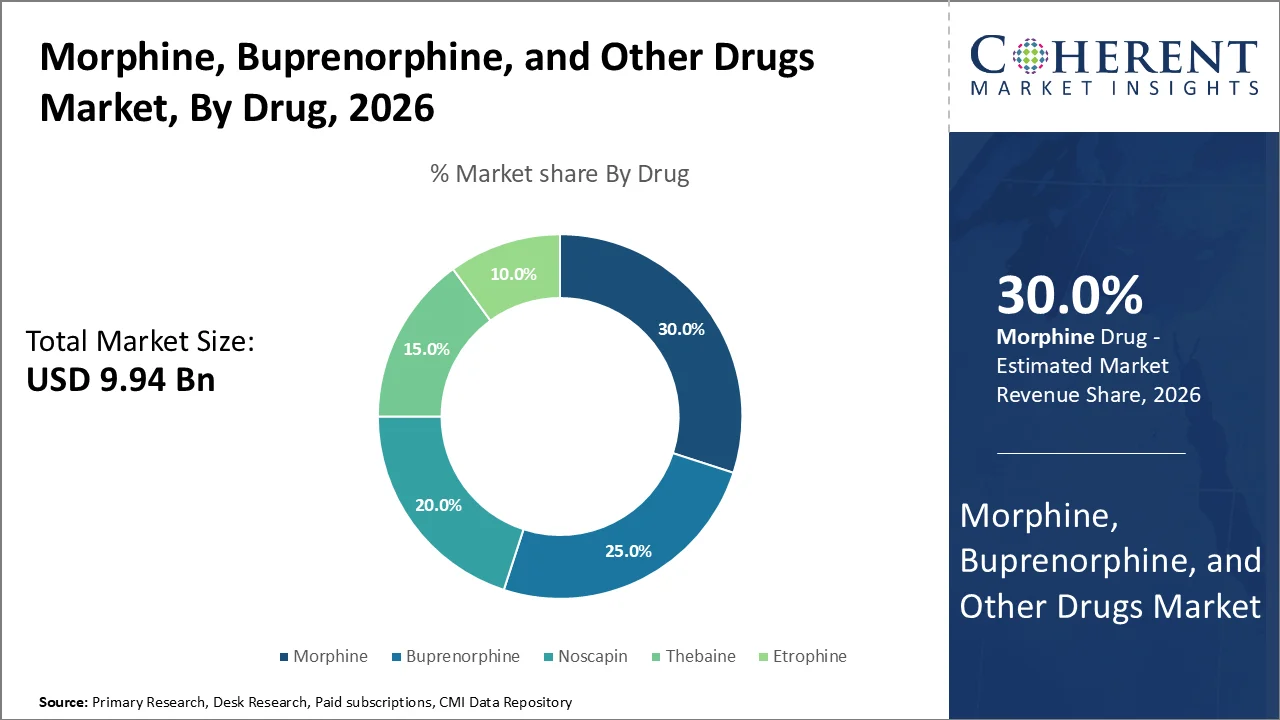
Why is Morphine Acquiring the Largest Market Share?
Morphine are projected to account for the largest share of product type in 2026, representing approximately 30% of the total volume. The segment is propelling owing to its long-standing clinical recognition as the gold standard opioid analgesic for moderate-to-severe pain management. Its high inclusion in national essential medicines lists across multiple countries, as well as its broad applicability across oncology, palliative care, post-surgical pain relief, emergency medicine settings, etc., is further stimulating the growth of the market. Estimated prevalence of chronic post-surgical pain was 7.2% (95%CI 6.4–8.1%).
The World Health Organization (WHO) has consistently listed morphine as an essential medicine under its Model List of Essential Medicines, supporting its irreplaceable role in global healthcare systems, particularly in palliative care as well as cancer pain management are the growth inducing factors.
According to the guidelines by WHO on the pharmacological treatment of persisting pain in children as well as adults with medical illnesses, morphine remains the preferred opioid for severe pain, a designation that has translated into large-scale procurement and distribution across both developed and developing healthcare systems.
- Current Industry Events of 2026
- Market Size Estimation
- Regional Breakdown
- Competitive Landscape
- Customer Intelligence
- Segmental Analysis
- Pricing Analysis
- Key Market Drivers, Challenges & Future Trends
- Customized Insights Section
Pain Management holds the Largest Market Share
Based on application, pain management dominates the market, accounting for a significant 60% share in 2026. The widespread and deeply entrenched clinical reliance on opioid-based pharmacological agents across a broad spectrum of therapeutic scenarios, ranging from acute postoperative pain to chronic cancer-related pain and palliative care are the factors stimulating the growth of the segment. Up to 55% of people with cancer undergoing treatment experience pain.
The sheer scale of pain-related health burden globally has made morphine and its derivative compounds as cornerstone agents in standard-of-care protocols endorsed by prominent health authorities globally.
The irreplaceable role that opioid analgesics play in managing moderate-to-severe pain, particularly in oncology and surgical settings is fueling the growth of the market. The World Health Organization (WHO) has long classified morphine as an essential medicine, targeting its high importance in the treatment of severe pain in developed as well as resource-limited healthcare systems.
According to guidelines by the WHO on palliative care, opioid analgesics remain clinically indispensable for managing pain in patients with advanced cancer, HIV/AIDS, as well as other life-limiting conditions, and access to these medications is considered a fundamental component of the right to health.
Oral holds the Largest Market Share
Based on route of administration, oral dominates the market, accounting for a significant 65% share in 2026, the widespread clinical adoption, superior patient compliance, and ease of administration are the factors augmenting the growth of the market. Telemedicine platforms experienced the fastest growth, increasing from 23% adoption in 2020 to 82% in 2025.
The oral route has long been regarded as the gold standard for chronic pain management as well as opioid use disorder (OUD) treatment, making it the preferred mode of delivery for morphine as well as buprenorphine across clinical settings globally.
Patient convenience and accessibility are the key factors for the growth. Oral medications can be self-administered by patients in outpatient or home-based settings, potentially reducing the burden on healthcare infrastructure.
The World Health Organization (WHO) has consistently promoted oral morphine as the cornerstone of palliative care and cancer pain management under its essential medicines framework. The WHO Model List of Essential Medicines has oral morphine formulations, reinforcing its global priority status as well as driving procurement across public health systems in low, middle, along with high-income countries alike.
Retail Pharmacies holds the Largest Market Share
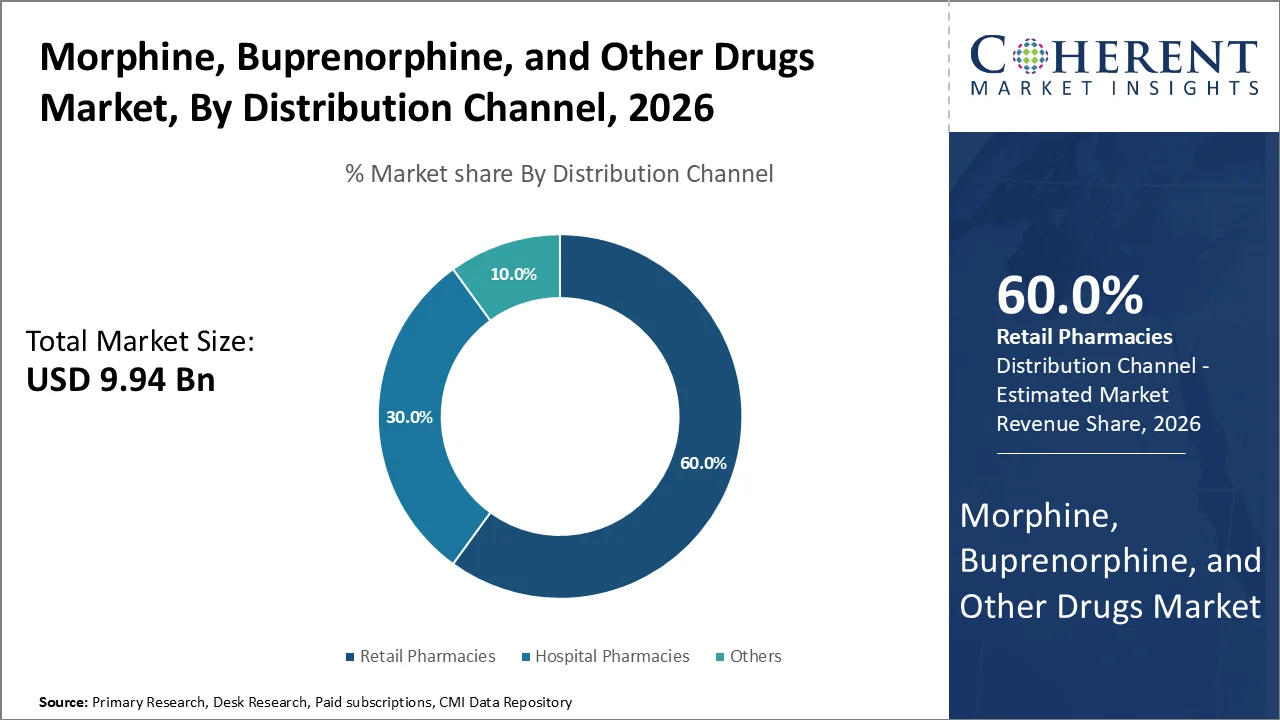
Based on distribution channel, retail pharmacies dominate the market, accounting for a significant 60% share in 2026, their widespread accessibility, extended operational hours, as well as the high prevalence of chronic pain conditions and opioid use disorder (OUD) management programs are the growth-inducing factors. According to the World Health Organization, in 2019 about 600 000 deaths were attributable to drug use. Close to 80% of these deaths are related to opioids, with about 25% of those deaths caused by opioid overdose.
Retail pharmacies serve as the most immediate along with approachable point of care for patients undergoing outpatient opioid therapy, particularly those prescribed buprenorphine-based medications for addiction treatment or morphine-based formulations for palliative and chronic pain management.
The global expansion of pharmacy retail chains, the increasing acceptance of telepharmacy models, along with the supportive regulatory frameworks that permit retail-level dispensing of controlled substances are further augmenting the market.
Market Drivers
Extended-Release (ER) and Controlled-Release (CR) Formulations is transforming the Morphine, Buprenorphine, and Other Drugs Industry
Extended-release (ER) and controlled-release (CR) medicines are made to release drugs slowly over time instead of all at once. This aid maintain a steady level of medicine in the body, lowers how usual patients need to take doses, as well as improves treatment adherence. These formulations are broadly used in long-term conditions like chronic pain, where stable drug levels are very important. Studies show they can lower dosing frequency from 4–6 times a day to 1–2 times a day, advancing patient compliance by around 30–40%.
These drugs use technologies like matrix systems and coated pellets, which control how the medicine is released in the body over 8–12 hours or longer. For example, extended-release opioids like morphine and oxycodone provide continuous pain relief with fewer peaks and drops in drug levels. This not only improves comfort but also helps reduce side effects linked to sudden high doses.
Current Events and Their Impact on the Morphine, Buprenorphine, and Other Drugs Market
Current Event | Description and its Impact |
Expansion of telemedicine-based opioid treatment services (2025–2026, U.S. DEA & global policy shift) |
|
FDA tightening and strengthening opioid Risk Evaluation and Mitigation Strategies (REMS) programs (2025–2026) |
|
Morphine, Buprenorphine, and Other Drugs Market Trends
- A key trend reshaping this market is the unprecedented global surge in opioid use disorder. Governments authorities and public health agencies worldwide are aggressively funding and expanding medication-assisted treatment (MAT) programs, with buprenorphine-based therapies particularly Suboxone (buprenorphine/naloxone) emerging as the gold standard. 2.3 million Americans received medication-assisted treatment (MAT) for opioids in 2023.
- Regulatory pressure as well as heightened societal awareness around opioid misuse are compelling manufacturers to pivot toward abuse-deterrent formulations.
- Extended-release morphine and buprenorphine products engineered with physical and chemical barriers to misuse are gaining rapid regulatory favor from the U.S. FDA, the European Medicines Agency (EMA), and other national drug authorities.
- The traditional oral tablet and injectable formats are being progressively supplemented and in several therapeutic segments, displaced by advanced delivery systems.
- Subcutaneous buprenorphine implants (e.g., Probuphine), extended-release injectable formulations (e.g., Sublocade), transdermal patches, and buccal films are gaining significant clinical traction.
- Patent expirations on several branded opioid products have opened the floodgates for generic manufacturers, particularly from India, China, as well as Eastern Europe.
Regional Insights
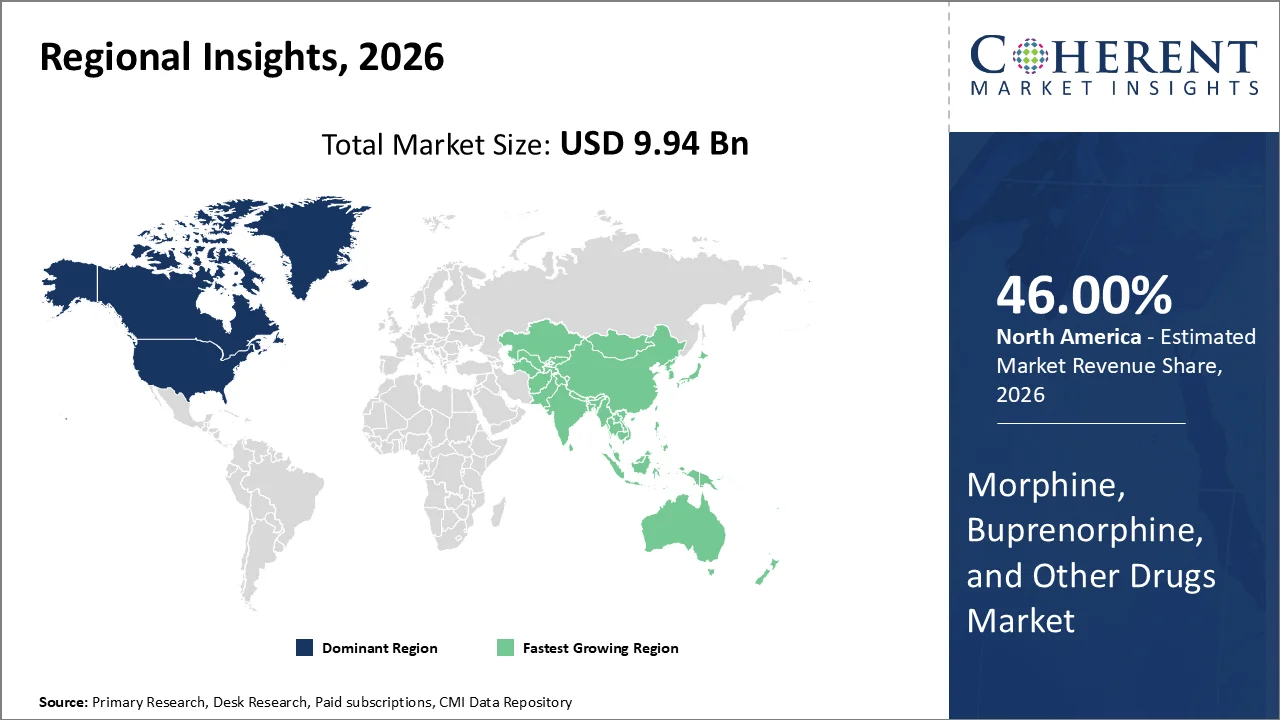
North America dominates owing to its robust pharmaceutical supply chains
North America account 46% market share in 2026, driven by its advanced pharmaceutical supply chains and well-established clinical frameworks for pain management and opioid use disorder (OUD) treatment.
In 2022, about 3.7% of U.S. adults required treatment for OUD, while only around one-quarter received medication-based treatment, showing a major care gap. Recent national surveys also shows that millions of individuals have received medications for OUD in recent years, reflecting strong but still insufficient treatment penetration in the region.
Asia Pacific Morphine, Buprenorphine, and Other Drugs Market Trends
The Asia Pacific region is poised to be the fastest-growing region through 2026-2033, expanding at a CAGR of approximately 7.5%. Driven by rapidly expanding healthcare access initiatives, advancing narcotics policy reforms, as well as a growing recognition of opioid use disorder as a treatable medical condition rather than a criminal offense across key economies including Australia, Japan, South Korea, India, China, etc.
The Australian Government Department of Health has scaled up its opioid pharmacotherapy programs, with Medicare-subsidized buprenorphine long-acting injectable formulations being integrated into community health centers across New South Wales and Victoria, making sure previously underserved rural populations to access consistent treatment regimens.
India amended the Narcotic Drugs and Psychotropic Substances (NDPS) Act in 2014 to improve access to opioids by centralizing certain licensing steps and reducing the paperwork burden. Yet, reports after 2014 show that ground-level access still lags where state rules, institutional practices, or provider fears remain unchanged.
Widespread Opioid Use Disorder (Oud) Treatment Programs is Accelerating the Morphine, Buprenorphine, and Other Drugs Market Demand in United States
The U.S. contributes the highest share in the Morphine, Buprenorphine, and Other Drugs Market in North America owing to its well-established healthcare infrastructure, widespread opioid use disorder (OUD) treatment programs, and the substantial burden of opioid-related morbidity and mortality that continues to drive demand for both pain management and addiction treatment pharmaceuticals.
The United States has one of the most comprehensive regulatory and clinical frameworks for opioid use disorder treatment in the world, with the Substance Abuse and Mental Health Services Administration (SAMHSA) actively authorizing and expanding access to buprenorphine-based medications through its waiver programs.
As per the U.S. Department of Health and Human Services (HHS), opioid overdose deaths in the U.S. have been a persistent national crisis, with tens of thousands of lives lost annually, showing the federal government to significantly expand access to medications for opioid use disorder (MOUD).
China Morphine, Buprenorphine, and Other Drugs Market Trends
China contributes the highest share in the market in APAC owing to its well-established healthcare infrastructure, massive patient population suffering from chronic pain conditions, and the government's progressive regulatory stance toward opioid-based pain management therapies.
China's National Health Commission has actively incorporated morphine and buprenorphine into its essential medicines list, making sure their availability across urban tertiary hospitals as well as rural healthcare networks.
According to the International Narcotics Control Board (INCB), China has consistently ranked among the top consumers of morphine for medical purposes in the Asia Pacific region, stimulated by escalating cancer prevalence as well as palliative care expansion. The National Cancer Center of China reported that the country registers over 4.8 million new cancer cases annually, directly amplifying demand for morphine-based pain relief protocols in oncology departments.
Who are the Major Companies in Morphine, Buprenorphine, and Other Drugs Industry
Some of the major key players in Morphine, Buprenorphine, and Other Drugs market include, Purdue Pharma, Sun Pharmaceuticals, Pfizer Inc., West Ward Pharmaceuticals, Teva Pharmaceuticals, Piramal Pharmaceuticals, Hikama Pharmaceuticals, Indivior PLC, Oreoxo AB, Camurus AB, and Novartis
Key News
- In July 2025, Hikma Pharmaceuticals PLC (Hikma), the multinational pharmaceutical company, launched Morphine Sulfate Injection, USP, in 2mg/mL and 4mg/mL doses in the US. The product has been launched in a prefilled syringe form and is indicated for the management of pain severe enough to require an opioid analgesic and for which alternative treatments are inadequate.
- In May 2025, Camurus introduced Buvidal® (buprenorphine) prolonged-release solution for subcutaneous injection to the Portuguese market, presenting an innovative and flexible treatment alternative for patients with opioid dependence. The product offers a flexible treatment regimen with both weekly and monthly doses, tailored to address the varied needs of those struggling with opioid dependence.
Market Report Scope
Morphine, Buprenorphine, and Other Drugs Market Report Coverage
| Report Coverage | Details | ||
|---|---|---|---|
| Base Year: | 2025 | Market Size in 2026: | USD 9.94 Bn |
| Historical Data for: | 2020 To 2024 | Forecast Period: | 2026 To 2033 |
| Forecast Period 2026 to 2033 CAGR: | 6.2% | 2033 Value Projection: | USD 13.97 Bn |
| Geographies covered: |
| ||
| Segments covered: |
| ||
| Companies covered: | Purdue Pharma, Sun Pharmaceuticals, Pfizer Inc., West Ward Pharmaceuticals, Teva Pharmaceuticals, Piramal Pharmaceuticals, Hikama Pharmaceuticals, Indivior PLC, Oreoxo AB, Camurus AB, and Novartis | ||
| Growth Drivers: |
| ||
| Restraints & Challenges: |
| ||
Analyst Opinion
- The morphine, buprenorphine, and other drugs market is experiencing significant transformation driven by escalating global demand for effective pain management solutions and opioid use disorder treatments. the existing strategies for preventing and treating OUD will still result in more than 700,000 deaths in the US between 2016 and 2025.
- The increasing prevalence of chronic pain conditions, cancer-related pain, and post-surgical pain management requirements continues to propel robust demand across both developed and emerging economies. The prevalence of postoperative pain was 84.6%, with 56.7% reporting moderate and 28.0% reporting severe pain.
- Buprenorphine, in particular, has gained considerable traction as a preferred pharmacological intervention for opioid addiction treatment, due to its favorable safety profile compared to traditional opioids.
- However, stringent regulatory frameworks governing controlled substances remain a critical restraint, creating complex compliance landscapes for manufacturers as well as healthcare providers alike.
- Growing concerns surrounding opioid misuse, addiction, with the associated societal consequences have prompted governments worldwide to implement rigorous prescription monitoring programs, subsequently limiting market expansion in certain regions.
- Supply chain vulnerabilities and raw material procurement challenges further compound operational difficulties for pharmaceutical manufacturers.
Speak to the analyst
Want personalized insights?
Take the findings above to one of our principal consultants, or have the report rebuilt around the segments, geographies and competitors you actually track.
Market Segmentation
- By Drug (Revenue, USD Bn, 2021-2033)
- Morphine
- Buprenorphine
- Noscapin
- Thebaine
- Etrophine
- By Application (Revenue, USD Bn, 2021-2033)
- Pain Management
- Opioid Addiction Treatment
- Others
- By Route Of Administration (Revenue, USD Bn, 2021-2033)
- Injectable
- Oral
- Transdermal
- By Distribution Channel (Revenue, USD Bn, 2021-2033)
- Hospital Pharmacies
- Retail Pharmacies
- Others
- By Region (Revenue, USD Bn, 2021-2033)
- North America
- U.S.
- Canada
- Latin America
- Brazil
- Mexico
- Argentina
- Rest of Latin America
- Europe
- Germany
- U.K.
- France
- Italy
- Spain
- Russia
- Rest of Europe
- Asia Pacific
- China
- India
- Japan
- Australia
- South Korea
- ASEAN
- Rest of Asia Pacific
- Middle East
- GCC
- Israel
- Rest of Middle East
- Africa
- South Africa
- Central Africa
- North Africa
- North America
Sources
Primary Research Interviews
- Pharmaceutical Manufacturers
- Drug Distributors & Wholesalers
- Hospital Pharmacists & Clinical Practitioners
- Regulatory & Compliance Specialists
- Others
Databases
- IQVIA Healthcare Database
- Pharmaprojects Database
- Others
Magazines
- Pharmacy Times
- Drug Topics
- Pharmaceutical Executive
- Formulary Watch
- Others
Journals
- Journal of Pain and Symptom Management
- Drug and Alcohol Dependence
- British Journal of Clinical Pharmacology
- Others
Newspapers
- The Wall Street Journal
- Financial Times
- The New York Times
- Reuters Health
- Others
Associations
- American Pain Society (APS)
- International Association for the Study of Pain (IASP)
- American Society of Addiction Medicine (ASAM)
- Drug Enforcement Administration (DEA)
- Others
Public Domain Sources
- U.S. Food and Drug Administration (FDA)
- World Health Organization (WHO)
- National Institute on Drug Abuse (NIDA)
- European Medicines Agency (EMA)
- Others
Proprietary Elements
- CMI Data Analytics Tool
- Proprietary CMI Existing Repository of information for last 10 years
Get access to 250+ pages report
Every segment, forecast, competitor profile and data table behind the analysis above — available for instant download.
- ESOMAR Member
- ISO 9001:2015 Certified
- D-U-N-S Registered
- GDPR & CCPA Compliant
Missing comfort of reading report in your local language? Find your preferred language:
Transform your Strategy with Exclusive Trending Reports
Frequently Asked Questions
The Morphine, Buprenorphine, and Other Drugs market is expected to reach USD 13.97 Bn in 2033.
Major players operating in the Morphine, Buprenorphine, and Other Drugs market include Purdue Pharma, Sun Pharmaceuticals, Pfizer Inc., West Ward Pharmaceuticals, Teva Pharmaceuticals, Piramal Pharmaceuticals, Hikama Pharmaceuticals, Indivior PLC, Oreoxo AB, Camurus AB, and Novartis
The rising number of lawsuits and overdose of opioids owing to its addiction is expected to restrain the Morphine, Buprenorphine, and Other Drugs market growth over the forecast period.
Increasing prevalence of cancer and increasing drug approvals and launches are driving growth of the Morphine, Buprenorphine, and Other Drugs market.
The Morphine, Buprenorphine, and Other Drugs market is anticipated to grow at a CAGR of 6.2% between 2026 and 2033.
Which region is dominating the Morphine, Buprenorphine, and Other Drugs market growth?
Buprenorphine is a powerful partial opioid agonist. Combining it with other medications or substances can lead to severe adverse effects, including dangerous respiratory depression, fatal overdoses, or sudden opioid withdrawal.