

Craniomaxillofacial Implants Market Size and Forecast: 2026-2033
The Craniomaxillofacial Implants Market is estimated to be valued at USD 3.1 Bn in 2026 and is expected to reach USD 5.3 Bn by 2033, exhibiting a compound annual growth rate (CAGR) of 9.8% from 2026 to 2033
Key Takeaways
- By Product Type, Bone Graft Substitutes hold the largest market share of 38.7% in 2026 owing to its rising prevalence of bone defects and trauma.
- By Raw Material, Metals acquired the prominent market share of 41.1% in 2026 owing to the superior mechanical strength & structural support.
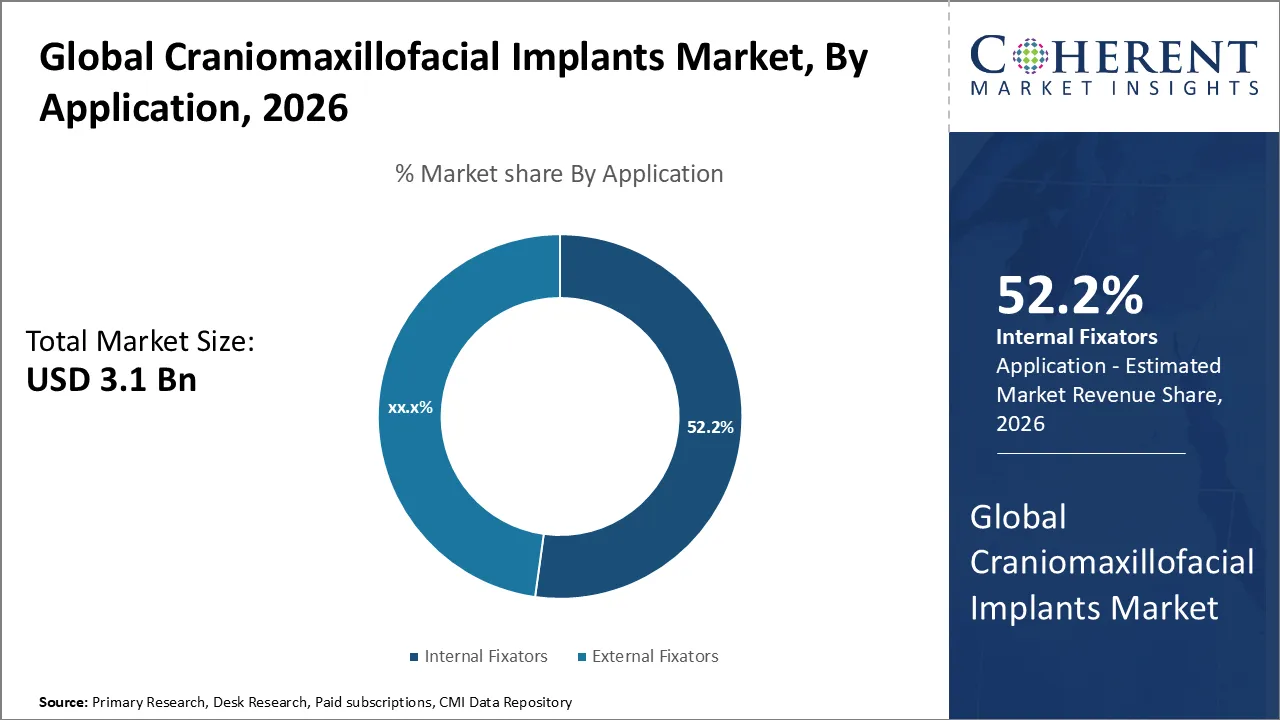
- By Application, Internal Fixators expected to hold the largest market share of 52.2% in 2026 owing to the rising incidence of facial trauma and injuries.
- By Property, Resorbable Fixators capture the largest market share of 51.8% in 2026 owing to the elimination of secondary removal surgery.
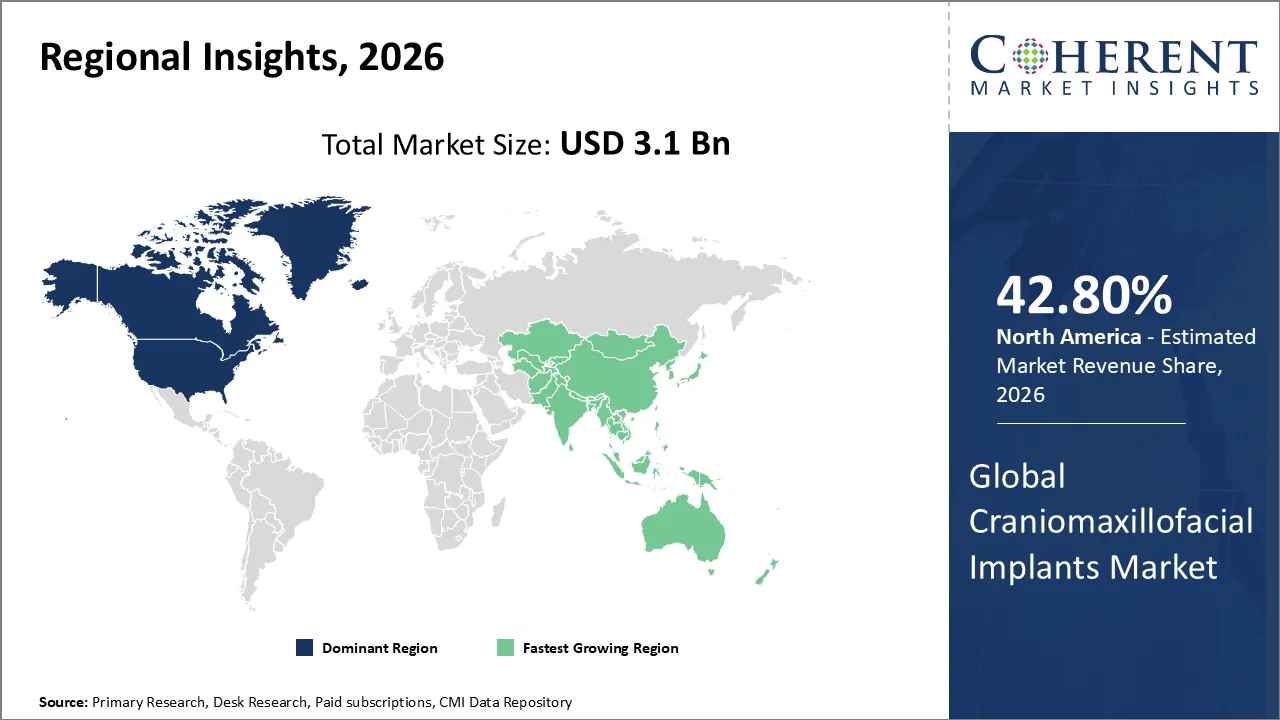
- By Region, North America dominates the overall market with an estimated share of 42.8% in 2026 owing to the high prevalence of facial trauma & surgical procedures.
Market Overview
The Craniomaxillofacial Implants Market delivers devices that reconstruct, stabilize, and repair cranial and facial bones damaged by trauma, congenital defects, or tumor removal. Manufacturers offer plates, screws, meshes, internal and resorbable fixators, and bone graft substitutes. Rising facial injuries, advances in implant design, and the adoption of minimally invasive, patient-specific procedures actively drive market expansion. Additionally, increasing awareness of reconstructive and aesthetic facial surgeries encourages broader use of these implants across healthcare settings.
Current Events and their Impact on the Craniomaxillofacial Implants Market
Current Events | Description and its impact |
Emergence of 3D Printing and Customization Technologies |
|
Regulatory Changes and Approvals |
|
Geopolitical and Economic Factors |
|
Segmental Insights
- Current Industry Events of 2026
- Market Size Estimation
- Regional Breakdown
- Competitive Landscape
- Customer Intelligence
- Segmental Analysis
- Pricing Analysis
- Key Market Drivers, Challenges & Future Trends
- Customized Insights Section
Craniomaxillofacial Implants Market Insights, By Application - Internal Fixators contribute the highest share of the market owing to its better clinical outcomes and faster healing
Internal Fixators expected to hold the largest market share of 52.2% in 2026. The Craniomaxillofacial Implants Market increasingly adopts Internal Fixators as surgeons use plates, screws, and meshes to provide stable, long-lasting support for fractured or reconstructed cranial and facial bones. Technological advancements, such as low-profile systems and patient-specific designs, improve surgical precision and bone alignment. The rising incidence of facial trauma, growing reconstructive procedures, and wider adoption of minimally invasive techniques actively drive the preference for internal fixators in both functional restoration and aesthetic craniofacial surgeries.
Craniomaxillofacial Implants Market Insights, By Product Type - Bone Graft Substitutes contribute the highest share of the market owing to its increase in elective and reconstructive procedures
Bone Graft Substitutes hold the largest market share of 38.7% in 2026. The Craniomaxillofacial Implants Market increasingly adopts Bone Graft Substitutes as craniofacial trauma and defects demand reconstruction. Manufacturers develop advanced synthetic and bioactive materials that improve bone regeneration, enhancing the effectiveness and reliability of substitutes. Surgeons choose these alternatives to minimize donor-site complications and infection risks linked to autografts. Expanding elective and reconstructive surgeries, along with wider use of patient-specific implants and minimally invasive techniques, actively drive the growing preference for bone graft substitutes in complex craniofacial procedures. For instance, in December 2025, CMRI, Kolkata, launched its dedicated Bone Bank, the first operational facility of its kind in Eastern India. Complying with national and international standards, the Bone Bank provides a reliable, high-quality source of bone allografts, enhancing the hospital’s capabilities in musculoskeletal, trauma, oncology, and reconstructive surgeries.
Craniomaxillofacial Implants Market Insights, By Raw Material - Metals contribute the highest share of the market owing to its excellent biocompatibility & corrosion resistance
Metals acquired the prominent market share of 41.1% in 2026. The Craniomaxillofacial Implants Market increasingly relies on metal implants for their exceptional strength, durability, and ability to rigidly stabilize complex cranial and facial structures. Surgeons prefer titanium and metal alloys due to their biocompatibility and long-term resistance to corrosion. Manufacturers leverage advances in custom fabrication and 3D printing to create precise, patient-specific implants, while the growing number of trauma, reconstructive, and aesthetic procedures drives higher adoption. Clinicians also favor metals for their proven reliability and seamless integration with advanced surgical techniques. For instance, in February 2026, Materialize has added custom-made PEEK implants to its cranio-maxillofacial (CMF) portfolio in Europe, giving surgeons more material options through its patient-specific implant planning and manufacturing services.
Craniomaxillofacial Implants Market Insights, By Property - Resorbable Fixators contribute the highest share of the market owing to its growing adoption in pediatric and growth‑sensitive cases
Resorbable Fixators capture the largest market share of 51.8% in 2026. Surgeons increasingly use Resorbable Fixators in the Craniomaxillofacial Implants Market to stabilize bones effectively without performing a second removal surgery. They favor these bioresorbable systems for pediatric and growth-sensitive patients to preserve natural bone development. Manufacturers enhance polymer materials and designs to improve strength, predictability, and patient outcomes. Rising reconstructive and trauma procedures, combined with the growing emphasis on minimally invasive techniques and patient-centered care, actively drive the widespread adoption of resorbable fixators in craniofacial reconstruction. For instance, Stryker launched the Citrelock Tendon Fixation Device System, offering surgeons a tendon thread with resorbable Citregen™ technology, featuring unique chemical and mechanical properties for orthopedic procedures.
Regional Insights
North America Craniomaxillofacial Implants Market Trends
North America dominates the overall market with an estimated share of 42.8% in 2026. Advanced healthcare systems and a robust network of trauma and specialized craniofacial centers actively shape the North America Craniomaxillofacial Implants Market. Surgeons increasingly implement digital planning, 3D-printed patient-specific implants, and minimally invasive techniques to improve precision and recovery. Growing awareness of reconstructive and aesthetic facial procedures drives higher implant usage, while leading medical device manufacturers continuously introduce innovations in fixation systems, resorbable materials, and bone graft substitutes, actively fueling the region’s rising demand for craniomaxillofacial implants. For instance, DePuy Synthes launched TRUMATCH Titanium 3D-Printed Implants in the U.S. for facial reconstruction, distributing them exclusively through Materialise, a leader in medical 3D printing and software solutions.
Asia Pacific Craniomaxillofacial Implants Market Trends
Increasing facial trauma from road accidents and sports injuries, combined with growing demand for reconstructive and aesthetic surgeries, drives the rapid expansion of the Asia Pacific Craniomaxillofacial Implants Market. Hospitals and surgical centers actively upgrade infrastructure and adopt modern technologies, such as 3D imaging and patient-specific implants, to enhance outcomes. Rising awareness among patients and surgeons about advanced craniofacial procedures further accelerates adoption, while global medical device manufacturers and local innovations in resorbable and metal implants actively strengthen the region’s market growth. For instance, Materialise introduced the Personalised TMJ Total Arthroplasty System, combining implants, guides, and digital planning to deliver faster, patient-specific treatment for total temporomandibular joint (TMJ) replacement.
United States Craniomaxillofacial Implants Market Trends
Surgeons increasingly adopt advanced implant technologies for trauma, reconstructive, and aesthetic facial procedures, driving growth in the United States Craniomaxillofacial Implants Market. Hospitals and specialized surgical centers actively implement digital planning, 3D-printed patient-specific implants, and minimally invasive techniques to improve precision and recovery. Growing awareness among patients and clinicians about innovative craniofacial solutions accelerates adoption, while leading medical device companies continuously develop metal, resorbable, and bone graft implants, actively fueling the expansion of the U.S. market.
India Craniomaxillofacial Implants Market Trends
Hospitals and surgical centers in India are actively upgrading infrastructure to manage the rising number of facial trauma and reconstructive cases, driving growth in the Craniomaxillofacial Implants Market. Surgeons increasingly use modern technologies, such as 3D imaging, patient-specific implants, and minimally invasive techniques, to enhance precision and outcomes. Growing awareness among patients and clinicians about aesthetic and corrective craniofacial procedures accelerates implant adoption, while global medical device manufacturers and locally developed metal and resorbable implants actively strengthen the country’s market expansion.
Craniomaxillofacial Implants Market Trend
Growing Adoption of Patient-Specific Implants
The market increasingly favors customized, patient-specific implants designed using 3D imaging and CAD/CAM technologies. Surgeons value these implants for their precise anatomical fit, which reduces intraoperative adjustments and improves functional and aesthetic outcomes. Hospitals are investing in digital planning software and printing capabilities, enabling faster production of tailored implants. This trend is particularly strong in complex reconstructive and orthognathic surgeries, where standard implants cannot achieve optimal bone alignment or facial symmetry.
Shift Towards Minimally Invasive Procedures
Surgeons are actively adopting minimally invasive techniques to reduce soft tissue trauma, scarring, and recovery times. Implants designed for smaller incisions, flexible handling, and low-profile fixation systems are gaining preference. These trends align with patient demands for faster recovery and less visible postoperative signs. Hospitals and surgical centers are investing in training and equipment to support these procedures, further driving the adoption of implants compatible with minimally invasive craniofacial reconstruction.
Craniomaxillofacial Implants Market Opportunity
Development of Patient-Specific Implants
There is a growing opportunity in customized, patient-specific implants created using 3D printing and CAD/CAM technologies. These implants provide precise anatomical fit, reducing surgical time and enhancing functional and aesthetic outcomes. As hospitals and surgeons increasingly adopt digital planning, manufacturers that offer integrated design-to-production solutions can gain a competitive edge. The trend is particularly relevant in complex reconstructive cases, pediatric surgery, and orthognathic procedures, where standard implants cannot provide optimal results.
Market Report Scope
Craniomaxillofacial Implants Market Report Coverage
| Report Coverage | Details | ||
|---|---|---|---|
| Base Year: | 2025 | Market Size in 2026: | USD 3.1 Bn |
| Historical Data for: | 2020 To 2024 | Forecast Period: | 2026 To 2033 |
| Forecast Period 2026 to 2033 CAGR: | 9.8% | 2033 Value Projection: | USD 5.3 Bn |
| Geographies covered: |
| ||
| Segments covered: |
| ||
| Companies covered: | Stryker Corporation, Johnson & Johnson, Zimmer Biomet Holdings, Inc., Medtronic Inc., Integra LifeSciences Holdings Corporation, OsteoMed L.P., Medartis AG, KLS Martin, Calavera Surgical Design, and Matrix Surgical USA | ||
| Growth Drivers: |
| ||
| Restraints & Challenges: |
| ||
Craniomaxillofacial Implants Market News
- In April 2024, ArcomedLab, a Chilean-North American biomedical 3D printing company, has completed 700 craniomaxillofacial implant cases across Latin America, setting a global record and advancing healthcare in Chile, Peru, Colombia, and Mexico.
Analyst Opinion (Expert Opinion)
- The current Craniomaxillofacial Implants landscape reflects a material shift from traditional fixation paradigms toward digitally enabled, anatomically precise solutions, underpinned by compelling procedural statistics and evolving clinical expectations. Data from recent industry analyses show that over 58% of trauma centers in key markets like the United States now deploy titanium implants as standard care, while 3D‑printed, patient‑specific implants have penetrated more than 30% of surgical applications, markedly improving anatomical fit and reducing intraoperative contingency adjustments.
- In parallel, internal fixation systems dominate procedural volume, with plate and screw constructs used in roughly 62% of annual craniofacial surgeries, highlighting enduring clinician preference for mechanical stability in complex reconstructions. These trends are not merely additive to market size projections; they reveal a strategic inflection point where digitally integrated surgical workflows and customized implant architectures are reshaping care pathways—reducing operative time, minimizing revision rates, and elevating functional and aesthetic outcomes. Moreover, the notable uptick in resorbable and polymer‑based systems—now accounting for significant adoption in pediatric and less load‑bearing indications—demonstrates a growing clinical risk‑benefit recalibration that challenges metal‑centric orthodoxy.
- These developments signal that technological differentiation and evidence‑based outcomes will increasingly determine competitive success, rather than traditional volume‑driven dynamics alone. Investment in integrated digital planning platforms, advanced biomaterials, and real‑world outcomes data will define the next phase of product leadership in the craniomaxillofacial implants space.
Speak to the analyst
Want personalized insights?
Take the findings above to one of our principal consultants, or have the report rebuilt around the segments, geographies and competitors you actually track.
Market Segmentation
- By Product Type
- Bone Graft Substitutes
- Distraction Systems
- Total TMJ Replacement Systems
- Cranial Flap Fixation Systems
- Thoracic Fixation Systems
- Dural Repair Products
- Screws
- Plates and Contourable Mesh
- By Raw Material
- Metals
- Ceramics
- Polymers
- Biomaterials
- By Application
- Internal Fixators
- External Fixators
- By Property
- Resorbable Fixators
- Non-Resorbable Fixators
- By Regional Insights
- North America
- U.S.
- Canada
- Latin America
- Brazil
- Argentina
- Mexico
- Rest of Latin America
- Europe
- Germany
- U.K.
- Spain
- France
- Italy
- Russia
- Rest of Europe
- Asia Pacific
- China
- India
- Japan
- Australia
- South Korea
- ASEAN
- Rest of Asia Pacific
- Middle East
- GCC Countries
- Israel
- Rest of Middle East
- Africa
- South Africa
- North Africa
- Central Africa
- North America
- Key Players Insights
- Stryker Corporation
- Johnson & Johnson
- Zimmer Biomet Holdings, Inc
- Medtronic Inc
- Integra LifeSciences Holdings Corporation
- OsteoMed L.P.
- Medartis AG
- KLS Martin
- Calavera Surgical Design
- Matrix Surgical USA
Sources
Primary Research interviews
- Surgeons specializing in craniofacial reconstruction and trauma care
- Hospital procurement managers and clinical coordinators
- Biomedical engineers and R&D teams of implant manufacturers
- Regulatory experts in medical devices
Databases
- PubMed
- ClinicalTrials.gov
- Scopus
- Web of Science
Magazines
- Medical Device & Diagnostic Industry (MD+DI)
- Biomedical Engineering News
- Healthcare Design Magazine
Journals
- Journal of Cranio-Maxillofacial Surgery
- Journal of Oral and Maxillofacial Surgery
- International Journal of Oral and Maxillofacial Implants
- Clinical Implant Dentistry and Related Research
Newspapers
- The New York Times – Health Section
- The Guardian – Health & Science
- The Times of India – Health & Medical News
Associations
- American Association of Oral and Maxillofacial Surgeons (AAOMS)
- International Association of Oral and Maxillofacial Surgeons (IAOMS)
- American Academy of Craniofacial Surgery
Public Domain sources
- U.S. Food & Drug Administration (FDA) device approvals
- National Institutes of Health (NIH) research publications
- World Health Organization (WHO) reports on craniofacial trauma
Proprietary Elements
- CMI Data Analytics Tool
- Proprietary CMI Existing Repository of information for last 8 years
Get access to 250+ pages report
Every segment, forecast, competitor profile and data table behind the analysis above — available for instant download.
- ESOMAR Member
- ISO 9001:2015 Certified
- D-U-N-S Registered
- GDPR & CCPA Compliant
Missing comfort of reading report in your local language? Find your preferred language:
Transform your Strategy with Exclusive Trending Reports
Frequently Asked Questions
The global craniomaxillofacial implants market is estimated to surpass USD 5.3 Bn by 2033.
Major players operating in the global craniomaxillofacial implants market market include Stryker Corporation, Johnson & Johnson, Zimmer Biomet Holdings, Inc., Medtronic Inc., Integra LifeSciences Holdings Corporation, OsteoMed L.P., Medartis AG, KLS Martin, Calavera Surgical Design, and Matrix Surgical USA
Among application, internal fixators segment held dominant position in the market
Rising cases of birth defects and abnormalities is one of the major factors that is expected to propel growth of the market over the forecast period.
The global craniomaxillofacial implants market is estimated to exhibit a CAGR of 9.8% over the forecast period.
Among regions, North America is expected to hold dominant position in the market over the forecast period.