

Global Crispr and Cas Gene Market Size and Share Analysis
Crispr And Cas Gene Market is estimated to be valued at USD 2.85 Bn in 2026 and is expected to reach USD 12.15 Bn in 2033, exhibiting a compound annual growth rate (CAGR) of 23.0% from 2026 to 2033.
Key Takeaways
- Based on Product Type, The Vector-Based Cas Segment is expected to hold a dominant position with 45.8% market share in 2026.
- North America is estimated to hold a dominant position with 33.5 % of the market share in 2026.
Market Overview
The CRISPR and Cas gene market is witnessing growth, driven by rising demand for precision medicine, gene therapy, and other emerging biotechnology applications. The rising incidence of genetic diseases, advancements in genome sequencing technologies, and increasing research on regenerative medicine are major drivers of market growth.
For example, in 2024, Vertex Pharmaceuticals and CRISPR Therapeutics gained U.S. FDA approval for Casgevy, the first CRISPR/Cas9-gene therapy for sickle cell disease and transfusion-dependent beta thalassemia. This approval was a watershed moment in the therapeutic application of gene editing and heralded the arrival of CRISPR treatments to market.
Current Events and Its Impact
Current Events | Description and its impact |
Casgevy Approval for Sickle Cell Disease and Beta Thalassemia
|
|
Patent Dispute Between UC Berkeley and Broad Institute
|
|
Role of AI in the CRISPR and Cas Gene Market
Artificial Intelligence (AI) is serving as a revolutionary force in propelling the CRISPR and Cas gene-editing industry forward with increased precision, efficiency, and scalability of genetic research and therapeutic development. AI technologies—specifically machine learning and deep learning—are being utilized to sift through enormous genomic datasets, determine gene targets, and forecast the results of gene edits with unprecedented precision. These abilities are important in reducing off-target effects, one major challenge in CRISPR technology, thus enhancing the efficacy and safety of gene-editing treatments.
One of the most important advances of AI lies in guide RNAs (gRNAs) design and optimization that is crucial for targeting Cas enzymes to precise DNA sequences. AI programs are able to screen thousands of possible gRNAs quickly to determine those that have the maximum on-target activity and minimum chance of causing off-target mutations. This speeds up the drug development pipeline and improves the consistency of CRISPR interventions.
AI helps drive CRISPR research through real-time imaging analysis, automated monitoring of cellular behaviour, and modelling of intricate gene interactions. Applications such as these cut experiment time and cost, allowing researchers to investigate more genetic targets efficiently.
Additionally, AI platforms are facilitating the personalization of gene therapies by incorporating personal genetic profiles, disease phenotypes, and environmental influences to develop customized treatment regimens. With further advancements in AI, its intersection with CRISPR technologies is likely to open new doors in genomics, making gene editing more accessible, accurate, and relevant across a wider range of diseases.
- Current Industry Events of 2026
- Market Size Estimation
- Regional Breakdown
- Competitive Landscape
- Customer Intelligence
- Segmental Analysis
- Pricing Analysis
- Key Market Drivers, Challenges & Future Trends
- Customized Insights Section
Global Crispr and Cas Gene Market - Drivers
- Increasing product launches by market players:
Increasing product launches by the market players are expected to aid in the market growth over the forecast period. For instance, on June 21, 2021, QIAGEN, a provider of sample and assay technologies for molecular diagnostics, applied testing, academic, and pharmaceutical research, announced the launch of QIAprep& CRISPR Kit and CRISPR Q-Primer Solutions that will help researchers to analyse edited gene material.
In September 2024, QIAGEN expanded its QI Acuity digital PCR platform by adding over 100 new validated assays for applications in cancer research, inherited genetic disorders, infectious disease surveillance, and other areas.
- Increasing research and development activities by the Market Players:
Increasing research and developmental activities by the market players is expected to propel the market growth over the forecast period. For instance, on April 27, 2023, a team of University of Florida researchers developed a promising new CRISPR-powered method for non-invasive blood tests that could help clinicians diagnose cancer at earlier stages. On December 2, 2019, Cyrus Biotechnology, Inc., a biotech company headquartered in Seattle, U.S. and the institute of MIT and Harvard launched multi-target collaboration to develop optimized Crispr gene editing technology.
Global Crispr and Cas Gene Market: Key Trends
- Introduction of technologically-advanced products in the market:
The market players are focusing on launching technologically advanced products, thus driving the market growth over the forecast period. In May 2024, Profluent, a U.S.-based AI-first protein design company, released the sequence of OpenCRISPR-1, a novel Cas9 gene editor developed using artificial intelligence. This AI-driven approach utilized a large language model trained on a database of 5.1 million Cas9-like proteins to design a gene editor with improved off-target editing capabilities.
Segmental Analysis
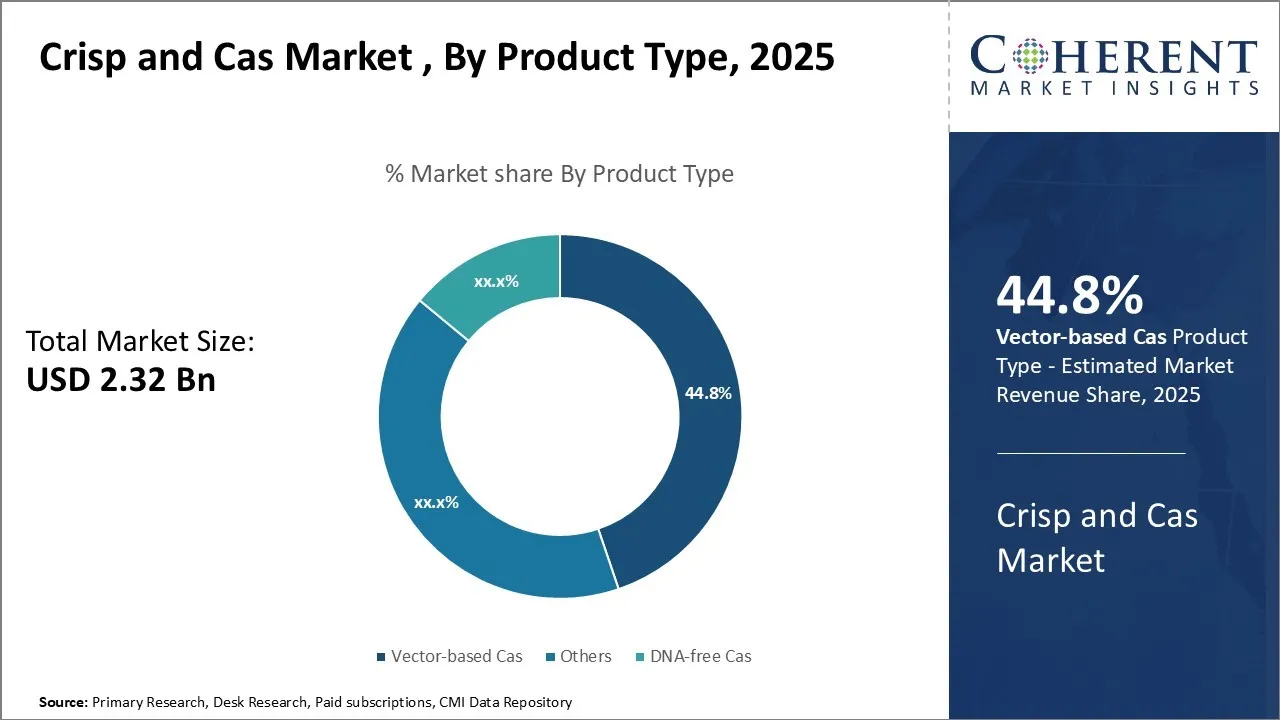
Global Crispr and Cas Gene Market Insights, by product type
By product type, the vector-based cas is expected to hold a dominant position in the global crispr and cas gene market during the forecast period, and this is attributed to the increasing development of innovative products.
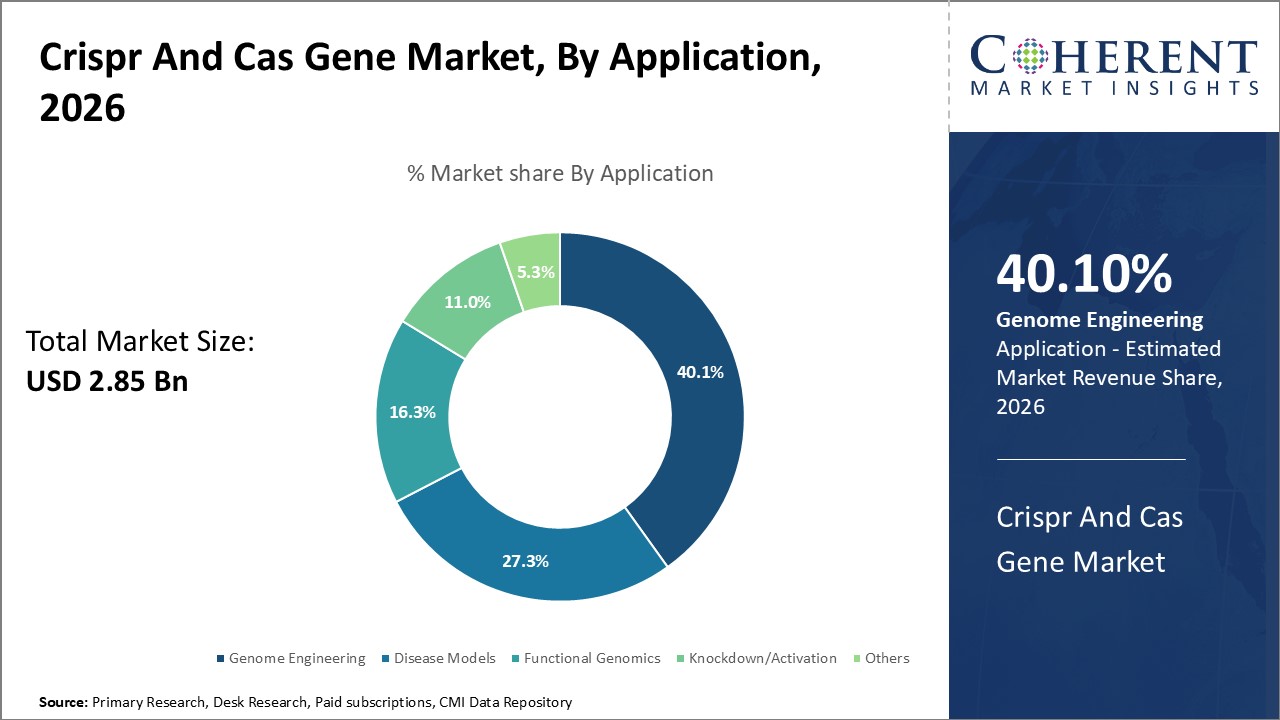
Global Crispr and Cas Gene Market insight, by application
By application, the genome engineering is expected to dominate the market over the forecast period, and this is attributed to increasing product launches.
Global Crispr and Cas Gene Market Insights, by end user
By end user, the biotechnology and pharmaceutical companies is expected to dominate the market over the forecast period, and this is attributed to the increasing research and development activities by biotechnology companies.
Global Crispr and Cas Gene Market - Cross Sectional Analysis:
Key players are focusing on inorganics strategies, such as collaborations, for the development of products is expected to drive the market growth over the forecast period. For instance, on August 18, 2023, CrisprBits, a technology company based in India, announced a strategic collaboration with Molbio Diagnostics, a molecular diagnostic company. This collaboration intends to focus on point of care (POC) diagnostics by the introduction of crispr in POC tests.
Global Crispr and Cas Gene Market - Regional Analysis
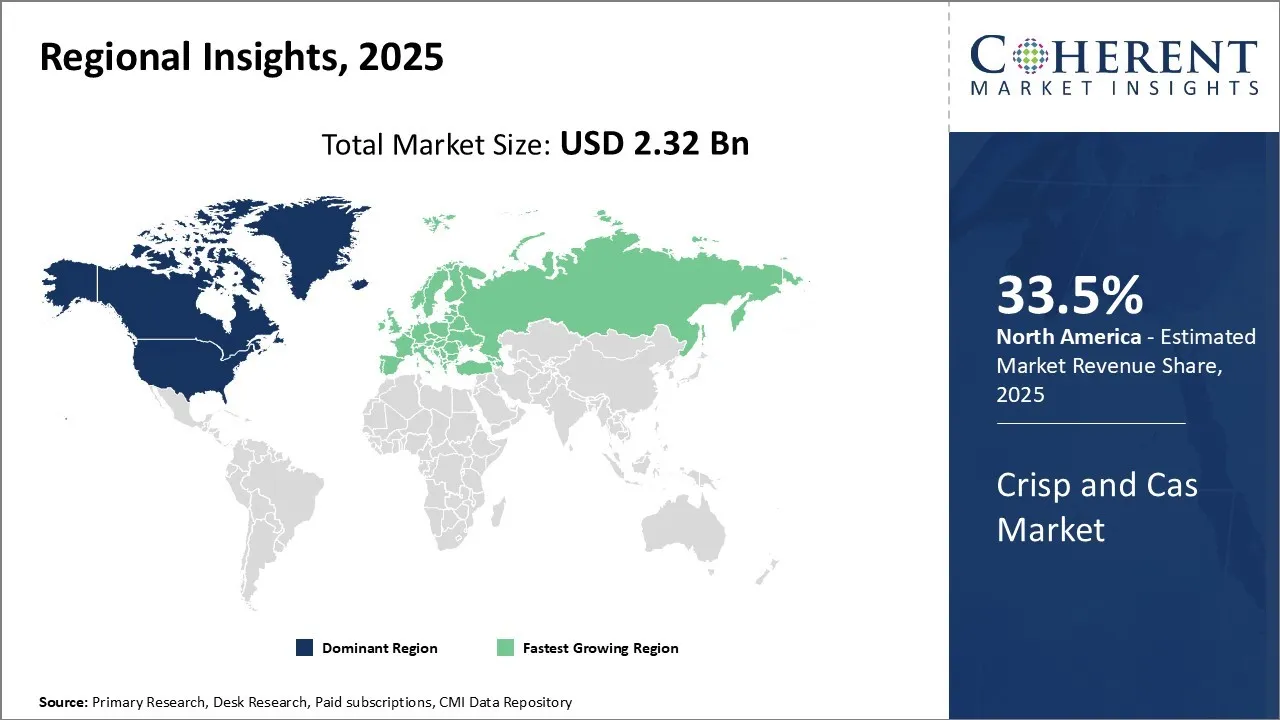
North America Crisp and Cas gene Market Analysis and Trends
Among regions, North America is estimated to hold a dominant position in the global crispr and cas gene market over the forecast period. North America is estimated to hold 33.5 % of the market share in 2026. Global crispr and cas gene market is expected to witness significant growth in the near future, driven by increasing research and development in the field by the market players.
Global Crispr and Cas Gene Market- Dominating Countries
United States Global Crispr and Cas Gene Market Analysis and Trend
The United States dominates the CRISPR and Cas gene space because of its strong biotechnology landscape, research institutions, and favorable regulatory environment. With the FDA's approval of Casgevy in 2024, the United States became the first nation to bring a CRISPR-based gene therapy to market. Major players like CRISPR Therapeutics, Editas Medicine, and Intellia Therapeutics have their headquarters here, advancing innovation through cutting-edge clinical trials and collaborations.
China Global Crispr and Cas Gene Market Analysis and Trend
China dominates the CRISPR market, with significant investment in gene-editing research and agri-biotech. Chinese researchers have been among the first to adopt CRISPR for research on human embryos, and the nation has rapidly scaled up the application of gene editing to plant improvement and animal breeding. The support of the government and more lenient regulatory environments allow quicker adoption of CRISPR technologies than in most Western countries.
Germany Global Crispr and Cas Gene Market Analysis and Trend
Germany is one of the leaders of CRISPR research in Europe and has a robust pharmaceutical industry and life science sector. The Max Planck Institute and Bayer are some of the players developing CRISPR technologies for gene therapy and precision medicine. High-quality inputs to the international gene-editing scene from Germany are promoted due to the nation's dedication to ethical research and clinical testing.
Market Report Scope
Crispr And Cas Gene Market Report Coverage
| Report Coverage | Details | ||
|---|---|---|---|
| Base Year: | 2025 | Market Size in 2026: | USD 2.85 Bn |
| Historical Data for: | 2020 To 2024 | Forecast Period: | 2026 To 2033 |
| Forecast Period 2026 to 2033 CAGR: | 23.0%2033 Value Projection: | USD 12.15 Bn | |
| Geographies covered: |
| ||
| Segments covered: |
| ||
| Companies covered: | Thermo Fisher Scientific Inc., Merck KGaA (Sigma-Aldrich), OriGene Technologies, Inc., New England Biolabs, Cellecta, Inc., Agilent Technologies, Inc., Applied StemCell, Inc., Synthego, Genscript, Mirus Bio LLC, Integrated DNA Technologies, Inc., and Mammoth Biosciences, Inc. | ||
| Growth Drivers: |
| ||
| Restraints & Challenges: |
| ||
Global Crispr and Cas Gene Market: Key Developments
- In June 2024, Syngenta made genome-editing and breeding technology available through rights to accelerate farm innovation. This initiative is likely to speed up the creation of genetically edited crops, leading to food security and agricultural sustainability. It demonstrates the increasing interest in using CRISPR technology for agriculture.
- In 2024, the U.S. Court of Appeals overturned a 2022 ruling and reinstated the University of California, Berkeley's legal suit to regain countrywide patent rights for CRISPR gene-editing technology.
Global Crispr and Cas Gene Market - Key Players
The major players operating in the global crispr and cas gene market includes Thermo Fisher Scientific Inc., Merck KGaA (Sigma-Aldrich), OriGene Technologies, Inc., New England Biolabs, Cellecta, Inc., Agilent Technologies, Inc., Applied StemCell, Inc., Synthego, Genscript, Mirus Bio LLC, Integrated DNA Technologies, Inc., and Mammoth Biosciences, Inc.
Analyst View
- The CRISPR and Cas gene market is poised for transformative growth, driven by accelerating research in therapeutic applications and strategic industry collaborations. A key driver is the expanding pipeline of clinical trials targeting genetic disorders, cancers, and neurodegenerative diseases, which underscores the technology’s potential to address previously untreatable conditions.
- Partnerships between pharmaceutical giants and specialized biotech firms are further propelling innovation, particularly in tailoring CRISPR systems for precision medicine. However, the market faces headwinds from ethical debates surrounding germline editing and technical challenges related to off-target effects, which could delay clinical adoption.
- North America maintains dominance in this space, supported by robust biotech infrastructure and progressive regulatory frameworks that facilitate early-stage research. Meanwhile, emerging opportunities lie in diversifying applications beyond healthcare—such as agricultural biotechnology, where CRISPR is being leveraged to enhance crop resilience and yield.
- Regulatory pathways remain a critical factor, as evolving guidelines for gene-editing therapies could either accelerate market entry or impose stringent compliance burdens. Additionally, intellectual property disputes among key players risk fragmenting innovation ecosystems, though cross-licensing agreements may mitigate this challenge.
- Integration of AI-driven design tools and CRISPR delivery system advancements could address current limitations, unlocking novel applications in diagnostics and industrial biotechnology. As the market matures, balancing scientific ambition with ethical governance will be pivotal to sustaining long-term growth and public trust.
Market Segmentation
- Global CRISPR and CAS Gene Market, By Product Type (Revenue, USD Bn, 2021 - 2033)
- Vector-based CAS
- DNA-free CAS
- Others
- Global CRISPR and CAS Gene Market, By Application (Revenue, USD Bn, 2021 - 2033)
- Genome Engineering
- Disease Models
- Functional Genomics
- Knockdown/Activation
- Others
- Global CRISPR and CAS Gene Market, By End User (Revenue, USD Bn, 2021 - 2033)
- Biotechnology and Pharmaceutical Companies
- Academic & Government Research Institutes
- Contract Research Organizations
- Global CRISPR and CAS Gene Market, By Region (Revenue, USD Bn, 2021 - 2033)
- North America
- U.S.
- Canada
- Latin America
- Brazil
- Argentina
- Mexico
- Rest of Latin America
- Europe
- Germany
- U.K.
- Spain
- France
- Italy
- Russia
- Rest of Europe
- Asia Pacific
- China
- India
- Japan
- Australia
- South Korea
- ASEAN
- Rest of Asia Pacific
- Middle East
- GCC Countries
- Israel
- Rest of Middle East
- Africa
- South Africa
- North Africa
- Central Africa
- North America
- Company Profiles
- Thermo Fisher Scientific Inc.
- Merck KGaA (Sigma-Aldrich)
- OriGene Technologies, Inc.
- New England Biolabs
- Cellecta, Inc.
- Agilent Technologies, Inc.
- Applied StemCell, Inc.
- Synthego
- Genscript
- Mirus Bio LLC
- Integrated DNA Technologies, Inc.
- Mammoth Biosciences, Inc.
Sources
Primary Research Interviews:
- Biotech and pharmaceutical company executives
- Academic researchers specializing in genomics
- Clinical trial investigators
- Regulatory affairs experts
- Others
Databases:
- Research Nester Analytics
- Others
Magazines:
- Genetic Engineering & Biotechnology News
- Nature Biotechnology
- The Scientist
- BioPharma Dive
- Others
Journals’:
- Genetics in Medicine Journal
- Journal of Gene Medicine
- CRISPR Journal
- Others
Newspapers:
- Bloomberg Businessweek
- The Wall Street Journal Health & Science Section
- Financial Times Biotech Updates
- Others
Associations:
- International Society for Stem Cell Research (ISSCR)
- American Society of Gene & Cell Therapy (ASGCT)
- European Society of Gene and Cell Therapy (ESGCT)
- Others
Public Domain Sources:
- National Institutes of Health (NIH) genomic databases
- ClinicalTrials.gov
- U.S. Food and Drug Administration (FDA) regulatory publications
- Research Nester CRISPR & Cas Gene Market Report [2][5]
- Others
Proprietary Elements:
- CMI Data Analytics Tool
- Proprietary CMI Existing Repository of information for last 8 years
Get access to 250+ pages report
Every segment, forecast, competitor profile and data table behind the analysis above — available for instant download.
- ESOMAR Member
- ISO 9001:2015 Certified
- D-U-N-S Registered
- GDPR & CCPA Compliant
Missing comfort of reading report in your local language? Find your preferred language:
Transform your Strategy with Exclusive Trending Reports
Frequently Asked Questions
The Crispr and Cas Gene Market size is estimated to be valued at USD 2.85 Bn in 2026, and is expected to reach USD 12.15 Bn by 2033.
The CAGR of the global Market is projected to be 23.0% from 2026 to 2033.
Increasing product launches by market players and increasing research and development activities are expected to propel the market growth over the forecast period.
Vector-based cas is the leading product type segment in the market.
Limitations associated with crispr and cas gene are expected to hamper the market growth over the forecast period.
The major players operating in the market are Thermo Fisher Scientific Inc., Merck KGaA (Sigma-Aldrich), OriGene Technologies, Inc., New England Biolabs, Cellecta, Inc., Agilent Technologies, Inc., Applied StemCell, Inc., Synthego, Genscript, Mirus Bio LLC, Integrated DNA Technologies, Inc., and Mammoth Biosciences, Inc.