

Isothermal Nucleic Acid Amplification Technology (INAAT) Market Analysis & Forecast
Isothermal Nucleic Acid Amplification Technology (INAAT) Market is estimated to be valued at USD 4,097.8 Mn in 2026 and is expected to reach USD 8,348.0 Mn in 2033, exhibiting a compound annual growth rate (CAGR) of 10.7% from 2026 to 2033.
Key Takeaways
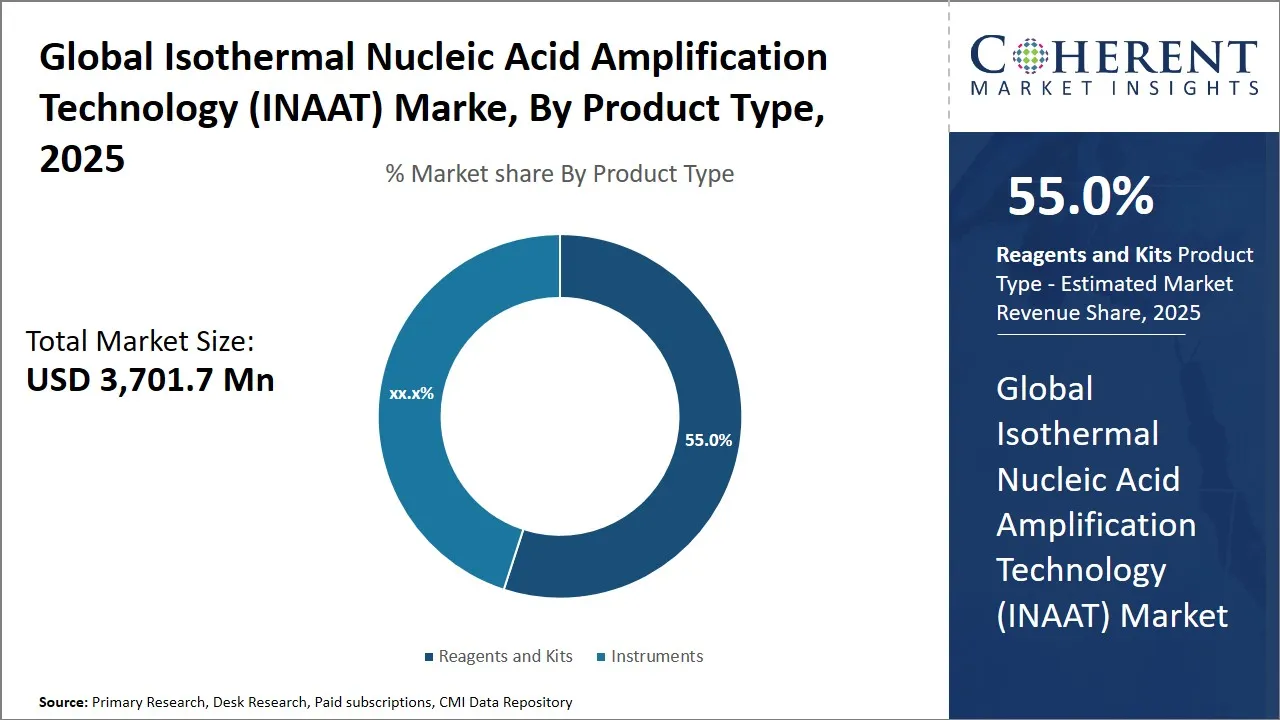
- Based on the Product Type, the Reagents and Kits segment dominates the market due to the increasing usage of reagents and kits.
- Based on the Application, the Infectious Disease Diagnostics segment dominates the market due to the rising number of infectious diseases.
- Based on the Technology, where the Loop-Mediated Isothermal Amplification (LAMP) segment dominates the market due to growing institutional and WHO backing.
- Based on the End User, the Diagnostic Laboratories segment dominates the market due to the increasing number of tests in laboratories.
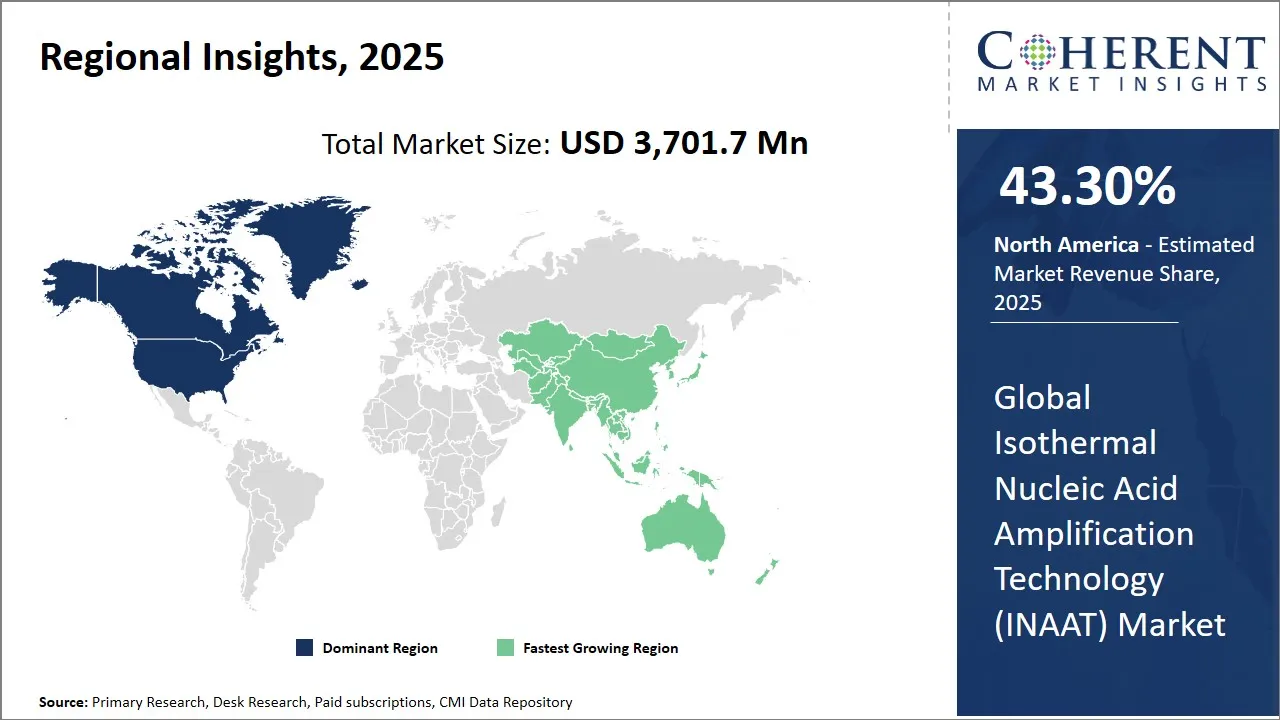
- On the basis of Region, North America holds 43.3% of the market share, due to the increasing prevalence of chronic diseases in the region.
Market Overview
The Isothermal Nucleic Acid Amplification Technology (INAAT) market is growing steadily because of the rising need for fast, accurate, and simple diagnostic methods. Since it does not require advanced lab equipment, it is well-suited for use in clinics and areas with limited resources. This technology is becoming more common in testing for infections, cancer, food safety, and the environment. Ongoing improvements and use of digital tools are also helping increase its use in both developed and developing countries.
Current Events and Their Impact on the Isothermal Nucleic Acid Amplification Technology Market
Current Events | Description and its impact |
Technological Innovation and AI Integration |
|
Research Funding and Healthcare Investment Shifts |
|
Regulatory Stringency and Harmonization Efforts |
|
Geopolitical Trade Tensions and Tariff Volatility |
|
End Use Application for Isothermal Nucleic Acid Amplification Technology Market
- Food Safety Testing: INAAT is used for quickly finding harmful germs like Salmonella, Listeria, and E. coli in food and drinks at the place where they are made or sold. It also helps check for contamination during the production process to ensure that the environment stays clean and food remains safe to eat.
- Veterinary Diagnostics: This technology helps in the fast detection of diseases in animals, such as foot-and-mouth disease and avian flu. It is also useful for tracking the spread of diseases that can be transmitted from animals to humans, making it beneficial for both animal and public health.
- Environmental Monitoring: INAAT helps find harmful microbes in water, soil, and air samples. It also supports the tracking of dangerous biological agents in the environment, which is important for public safety and preventing the spread of disease.
- Agricultural & Plant Pathogen Detection: The technology is used to find plant diseases that can damage crops, such as Xylella fastidiosa and phytoplasmas. It also helps test seeds and plants on the spot to make sure they are healthy before being planted or sold.
- Current Industry Events of 2026
- Market Size Estimation
- Regional Breakdown
- Competitive Landscape
- Customer Intelligence
- Segmental Analysis
- Pricing Analysis
- Key Market Drivers, Challenges & Future Trends
- Customized Insights Section
End-user Feedback and Unmet Needs in the Isothermal Nucleic Acid Amplification Technology Market
End-user Feedback
- Ease of Use & Minimal Infrastructure Needs: Healthcare workers in decentralized settings (e.g., rural clinics, refugee camps, mobile units) highly appreciate platforms like Abbott’s ID NOW and Eiken’s LAMP, which require no thermal cycling or complex setup. Their plug-and-play usability enables same-day testing and results without needing a trained lab technician or electricity-intensive infrastructure.
- Rapid Turnaround Time: Speed remains one of INAAT's biggest advantages. Clinicians report diagnostic decisions being made within 15–30 minutes using systems like Cue Health or Lucira, especially critical for diseases like influenza, COVID-19, or STIs in walk-in community settings.
- Operational Flexibility in Non-Lab Environments: INAAT systems are praised for their ability to function in non-traditional testing spaces—border entry points, pharmacies, and even school clinics—due to their ambient-temperature operation and low reagent complexity.
Unmet Needs
- Multiplexing Limitations: Many current INAAT platforms are singleplex, meaning one test per target. In high-burden settings (e.g., co-infection zones for dengue, malaria, and TB), clinicians express the need for multi-pathogen panels to reduce turnaround time and test fatigue.
- Cold Chain Dependence for Reagents: Despite simplified instruments, some INAAT kits still require cold chain logistics, which restricts their deployment in tropical or remote environments. Users in Africa and Southeast Asia reported recurring supply issues due to concerns about reagent stability.
- Lack of Digital Integration: Many INAAT devices lack built-in connectivity for automated result transmission to EMR systems or national databases. This hampers disease surveillance efforts and slows contact tracing during outbreaks.
Segmental Insights
Isothermal Nucleic Acid Amplification Technology Market Insights, By Product Type
The reagents and kits segment dominates the market due to the increasing usage of reagents and kits
Based on Product Type, the market is segmented into instruments, reagents, and kits. Out of which, the reagents and kits segment is expected to hold a dominant position with a share of 56.0% in the global isothermal nucleic acid amplification technology (INAAT) market during the forecast period, owing to increasing usage of reagents and kits. For instance, PCR Biosystems have launched a new line of Bst polymerase reagents with AptaLockTM hot start technology for increased speed, specificity, and sensitivity in isothermal amplification, including Loop-mediated isothermal amplification (LAMP). This is further propelling the isothermal nucleic acid amplification technology market growth.
-market-by-application.webp "Isothermal Nucleic Acid Amplification Technology (INAAT) Market, By Application")
Isothermal Nucleic Acid Amplification Technology Market Insights, By Application
The infectious disease segment dominates the market due to the rising number of infectious diseases
Based on Application, the market is segmented into infectious disease diagnostics, blood screening, and others. Out of which, the infectious disease diagnostics segment is expected to dominate the market over the forecast period, primarily due to its critical role in the rapid detection of a wide range of pathogens. Technologies such as Loop-mediated Isothermal Amplification (LAMP) and Recombinase Polymerase Amplification (RPA) have proven especially effective for diagnosing infectious diseases like HIV, tuberculosis, hepatitis, malaria, and respiratory infections. These methods are highly valued for their speed, sensitivity, and ability to operate in decentralized or resource-limited settings without requiring complex thermal cyclers.
Isothermal Nucleic Acid Amplification Technology Market Insights, By Technology
The loop-mediated isothermal amplification (LAMP) segment dominates the market due to growing institutional and WHO backing
Based on Technology, the market is segmented into helicase-dependent amplification (HAD), nicking enzyme amplification reaction (NEAR), nucleic acid sequence-based amplification (NASBA), transcription-mediated amplification (TMA), single primer isothermal amplification (SPIA), and loop-mediated isothermal amplification (LAMP). Out of which, the loop-mediated isothermal amplification (LAMP) segment is expected to hold a dominant position in the global isothermal nucleic acid amplification technology (INAAT) market during the forecast period, owing to increasing product launches by the key players. For instance, Eiken Chemical launched a new, enhanced LAMP kit capable of identifying multiple pathogens simultaneously, aiming to improve diagnostic turnaround times in healthcare settings.
Isothermal Nucleic Acid Amplification Technology Market Insights, By End User
The diagnostic laboratories segment dominates the market due to the increasing number of tests in laboratories
Based on End User, the market is segmented into academic and research institutes, diagnostic laboratories, and others. Out of which, the diagnostic laboratories segment is expected to dominate the market over the forecast period, owing to the increasing number of tests in laboratories. Diagnostic laboratories are at the forefront of adopting INAAT technologies due to their need for high-throughput, accurate, and rapid testing solutions for infectious diseases and genetic disorders. These labs often handle large volumes of patient samples and require fast turnaround times, making isothermal amplification methods like LAMP and RPA particularly advantageous. Unlike traditional PCR, INAAT methods do not require complex thermal cyclers, enabling laboratories to reduce equipment costs while improving workflow efficiency.
Regional Insights
North America Isothermal Nucleic Acid Amplification Technology Market Analysis and Trends
Among regions, North America is estimated to hold a dominant position in the global isothermal nucleic acid amplification technology (INAAT) market with a share of 43.3% in 2026, due to the increasing prevalence of chronic diseases in the region. An American company Meridian Bioscience launched Lyo-Ready Direct DNA & RNA-DNA LAMP saliva mixes, which are designed for direct use in point-of-care diagnostic assays. These mixes enable rapid and sensitive detection of DNA and RNA from saliva and sputum samples using isothermal amplification methods. This is further proliferating the isothermal nucleic acid amplification technology market growth.
Asia Pacific Isothermal Nucleic Acid Amplification Technology Market Trends
The Asia Pacific Isothermal Nucleic Acid Amplification Technology (INAAT) market is growing due to the rising need for fast and affordable diagnostic tests in low-resource and rural areas. Government efforts to improve the tracking of infectious diseases and expand testing facilities close to patients are also helping its adoption. In addition, the increasing number of cases of diseases like tuberculosis, and dengue is creating a greater need for local and easy-to-use molecular testing solutions.
Apart from this, Korea Research Institute of Bioscience and Biotechnology (KRIBB) introduced a novel Nucleic Acid Amplification Circuit-Based Hydrogel (NACH) assay. This assay allows for the one-step detection of exosomal microRNA linked to metastatic gastric cancer, demonstrating the potential of isothermal nucleic acid amplification technology (INAAT) in oncology diagnostics. This is further propelling the isothernam nucleic acid amplification technology market revenue.
United States Isothermal Nucleic Acid Amplification Technology Market Trends
The growth of the U.S. isothermal nucleic acid amplification (INAAT) market is being driven by the increasing need for fast and easy-to-use diagnostic tools—especially for common and serious diseases—as more healthcare services move closer to patients. New technologies like LAMP and RPA, supported by advances in automation and digital tools, are making testing quicker, more accurate, and easier to use. In addition, strong government support, simple approval processes, and the launch of new testing products by major biotech companies are helping the market grow and improving product availability. For instance, the American company Thermo Fisher Scientific expanded its product portfolio with launches like the Invitrogen SuperScript IV RT-LAMP Master Mix for viral pathogen detection.
Spain Isothermal Nucleic Acid Amplification Technology Market Trends
The growth of Spain’s isothermal nucleic acid amplification technology market is driven by the rise in infectious diseases like HIV and hepatitis, which increases the need for fast, accurate, and easy-to-use diagnostic tests. Government approvals and the launch of new testing products also support this growth. Lower costs compared to PCR and the use of smart technologies help adoption, especially for LAMP, SDA, and TMA methods. For instance, the Spanish company Grifols developed and launched the Procleix SARS-CoV-2 assay, a commercially available INAAT-based COVID-19 testing product.
Market Report Scope
Isothermal Nucleic Acid Amplification Technology (INAAT) Market Report Coverage
| Report Coverage | Details | ||
|---|---|---|---|
| Base Year: | 2025 | Market Size in 2026: | USD 4,097.8 Mn |
| Historical Data for: | 2020 To 2024 | Forecast Period: | 2026 To 2033 |
| Forecast Period 2026 to 2033 CAGR: | 10.7% | 2033 Value Projection: | USD 8,348.0 Mn |
| Geographies covered: |
| ||
| Segments covered: |
| ||
| Companies covered: | Alere Inc., Becton, Dickinson & Company, BioHelix Corporation, BioMerieux Biotechnology Company, Hologic Gene-Probe, QIAGEN Company, Thermo Fisher Scientific, Inc., Lucigen Corporation, Quidel Corporation, and NuGEN. | ||
| Growth Drivers: |
| ||
| Restraints & Challenges: |
| ||
Global Isothermal Nucleic Acid Amplification Technology (INAAT) Market– Driver
Increasing Approvals From Healthcare Regulatory Authorities For Innovative Technologies
Increasing approvals from healthcare regulatory authorities for innovative technologies by key market players are expected to drive the global isothermal nucleic acid amplification technology (INAAT) market growth over the forecast period. For instance, in 2022, according to the article published in the Analyst Journal, LAMP technology used showed how smartphone-integrated equipment could quickly test for the Zika virus in a single blood drop. Such advances are probably going to increase the technique's market penetration in the near future.
Global Isothermal Nucleic Acid Amplification Technology (INAAT) Market- Key Developments
- In June 2024, QIAGEN introduced 35 new, wet-lab-verified digital PCR (dPCR) assays for microbial DNA detection, specifically designed for their QIAcuity dPCR platforms. These assays aim to enhance microbial research capabilities by offering precise and sensitive detection of microbial DNA.
- In June 2024, Abbott released an updated version of its ID NOW system, designed for rapid detection of RSV, and Influenza A/B. This system utilizes INAAT and delivers results in 15 minutes, making it suitable for urgent care and decentralized testing.
- In February 2023, Sherlock Biosciences acquired Sense Biodetection to strengthen its position in molecular point-of-care testing.
Analyst Opinion (Expert Opinion)
- Clinical adoption of INAAT is outpacing traditional PCR due to operational pragmatism, not just innovation. The shift toward decentralized diagnostics—driven by real-world conditions in resource-limited settings—is accelerating INAAT use in infectious disease testing. For instance, Abbott’s ID NOW platform saw over 1 million units deployed across non-laboratory settings in under 12 months during the COVID-19 peak, emphasizing how INAAT’s minimal infrastructure requirements offer unmatched deployment speed. Labs are not just choosing speed—they’re choosing resilience.
- The INAAT market is dangerously underestimated in veterinary and food safety diagnostics, where the regulatory lag masks actual demand. Companies like BioFire and TwistDx have seen double-digit year-over-year growth in veterinary panel kits, especially for zoonotic diseases like ASFV and avian flu, where real-time containment hinges on in-field results. For food safety, INAAT’s sub-30-minute LAMP-based pathogen detection protocols now threaten the status quo of lab-bound enrichment methods, particularly with 90%+ + sensitivity and specificity for E. coli and Listeria reported in ambient conditions.
- Major diagnostic players are quietly pivoting R&D pipelines toward INAAT platforms, signaling a structural shift away from thermocycler dependency. Roche’s acquisition of GenMark and Thermo Fisher’s partnership with Mologic indicate not just diversification, but a strategic hedge against PCR supply-chain fragility. With over 200 INAAT-based patents filed globally in 2023 alone, especially in CRISPR-integrated detection systems, the signal is clear: the future of molecular diagnostics will be isothermal, field-adapted, and algorithm-augmented.
Speak to the analyst
Want personalized insights?
Take the findings above to one of our principal consultants, or have the report rebuilt around the segments, geographies and competitors you actually track.
Market Segmentation
- Global Isothermal Nucleic Acid Amplification Technology (INAAT) Market, By Product Type (Revenue, USD Mn, 2021 - 2033)
- Instruments
- Reagents and Kits
- Global Isothermal Nucleic Acid Amplification Technology (INAAT) Market, By Application (Revenue, USD Mn, 2021 - 2033)
- Infectious Disease Diagnostics
- Blood Screening
- Others
- Global Isothermal Nucleic Acid Amplification Technology (INAAT) Market, By Technology (Revenue, USD Mn, 2021 - 2033)
- Helicase Dependent Amplification (HAD)
- Nicking Enzyme Amplification Reaction (NEAR)
- Nucleic Acid Sequence Based Amplification (NASBA)
- Transcription Medicated Amplification (TMA)
- Single Primer Isothermal Amplification (SPIA)
- Loop-mediated Isothermal Amplification (LAMP)
- Global Isothermal Nucleic Acid Amplification Technology (INAAT) Market, By End User
- Academic and Research Institutes
- Diagnostic Laboratories
- Others
- Global Isothermal Nucleic Acid Amplification Technology (INAAT) Market, By Region (Revenue, USD Mn, 2021 - 2033)
- North America
- U.S.
- Canada
- Latin America
- Brazil
- Argentina
- Mexico
- Rest of Latin America
- Europe
- Germany
- U.K.
- Spain
- France
- Italy
- Russia
- Rest of Europe
- Asia Pacific
- China
- India
- Japan
- Australia
- South Korea
- ASEAN
- Rest of Asia Pacific
- Middle East
- GCC Countries
- Israel
- Rest of Middle East
- Africa
- South Africa
- North Africa
- Central Africa
- North America
- Company Profiles
- Alere Inc.
- Becton, Dickinson & Company
- BioHelix Corporation
- BioMerieux Biotechnology Company
- Hologic Gene-Probe
- QIAGEN Company
- Thermo Fisher Scientific Inc.
- Lucigen Corporation
- Quidel Corporation
- NuGEN
Sources
Primary Research
Interviews from the following stakeholders
Stakeholders
Interviews were conducted with clinical microbiologists, point-of-care diagnostics managers, infectious disease specialists, procurement officers from diagnostic labs, R&D scientists specializing in molecular diagnostics, QA/QC professionals, platform engineers, technology transfer managers, regulatory affairs officers, and business development leads involved in the development, deployment, sourcing, and commercialization of INAAT-based diagnostic systems across centralized labs, decentralized healthcare settings, research institutions, and mobile diagnostics units.
Databases
- WHO Global Observatory on Health R&D – Diagnostic technology adoption across countries
- CDC (Centers for Disease Control and Prevention) – Infectious disease surveillance and molecular testing protocols
- GLOBOCAN / IARC – Global burden of disease data influencing diagnostic needs
- UN Comtrade & ITC Trade Map – Global import/export data for diagnostic kits and nucleic acid testing systems
- PubMed & NIH RePORTER – Research funding, publications, and clinical trial activity related to INAAT
- FindDx (Foundation for Innovative New Diagnostics) – Evaluations of diagnostic tools for use in low-resource settings
- OECD Health Statistics – Country-level diagnostic testing availability and utilization
- IndiaStat & MoHFW (India) – Government diagnostic policies, testing rates, and health infrastructure
- China National Health Commission – INAAT adoption and infectious disease management data
- European Centre for Disease Prevention and Control (ECDC) – Laboratory testing guidelines and market outlook
Magazines
- Nature Biotechnology
- The Scientist – Diagnostics Section
- Clinical Lab Products Magazine
- Diagnostics World
- Biotech Express
- MedTech Insight
- Lab Manager – Molecular Diagnostics Reports
Journals
- Journal of Molecular Diagnostics
- PLoS ONE – Molecular Biology and Diagnostics
- Frontiers in Microbiology – Molecular Diagnostic Technologies
- BMC Infectious Diseases
- IEEE Transactions on Biomedical Engineering
- Clinical Chemistry
- Analytical Biochemistry
Newspapers
- The Economic Times – Healthcare & Biotech
- Business Standard – Diagnostics Market News
- Mint – HealthTech and Life Sciences
- Reuters – Global Health and Diagnostics
- Nikkei Asia – Biotech and MedTech Sector Insights
Associations
- World Health Organization (WHO) – Diagnostics Technical Advisory Group
- Clinical and Laboratory Standards Institute (CLSI)
- European Molecular Biology Laboratory (EMBL)
- Asia-Pacific Diagnostics Forum
- Indian Association of Medical Microbiologists (IAMM)
- Association of Molecular Pathology (AMP)
- American Association for Clinical Chemistry (AACC)
- African Society for Laboratory Medicine (ASLM)
Public Domain Sources
- Ministry of Health and Family Welfare (India) – National diagnostics strategies and PLI scheme data
- U.S. FDA – 510(k) and EUA submissions for INAAT platforms
- European Commission – In Vitro Diagnostic Regulation (IVDR) documents
- UNCTAD – Trade flows of diagnostic technologies in emerging markets
- WTO – Trade policy reviews for diagnostic technology exports
- Global AMR Surveillance System (GLASS) – Diagnostic requirements for antimicrobial resistance
- OECD – Adoption of point-of-care and molecular diagnostics
Proprietary Elements
- CMI Data Analytics Tool, and Proprietary CMI Existing Repository of information for last 8 years
*Definition: Nucleic acid sequence-based amplification is a method in molecular biology that is used to amplify RNA sequences. Isothermal nucleic acid amplification technology (INAAT) is segregated into several methods, such as transcription-mediated amplification, nucleic acid sequence-based amplification, signal-mediated amplification of RNA technology, and others. Such methods of isothermal nucleic acid amplification technology are used to amplify RNA sequences.
Get access to 250+ pages report
Every segment, forecast, competitor profile and data table behind the analysis above — available for instant download.
- ESOMAR Member
- ISO 9001:2015 Certified
- D-U-N-S Registered
- GDPR & CCPA Compliant
Missing comfort of reading report in your local language? Find your preferred language:
Transform your Strategy with Exclusive Trending Reports
Frequently Asked Questions
The Isothermal Nucleic Acid Amplification Technology (INAAT) Market is estimated to be valued at USD 4,097.8 Mn in 2026, and is expected to reach USD 8,348.0 Mn by 2033.
The CAGR of the Isothermal Nucleic Acid Amplification Technology (INAAT) Market is projected to be 10.7% from 2026 to 2033.
Increasing approvals from healthcare regulatory authorities for innovative technologies is expected to drive the market growth.
Reagents and Kits are the leading product type segment in the market.
High Cost of Technology is expected to hinder the market growth over the forecast period.
Major players operating in the market include Alere Inc., Becton, Dickinson & Company, BioHelix Corporation, BioMerieux Biotechnology Company, Hologic Gene-Probe, QIAGEN Company, Thermo Fisher Scientific, Inc., Lucigen Corporation, Quidel Corporation, and NuGEN.