

Distraction Osteogenesis Devices Market Size and Share Analysis: (2026 - 2033)
The global distraction osteogenesis devices market size is expected to reach USD 364 Mn in 2026 and is projected to grow at a compound annual growth rate (CAGR) of about 6% during the forecast period (2026-2033), reaching USD 548 Mn by 2033. This growth is attributable to increasing prevalence of craniofacial and orthopedic deformities worldwide and rising adoption of advanced minimally invasive surgical techniques.
Key Takeaways from the Distraction Osteogenesis Devices Market Report
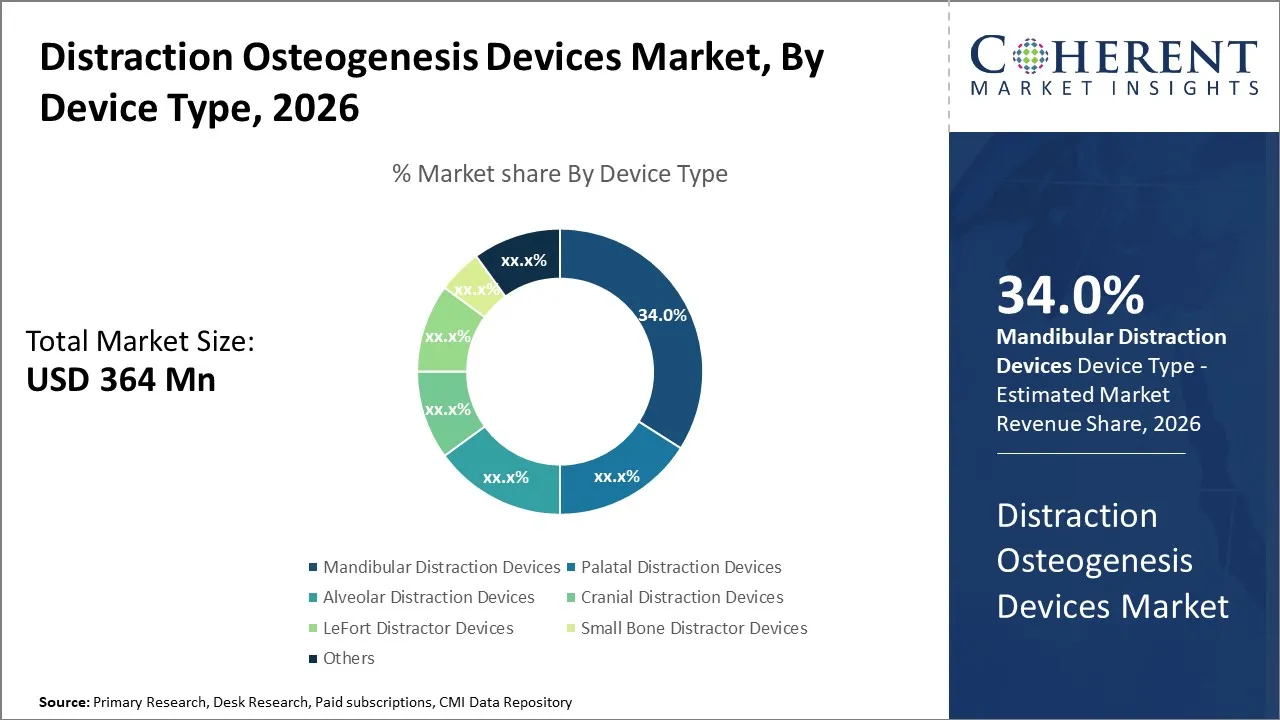
- Mandibular distraction devices are expected to remain the most popular device type in the market, accounting for a revenue share of 34% in 2026, due to their high clinical use in lower jaw (orthognathic) corrections and airway procedures.
- By placement type, external distractors are slated to account for a market share of 60% in 2026 because of their versatility in complex limb-lengthening and multi planar corrections.
- Hospitals are likely to remain the leading end users of distraction osteogenesis devices, accounting for a market share of 55% in 2026, owing to advanced surgery infrastructure, multidisciplinary teams, and higher procedural volumes.
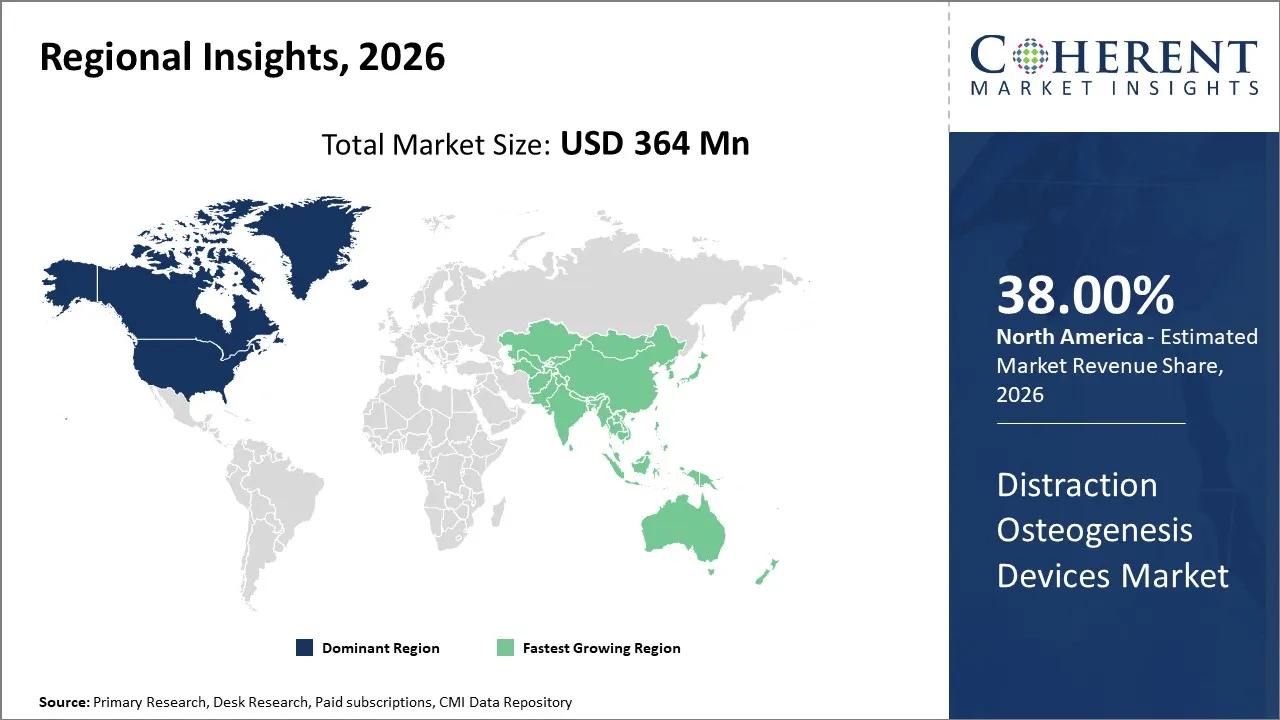
- North America is projected to lead the global distraction osteogenesis devices industry with a share of 38% in 2026, mostly due to strong healthcare infrastructure and early adoption of advanced DO technologies.
- Asia Pacific, with a 22% share in 2026, is poised to emerge as the fastest growing distraction osteogenesis devices market during the forecast period, supported by increasing healthcare investments and growing patient awareness.
Distraction Osteogenesis Devices Market Overview
The global distraction osteogenesis market is poised to record steady growth during the forecast period. This is primarily due to rising prevalence of orthopedic disorders, growing geriatric population prone to bone-related disorders, and advancements in surgical techniques and medical devices. In addition, innovations in distraction osteogenesis devices and rising need for advanced bone lengthening technologies are supporting market expansion.
Distraction osteogenesis (DO), also called callus distraction, callotasis, osteodistraction, or distraction histogenesis, is a surgical process used to reconstruct skeletal deformities and lengthen bones. Depending on the site of application, DO devices can be classified as mandibular (lower jaw), maxillary (upper jaw), alveolar (tooth-bearing regions of the jaws), palatal (roof of the mouth), or craniofacial (skull and facial bones).
Distraction osteogenesis devices are used in orthopedic, maxillofacial, and oral surgery. They are indicated for treating bone defects, correcting limb length discrepancies, and managing craniofacial anomalies such as cleft palate, craniosynostosis, hemifacial microsomia, and other congenital or acquired skeletal deformities. Thus, rising cases of these disorders are expected to boost growth of distraction osteogenesis devices market during the forecast period.
Growing awareness and acceptance of distraction osteogenesis techniques among orthopedic and craniofacial surgeons are driving sales of distraction osteogenesis devices. These procedures are gaining traction due to their improved functional and aesthetic outcomes compared with traditional methods in selected cases. Customization is becoming increasingly important in the distraction osteogenesis industry. The use of 3D printing, advanced imaging, and surgical planning technologies allows the creation of patient‑specific devices designed for each person's anatomy, which can improve treatment outcomes and encourage wider adoption.
Current Events and Their Impact on the Distraction Osteogenesis Devices Market
Current Event | Description and its Impact |
Technological Advancements and AI Integration in Medical Devices |
|
Demographic Shifts and Rising Healthcare Demand |
|
Segmental Insights
- Current Industry Events of 2026
- Market Size Estimation
- Regional Breakdown
- Competitive Landscape
- Customer Intelligence
- Segmental Analysis
- Pricing Analysis
- Key Market Drivers, Challenges & Future Trends
- Customized Insights Section
Which is the Most Sought-After Device Type in the Distraction Osteogenesis Market?
Demand Remains High for Mandibular Distraction Devices
By device type, mandibular distraction devices segment is projected to lead the market, generating a revenue share of 34% in 2026. This is mostly due to their extensive use in correcting congenital and acquired mandibular deformities, increasing prevalence of craniofacial anomalies, and rising awareness among surgeons about minimally invasive corrective procedures.
Mandibular distraction devices are favored due to their precision, ease of application, and ability to stimulate bone growth effectively, which enhances both functional and aesthetic outcomes. In addition, technological advancements such as motorized and bioresorbable devices are also driving adoption in clinical settings.
What Makes External Distractors Popular Globally?
Complex Versatility and Widespread Adoption in Complex Cases
According to Coherent Market Insights’ new distraction osteogenesis devices market analysis, external distractors are expected to account for a market share of 60% in 2026. This is mostly because of their versatility in complex limb-lengthening and multi planar corrections. External distractors are favored worldwide due to their adaptability in treating a variety of craniofacial conditions, including severe micrognathia, hemifacial microsomia, and post-traumatic mandibular defects.
The design of external distractors allows for precise control over bone movement in multiple planes, making them ideal for complex reconstructions. In addition, external devices are often preferred in pediatric and high-risk cases where internal distractors may pose surgical or anatomical limitations, contributing to their strong adoption among craniofacial surgeons globally.
For instance, in clinical series, external distractors were used in approximately 54% of mandibular distraction osteogenesis cases, compared with 46% for internal devices. This indicates a modest preference for external systems in complex or pediatric presentations. As a result, the external distractors segment is likely to retain its market dominance in the coming years.
Regional Insights
North America Leads in Distraction Osteogenesis Device Adoption
North America is expected to lead the global distraction osteogenesis devices market, capturing a share of 38% in 2026. This is driven by a high volume of reconstructive facial procedures in the United States and the presence of advanced care facilities. According to the American Society of Plastic Surgeons’ 2023 procedural data, there were about 1.02 million reconstructive plastic surgery procedures performed in the U.S., including approximately 52,868 maxillofacial surgeries, a category where distraction osteogenesis is often applied.
Specialized craniofacial centers, such as the Cleft and Craniofacial Anomalies Clinic at American Family Children's Hospital and Children's Hospital of Wisconsin, provide comprehensive treatment for congenital and acquired facial defects, supporting market growth. High procedural volumes, robust clinician expertise, and strong research support drive the adoption of innovative techniques, including magnetically actuated distractors and precision-controlled bone regeneration solutions.
Favorable reimbursement policies and broad insurance coverage further enhance patient access, while ongoing R&D and collaboration between manufacturers and hospitals promote advanced device materials and minimally invasive procedures. Rising use of distraction osteogenesis in orthodontics is also expected to contribute to market expansion in North America during the forecast period.
Asia Pacific Emerging as a Central Hub for Distraction Osteogenesis Devices
Asia Pacific is emerging as the fastest growing distraction osteogenesis market, holding a global market share of 22% in 2026. This is mostly due to rapid expansion of healthcare infrastructure, increasing patient awareness of reconstructive surgical options, and rising demand for advanced orthopaedic solutions. Rising incidence of traumatic injuries from accidents and a large population with congenital bone deformities are increasing demand for distraction techniques that can correct limb length discrepancies and skeletal asymmetries.
Another key growth driver in Asia Pacific is the rise of medical tourism and cost-competitive care, attracting international patients to countries such as South Korea and India for distraction osteogenesis treatments at comparatively lower prices. Local manufacturers are also developing affordable distraction devices that meet international quality standards, making these treatments more accessible across urban and semi urban markets. Rising adoption of distraction osteogenesis in dentistry is also fostering revenue growth in the region.
Several global medical technology companies continue to strengthen their presence in the region by establishing local subsidiaries and operations to better serve customers as well as expand geographic reach. For instance, in 2024, Medtronic expanded its investment in the Asia Pacific region by launching its first Robotics Experience Studio in Singapore. It is designed to help hospitals in Southeast Asia use advanced robotics and AI more quickly and to work closely with local healthcare providers and partners.
Distraction Osteogenesis Devices Market Outlook – Country-wise
U.S. Distraction Osteogenesis Devices Market Trends
The U.S. distraction osteogenesis devices market is expected to maintain its leading position globally on account of strong healthcare infrastructure, high procedural volumes, and wide availability of advanced surgical solutions. Increasing demand for corrective bone lengthening procedures, rising incidence of trauma-related fractures, and growing preference for minimally invasive orthopedic and craniofacial surgeries are also supporting market expansion in the region.
A key trend in the U.S. distraction osteogenesis devices market is the fast adoption of advanced distraction systems, such as motorized and precision-controlled internal distractors, which provide better comfort and outcomes for patients. These innovative devices allow surgeons to achieve accurate bone regeneration with fewer complications and shorter recovery times, making them preferred in both specialized hospitals and ambulatory surgical centers across the country.
China Distraction Osteogenesis Devices Market Forecast
The distraction osteogenesis devices market in China is projected to grow rapidly during the forecast period. This is mostly due to expanding healthcare access, increasing surgical volumes, and supportive government initiatives for advanced medical care. The rise in road traffic accidents and sports injuries has led to greater demand for effective orthopedic reconstruction techniques, while an expanding middle class is increasingly seeking corrective procedures for congenital deformities and skeletal discrepancies.
Distraction Osteogenesis Industry News
- In January 2026, Zimmer Biomet launched the Brachiator Mini-Rail External Fixation System. The system is designed for precise reconstruction and stabilization of small bones in the foot and ankle.
- In July 2025, Johnson & Johnson launched the VIRTUGUIDE System, an AI-powered, patient-matched solution. It is designed to support Lapidus procedures, a type of bunion surgery.
Market Report Scope
Distraction Osteogenesis Devices Market Report Coverage
| Report Coverage | Details | ||
|---|---|---|---|
| Base Year: | 2025 | Market Size in 2026: | USD 364 Mn |
| Historical Data for: | 2020 To 2024 | Forecast Period: | 2026 To 2033 |
| Forecast Period 2026 to 2033 CAGR: | 6% | 2033 Value Projection: | USD 548 Mn |
| Geographies covered: |
| ||
| Segments covered: |
| ||
| Companies covered: | Johnson & Johnson, Zimmer Biomet Holdings, Inc., Stryker Corporation, KLS Martin Group, Acumed LLC, OsteoMed, and Titamed. | ||
| Growth Drivers: |
| ||
| Restraints & Challenges: |
| ||
Distraction Osteogenesis Devices Market Drivers
Rising Prevalence of Orthopedic and Skeletal Disorders: The global occurrence of congenital skeletal deformities, including limb length discrepancies, cleft palate, and mandibular hypoplasia, as well as trauma-related bone injuries, is high. According to the This rising burden is boosting demand for distraction osteogenesis devices, because these conditions often require distraction osteogenesis as a key treatment. Thus, increasing cases of skeletal disorders are expected to provide a strong impetus for the growth of distraction osteogenesis market during the forecast period.
Growing Demand for Minimally Invasive Distraction Osteogenesis Procedures: Surgeons and patients in the contemporary world increasingly prefer less invasive bone reconstruction techniques because they offer controlled bone growth with fewer complications. This is leading to higher adoption of distraction osteogenesis devices, thereby boosting market revenue growth.
Distraction Osteogenesis Devices Market Trends
Integration of Smart Technologies The integration of smart technologies in distraction osteogenesis devices, such as built-in sensors and connectivity features, is transforming the field by enabling real-time monitoring of treatment progress. These innovations make distraction protocols more precise and data-driven, allowing clinicians to adjust therapy based on actual patient progress rather than estimations.
Internal Fixators Gaining Traction Internal distractors like magnetically controlled lengthening systems are becoming increasingly preferred because of better aesthetics, lower infection risk, and greater patient comfort. Rising adoption of these internal fixators is expected to boost distraction osteogenesis devices market growth during the assessment period.
Distraction Osteogenesis Devices Market Opportunities
Technological Advancements in Distraction Osteogenesis Device Designs Continuous innovation, such as motorized and magnetic distractors, enhanced biocompatible materials, remote adjustment systems, and smart sensor integration, improves precision as well as enhances patient comfort and outcomes. This makes procedures more efficient and appealing to clinicians and patients alike, thereby creating growth opportunities for the distraction osteogenesis devices market.
Expanding Clinical Applications Traditionally distraction osteogenesis techniques were used for limb lengthening. However, today their scope is expanding significantly. They are now being applied in facial reconstruction, spinal deformity correction, bone defect repair, and even dental/maxillofacial surgeries. These expanding applications are expected to open new revenue streams for manufacturers of distraction osteogenesis devices during the assessment period.
Analyst Opinion (Expert Opinion)
- Academic momentum doesn’t always reflect clinical adoption depth. Over the past four decades, research on distraction osteogenesis has ballooned annual publications grew roughly fifteen‑fold from 1980 to 2021 and remain robust at ~350 papers yearly , but this breadth masks uneven translation into standardized surgical practice globally. Publication volume has plateaued since 2013, suggesting that fundamental DO science is maturing faster than its disruptive innovation curve in clinical orthopedics and craniofacial care. The U.S. and China dominate research output, yet many high‑impact concepts from smaller cohorts have not permeated routine protocols outside specialized centers.
- Functional outcomes expose a nuanced reality. Prospective clinical data indicate that DO delivers predictable bone healing and independent weight‑bearing across limb reconstructions, but this success is highly context‑dependent. In one series, all patients achieved full weight‑bearing by ~12 months, yet concurrent chemotherapy nearly halved the bone healing index compared to non‑chemotherapy cases (2.3 vs 1.2). This isn’t a minor technicality; it quantifies how systemic biologic stressors dramatically modulate DO’s regenerative performance, a factor many device‑centric narratives underplay.
- Clinical heterogeneity highlights protocol fragility. Experimental investigations into mandibular DO show that minor shifts in latency, distraction rate, or consolidation timing materially alter histologic outcomes, underscoring that the biology of DO is not plug‑and‑play. For example, in animal models, a latency of about 5 days with a distraction rate of 1 mm/day worked best for segment lengths under 20 mm, while longer gaps required faster rates. This shows that the procedure is highly sensitive to specific parameters rather than being universally applicable. Such dependency on precise settings helps explain why outcomes still vary across practices even after decades of use.
- Mandibular indications are increasingly compelling but still niche. Meta‑analytic evidence from mandibular DO demonstrates high effectiveness for structural correction and airway management preventing tracheostomy in over 90 % of infants with respiratory compromise and alleviating obstructive sleep apnea in ~97 % of pediatric cases yet these impressive metrics come from select cohorts and older comparative data. The technique’s retention in these hard‑to‑treat niches says less about universal utility and more about DO’s unique value where conventional osteotomies fail. Wider mainstream adoption, especially in non‑craniofacial deformities, still lags behind the compelling positive outcome signals.
Speak to the analyst
Want personalized insights?
Take the findings above to one of our principal consultants, or have the report rebuilt around the segments, geographies and competitors you actually track.
Distraction Osteogenesis Devices Market Segmentation
- By Device Type Insights ( Revenue, USD Mn, 2021 - 2033)
- Mandibular Distraction Devices
- Palatal Distraction Devices
- Alveolar Distraction Devices
- Cranial Distraction Devices
- LeFort Distractor Devices
- Small Bone Distractor Devices
- Others
- By Placement Insights ( Revenue, USD Mn, 2021 - 2033)
- Internal Distractors
- External Distractors
- By End User ( Revenue, USD Mn, 2021 - 2033)
- Hospitals
- Orthopedic Clinics
- Others
- By Region Insights ( Revenue, USD Mn, 2021 - 2033)
- North America
- U.S.
- Canada
- Latin America
- Brazil
- Argentina
- Mexico
- Rest of Latin America
- Europe
- Germany
- U.K.
- Spain
- France
- Italy
- Russia
- Rest of Europe
- Asia Pacific
- China
- India
- Japan
- Australia
- South Korea
- ASEAN
- Rest of Asia Pacific
- Middle East & Africa
- GCC Countries
- Israel
- Rest of Middle East & Africa
- North America
- Key Players in the Distraction Osteogenesis Devices Market
- Johnson & Johnson
- Zimmer Biomet Holdings, Inc
- Stryker Corporation
- KLS Martin Group
- Acumed LLC
- OsteoMed
- Titamed
Sources
Primary Research interviews
- Interviews with Orthopedic Surgeons and Maxillofacial Surgeons
- Interviews with Hospital Procurement Managers
- Interviews with Clinical Engineers
- Interviews with Medical Device Distributors
- Interviews with Key Opinion Leaders in Craniofacial Surgery
Databases
- PubMed
- FDA Medical Device Databases
- ClinicalTrials.gov
- WHO Global Health Observatory
- Indian Council of Medical Research Database
- Ministry of Health & Family Welfare (Government of India) databases
- National Health Service (NHS) Digital
Magazines
- Medical Device News Magazine
- Orthopedic Design & Technology Magazine
- Dental Implantology Today
- HealthTech Insights Magazine
- Surgical Products Magazine
Journals
- Journal of Cranio-Maxillofacial Surgery
- Journal of Orthopaedic Research
- International Journal of Oral and Maxillofacial Surgery
- Journal of Clinical Orthopaedics and Related Research
- Journal of Medical Devices (ASME)
- Journal of Bone and Mineral Research
- European Journal of Orthopaedic Surgery & Traumatology
Newspapers
- The Times of India – Health/Science Section
- The Hindu – Health Plus
- The Guardian – Health & Wellbeing
- New York Times – Health Section
- Wall Street Journal – Health & Science
Associations
- American Association of Oral and Maxillofacial Surgeons (AAOMS)
- International Association of Oral and Maxillofacial Surgeons (IAOMS)
- American Academy of Orthopaedic Surgeons (AAOS)
- British Association of Oral and Maxillofacial Surgeons (BAOMS)
- Indian Orthopaedic Association
- World Dental Federation (FDI)
Public Domain sources
- World Health Organization (WHO) Reports
- Government healthcare expenditure reports
- National registries of surgical procedures
- Patent filings from USPTO, EPO, WIPO
- Clinical Guidelines published by Health Ministries
- Public hospital annual reports
Proprietary Elements
- CMI Data Analytics Tool
- Proprietary CMI Existing Repository of information for last 8 years
Get access to 250+ pages report
Every segment, forecast, competitor profile and data table behind the analysis above — available for instant download.
- ESOMAR Member
- ISO 9001:2015 Certified
- D-U-N-S Registered
- GDPR & CCPA Compliant
Missing comfort of reading report in your local language? Find your preferred language:
Transform your Strategy with Exclusive Trending Reports
Frequently Asked Questions
The global market is estimated to be valued at USD 364 Mn in 2026.
The global Distraction Osteogenesis Devices Market value is expected to reach US$ 548 Mn by 2033.
The global market is poised to exhibit a CAGR of 6% from 2026 to 2033.
Major growth factors include increasing prevalence of skeletal disorders and advancements in distraction osteogenesis technologies
High treatment and device costs are slowing down market growth.
Some major companies in the Distraction Osteogenesis Devices Market include Johnson & Johnson, Zimmer Biomet Holdings, Inc., Stryker Corporation, KLS Martin Group, Acumed LLC, OsteoMed, and Titamed.
North America, with 38% share in 2026, is set to lead the market during the forecast period