

Medical Aesthetics Market Size and Share Analysis - 2026 To 2033
The global medical aesthetics market is expected to grow at a CAGR of 13.7%, moving from USD 31.96 Bn in 2026 to approximately USD 78.76 Bn by 2033. The major factors influencing market growth include the increasing demand for minimally-invasive and non-invasive aesthetic procedures, increasing awareness among consumers about cosmetic procedures, advances in aesthetics device technology, and rising popularity of facial injectable, body contouring, and skin rejuvenation procedures. As per the data provided by International Society of Aesthetic Plastic Surgery, close to 38 million aesthetic procedures have been conducted worldwide in 2024, which includes 20.5 million non-surgical and 17.4 million surgical procedures.
Key Takeaways
- The facial-aesthetics segment is projected to hold the largest market share, accounting for approximately 55.0% of revenue in 2026. The key driving factors responsible for the growth of this market segment include the recurring demand for botulinum toxin injections, dermal fillers, chemical peels, microdermabrasion, and several other facial rejuvenation treatments, owing to their high efficacy and low invasiveness. According to the International Society of Aesthetic Plastic Surgery, about 7.8 million treatments of botulinum toxins and 6.3 million treatments of hyaluronic acid fillers have been performed worldwide in 2024. This represents a growth of 5.2% from 2023.
- The clinics and medical spas segment will dominate the market with an expected share of 70.0% by 2026. This growth is due to the presence of competent aestheticians, high-end injection and energy treatment systems, customized combination treatments, better clinical guidance, and rising trend of performing procedures on an outpatient basis. As per the American Med Spa Association’s industry review in 2024, the number of medical spas in the U.S. has grown from 8,899 to 10,488, which accounts for a growth rate of about 17.9%.
- North America will hold the dominant position in the global medical aesthetics market share with the estimated market share of around 55.5% in 2026. North America’s leading position is supported by high spending on aesthetic treatments, high acceptance of injectable and energy-based solutions, strong availability of plastic surgeons and dermatologists, and early launch of advanced aesthetic products. According to International Society of Aesthetic Plastic Surgery, in 2024, the United States conducted over 6.1 million aesthetic treatments which was the highest among all countries globally.
Market Drivers
Rising Preference for Minimally Invasive and Preventive Aesthetic Treatments
The market for medical aesthetics is growing due to patient preference for treatments that produce visible, natural-looking results with limited downtime and lower procedural burden. This is contributing to the uptake of injectables, skin tightening, microneedling, facial rejuvenation, and other aesthetic procedures performed in offices.
Based on the survey conducted by the American Academy of Facial Plastic and Reconstructive Surgery in 2025 and reported in February 2026, 57 percent of facial plastic surgeons said they have seen an increase in their patient under the age of 30 requesting cosmetic procedures or injectable treatments.
Growing Demand for Facial Rejuvenation Following Rapid Weight Loss
The increasing use of GLP-1 weight-loss therapies is creating a new patient group seeking facial rejuvenation, skin tightening, volume restoration, and body-contouring procedures. Rapid weight loss can contribute to facial volume loss, loose skin, hollow cheeks, and more visible signs of ageing, encouraging patients to consider both surgical and non-surgical aesthetic treatments.
In addition, one in four surveyed surgeons expected GLP-1 use to generate further demand for non-surgical treatments such as dermal fillers and skin-tightening procedures. This trend is expanding the addressable patient population for facial aesthetics and post-weight-loss body-contouring solutions.
In February 2026, the AAFPRS noted that 67% of facial plastic surgeons had witnessed an increase in the number of patients seeking treatment due to quick weight loss, which was an increase of 45 percent from the year before. The association also noted that there was a continued 50 percent increase in the number of facial fat grafts, due to patients having lost too much weight.
Current Events and Their Impact on the Medical Aesthetics Market
Current Event | Description and its Impact |
FDA Issues Safety Communication on Radiofrequency Microneedling Devices (October 2025) |
|
FDA Intensifies Enforcement Against Unapproved Botulinum Toxin Products (November 2025) |
|
- Current Industry Events of 2026
- Market Size Estimation
- Regional Breakdown
- Competitive Landscape
- Customer Intelligence
- Segmental Analysis
- Pricing Analysis
- Key Market Drivers, Challenges & Future Trends
- Customized Insights Section
Segmental Insights
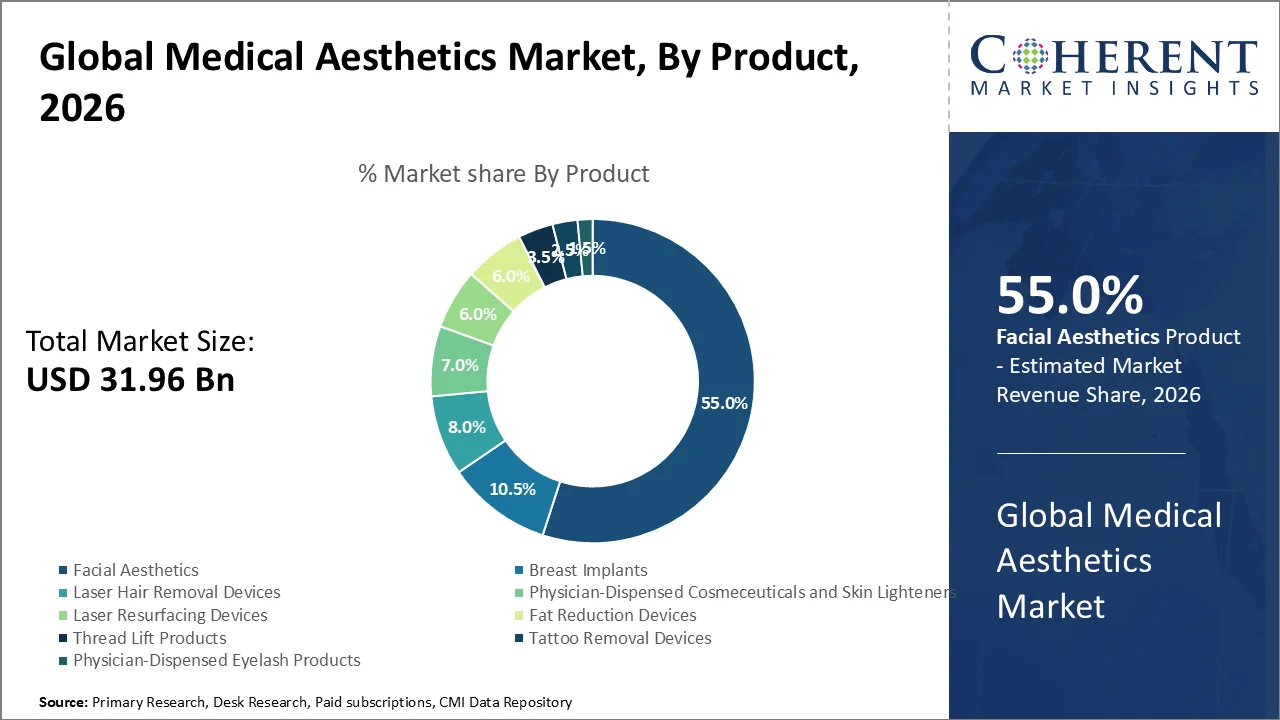
Why Is Facial Aesthetics Acquiring the Largest Share?
On the basis of product, the facial aesthetics segment is projected to account for the largest medical aesthetics market share of approximately 55.0% in 2026. The segment’s growth is driven by strong demand for facial injectables, skin resurfacing, facial implants, eyelid correction, facelifts, rhinoplasty, facial fat grafting, and other minimally invasive rejuvenation procedures.
The American Society of Plastic Surgeons reported 120,755 eyelid surgeries, 79,058 facelift procedures, and 48,423 rhinoplasty procedures performed by its member surgeons in 2024. In addition, 34,260 facial fat-grafting procedures, 24,000 chin-liposuction procedures, and 22,445 neck-lift procedures were recorded.
In July 2026, Allergan Aesthetics, an AbbVie company, announced that Boey (trenibotulinumtoxinE) received approval in Europe for the temporary improvement of moderate-to-severe glabellar lines, commonly known as frown lines, in adult patients.
Clinics and Medical Spas Hold the Largest Market Share
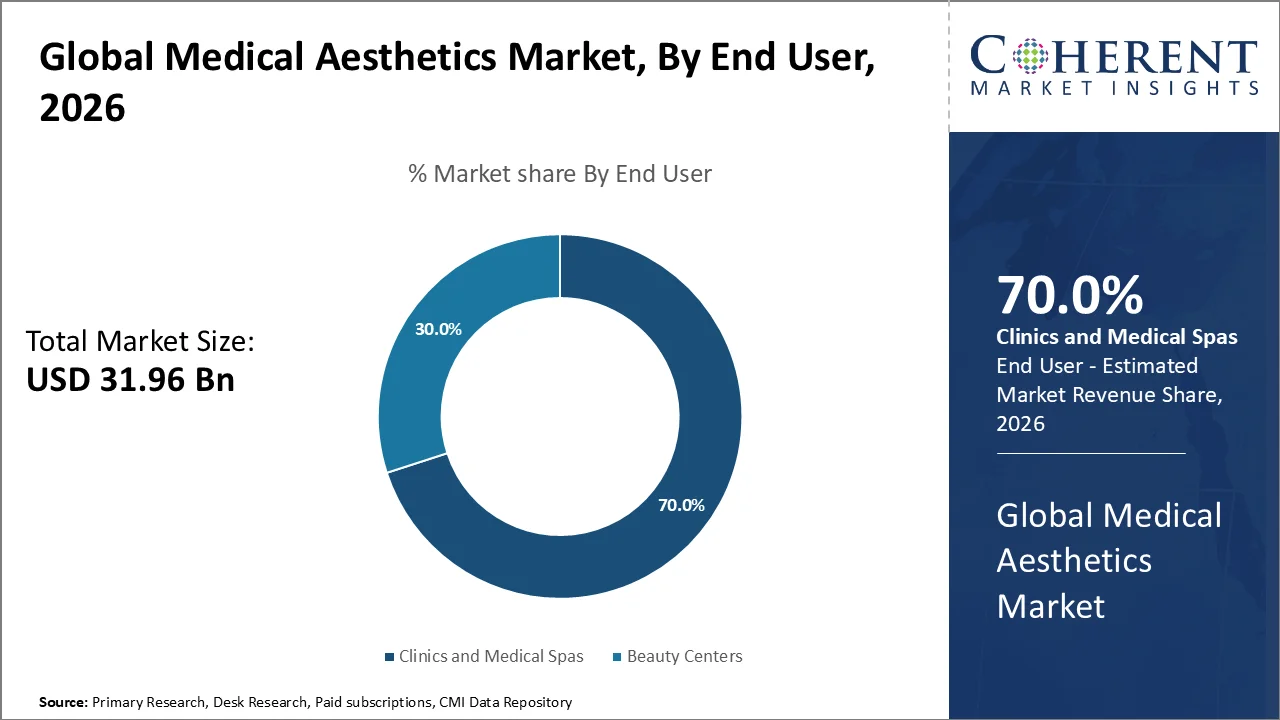
On the basis of end user, the clinics and medical spas segment is projected to lead the medical aesthetics market with an estimated share of approximately 70.0% in 2026. The segment’s dominance is attributed to the availability of qualified practitioners, convenient outpatient treatment settings, broad portfolios of injectables and energy-based procedures, personalized treatment plans, and the recurring nature of aesthetic services.
As per the industry report released by the American Med Spa Association in 2024, an average medical spa had around 245 patients per month, where 73% were repeat patients, compared to 65% in its earlier report. Patients would spend an average amount of around USD 527 per visit.
In May 2026, Advanced MedAesthetic Partners announced the nationwide launch of Avelure Med Spa through 12 locations across Florida, Indiana, Michigan, Missouri, and New York.
Medical Aesthetics Market Trends
- The growing trend towards minimally invasive and doctor-administered aesthetic treatments has been driving up the demand for injectables, lasers, skin resurfacing, and non-invasive body contouring. According to the American Society for Dermatologic Surgery's 2025 survey among 3,500 consumers, 70% were thinking of getting a cosmetic treatment. The top aesthetic issues that people faced were skin texture/darkness at 78%, excess fat in the chin/neck area at 77%, and midface lines, wrinkles and folds at 73%.
- The rising popularity of regenerative aesthetic therapies has increased the market need for biostimulators capable of stimulating collagen production. Galderma informed that their fillers and biostimulators contributed to the net sales revenue of USD 284 million for the first quarter of 2026, recording a year-over-year growth of 14.0%. In addition, Galderma witnessed continued double-digit growth of its Sculptra therapy due to commercial success for regenerative therapies.
- The development of indication-specific fillers with longer-lasting and natural-looking outcomes is increasing treatment personalization. In March 2026, the U.S. FDA approved Restylane Contour for correcting temple hollowing in adults over 21 years of age. Clinical results showed that 91% of patients were responders after three months, while more than 85% remained responders for up to 18 months.
Regional Insights
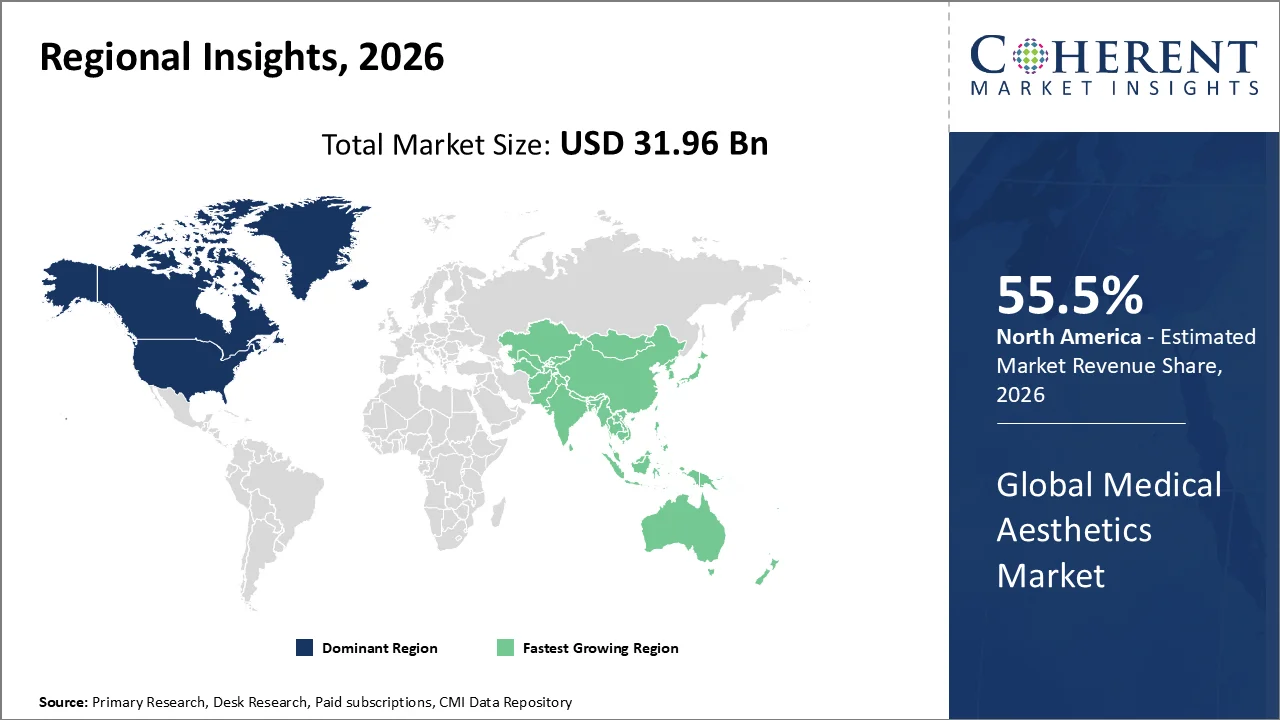
North America Dominates Owing to High Procedure Volumes and Advanced Aesthetic Treatment Infrastructure
The North America region is projected to account for approximately 55.5% of the global medical aesthetics market in 2026. The region’s dominance is supported by high consumer expenditure, a large base of qualified practitioners, widespread availability of clinics and medical spas, and early adoption of facial injectables, laser systems, skin-resurfacing devices, and non-surgical body-contouring technologies. The American Society of Plastic Surgeons reported that U.S. minimally invasive aesthetic procedures increased by approximately 3% in 2024, despite economic uncertainty.
In February 2026, Galderma announced that the U.S. FDA had accepted the resubmission of the Biologics License Application for relabotulinumtoxinA, intended for the temporary improvement of moderate-to-severe frown lines and crow’s feet in adults. This regulatory progress demonstrates the continued expansion of the North American facial-injectables pipeline and may provide aesthetic clinics with additional treatment options.
Asia Pacific Medical Aesthetics Market Trends
Asia Pacific is expected to witness the fastest growth in the medical aesthetics market over the forecast period. The region’s growth is supported by the expansion of aesthetic clinics, increasing availability of trained practitioners, rising acceptance of non-surgical procedures, and growing demand for facial injectables, skin rejuvenation, laser hair removal, and body-contouring treatments.
ISAPS reported that China had approximately 5,000 plastic surgeons in 2024, followed by Japan with 4,000, South Korea with 2,808, and India with 2,800. Together, these four markets represented more than 14,600 plastic surgeons, demonstrating the region’s substantial aesthetic-treatment infrastructure.
In December 2025, Merz Aesthetics launched XEOMIN (incobotulinumtoxinA) and RADIESSE in China, expanding its facial-injectables and regenerative-aesthetics portfolio in one of Asia Pacific’s strategically important markets.
High Procedure Volumes and Continuous Product Innovation Are Accelerating the Medical Aesthetics Market in the United States
The U.S. market for medical aesthetics is registering robust growth because of the immense popularity of minimally invasive procedures, strong infrastructure of skilled physicians, and constant innovations in facial injections, skin resurfacing techniques, and body contouring products.
In July 2026, Croma-Pharma announced U.S. FDA approval of Obagi saypha ChIQ, a hyaluronic acid injectable gel for cheek augmentation and correction of midface contour deficiencies in adults over 21 years of age.
China Medical Aesthetics Market Trends
China is expected to witness strong growth in the medical aesthetics market due to the expansion of regulated injectable portfolios, rising demand for facial contouring and regenerative treatments, and increasing investment by international aesthetics manufacturers in local clinical studies, product approvals, and practitioner education.
China’s injectable portfolio also expanded in January 2025 when Algeness VL received National Medical Products Administration registration as an imported Class III medical device. It became the first officially approved agarose-based injectable filler in China and was authorized for treating nasolabial folds. The approval introduced an alternative to conventional hyaluronic acid fillers and strengthened product diversity within China’s facial-aesthetics market.
In May 2025, Sinclair launched MaiLi Extreme in China following a multicenter Chinese clinical study involving 159 patients receiving chin-augmentation treatment. At six months, investigators recorded a 94.3% improvement rate on the Global Aesthetic Improvement Scale, while 72.6% of patients reported satisfaction.
Who are the Major Companies in Medical Aesthetics Industry
Some of the major key players in Medical Aesthetics Market are Cynosure, Inc., Allergan, Inc., Alma Lasers, Ltd., Mentor Worldwide LLC, Lumenis Ltd., ZELTIQ Aesthetics, Inc., PhotoMedex, Inc., Galderma S.A., Syneron Medical, Ltd., and Solta Medical, Inc.
Key News
- In February 2026, Cynosure Lutronic received regulatory approvals for the Clarity II laser platform in China and Japan. China approved its 755-nm wavelength for cheek-wrinkle treatment and its 1,064-nm wavelength for unwanted body-hair reduction. Japan cleared the platform for long-term hair reduction.
- In March 2025, Alma introduced its latest Alma Harmony aesthetic platform. The system combines five technologies: Q-switched laser, fractional ablative laser, intense pulsed light, non-ablative laser, and green-diode laser.
Market Report Scope
Medical Aesthetics Market Report Coverage
| Report Coverage | Details | ||
|---|---|---|---|
| Base Year: | 2025 | Market Size in 2026: | USD 31.96 Bn |
| Historical Data for: | 2020 To 2024 | Forecast Period: | 2026 To 2033 |
| Forecast Period 2026 to 2033 CAGR: | 13.7% | 2033 Value Projection: | USD 78.76 Bn |
| Geographies covered: |
| ||
| Segments covered: |
| ||
| Companies covered: | Cynosure, Inc., Allergan, Inc., Alma Lasers, Ltd., Mentor Worldwide LLC, Lumenis Ltd., ZELTIQ Aesthetics, Inc., PhotoMedex, Inc., Galderma S.A., Syneron Medical, Ltd., and Solta Medical, Inc. | ||
| Growth Drivers: |
| ||
| Restraints & Challenges: |
| ||
Analyst Opinion
- The medical aesthetics market is increasingly shifting from one-time corrective procedures toward recurring, multi-treatment beauty and wellness routines. A 2026 peer-reviewed survey of 15,155 adults across 15 countries found that 48% had previously received an aesthetic treatment, while 20% were current users of facial injectables, energy-based devices, or facial treatments. Among respondents treated during the preceding 12 months, 58% had received at least two types of treatments.
- Combination therapies are expected to become an important source of differentiation for aesthetic clinics and medical spas. A June 2026 study highlighted by the American Society of Plastic Surgeons evaluated 96 patients treated with face and neck lifting, fat grafting, plasma resurfacing, and regenerative treatments. The approach produced an average four-year improvement in measured skin age, an almost 10-year improvement in elasticity, and a seven-year improvement in wrinkles.
- Clinical education, practitioner training, and product-portfolio breadth will remain central to commercialization. The 2026 Aesthetic & Anti-Aging Medicine World Congress attracted 17,688 attendees, including 13,087 delegates and 507 speakers, and featured more than 350 exhibitors representing over 1,000 brands. The program included 103 scientific sessions and 681 presentations, while nine out of ten surveyed exhibitors indicated that they were likely to return.
Speak to the analyst
Want personalized insights?
Take the findings above to one of our principal consultants, or have the report rebuilt around the segments, geographies and competitors you actually track.
Market Segmentation
- By Product (Revenue, USD Bn, 2021-2033)
- Breast Implants
- Facial Aesthetics
- Laser Hair Removal Devices
- Physician-Dispensed Cosmeceuticals and Skin Lighteners
- Tattoo Removal Devices
- Physician-Dispensed Eyelash Products
- Laser Resurfacing Devices
- Thread Lift Products
- Fat Reduction Devices
- By End User (Revenue, USD Bn, 2021-2033)
- Beauty Centers
- Clinics and Medical Spas
- By Region (Revenue, USD Bn, 2021-2033)
- North America
- U.S.
- Canada
- Latin America
- Brazil
- Mexico
- Argentina
- Rest of Latin America
- Europe
- Germany
- U.K.
- France
- Italy
- Spain
- Russia
- Rest of Europe
- Asia Pacific
- China
- India
- Japan
- Australia
- South Korea
- ASEAN
- Rest of Asia Pacific
- Middle East
- GCC
- Israel
- Rest of Middle East
- Africa
- South Africa
- Central Africa
- North Africa
- North America
Sources
Primary Research Interviews
- Plastic surgeons, dermatologists, and facial aesthetic physicians
- Medical directors and owners of aesthetic clinics and medical spas
- Manufacturers of facial injectables, breast implants, and cosmeceuticals
- Manufacturers of laser, radiofrequency, ultrasound, and body-contouring devices
- Aesthetic-device distributors and authorized product suppliers
- Clinic procurement managers and aesthetic practice administrators
- Regulatory, clinical affairs, and product-development professionals
- Key opinion leaders in cosmetic dermatology and plastic surgery
Databases
- U.S. Food and Drug Administration—510(k), PMA, and Drugs@FDA databases
- ClinicalTrials.gov
- World Health Organization International Clinical Trials Registry Platform
- European Medicines Agency database
- European Commission—EUDAMED and medical-device resources
- Health Canada Medical Devices Active Licence Listing
- Australian Therapeutic Goods Administration database
- Japan Pharmaceuticals and Medical Devices Agency database
- China National Medical Products Administration database
- World Bank
- Organisation for Economic Co-operation and Development
- United Nations Comtrade Database
Magazines
- Modern Aesthetics
- Aesthetic Medicine
- MedEsthetics
- The Aesthetic Guide
- Dermatology Times
- Practical Dermatology
- Plastic Surgery Practice
- Prime Journal
Journals
- Aesthetic Surgery Journal
- Plastic and Reconstructive Surgery
- Dermatologic Surgery
- Journal of Cosmetic Dermatology
- Aesthetic Plastic Surgery
- Lasers in Surgery and Medicine
- Journal of Drugs in Dermatology
- Facial Plastic Surgery & Aesthetic Medicine
- Journal of Clinical and Aesthetic Dermatology
- Clinical, Cosmetic and Investigational Dermatology
Newspapers and Business Publications
- Reuters
- Bloomberg
- The Wall Street Journal
- Financial Times
- The New York Times
- Forbes
- The Economic Times
- Nikkei Asia
Associations
- International Society of Aesthetic Plastic Surgery
- American Society of Plastic Surgeons
- The Aesthetic Society
- American Academy of Facial Plastic and Reconstructive Surgery
- American Society for Dermatologic Surgery
- American Society for Laser Medicine and Surgery
- American Med Spa Association
- European Association of Societies of Aesthetic Plastic Surgery
- British Association of Aesthetic Plastic Surgeons
- International Master Course on Aging Science
Public Domain Sources
- Company annual reports, financial statements, and investor presentations
- Company product-launch, regulatory-approval, and clinical-study announcements
- FDA, EMA, PMDA, NMPA, TGA, and Health Canada regulatory publications
- Clinical-trial registries and peer-reviewed clinical-study publications
- Government healthcare expenditure and demographic databases
- Aesthetic procedure statistics published by professional association
- Medical-device recall, safety communication, and adverse-event databases
- Patent databases, including WIPO, USPTO, EPO, and Google Patents
- Conference presentations, scientific abstracts, and poster publications
- Import–export and customs data for aesthetic devices, implants, and injectables
Proprietary Elements
- CMI Data Analytics Tool
- Proprietary CMI Existing Repository of Information for the Last 10 Years
Get access to 250+ pages report
Every segment, forecast, competitor profile and data table behind the analysis above — available for instant download.
- ESOMAR Member
- ISO 9001:2015 Certified
- D-U-N-S Registered
- GDPR & CCPA Compliant
Missing comfort of reading report in your local language? Find your preferred language:
Transform your Strategy with Exclusive Trending Reports
Frequently Asked Questions
The global Medical Aesthetics Market is expected to increase from USD 31.96 Bn in 2026 to approximately USD 78.76 Bn by 2033.
The Medical Aesthetics Market is anticipated to grow at a CAGR of approximately 13.7% between 2026 and 2033.
Major companies operating in the global market include Cynosure, Inc., Allergan, Inc., Alma Lasers, Ltd., Mentor Worldwide LLC, Lumenis Ltd., ZELTIQ Aesthetics, Inc., PhotoMedex, Inc., Galderma S.A., Syneron Medical, Ltd., and Solta Medical, Inc.
The market is primarily driven by the increasing adoption of minimally invasive and non-invasive procedures, rising demand for facial injectables, growing consumer awareness, expanding medical-spa networks, and technological advancements in laser, radiofrequency, skin-resurfacing, and body-contouring systems.
High treatment and aesthetic-device costs, risks of adverse effects and procedural complications, stringent regulatory requirements, limited insurance reimbursement, and the availability of counterfeit or unapproved products are major challenges affecting market growth.
The facial aesthetics segment is projected to dominate the market with an estimated share of approximately 55.0% in 2026, supported by strong demand for botulinum toxin, dermal fillers, skin resurfacing, facial implants, facelifts, and other facial-rejuvenation procedures.
The clinics and medical spas segment is expected to lead with an estimated share of approximately 70.0% in 2026. Its dominance is supported by qualified practitioners, broad treatment portfolios, clinical supervision, personalized treatment plans, and recurring outpatient procedures.