

Friedreich’s Ataxia Market Size and Share Analysis - 2026 to 2033
The Friedreich’s Ataxia market was valued at USD 793.5 Mn in 2026 and is forecast to reach a value of USD 1,513.1 Mn by 2033 at a CAGR of 10.5% between 2026 and 2033.
Key Takeaways
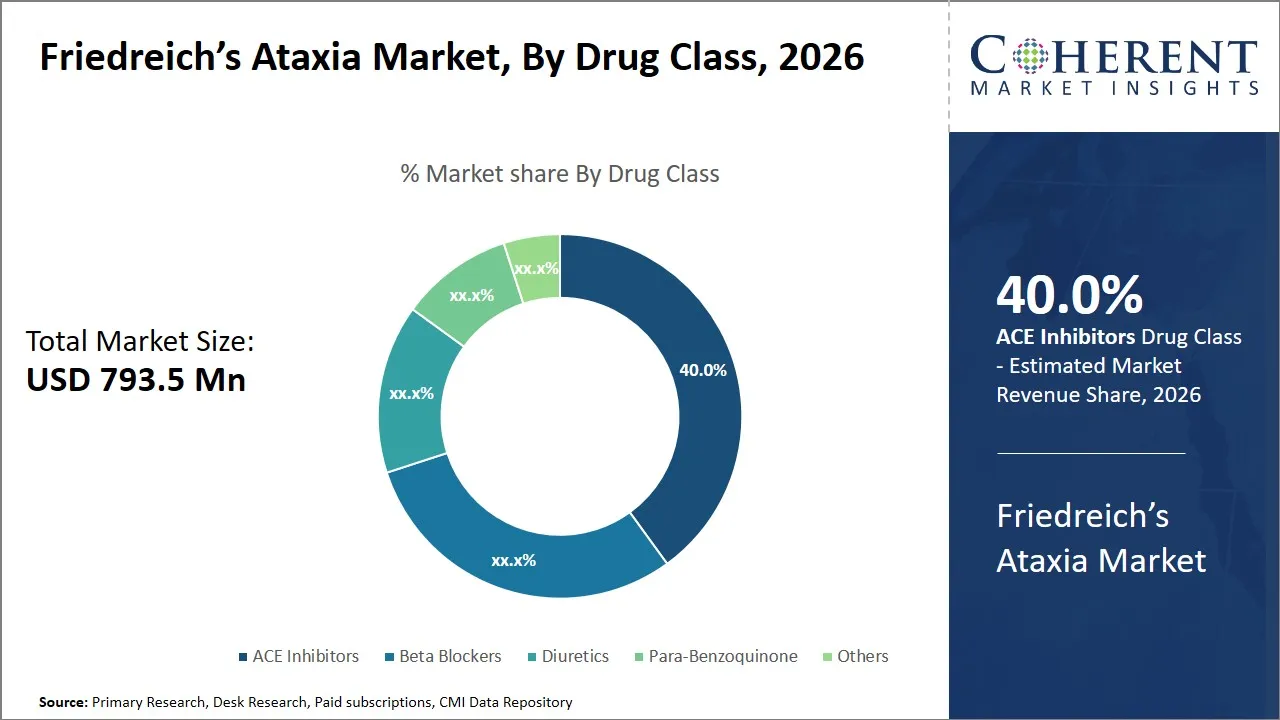
- Based on drug class, the ACE inhibitors segment is expected to hold 40% share of the market in 2026.
- Based on route of administration, the oral segment is projected to account for 72.8% share of the market in 2026.
- Based on distribution channel, the hospital pharmacies segment is projected to capture 48.1% share in 2026.
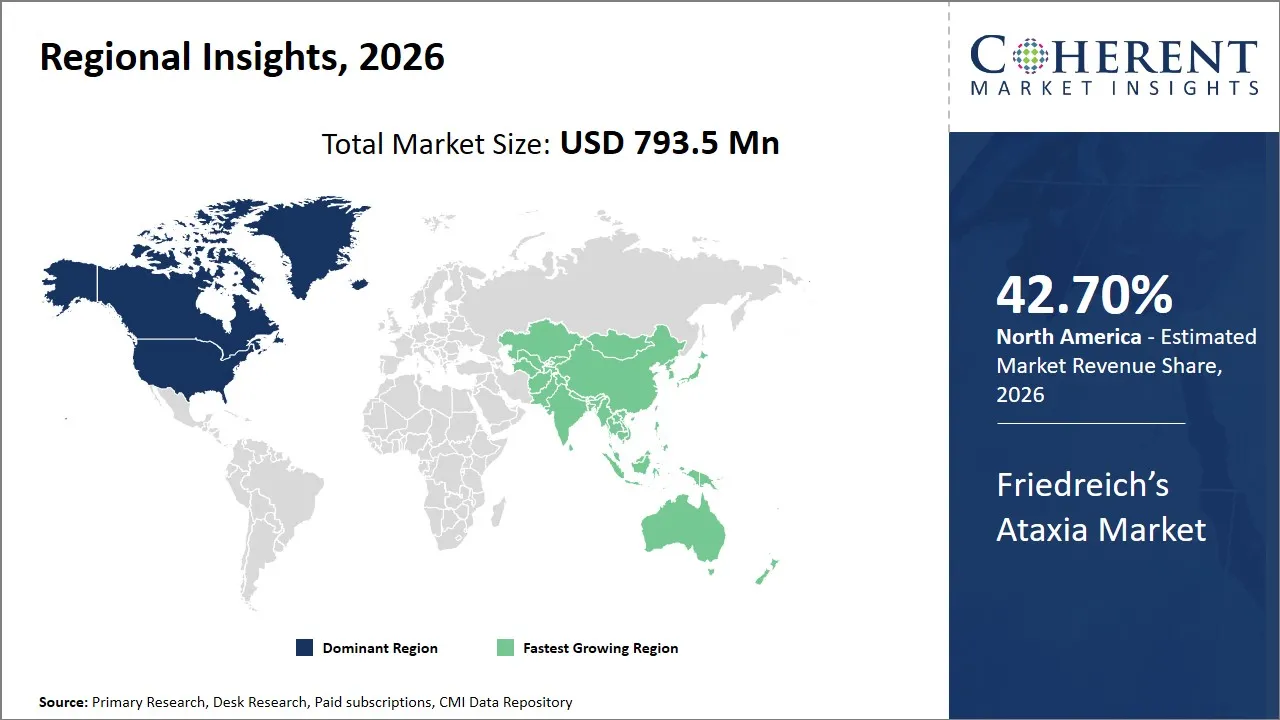
- Based on Region, North America is set to lead the Friedreich’s Ataxia market with 42.7% share in 2026. While, Asia Pacific is anticipated to have the fastest growing region.
Market Overview
The market for Friedreich’s Ataxia therapies is expanding due to increasing disease awareness, improved genetic diagnostics, and growing research investments in rare neurological disorders. Advances in gene therapy, disease-modifying treatments, and supportive care options are driving market growth. Regulatory incentives for orphan diseases and ongoing clinical trials by biotechnology companies are further supporting innovation, creating opportunities for new therapeutic developments and improved patient outcomes in the coming years.
Current Events and their Impacts on the Friedreich’s Ataxia Market
Current Event | Description and its Impact |
Advancements in Gene Therapy for Friedreich’s Ataxia |
|
Strategic Partnerships and Funding Initiatives |
|
Segmental Insights
- Current Industry Events of 2026
- Market Size Estimation
- Regional Breakdown
- Competitive Landscape
- Customer Intelligence
- Segmental Analysis
- Pricing Analysis
- Key Market Drivers, Challenges & Future Trends
- Customized Insights Section
Friedreich’s Ataxia Market Insights, By Drug Class: ACE Inhibitors represent the largest share, owing to their widespread use in managing cardiomyopathy and heart-related complications commonly associated with the disease
In terms of drug class, the ACE inhibitors segment is expected to lead the market with 40% share in 2026, owing to their proven efficacy in managing cardiac complications associated with Friedreich’s Ataxia (FA), particularly cardiomyopathy, which is a leading cause of mortality in FA patients. The progressive cardiac hypertrophy and fibrosis common in FA lead to heart failure, arrhythmia, and other cardiovascular issues, making ACE inhibitors a cornerstone in therapeutic intervention.
For instance, ongoing developments in heart failure therapies, such as Novartis’ Entresto (LCZ696) pediatric safety survey in chronic heart failure patients (September 2025), highlight continued innovation in cardiac care. While not FA-specific, these studies reinforce the central role of ACE inhibitors in managing heart complications and indicate potential future alternatives that could complement standard FA treatment.
Friedreich’s Ataxia Market Insights, By Route of Administration: Oral segment dominate market, owing to its ease of use, patient compliance, and suitability for long-term management of chronic conditions like FA.
In terms of route of administration, the oral segment is expected to hold 72.8% share of the market in 2026. This dominance of the oral segment can be attributed to several key factors intrinsic to patient preferences, therapeutic convenience, and treatment adherence. Oral medications offer ease of administration, greater patient comfort, and reduced need for professional healthcare settings, making them the preferred mode of therapy for chronic conditions such as Friedreich’s Ataxia.
For instance, Minoryx Therapeutics has announced the ongoing development of Leriglitazone (MIN-102), a novel, orally bioavailable, and selective PPAR gamma agonist with potential best-in-class properties for central nervous system (CNS) diseases. As a metabolite of pioglitazone, Leriglitazone demonstrates sufficient brain penetration and a favorable safety profile in humans, enabling effective engagement of PPAR gamma in the CNS beyond levels achievable with traditional glitazones.
Friedreich’s Ataxia Market Insights, By distribution channel: hospital pharmacies leads because FA therapies, including ACE inhibitors and other prescription medications, are often administered under physician supervision
In terms of distribution channel, the hospital pharmacies segment is projected to account for 48.1% share of the market in 2026. This dominance of the Oral segment can be attributed to several key factors intrinsic to patient preferences, therapeutic convenience, and treatment adherence. Oral medications offer ease of administration, greater patient comfort, and reduced need for professional healthcare settings, making them the preferred mode of therapy for chronic conditions such as Friedreich’s Ataxia.
For many patients, managing this progressive neurodegenerative disorder involves long-term treatment regimens, and oral formulations significantly enhance compliance by allowing self-administration without frequent clinical visits or invasive procedures. This is particularly important since Friedreich’s Ataxia patients often face mobility challenges, making in-clinic injectable administration logistically difficult. International non-profit organizations like the Friedreich’s Ataxia Research Alliance (FARA) stress the importance of patient-centered therapies that minimally disrupt daily life, a factor that strongly favors oral medications.
Regional Insights
North America Friedreich’s Ataxia Market Analysis & Trends
North America is expected to dominate the Friedreich’s Ataxia market with 42.70% share in 2026, owing to several critical factors tied to the healthcare infrastructure, research initiatives, and the presence of pivotal patient advocacy groups. The United States, in particular, stands out due to its advanced genetic research capabilities and an established healthcare system that prioritizes rare disease management.
For instance, in June 2025, Design Therapeutics, Inc., a biotech company working on treatments for serious genetic diseases, announced that the first Friedreich’s Ataxia (FA) patient has received an intravenous (IV) dose of DT-216P2. This is part of their RESTORE-FA Phase 1/2 clinical trial, which tests increasing doses of the therapy to evaluate safety and effectiveness.
Asia Pacific Friedreich’s Ataxia Market Analysis & Trends
Asia Pacific is expected to exhibit the fastest growth, due to increasingly sophisticated healthcare infrastructure, expanding patient awareness, and rapidly advancing biotechnology sectors, especially in countries such as Japan, China, South Korea, and India. Recent developments illustrate the rising emphasis on rare genetic disorders, including Friedreich’s Ataxia, as public health priorities in these countries evolve from merely infectious disease control toward managing chronic and genetic illnesses.
In particular, China’s National Health Commission has issued specific policy frameworks supporting rare disease diagnosis and treatment pathways that catalyze research and clinical care for Friedreich’s Ataxia. For example, the China Rare Diseases Registry System, established to collect and analyze patient data for over 70 rare diseases, has progressively included neurodegenerative disorders such as Friedreich’s Ataxia, thus enabling more precise epidemiological understanding and accelerating drug development access.
Friedreich’s Ataxia Market Outlook Country-Wise
The U.S. Friedreich’s Ataxia Market Trends
the U.S. contributes the highest share in the Friedreich’s Ataxia market, owing to a combination of extensive research infrastructure, advanced healthcare systems, and a well-established network of clinical trial centers specializing in rare neurodegenerative disorders. The U.S. leads largely because it houses a concentration of dedicated research institutions such as the National Ataxia Foundation (NAF), which actively funds and supports Friedreich’s Ataxia research and patient advocacy.
For instance, in February 2025, PTC Therapeutics, Inc. announced that the U.S. FDA has accepted its application to approve vatiquinone, a treatment for Friedreich’s Ataxia (FA) in children and adults. The FDA has given the application Priority Review, with a decision expected by August 19, 2025. The company is currently valued at $3.82 billion, and its stock has increased by over 90% in the past year.
China Friedreich’s Ataxia Market Trends
The China subsegment contributes the highest share in the Friedreich’s Ataxia market owing to several critical factors rooted in its extensive healthcare infrastructure developments, growing governmental focus on rare diseases, and expanding research initiatives in neurodegenerative disorders. China’s significant patient population base and rising awareness about rare inherited ataxias underpin its leadership in the region.
For instance, the China Rare Diseases Diagnosis and Treatment Alliance, established under the National Health Commission, has been pivotal in consolidating patient registries and facilitating multi-center clinical research across prominent Chinese hospitals. These efforts have improved diagnostic accuracy and treatment protocols tailored for Friedreich’s Ataxia, helping China maintain its dominant position within APAC.
Market Report Scope
Friedreich’s Ataxia Market Report Coverage
| Report Coverage | Details | ||
|---|---|---|---|
| Base Year: | 2025 | Market Size in 2026: | USD 793.5 Mn |
| Historical Data for: | 2020 To 2024 | Forecast Period: | 2026 To 2033 |
| Forecast Period 2026 to 2033 CAGR: | 10.5% | 2033 Value Projection: | USD 1,513.1 Mn |
| Geographies covered: |
| ||
| Segments covered: |
| ||
| Companies covered: | Reata Pharmaceuticals, Inc., Retrotope Inc., Minoryx, PTC Therapeutics, Design Therapeutics, Inc., Larimar Therapeutics, Inc., Jupiter Neurosciences, Inc., Lexeo Therapeutics, Zydus Lifesciences Ltd., Cipla Limited, GlaxoSmithKline Plc., Aurobindo Pharma Ltd., Sun Pharmaceutical Industries Ltd., Torrent Pharmaceuticals Ltd., and Intas Pharmaceuticals Ltd. | ||
| Growth Drivers: |
| ||
| Restraints & Challenges: |
| ||
Friedreich’s Ataxia Market Driver
Increasing prevalence of Friedreich’s Ataxia globally
The increasing prevalence of Friedreich’s Ataxia (FA) globally is a significant factor propelling the expansion of the Friedreich’s Ataxia market. FA, a rare genetic disorder characterized by progressive damage to the nervous system, leading to symptoms such as gait disturbance, speech problems, and heart disease, has seen a rise in diagnosed cases partly due to improved genetic screening methods and awareness initiatives.
Rising investment in research and development activities
The increasing investment in research and development (R&D) activities is a pivotal factor driving the advancement and growth of the Friedreich’s Ataxia market. Friedreich’s Ataxia, a rare inherited neurodegenerative disorder characterized by progressive damage to the nervous system and impaired muscle coordination, has long been an area with limited therapeutic options. However, heightened funding and focus on innovative research programs are fostering the discovery and development of novel treatment candidates and diagnostic tools.
Friedreich’s Ataxia Market Opportunity
Development of novel gene editing and therapy techniques
The development of novel gene editing and therapy techniques presents a transformative opportunity within the Friedreich’s Ataxia (FA) market, fundamentally reshaping treatment paradigms for this rare neurodegenerative disorder. Friedreich’s Ataxia is primarily caused by a genetic mutation resulting in the deficiency of frataxin, a protein vital to mitochondrial function. Traditional therapeutic approaches have largely focused on symptom management and slowing disease progression, often with limited efficacy.
Analyst Opinion (Expert Opinion)
The Friedreich’s Ataxia (FA) market is witnessing significant momentum driven by growing awareness of this rare genetic disorder and advancements in therapeutic research. Key drivers include increasing investments in gene therapy and innovative drug development focused on symptom management and disease modification. Additionally, rising diagnosis rates due to improved genetic testing contribute to greater patient identification, fueling demand for targeted treatments.
However, the market faces notable challenges such as the complex pathophysiology of Friedreich’s Ataxia and limited understanding of its progression, which hinder rapid drug development. Furthermore, high treatment costs and a relatively small patient population limit widespread commercial viability, posing restraint on market expansion.
On the opportunity front, ongoing clinical trials exploring novel molecules and the potential of gene-editing technologies offer promising avenues to address unmet medical needs. Collaborations between pharmaceutical companies, research institutions, and patient advocacy groups are also enhancing innovation and facilitating faster regulatory approvals.
Geographically, North America dominates the Friedreich’s Ataxia market, driven by advanced healthcare infrastructure, availability of funding, and a strong presence of key market players. Europe follows closely, benefiting from robust rare disease frameworks and increasing government support. Meanwhile, the Asia-Pacific region is emerging as the fastest-growing market due to improving healthcare access and rising awareness.
Speak to the analyst
Want personalized insights?
Take the findings above to one of our principal consultants, or have the report rebuilt around the segments, geographies and competitors you actually track.
Global Friedreich’s Ataxia Market: Key Developments
- In February 2026, Everest Clinical Research and the Friedreich’s Ataxia Research Alliance (FARA) announced a partnership to make FA patient data easier to access and use, aiming to speed up the development of new treatments for Friedreich’s Ataxia.
- In February 2026, Solaxa Inc. announced a global agreement with Alvogen to develop SLX-100, a potential treatment for Spinocerebellar Ataxia Type 27B (SCA27B). The partnership will help continue clinical trials and could make the therapy available worldwide.
- In February 2026, announced that the U.S. FDA has given Breakthrough Therapy Designation to nomlabofusp, a treatment for children and adults with Friedreich’s Ataxia.
- In February 2026, the Oxford-Harrington Rare Disease Centre announced that five Oxford researchers received funding from the FA Alliance Innovation Fund to develop new treatments for Friedreich’s Ataxia.
Market Segmentation
- By Drug Class
- ACE Inhibitors
- Beta Blockers
- Diuretics
- Para-Benzoquinone
- Others (Vitamin E, Immunomodulators, Skeletal Muscle Relaxants, and Anti-Epileptic Drugs, among others)
- By Route of Administration
- Oral
- Injectable
- By Distribution Channel
- Hospital Pharmacies
- Retail Pharmacies
- Online Pharmacies
- By Region
- North America
- U.S.
- Canada
- Latin America
- Brazil
- Argentina
- Mexico
- Rest of Latin America
- Europe
- Germany
- U.K.
- Spain
- France
- Italy
- Russia
- Rest of Europe
- Asia Pacific
- China
- India
- Japan
- Australia
- South Korea
- ASEAN
- Rest of Asia Pacific
- Middle East & Africa
- GCC Countries
- Israel
- Rest of Middle East & Africa
- North America
- Key Players
- Reata Pharmaceuticals, Inc.
- Retrotope Inc.
- Minoryx
- PTC Therapeutics
- Design Therapeutics, Inc.
- Larimar Therapeutics, Inc.
- Jupiter Neurosciences, Inc.
- Lexeo Therapeutics
- Zydus Lifesciences Ltd.
- Cipla Limited
- GlaxoSmithKline Plc.
- Aurobindo Pharma Ltd.
- Sun Pharmaceutical Industries Ltd.
- Torrent Pharmaceuticals Ltd.
- Intas Pharmaceuticals Ltd
Sources
Primary Research Interviews
- Neurologists specializing in Friedreich’s Ataxia
- Clinical Researchers in neurodegenerative diseases
- Pharmaceutical company R&D heads focused on rare diseases
- Healthcare payers and insurance specialists
- Others
Databases
- GlobalData
- EvaluatePharma
- ClinicalTrials.gov
- Others
Magazines
- Neurology Today
- Rare Disease Report
- Genetic Engineering & Biotechnology News
- Others
Journals
- The Journal of Neurology
- Neuroscience & Therapy
- Movement Disorders
- Orphanet Journal of Rare Diseases
- Others
Newspapers
- The New York Times (Health Section)
- The Guardian (Science Section)
- Reuters Health News
- Others
Associations
- Friedreich’s Ataxia Research Alliance (FARA)
- Rare Diseases International
- National Organization for Rare Disorders (NORD)
- European Friedreich’s Ataxia Consortium for Translational Studies (EFACTS)
- Others
Public Domain Sources
- World Health Organization (WHO)
- U.S. National Institutes of Health (NIH)
- Centers for Disease Control and Prevention (CDC)
- Orphanet
- Others
Proprietary Elements
- CMI Data Analytics Tool
- Proprietary CMI Existing Repository of Information for the Last 8 Years
Get access to 250+ pages report
Every segment, forecast, competitor profile and data table behind the analysis above — available for instant download.
- ESOMAR Member
- ISO 9001:2015 Certified
- D-U-N-S Registered
- GDPR & CCPA Compliant
Missing comfort of reading report in your local language? Find your preferred language:
Transform your Strategy with Exclusive Trending Reports
Frequently Asked Questions
The global Friedreich’s Ataxia Market size was valued at USD 793.5 Mn in 2026 and is expected to reach USD 1,513.1 Mn in 2033.
Major players operating in the market include Reata Pharmaceuticals, Inc., Retrotope Inc., Minoryx, PTC Therapeutics, Design Therapeutics, Inc., Larimar Therapeutics, Inc., Jupiter Neurosciences, Inc., Lexeo Therapeutics, Zydus Lifesciences Ltd., Cipla Limited, GlaxoSmithKline Plc., Aurobindo Pharma Ltd., Sun Pharmaceutical Industries Ltd., Torrent Pharmaceuticals Ltd., and Intas Pharmaceuticals Ltd.
Among drug class, the ACE Inhibitors segment estimated significant revenue in 2026.
High burden of Friedreich's ataxia and rapid research and development activities for development of novel therapeutics for Friedreich's ataxia treatment are expected to drive the market growth over the forecast period.
The market is estimated to exhibit a CAGR of 10.5% till 2033.
Among region, North America is expected to witness significant growth over the forecast period.