

Huntington’s Disease Treatment Market Size and Share Analysis – 2026 To 2033
The global Huntington’s disease treatment market size is projected to grow from USD 766 Mn in 2026 to USD 4,197 Mn by 2033, registering a compound annual growth rate (CAGR) of 23.8% during the forecast period (2026–2033). This growth is driven by increasing prevalence of Huntington’s disease, rising investment in gene and RNA-based therapies, growing pipeline of disease-modifying treatments, and advancements in neurodegenerative disorder research and precision medicine approaches. About 41,000 Americans have symptomatic Huntington’s Disease, while more than 200,000 are at risk of inheriting it.
Key Takeaways
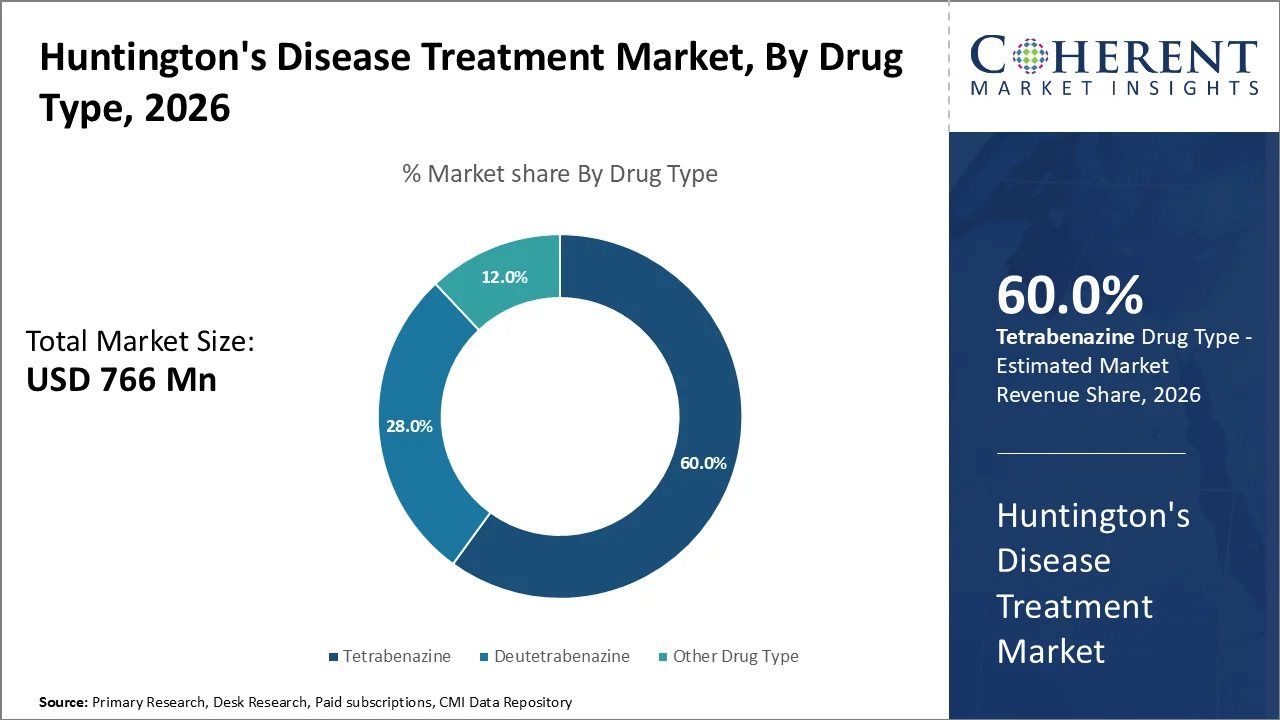
- Tetrabenazine are expected to dominate the market with 60% share in 2026, driven by their role as the only FDA-approved symptomatic therapies for Huntington’s disease chorea. The National Institute of Neurological Disorders and Stroke (NINDS) further states that Huntington’s disease has no cure, and treatment is purely symptomatic, primarily targeting motor symptoms like chorea affecting 90% of patients.
- Based on distribution channel, hospital pharmacies are anticipated to hold 47% share in 2026, as Huntington’s disease treatment requires neurologist supervision, dose titration, and long-term monitoring of psychiatric and motor side effects. Clinical literature supported by peer-reviewed studies shows that VMAT2 inhibitors require careful monitoring due to adverse effects such as depression, somnolence, and dose adjustment needs, leading to higher reliance on hospital-based dispensing.
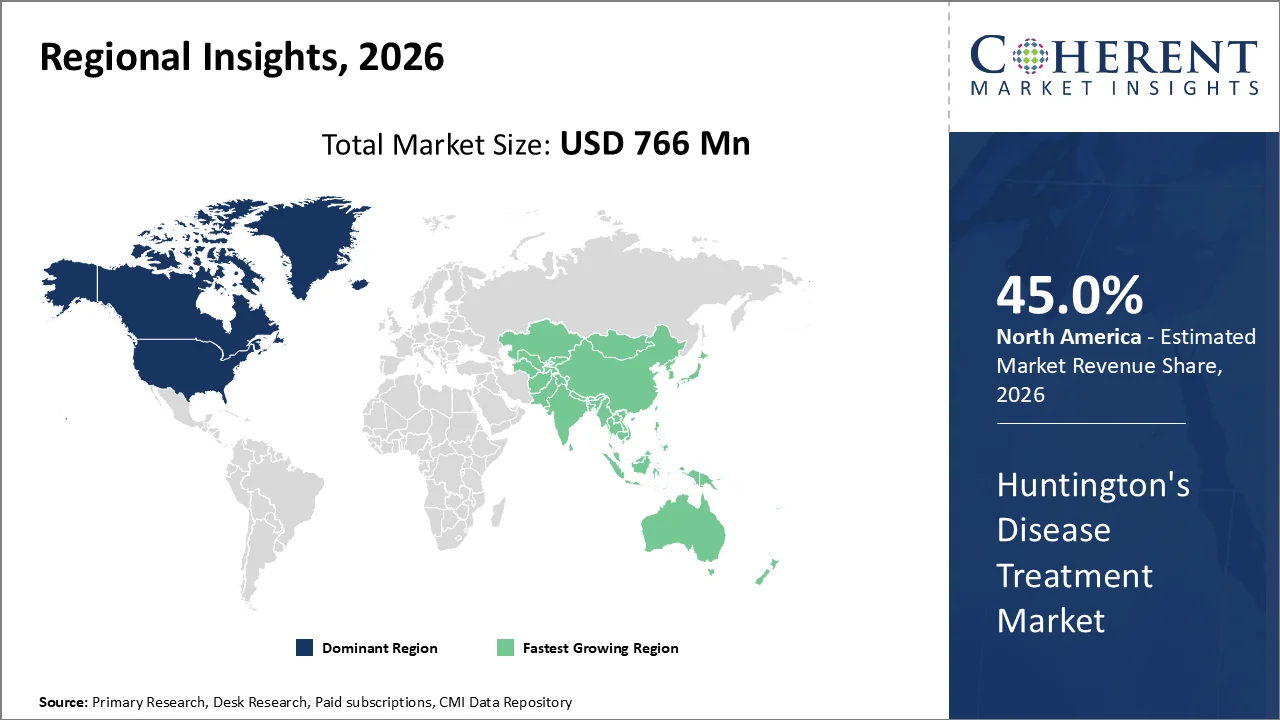
- The North American region is projected to account for the largest market share of 45% by 2026 owing to increased diagnosis levels, genetic testing availability, and superior infrastructure of neurological treatment facilities. According to the U.S. National Library of Medicine (GeneReviews – NCBI), Huntington’s disease prevalence in North America is 8.87 per 100,000 population, among the highest globally, reflecting strong disease identification and treatment demand.
Segmental Insights
Why do Tetrabenazine Dominate the Huntington’s Disease Treatment Market?
Tetrabenazine is expected to account for around 60% of the Huntington’s disease treatment market share in 2026, making them the dominant drug class in the segment. Tetrabenazine dominates the treatment of Huntington's disease due to its approval as a treatment drug by the Food and Drug Administration (FDA). It is the only approved treatment drug that focuses on Huntington's chorea.
The U.S. Food and Drug Administration (FDA) has approved tetrabenazine as the first treatment for Huntington’s chorea, while deutetrabenazine is a next-generation VMAT2 inhibitor with improved tolerability and reduced side effects.
- Current Industry Events of 2026
- Market Size Estimation
- Regional Breakdown
- Competitive Landscape
- Customer Intelligence
- Segmental Analysis
- Pricing Analysis
- Key Market Drivers, Challenges & Future Trends
- Customized Insights Section
Why do Hospital Pharmacies Dominate the Huntington’s Disease Treatment Market?
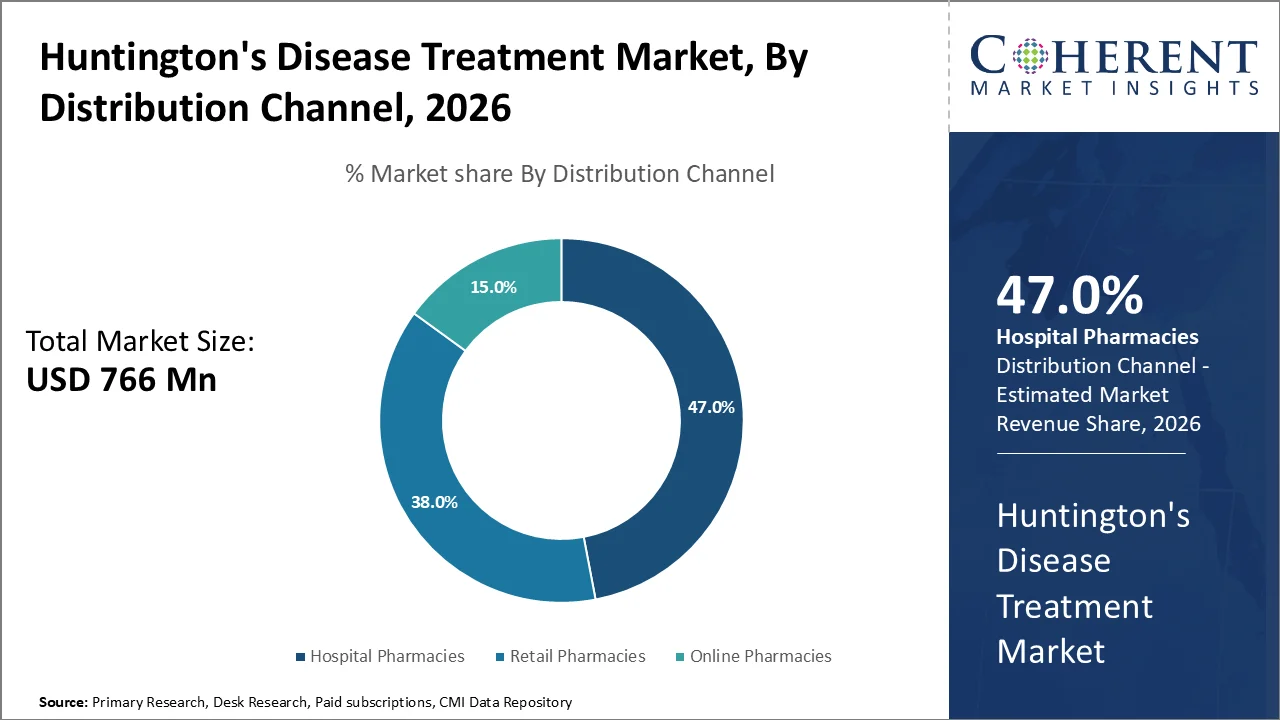
Hospital pharmacies are expected to capture a significant 47% market share by 2026, becoming the most dominant distribution channel in the HD therapeutics market. The reason behind the dominance is the complexity involved in managing the condition that requires neurologist oversight, dosage adjustment, and evaluation of psychiatric and motor symptoms.
As per the National Institute of Neurological Disorders and Stroke (NINDS), Huntington’s disease requires a multi-disciplinary treatment approach by doctors specializing in neurology and psychiatry because of the disease's progressive nature and involvement of the brain.
In April 2025, the FDA granted Breakthrough Therapy Designation to AMT-130, a gene therapy for Huntington’s disease, accelerating its development pathway and reinforcing the need for hospital-based clinical administration and monitoring infrastructure.
Market Driver
High Disease Burden and Progressive Neurodegeneration is Driving the Huntington’s Disease Treatment Market Globally
Huntington’s disease is a progressive, inherited neurodegenerative disorder that leads to deterioration of motor control, cognition, and psychiatric function. As per the National Institute of Neurological Disorders and Stroke (NINDS), the disease progressively worsens over time and currently has no cure, making long-term symptomatic treatment essential for patient care.
Clinical evidence shows that chorea affects approximately 90% of patients, making it one of the most common and disabling symptoms requiring continuous pharmacological management.
Increasing Genetic Testing and Early Diagnosis is Expanding the Treated Patient Population
The increasing use of genetic testing technology has helped achieve an early diagnosis of Huntington's disease, even prior to the manifestation of symptoms.
As stated by, NCBI GeneReviews, Huntington’s disease is a monogenic autosomal dominant disorder, and genetic testing can confirm diagnosis with nearly 100% accuracy in symptomatic individuals.
The National Human Genome Research Institute (NHGRI) confirms that predictive genetic testing allows identification of individuals at risk before symptoms appear, significantly increasing early medical intervention rates.
Current Events and Their Impact on the Huntington’s Disease Treatment Market
Current Event | Description and its Impact |
Rising Adoption of Predictive Genetic Testing and Early Diagnosis Programs |
|
Expansion of Gene Therapy Clinical Trials and FDA Fast-Track Approvals |
|
Huntington’s Disease Treatment Market Trends
- Rising global prevalence is expanding the patient pool: The global prevalence of Huntington’s disease is approximately 4.88 per 100,000 people, with higher rates in North America and Europe, increasing long-term treatment demand.
- Expansion of predictive genetic testing is enabling earlier diagnosis: Predictive genetic testing allows identification of at-risk individuals before symptom onset, leading to earlier monitoring and increased treatment initiation rates.
- Strong orphan drug incentives are accelerating drug development: Huntington’s disease qualifies as a rare disease (affecting fewer than 200,000 patients in the U.S.), enabling FDA incentives such as fast-track approval and market exclusivity.
Regional Insights
Strong Genetic Testing and Advanced Neurology Infrastructure Making North America a Dominant Market
The North American region will have the highest market share for Huntington’s disease treatments in 2026, with about 45% shares attributed to its high rates of diagnosis, superior facilities for genetic testing, and well-developed neurological health care.
Moreover, the prevalence of Huntington’s disease is about 4-10 cases for every 100,000 individuals in North America and Europe, while more diagnoses have been made in the United States because of superior testing systems.
In April 2025, uniQure announced that the U.S. Food and Drug Administration (FDA) granted Breakthrough Therapy Designation to AMT-130, an investigational gene therapy for Huntington’s disease.
Asia Pacific region is expected to be the fastest growing market due to rising neurodegenerative disease burden
The Asia-Pacific region is anticipated to have the highest growth rate in the Huntington’s disease treatment market due to rising awareness about neurological disorders, enhanced diagnosis, and increased access to genetic tests and specialist care.
In May 2025, PTC Therapeutics announced that its Phase 2 PIVOT-HD study of PTC518 (votoplam) met its primary endpoint, demonstrating dose-dependent lowering of huntingtin (HTT) protein levels and encouraging trends in neurodegeneration biomarkers, supporting further development as a potential disease-modifying oral therapy for Huntington’s disease.
U.S. Huntington’s Disease Treatment Market Trends
The U.S. Huntington’s disease (HD) treatment market is projected to show considerable growth over the forecast period due to several factors. The major growth drivers include greater accessibility to novel clinical trials, presence of biotechnological companies in the industry, increased uptake of precision medicine, and growing regulations for rare neurodegenerative diseases.
In April 2025, Roche announced an update on its Phase II GENERATION HD2 trial of tominersen, confirming that an independent monitoring committee recommended continuation of the study after no safety concerns were observed, and that the 100 mg dose showed stronger potential clinical benefit in early-stage Huntington’s disease patients in the U.S. trial program.
China Huntington’s Disease Treatment Market Forecast
China will continue to be an emerging market for HD therapy, although one that is developing at a rapid rate. The growth will be attributed to increased knowledge about rare neurological diseases, advances in genomic medicine capabilities, higher spending on health care, and evolving rare disease policy frameworks.
Huntington’s disease has a low but increasing reported prevalence in China, estimated at approximately 0.1–1 per 100,000 people, which is significantly lower than Western regions. This lower prevalence is primarily attributed to historical underdiagnosis, limited genetic screening coverage, and lower awareness of rare neurodegenerative disorders.
Who are the Major Companies in Huntington’s Disease Treatment Industry
Some of the major key players in Huntington’s Disease Treatment are Valeant Pharmaceuticals International Inc., Alnylam Pharmaceuticals Inc., Ceregene Inc., Lundbeck, Prana Biotechnology Limited, Teva Pharmaceutical Industries Ltd., Cortex Pharmaceuticals Inc., Vertex Pharmaceuticals Incorporated, Auspex Pharmaceuticals, SOM Biotech, GlaxoSmithKline, Siena Biotech, Raptor Pharmaceutical, Pfizer limited, Palobiofarma S.L, Omeros and Ipsen.
Key Strategies Adopted by Industry Players
- In February 2025, Alnylam announced continued progress in its ALN-HTT02 siRNA program for Huntington’s disease, reporting ongoing Phase 1 study enrollment and confirming development of a novel exon-1 targeting approach to reduce mutant huntingtin (HTT) protein.
Market Report Scope
Huntington’s Disease Treatment Report Coverage
| Report Coverage | Details | ||
|---|---|---|---|
| Base Year: | 2025 | Market Size in 2026: | USD 766 Mn |
| Historical Data for: | 2020 To 2024 | Forecast Period: | 2026 To 2033 |
| Forecast Period 2026 to 2033 CAGR: | 23.8% | 2033 Value Projection: | USD 4,197 Mn |
| Geographies covered: |
| ||
| Segments covered: |
| ||
| Companies covered: | Valeant Pharmaceuticals International Inc., Alnylam Pharmaceuticals Inc., Ceregene Inc., Lundbeck, Prana Biotechnology Limited, Teva Pharmaceutical Industries Ltd., Cortex Pharmaceuticals Inc., Vertex Pharmaceuticals Incorporated, Auspex Pharmaceuticals, SOM Biotech, GlaxoSmithKline, Siena Biotech, Raptor Pharmaceutical, Pfizer limited, Palobiofarma S.L, Omeros and Ipsen. | ||
| Growth Drivers: |
| ||
| Restraints & Challenges: |
| ||
Analyst Opinion
- Huntington’s disease treatment market is driven by a high unmet medical need, as there is currently no widely approved curative therapy, creating strong demand for disease-modifying solutions.
- The market trend includes the shift from symptomatic treatments to gene- and RNA-targeting treatments, with HTT reduction therapies (ASO, siRNA, gene therapy) likely setting new standards for treatment.
- Increasing clinical success signals from late-stage pipelines such as gene therapy (AMT-130) and oral HTT-lowering drugs (PTC518) are improving long-term market confidence and investment momentum.
- Despite low prevalence, the market is highly valuable due to lifelong disease progression, high treatment burden, and increasing genetic diagnosis rates, which expand the identified patient pool.
- The market will have strong growth potential owing to fast regulatory approval for orphan neurological diseases in the U.S. and Europe, ensuring faster commercialization of treatments.
Speak to the analyst
Want personalized insights?
Take the findings above to one of our principal consultants, or have the report rebuilt around the segments, geographies and competitors you actually track.
Market Segmentation
- By Drug Type (Revenue, USD Mn, 2021-2033)
- Tetrabenazine
- Deutetrabenazine
- Other Drug Type
- By Distribution Channel (Revenue, USD Mn, 2021-2033)
- Hospital Pharmacies
- Retail Pharmacies
- Online Pharmacies
- By Region (Revenue, USD Mn, 2021-2033)
- North America
- U.S.
- Canada
- Latin America
- Brazil
- Mexico
- Argentina
- Rest of Latin America
- Europe
- Germany
- U.K.
- France
- Italy
- Spain
- Russia
- Rest of Europe
- Asia Pacific
- China
- India
- Japan
- Australia
- South Korea
- ASEAN
- Rest of Asia Pacific
- Middle East
- GCC
- Israel
- Rest of Middle East
- Africa
- South Africa
- Central Africa
- North Africa
- North America
Sources
Primary Research interviews
- Interviews with neurologists, genetic counselors, movement disorder specialists, clinical trial investigators, pharmaceutical R&D heads, biotech pipeline managers, and rare disease key opinion leaders (KOLs) involved in Huntington’s disease treatment development
Databases
- ClinicalTrials.gov (U.S. National Library of Medicine)
- NCBI GeneReviews and PubMed medical literature database
- World Health Organization (WHO) rare disease and neurological disorder datasets
- National Institute of Neurological Disorders and Stroke (NINDS) data repositories
- European Medicines Agency (EMA) clinical and orphan drug databases
- U.S. FDA drug approval and orphan drug designation database
Magazines
- Nature Medicine
- The Lancet Neurology
- Neurology Today
- Fierce Biotech
- BioCentury
- Endpoints News
Journals
- Journal of Huntington’s Disease
- Movement Disorders Journal
- Neurotherapeutics Journal
- Brain: A Journal of Neurology
- Nature Reviews Neurology
- Lancet Neurology (peer-reviewed publications)
Newspapers
- Reuters Health
- Bloomberg Healthcare News
- Financial Times (Life Sciences coverage)
- Wall Street Journal (Pharma & Biotech section)
- STAT News (biotech and rare disease reporting)
Associations
- Huntington’s Disease Society of America (HDSA)
- European Huntington Association (EHA)
- CHDI Foundation (Huntington’s disease research consortium)
- National Institutes of Health (NIH)
- National Human Genome Research Institute (NHGRI)
- International Parkinson and Movement Disorder Society (MDS)
Public Domain sources
- U.S. FDA drug approval database and orphan drug listings
- European Medicines Agency (EMA) public assessment reports
- National Library of Medicine (NCBI) publications and clinical reviews
- WHO neurological disorder fact sheets
- Company investor relations filings and annual reports (Roche, PTC Therapeutics, uniQure, Teva, etc.)
- Clinical trial registry data (global HD trials)
Proprietary Elements
- CMI Data Analytics Tool
- Proprietary CMI Existing Repository of information for last 10 years
Get access to 250+ pages report
Every segment, forecast, competitor profile and data table behind the analysis above — available for instant download.
- ESOMAR Member
- ISO 9001:2015 Certified
- D-U-N-S Registered
- GDPR & CCPA Compliant
Missing comfort of reading report in your local language? Find your preferred language:
Transform your Strategy with Exclusive Trending Reports
Frequently Asked Questions
The global market is estimated to be valued at USD 766 Mn in 2026.
The global market value is expected to reach USD 4,197 Mn by 2033.
The global market is projected to grow at a CAGR of 23.8% from 2026 to 2033.
Key growth drivers include increasing prevalence of Huntington’s disease, rising adoption of gene and RNA-based therapies, expansion of genetic testing, and strong pipeline of disease-modifying treatments.
The tetrabenazine segment, with around 60% share in 2026, dominates due to its role as a key FDA-approved symptomatic therapy for chorea.
Hospital pharmacies, with about 47% share in 2026, dominate due to need for neurologist supervision, dose adjustment, and long-term patient monitoring.
North America, with around 45% share in 2026, leads the market due to higher diagnosis rates, advanced genetic testing, and strong healthcare infrastructure.