

Idiopathic Pulmonary Fibrosis Market Size and Forecast
Idiopathic Pulmonary Fibrosis Market is estimated to be valued at USD 5,390.6 Mn in 2026 and is expected to reach USD 9,791.0 Mn in 2033, exhibiting a compound annual growth rate (CAGR) of 8.9% from 2026 to 2033.
Key Takeaways
- By Drug, Pirfenidone acquired the prominent share of 51.5% in 2026 as proven clinical efficacy & safety.
- By Route of Administration, Oral holds the largest market share in 2026 as patient convenience & treatment adherence.
- By Distribution Channel, Hospital Pharmacies dominates the overall market in 2026 owing to central role in clinical trials & new therapies.
- By Region, North America dominates the overall market with an estimated share of 37.8% in 2026 as access to approved antifibrotics & generics.
Market Overview
Aging populations, rising awareness, and increasing disease prevalence are steadily expanding the idiopathic pulmonary fibrosis (IPF) market. Approved antifibrotic drugs like pirfenidone and nintedanib continue to support treatment adoption, while the growing availability of generics enhances affordability. Ongoing clinical trials for innovative therapies, along with favorable reimbursement policies and improved diagnostic technologies, are further accelerating the idiopathic pulmonary fibrosis market growth.
Current Events and their Impact on the Idiopathic Pulmonary Fibrosis Market
Current Events | Description and its impact |
Regulatory Approvals and Policy Changes |
|
Macro-Level Economic and Healthcare Trends |
|
Public Awareness and Advocacy Movements |
|
End-user Feedback and Unmet Needs in the Idiopathic Pulmonary Fibrosis Market End-user Feedback and Unmet Needs
- Delayed Diagnosis and Misdiagnosis Remain Common: Patients often report delays in receiving an accurate IPF diagnosis, frequently being misdiagnosed with asthma, COPD, or heart failure. Lack of disease awareness among primary care providers and limited access to high-resolution imaging in rural areas contribute significantly to diagnostic delays, impacting treatment outcomes and disease progression.
- Limited Treatment Options and No Cure: Despite the availability of pirfenidone and nintedanib, patients and clinicians express the need for more effective treatments. Current antifibrotics only slow disease progression without reversing damage. The absence of curative therapies leads to frustration among patients, highlighting the critical unmet need for innovative drugs with better efficacy and safety.
- Adverse Effects and Tolerability Issues: End-users frequently cite side effects like gastrointestinal discomfort, fatigue, and liver toxicity as major concerns with existing antifibrotics. These adverse reactions often lead to poor adherence or treatment discontinuation. Patients express the need for therapies with improved tolerability that support long-term use without compromising quality of life.
- Current Industry Events of 2026
- Market Size Estimation
- Regional Breakdown
- Competitive Landscape
- Customer Intelligence
- Segmental Analysis
- Pricing Analysis
- Key Market Drivers, Challenges & Future Trends
- Customized Insights Section
Segmental Insights
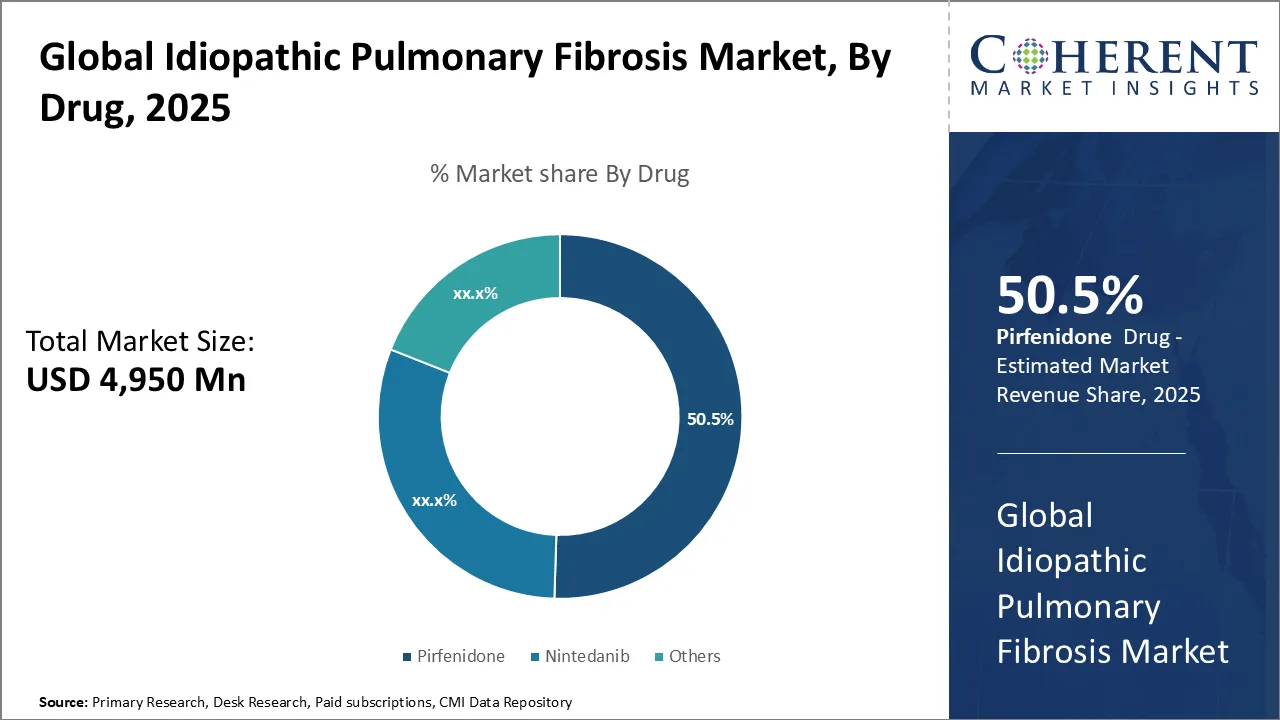
Idiopathic Pulmonary Fibrosis Market Insights, By drug
Pirfenidone contribute the highest share of the market owing to its rise of generics & broader access
Pirfenidone acquired the prominent share of 51.5% in 2026. Pirfenidone propels the IPF market by delaying disease progression and preserving lung function, backed by strong clinical evidence and its early approval as one of the first licensed antifibrotics. Its early market entry and global regulatory approvals helped build a strong reputation. The launch of generic versions has lowered its cost, while ongoing research—focusing on combination therapies and sustained-release formulations—continues to drive its rapid growth. For instance, in May 2022, Sandoz, a global leader in generic and biosimilar medicines, has announced the U.S. launch of its generic pirfenidone, the first AB-rated (fully substitutable) equivalent to Genentech's Esbriet®*, for treating idiopathic pulmonary fibrosis (IPF). The prescription oral medication is now available through specialty pharmacies, with a $0 co-pay program for eligible patients. This is further accelerating the idiopathic pulmonary fibrosis market demand.
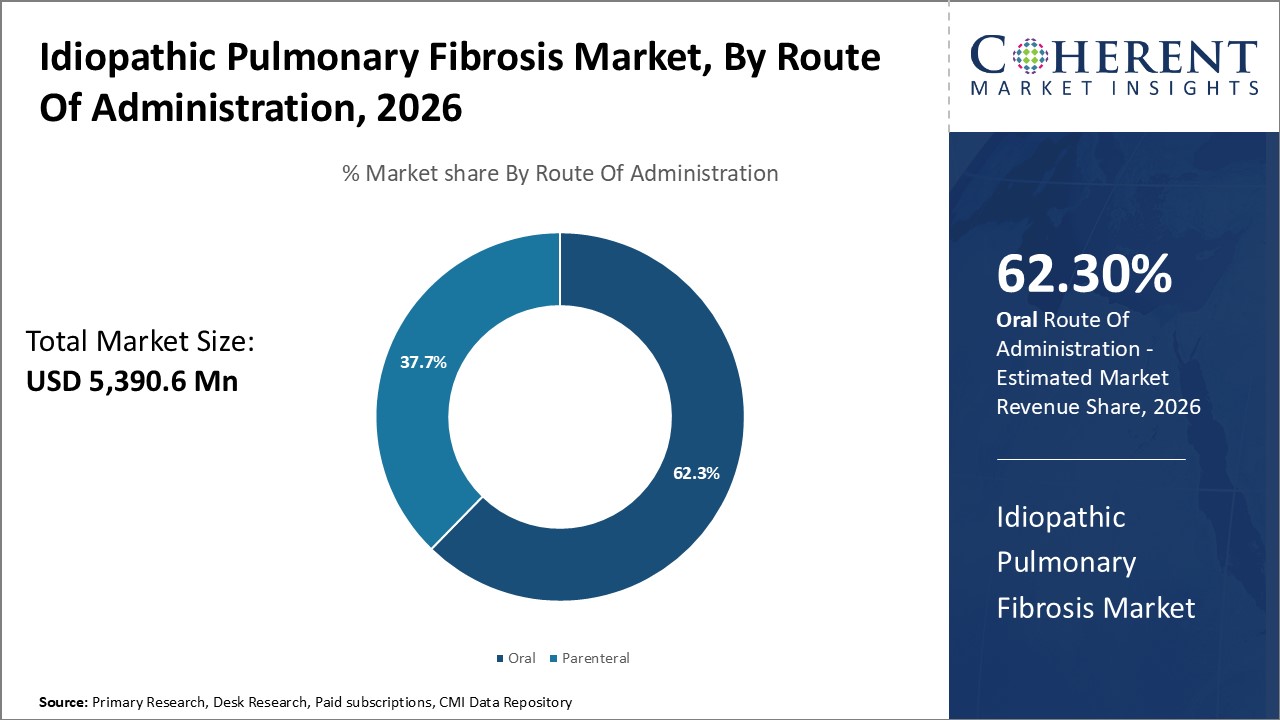
Idiopathic Pulmonary Fibrosis Market Insights, By route of administration
Oral contributes the highest share of the market owing to its R&D momentum & novel oral candidates
Oral medicines dominate the IPF market by offering convenient at-home dosing that supports long-term adherence. Antifibrotic drugs like pirfenidone and nintedanib gain widespread use due to strong clinical outcomes and simple dosing regimens. The introduction of generics has reduced costs, while enhanced reimbursement policies have improved access. Advancements in imaging enable earlier diagnosis, allowing patients to start treatment sooner, and ongoing R&D into new oral drugs and formulations continues to drive market growth. For instance, in September 2024, Trevi Therapeutics, Inc., a clinical-stage biopharmaceutical company, developed Haduvio™ (oral nalbuphine ER) as an investigational therapy to treat chronic cough associated with idiopathic pulmonary fibrosis (IPF) and refractory chronic cough (RCC). This is further propelling the idiopathic pulmonary fibrosis market revenue.
Idiopathic Pulmonary Fibrosis Market Insights, By distribution channel
Hospital Pharmacies contribute the highest share of the market owing to its complex treatment regimens & specialist oversight
Hospital pharmacies control acquires the most prominent share in 2026 by dispensing antifibrotics and specialty medications during inpatient stays, especially for acute exacerbations and complex treatment regimens. They ensure accurate dosing, maintain pharmacovigilance, and integrate closely with diagnostic and patient monitoring systems. Hospital settings also support clinical trials for investigational IPF therapies, emphasizing the crucial role these pharmacies play in initiating treatment and delivering advanced care.
Regional Insights
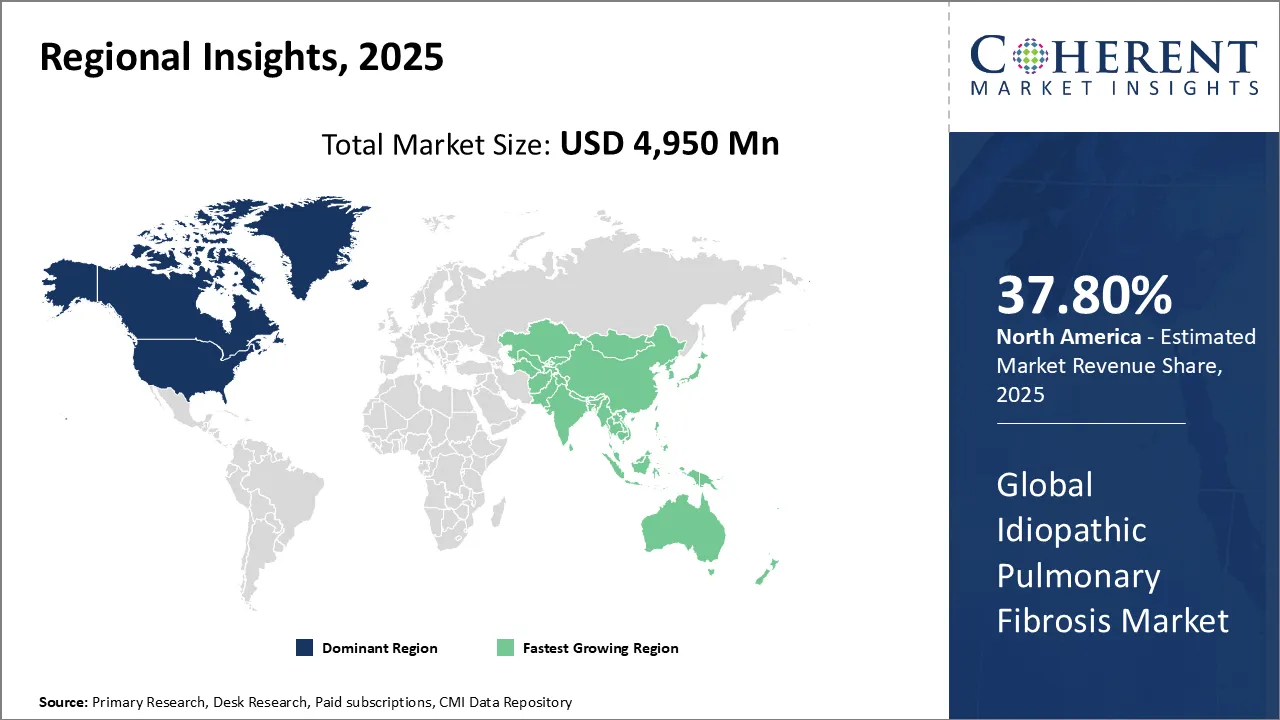
North America Idiopathic Pulmonary Fibrosis Market Trends
North America leads the global IPF market with a share of 37.80% by leveraging strong R&D efforts, high patient awareness, and advanced healthcare infrastructure. The region ensures widespread availability of antifibrotic drugs like pirfenidone and nintedanib through robust diagnostic systems and favorable reimbursement policies. Canada contributes to this momentum by expanding diagnostic capabilities and maintaining universal healthcare coverage.
Asia Pacific Idiopathic Pulmonary Fibrosis Market Trends
The Asia Pacific region is experiencing the fastest growth in the global IPF market as countries improve diagnosis, increase healthcare spending, and raise disease awareness. Governments are advancing early detection and treatment adoption through national health programs, particularly in urban centers with advanced medical infrastructure. Nations like China, India, and Indonesia are expanding access to specialized care and investing heavily in diagnostic tools like high-resolution CT scanners and pulmonary function labs to enable accurate, early IPF detection. For instance, in June 2026, Specialized Therapeutics (ST) announced the extension of its existing supply and distribution agreement with Incyte Biosciences International Sàrl, the Swiss affiliate of Incyte. Under the expanded agreement, ST will introduce and distribute two additional oncology drugs in Australia, New Zealand, and Singapore, with the potential to include more Asia-Pacific countries.
China Idiopathic Pulmonary Fibrosis Market Trends
Major cities like Beijing, Shanghai, and Guangzhou have enhanced early and accurate IPF diagnosis by upgrading pulmonary labs, specialized clinics, and HRCT capabilities. However, primary and rural hospitals continue to face shortages of imaging equipment and trained radiologists. Chinese regulatory authorities approved pirfenidone and nintedanib, transforming IPF treatment. Domestic manufacturers have introduced cost-effective generics, improving accessibility and affordability across urban and peri-urban regions. Domestic drug development and licensing deals, such as the Bersiporocin agreement, highlight China’s growing pharmaceutical ecosystem. For instance, in February 2026, Cumberland Pharmaceuticals Inc. and SciClone Pharmaceuticals (Holdings) Limited announced that the NMPA has approved Cumberland's Vibativ® injection in China. This is further propelling the idiopathic pulmonary fibrosis market revenue.
United States Idiopathic Pulmonary Fibrosis Market Trends
Advancements in U.S. healthcare have enabled the widespread use of HRCT scans, pulmonary labs, and specialized facilities, allowing for early and accurate IPF diagnosis. This infrastructure strengthens IPF management and ensures timely initiation of antifibrotic treatments. Favorable insurance coverage, especially through Medicare, improves access to costly IPF drugs. Ongoing investments in clinics and healthcare systems further support market stability by ensuring continuous treatment delivery and patient care. For instance, in May 2023, Cumberland Pharmaceuticals, a U.S.-based company, unveiled the Phase II FIGHTING FIBROSIS trial of oral ifetroban for idiopathic pulmonary fibrosis (IPF). This move follows the U.S. Food and Drug Administration’s approval of the company’s investigational new drug application for the treatment.
Market Report Scope
Idiopathic Pulmonary Fibrosis Market Report Coverage
| Report Coverage | Details | ||
|---|---|---|---|
| Base Year: | 2025 | Market Size in 2026: | USD 5,390.6 Mn |
| Historical Data for: | 2020 To 2024 | Forecast Period: | 2026 To 2033 |
| Forecast Period 2026 to 2033 CAGR: | 8.9% | 2033 Value Projection: | USD 9,791.0 Mn |
| Geographies covered: |
| ||
| Segments covered: |
| ||
| Companies covered: | Genentech, Inc., Boehringer Ingelheim International GmbH, Avalyn Pharma, Inc., AstraZeneca, Blade Therapeutics, Bristol-Myers Squibb Company, Cipla Inc., F. Hoffmann-La Roche, FibroGen, Inc., Galapagos NV, MediciNova, Inc., Merck & Co., Inc., Promedior, Inc., Prometic Life Sciences Inc., Daewoong Pharmaceutical (India) Pvt Ltd, Sandoz International GmbH (Novartis) and Algernon Pharmaceuticals Inc. | ||
| Growth Drivers: |
| ||
| Restraints & Challenges: |
| ||
Idiopathic Pulmonary Fibrosis Market Trend
Rising Prevalence Due to Aging Population and Environmental Factors
The global increase in IPF cases is closely tied to aging populations and exposure to risk factors such as smoking, air pollution, and occupational hazards. As more individuals reach the 60+ age group, IPF diagnoses continue to rise. This trend is especially pronounced in developed regions like North America, Europe, and parts of Asia. Increased disease awareness, coupled with improved diagnostic capabilities, also contributes to the detection of more cases, thereby expanding the treatment market.
Idiopathic Pulmonary Fibrosis Market Opportunity
Expansion of Diagnostic Capabilities in Emerging Markets
Emerging markets offer a strong growth opportunity through the expansion of diagnostic infrastructure. Early and accurate diagnosis of IPF remains a challenge in low- and middle-income countries due to limited access to HRCT and pulmonary specialists. Companies that provide affordable diagnostic tools, AI-based imaging analysis, or telehealth-supported respiratory assessments can play a key role in these markets. Improved diagnosis will enable earlier treatment initiation, ultimately expand the eligible treatment population and boost long-term market revenues.
Idiopathic Pulmonary Fibrosis Market News
- In July 2024, Brainomix partnered with Boehringer Ingelheim to launch a collaborative program aimed at enhancing care for patients with fibrosing lung disease in the U.S. The project will leverage Brainomix 360 e-Lung for AI imaging analysis on routine CT scans to speed up diagnosis and expand access to treatment for individuals affected by the condition.
- In November 2022, Bridge Biotherapeutics initiated a Phase 2a clinical trial to assess the efficacy, safety, and tolerability of BBT-877 in patients with idiopathic pulmonary fibrosis (IPF).
Analyst Opinion (Expert Opinion)
- The Idiopathic Pulmonary Fibrosis (IPF) market stands on the cusp of meaningful transformation. While current therapies—namely, pirfenidone and nintedanib—have long defined the treatment landscape, their limitations have catalyzed a wave of next-generation innovation that signals a transition from disease management to potential disease modification.
- Encouragingly, the clinical community has now moved beyond the initial antifibrotic paradigm and is actively exploring a broad spectrum of novel mechanisms. This shift is not speculative—it is data-driven. Multiple agents in the mid- to late-stage pipeline have demonstrated early signals of efficacy, with mechanistic differentiation that directly addresses the pathobiological heterogeneity of IPF.
- One of the most promising trajectories is the development of autotaxin inhibitors. Bristol Myers Squibb’s BMS-986278, for instance, is progressing through clinical trials with early-phase data showing dose-responsive attenuation of FVC decline. This represents a rational and targeted intervention within the lysophosphatidic acid (LPA) signaling axis, which is strongly implicated in fibroblast activation. Its advancement is illustrative of how translational science is beginning to converge with clinical development in a meaningful way.
- Equally encouraging is the diversification of therapeutic modalities beyond small molecules. Anti-integrin agents, recombinant proteins, and cell-based therapies—such as mesenchymal stem cells—are gaining regulatory traction, supported by advances in imaging, liquid biopsies, and machine learning-enabled stratification. These technologies are enabling more precise characterization of fibrotic burden, disease trajectory, and treatment responsiveness, which have historically hampered development efforts.
Speak to the analyst
Want personalized insights?
Take the findings above to one of our principal consultants, or have the report rebuilt around the segments, geographies and competitors you actually track.
Market Segmentation
- Global Idiopathic pulmonary fibrosis market, By Drug (Revenue, USD Mn, 2021 - 2033)
- Pirfenidone
- Nintedanib
- Others (Interferon gamma-1b and Others)
- Global Idiopathic pulmonary fibrosis market, By Route of Administration (Revenue, USD Mn, 2021 - 2033)
- Oral
- Parenteral
- Global Idiopathic pulmonary fibrosis market, By Distribution Channel (Revenue, USD Mn, 2021 - 2033)
- Hospital Pharmacies
- Retail Pharmacies
- Online Pharmacies
- Global Idiopathic pulmonary fibrosis market, By Region (Revenue, USD Mn, 2021 - 2033)
- North America
- U.S.
- Canada
- Latin America
- Brazil
- Argentina
- Mexico
- Rest of Latin America
- Europe
- Germany
- U.K.
- Spain
- France
- Italy
- Russia
- Rest of Europe
- Asia Pacific
- China
- India
- Japan
- Australia
- South Korea
- ASEAN
- Rest of Asia Pacific
- Middle East
- GCC Countries
- Israel
- Rest of Middle East
- Africa
- South Africa
- North Africa
- Central Africa
- North America
- Key Players Insights
- Genentech, Inc.
- Boehringer Ingelheim International GmbH
- Avalyn Pharma, Inc.
- AstraZeneca
- Blade Therapeutics
- Bristol-Myers Squibb Company
- Cipla Inc.
- Hoffmann-La Roche
- FibroGen, Inc.
- Galapagos NV
- MediciNova, Inc.
- Merck & Co., Inc.
- Promedior, Inc.
- Prometic Life Sciences Inc.
- Daewoong Pharmaceutical (India) Pvt Ltd.
- Sandoz International GmbH (Novartis)
- Algernon Pharmaceuticals Inc.
Sources
Primary Research interviews
- Pulmonologists and respiratory physicians
- Hospital pharmacy directors and procurement managers
- Clinical researchers specializing in interstitial lung diseases
- Representatives from pharmaceutical manufacturing and regulatory affairs
- IPF patients and caregivers
Databases
- PubMed
- ClinicalTrials.gov
- Drugs@FDA
- European Medicines Agency (EMA) Database
- World Health Organization (WHO) Global Health Observatory
Magazines
- PharmaTimes
- Pharmaceutical Executive
- Biopharma Dive
- Nature Outlook Pulmonary Fibrosis
- Medical Device and Diagnostic Industry (MD+DI)
Journals’
- American Journal of Respiratory and Critical Care Medicine
- The Lancet Respiratory Medicine
- European Respiratory Journal
- Chest Journal
- Journal of Pulmonary & Respiratory Medicine
Newspapers
- The New York Times – Health Section
- The Guardian – Science & Health
- The Washington Post – Health
- Financial Times – Pharma & Biotech
- The Hindu – Science & Technology
Associations
- American Thoracic Society (ATS)
- European Respiratory Society (ERS)
- Pulmonary Fibrosis Foundation (PFF)
- National Heart, Lung, and Blood Institute (NHLBI)
- Japanese Respiratory Society (JRS)
Public Domain sources
- U.S. Food and Drug Administration (FDA)
- Centers for Disease Control and Prevention (CDC)
- National Institutes of Health (NIH)
- World Health Organization (WHO)
- China National Medical Products Administration (NMPA)
- National Health Service (NHS)
- Indian Council of Medical Research (ICMR)
Proprietary Elements
- CMI Data Analytics Tool, and Proprietary CMI Existing Repository of information for last 8 years
Get access to 250+ pages report
Every segment, forecast, competitor profile and data table behind the analysis above — available for instant download.
- ESOMAR Member
- ISO 9001:2015 Certified
- D-U-N-S Registered
- GDPR & CCPA Compliant
Missing comfort of reading report in your local language? Find your preferred language:
Transform your Strategy with Exclusive Trending Reports
Frequently Asked Questions
The Idiopathic Pulmonary Fibrosis Market is estimated to be valued at USD 5,390.6 Mn in 2026, and is expected to reach USD 9,791.0 Mn by 2033.
The CAGR of the Idiopathic Pulmonary Fibrosis Market is projected to be 8.9% from 2026 to 2033.
Increasing research and development activites by the key market players for treatment of patients suffering from idiopathic pulmonary fibrosis and increasing prevalence of idiopathic pulmonary fibrosis is expected to drive the market growth.
Pirfenidone is the leading drug segment in the market.
The major factors that can hamper the growth of the market include side effects associated with the drugs such as enidone, Nintedanib and Others (Interferon gamma-1b and Others) that are used for the treatment of patients suffering from Idiopathic Pulmonary Fibrosis, and lack of awareness and unavailability of proper treatment for IPF.
Major players operating in the market include Genentech, Inc., Boehringer Ingelheim International GmbH, Avalyn Pharma, Inc., AstraZeneca, Blade Therapeutics, Bristol-Myers Squibb Company, Cipla Inc., F. Hoffmann-La Roche, FibroGen, Inc., Galapagos NV, MediciNova, Inc., Merck & Co., Inc., Promedior, Inc., Prometic Life Sciences Inc., Daewoong Pharmaceutical (India) Pvt Ltd, Sandoz International GmbH (Novartis), and Algernon Pharmaceuticals Inc.