

India and Oman Pharmaceutical Industry Market Size and Share Analysis - 2026 To 2033
The India and Oman pharmaceutical industry market is estimated to be valued at USD 85,397.5 Mn in 2026 and is projected to grow at a CAGR of 12.6% during the forecast period, reaching approximately USD 195,981 Mn by 2033. This growth is mostly due to increasing prevalence of chronic diseases, expanding access to healthcare services, growing demand for generic medicines, and supportive government initiatives. About 90% of the $5.3 trillion spent annually on health care in the country goes toward individuals with chronic and mental health conditions.
Key Takeaways from the India and Oman Pharmaceutical Industry Market Report
- Generic drugs are expected to dominate the market with a share of 75% in 2026 due to their low cost as well as government support and growing exports of generic medicines from India. For example,
- Prescription drugs are set to account for the largest market share of 86% in 2026 because chronic diseases require prescription medicines.
- By application, cardiovascular segment is projected to hold 18% of the India and Oman pharmaceutical market in 2026 because cardiovascular diseases require long-term treatment. Cardiovascular diseases are responsible for nearly 32% of global deaths, according to the World Health Organization, and most patients require lifelong medication such as antihypertensives, statins, and anticoagulants.
- India is expected to dominate the market with a share of more than 96% in 2026 because of strong pharmaceutical manufacturing, a large patient pool, and rising exports. For instance, I
India and Oman Pharmaceutical Industry Market Overview
The India and Oman pharmaceutical market is expected to grow rapidly during the forecast period. This growth is primarily driven by increasing healthcare expenditure, rising burden of chronic and infectious diseases, expanding access to healthcare services, and growing demand for affordable generic medicines. Adoption of advanced drug manufacturing technologies, increasing research and development activities, and rising demand for specialty drugs and biologic medicines are also supporting market expansion.
The pharmaceutical market comprises the sale of medicines, vaccines, biologics, and other therapeutic products used to prevent, diagnose, treat, and manage diseases across a wide range of therapeutic areas. The industry includes organizations and companies that develop and manufacture both small-molecule drugs and biologics.
Pharmaceutical companies across India and Oman are increasingly developing therapies tailored to individual patient needs for the treatment of various diseases. Personalized medicine, also known as precision medicine, aims to provide medical care based on a patient's individual characteristics, including their genetic makeup and biomarkers.
Precision therapies are increasingly being adopted as the industry moves away from the one-size-fits-all approach to treating medical conditions such as lung cancer, melanoma (skin cancer), colorectal cancer, pancreatic cancer, cystic fibrosis, and certain rare genetic disorders. Rising adoption of these therapies, along with growing patient population, is expected to boost the growth of India and Oman pharmaceutical industry market during the forecast period.
Segmental Insights
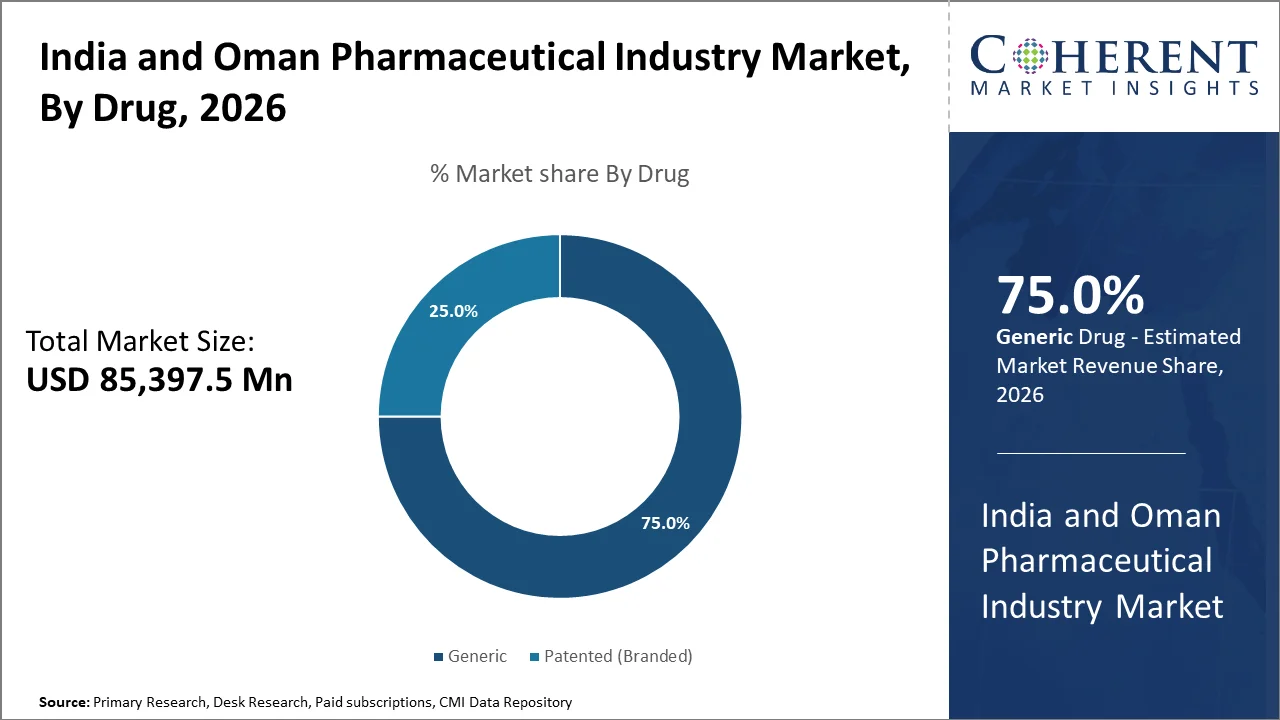
Which Drug Dominates the India and Oman Pharmaceutical Industry Market?
Generic Drugs to Lead the Market with Nearly Three-Fourth of Market Share
According to Coherent Market Insights’ latest India and Oman pharmaceutical industry market analysis, generic drugs are set to lead the market, accounting for a revenue share of 75% in 2026. This dominance is due to their affordability, widespread availability, and therapeutic equivalence to branded medicines.
India is the largest global supplier of generic medicines, manufacturing about 60,000 generic brands across 60 therapeutic categories. This strong manufacturing base and increasing exports of generic medicines are expected to improve share of generic drugs segment throughout the forecast period.
Growing demand for cost-effective healthcare solutions and increasing prevalence of chronic diseases like diabetes, cardiovascular disorders, and respiratory conditions are fueling demand for generic medications across both countries. Similarly, government initiatives promoting the use of generic medicines are expected to boost segment growth during the forecast period.
- Current Industry Events of 2026
- Market Size Estimation
- Regional Breakdown
- Competitive Landscape
- Customer Intelligence
- Segmental Analysis
- Pricing Analysis
- Key Market Drivers, Challenges & Future Trends
- Customized Insights Section
Which Drug Type Accounts for the Largest Market Share?
Prescription Drugs to Account for Over 86% of the Market Share in 2026
Based on type, prescription drugs are projected to account for the largest market revenue share of 86% in 2026. This is mostly due to rising prevalence of chronic and infectious diseases, increasing demand for specialized therapies, and growing adoption of biologics and high-value branded medications that require physician supervision.
Continuous advancements in pharmaceutical research and development and expanding access to healthcare services and favorable reimbursement policies across India and Oman are also driving demand for prescription medicines. In addition, increasing elderly population, which is more susceptible to chronic health conditions requiring long-term treatment, continues to support the growth of the prescription drugs segment.
India and Oman Pharmaceutical Industry Market Growth Drivers
Rising Burden of Chronic Diseases
Increasing prevalence of chronic diseases is providing a strong impetus for the growth of India and Oman pharmaceutical market. There is a spike in cases of diabetes, cardiovascular diseases, cancer, respiratory disorders, and other chronic conditions across India and Oman. This expanding patient pool is creating strong demand for long-term therapeutic drugs, especially cardiovascular and anti-diabetic medicines.
India and Oman Pharmaceutical Industry Market Opportunities
Government Healthcare Reforms and Policy Support
Supportive government policies are expected to create lucrative growth opportunities for the India and Oman pharmaceutical industry market during the forthcoming period. Both India and Oman are actively strengthening their pharmaceutical sectors through the expansion of public healthcare systems, insurance coverage reforms, and pharma-friendly policies. In addition, incentives for local manufacturing and import substitution are also enhancing domestic production capacity and improving access to affordable medicines.
A key recent development supporting this growth is the operationalisation of the India–Oman Comprehensive Economic Partnership Agreement (CEPA) from June 2026. Under this agreement, India gains zero-duty access for key pharmaceutical exports, including finished medicines, vaccines, and active pharmaceutical ingredients (APIs), significantly improving market access and boosting bilateral pharmaceutical trade.
India and Oman Pharmaceutical Industry Market Trends
Rising Shift Towards Generic Medicines
Increasing adoption of cost-effective generic drugs is a key growth-shaping trend in the India and Oman pharmaceutical industry market. Generics are preferred due to their affordability, proven therapeutic equivalence to branded medicines, and government-led cost-containment initiatives. Similarly, biosimilars are gradually gaining traction across both India and Oman, further supporting the shift toward affordable biologic alternatives.
Current Events and Their Impact on the India and Oman Pharmaceutical Industry Market
Current Event | Description and its Impact |
India Expands Domestic API Manufacturing Through PLI Scheme (2026) |
|
Oman Strengthens Local Pharmaceutical Manufacturing Through Government Procurement (2025) |
|
India and Oman Pharmaceutical Industry Market Outlook – Country-wise
India Pharmaceutical Industry Market Forecast
India is projected to account for over 96% share of the India and Oman pharmaceutical market in 2026. This dominance is attributable to increasing generic drug manufacturing, rising healthcare expenditure, expanding domestic pharmaceutical demand, and government initiatives to improve healthcare access. Rising demand for affordable medicines and growing pharmaceutical exports are also supporting market growth.
Rising burden of chronic diseases is expected to provide a strong impetus for the growth of Indian pharmaceutical market during the forecast period. According to the World Health Organization (WHO), noncommunicable diseases (NCDs) account for approximately 68% of all deaths in India, highlighting the growing demand for pharmaceutical products for conditions such as cardiovascular diseases, diabetes, and cancer.
Oman Pharmaceutical Industry Market Trends
Oman's pharmaceutical industry market is expected to witness strong growth during the forecast period. This is mostly due to rising healthcare expenditure, increasing prevalence of chronic diseases like diabetes, cancer, and cardiovascular disorders, and government initiatives to strengthen the healthcare system under Vision 2040. Expansion of hospitals and healthcare facilities, growing demand for generic medicines, and efforts to enhance local pharmaceutical manufacturing are further supporting market growth.
Who are the Major Companies in the India and Oman Pharmaceutical Industry Market?
Some of the major players in India and Oman pharmaceutical industry market are Pfizer, Inc., Bristol Myers Squibb, Sanofi S.A., F. Hoffmann-La Roche AG, Bayer AG, Novartis International AG, Merck & Co., Inc., AbbVie, GlaxoSmithKline plc, Eli Lilly and Company, Zydus Cadila, Aurobindo Pharma Ltd., Cipla Ltd., Dr. Reddy's Laboratories Ltd., Lupin Ltd., Sun Pharmaceutical Industries Limited, Serum Institute of India Pvt. Ltd., Biocon Limited, Strides Pharma Science Limited, and Unichem Laboratories.
Key Strategies Adopted by Industry Players
Top pharmaceutical manufacturers across India and Oman are adopting various organic and inorganic strategies to boost their revenue as well as gain a competitive edge in the industry. These include new product launches and approvals, investments in R&D activities, new clinical trials, partnerships, mergers, acquisitions, collaborations, and distribution agreements.
- In April 2026, IZZ Pharma inaugurated a new pharmaceutical manufacturing facility in Nizwa. The facility strengthens Oman’s national health security and supports its position as a growing regional hub for vital industries.
- In May 2026, Eli Lilly launched its Alzheimer’s drug donanemab in India. The drug is used for treating early-stage Alzheimer’s disease.
- In February 2026, Bayer expanded the use of Nubeqa in India. It is a non-chemotherapy treatment for men with metastatic hormone-sensitive prostate cancer.
- In April 2024, Sanofi launched Soliqua in India after receiving regulatory approval. It is a once-daily treatment used for type 2 diabetes management.
Market Report Scope
India and Oman Pharmaceutical Industry Market Report Coverage
| Report Coverage | Details | ||
|---|---|---|---|
| Base Year: | 2025 | Market Size in 2026: | USD 85,397.5 Mn |
| Historical Data for: | 2020 To 2024 | Forecast Period: | 2026 To 2033 |
| Forecast Period 2026 to 2033 CAGR: | 12.6% | 2033 Value Projection: | USD 195,981 Mn |
| Geographies covered: |
| ||
| Segments covered: |
| ||
| Companies covered: | Pfizer, Inc., Bristol Myers Squibb, Sanofi S.A., F. Hoffmann-La Roche AG, Bayer AG, Novartis International AG, Merck & Co., Inc., AbbVie, GlaxoSmithKline plc, Eli Lilly and Company, Zydus Cadila, Aurobindo Pharma Ltd., Cipla Ltd., Dr. Reddy's Laboratories Ltd., Lupin Ltd., Sun Pharmaceutical Industries Limited, Serum Institute of India Pvt. Ltd., Biocon Limited, Strides Pharma Science Limited, and Unichem Laboratories | ||
| Growth Drivers: |
| ||
| Restraints & Challenges: |
| ||
Analyst Opinion (Expert Opinion)
- India is becoming a global supplier of medicines. India provides around 20% of the world's generic medicines by volume and is one of the largest vaccine producers, making it an important part of the global pharmaceutical supply chain. This strengthens export opportunities and encourages investment in manufacturing.
- Healthcare spending is increasing in Oman. The Omani government continues to invest in hospitals, healthcare services, and medicine availability as part of its long-term development plans. Higher healthcare investment is expected to increase demand for pharmaceutical products and attract more international companies.
- Chronic diseases are creating long-term demand for medicines. Rising cases of diabetes, heart disease, and cancer in both India and Oman are increasing the need for regular medications and advanced treatments. This supports steady growth in prescription drugs and specialty pharmaceuticals.
- Local manufacturing is becoming more important. India is expanding domestic pharmaceutical production through government initiatives, while Oman is encouraging local drug manufacturing to reduce dependence on imports. Greater local production can improve medicine availability, strengthen supply chains, and create new business opportunities.
Speak to the analyst
Want personalized insights?
Take the findings above to one of our principal consultants, or have the report rebuilt around the segments, geographies and competitors you actually track.
Market Segmentation
- By Drug Insights ( Revenue, USD Mn, 2021 - 2033)
- Generic
- Patented (Branded)
- By Type Insights ( Revenue, USD Mn, 2021 - 2033)
- Prescription Drugs
- Over the Counter Drugs
- By Drug Class Insights ( Revenue, USD Mn, 2021 - 2033)
- Analgesics
- Anesthetics
- Antibacterials
- Antidepressants
- Corticosteroids
- Nonsteroidal Anti-inflammatory Drugs (NSAIDs)
- Anticonvulsants
- Antivirals
- Anticoagulants
- ACE inhibitors
- Hormonal agents
- Insulin
- Contraceptives
- Diuretics
- Vaccines
- Others
- By Application Insights ( Revenue, USD Mn, 2021 - 2033)
- Cardiovascular
- Ischemic Heart Disease
- Others
- Hypertension
- Musculoskeletal
- Oncology
- Anti-infective
- Cirrhosis
- Metabolic Disorder
- Diabetes
- Others
- Weight Management
- Central Nervous System
- Genito-urinary
- Kidney Disease
- Gastrointestinal
- Respiratory
- Hematology
- Dermatology
- Ophthalmology
- Others (Nutraceutical, Dentals, and Gynecology)
- Cardiovascular
- By Distribution Channel Insights ( Revenue, USD Mn, 2021 - 2033)
- Hospital Pharmacies
- Retail Pharmacies
- Online Pharmacies
- By Region Insights ( Revenue, USD Mn, 2021 - 2033)
- India
- Oman
Sources
Primary Research Interviews
- Chief Executive Officers (CEOs)
- Chief Operating Officers (COOs)
- Vice Presidents (Sales, Marketing & Operations)
- Business Development Managers
- Product Managers
- Regulatory Affairs Managers
- Manufacturing & Plant Heads
- Procurement & Supply Chain Managers
- Hospital Pharmacists
- Healthcare Distributors
- Pharmaceutical Wholesalers
- Industry Experts and Key Opinion Leaders (KOLs)
Databases
- UN Comtrade Database
- World Bank Open Data
- International Trade Centre (ITC) Trade Map
- United Nations Data (UNData)
- OECD Data
- World Health Organization (WHO) Global Health Observatory
- National Center for Biotechnology Information (NCBI)
- PubMed
- World Integrated Trade Solution (WITS)
- Observatory of Economic Complexity (OEC)
Magazines
- Pharma Manufacturing
- Pharmaceutical Executive
- Pharmaceutical Technology
- European Pharmaceutical Review
- Express Pharma
- Pharma Biz
- Drug Today
- Manufacturing Chemist
Journals
- International Journal of Pharmaceutical Sciences
- Journal of Pharmaceutical Sciences
- International Journal of Pharmaceutics
- Indian Journal of Pharmaceutical Sciences
- Journal of Drug Delivery Science and Technology
- Asian Journal of Pharmaceutical Sciences
- BMJ Open
- The Lancet
- Nature Reviews Drug Discovery
Newspapers
- The Hindu BusinessLine
- The Economic Times
- Financial Express
- Business Standard
- Times of Oman
- Oman Daily Observer
- Muscat Daily
- Gulf News
Associations
- Indian Pharmaceutical Alliance (IPA)
- Organisation of Pharmaceutical Producers of India (OPPI)
- Indian Drug Manufacturers' Association (IDMA)
- Federation of Indian Chambers of Commerce & Industry (FICCI)
- Confederation of Indian Industry (CII)
- Oman Chamber of Commerce and Industry (OCCI)
- Gulf Central Committee for Drug Registration (GCC-DR)
- International Federation of Pharmaceutical Manufacturers & Associations (IFPMA)
Public Domain Sources
- Ministry of Health and Family Welfare (India)
- Central Drugs Standard Control Organization (CDSCO)
- Department of Pharmaceuticals (India)
- National Pharmaceutical Pricing Authority (NPPA)
- Invest India
- Ministry of Commerce and Industry (India)
- Directorate General of Commercial Intelligence and Statistics (DGCIS)
- Ministry of Health (Oman)
- Oman Vision 2040
- National Centre for Statistics and Information (NCSI), Oman
- Central Bank of Oman
- World Health Organization (WHO)
- World Trade Organization (WTO)
- World Bank
- International Monetary Fund (IMF)
- United Nations Industrial Development Organization (UNIDO)
- United Nations Conference on Trade and Development (UNCTAD)
- OECD
- UNICEF
- United States Food and Drug Administration (US FDA)
- European Medicines Agency (EMA)
Proprietary Elements
- CMI Data Analytics Tool
- Proprietary CMI Existing Repository of Information for Last 10 Years
Get access to 250+ pages report
Every segment, forecast, competitor profile and data table behind the analysis above — available for instant download.
- ESOMAR Member
- ISO 9001:2015 Certified
- D-U-N-S Registered
- GDPR & CCPA Compliant
Missing comfort of reading report in your local language? Find your preferred language:
Transform your Strategy with Exclusive Trending Reports
Frequently Asked Questions
The India and Oman Pharmaceutical Industry Market is estimated to be valued at USD 85,397.5 Mn in 2026.
The India and Oman Pharmaceutical Industry Market value is expected to reach USD 195,981 Mn by 2033.
The India and Oman Pharmaceutical Market size is poised to grow at a CAGR of 12.6% from 2026 to 2033.
Major growth factors include rising prevalence of chronic and infectious diseases, growing demand for generic medicines, and new drug launches and approvals.
Generic drugs are expected to dominate the market with a share of 75% in 2026.
Some major companies in the India and Oman Pharmaceutical Industry Market include Pfizer, Inc., Bristol Myers Squibb, Sanofi S.A., F. Hoffmann-La Roche AG, Bayer AG, Novartis International AG, Merck & Co., Inc., AbbVie, GlaxoSmithKline plc, Eli Lilly and Company, Zydus Cadila, Aurobindo Pharma Ltd., Cipla Ltd., Dr. Reddy's Laboratories Ltd., Lupin Ltd., Sun Pharmaceutical Industries Limited, Serum Institute of India Pvt. Ltd., Biocon Limited, Strides Pharma Science Limited, and Unichem Laboratories.