

Interstitial Lung Disease Market Size and Share Analysis- Growth Trends and Forecasts (2026-2033)
The Interstitial Lung Disease Market size is anticipated to grow at a CAGR of 6.8% with USD 4.5 Bn in 2026 and is expected to reach USD 7.20 Bn in 2033. The primary drivers are defined by rising prevalence of progressive fibrotic lung disorders, increasing diagnosis through HRCT and pulmonary function testing, and growing adoption of antifibrotic therapies such as nintedanib and pirfenidone. Some of the other factors include aging population, higher autoimmune disease-associated ILD cases, expanding pulmonology care networks, rising awareness programs, increasing clinical trials, better reimbursement for specialty drugs, and demand for early disease management. According to the Pulmonary Fibrosis Foundation, ILD includes over 200 diseases, with more than 250,000 Americans living with ILD and 50,000 new cases diagnosed annually.
Key Takeaways
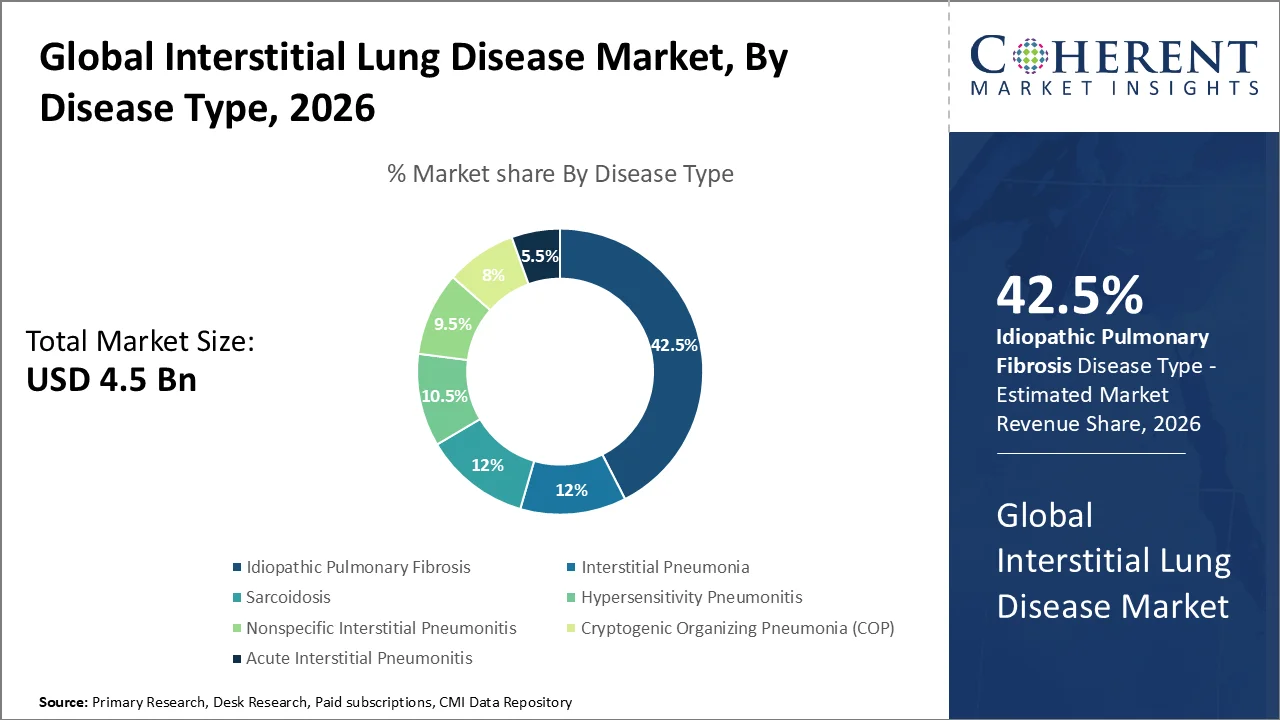
- The idiopathic pulmonary fibrosis segment is likely to dominate the market with 42.5% in 2026. The segment’s growth is owing to the high disease burden, rising aging population prevalence, progressive lung scarring, and strong clinical focus on early diagnosis and long-term management in specialized respiratory care According to MedlinePlus Genetics, IPF affects around 13 to 20 per 100,000 people worldwide, supporting long-term demand for diagnosis and anti-fibrotic treatment.
- The anti-fibrotic medication segment is set to lead with 54.4% in 2026. The segment’s growth is owing to the increasing adoption of pirfenidone and nintedanib as disease-modifying therapies, expanding clinical evidence, and strong preference for hospital-based prescription treatment in progressive fibrosing ILD. According to the European Medicines Agency, Ofev is authorized for IPF, systemic sclerosis-associated ILD, and other progressive chronic fibrosing ILDs, strengthening its clinical role.
- The hospital pharmacies segment is set to lead with 41% in 2026. The segment’s growth is owing to the prescription-based nature of ILD therapies, need for specialist supervision, regular patient monitoring, and strong drug dispensing through hospitals managing complex pulmonary and autoimmune-associated ILD cases.
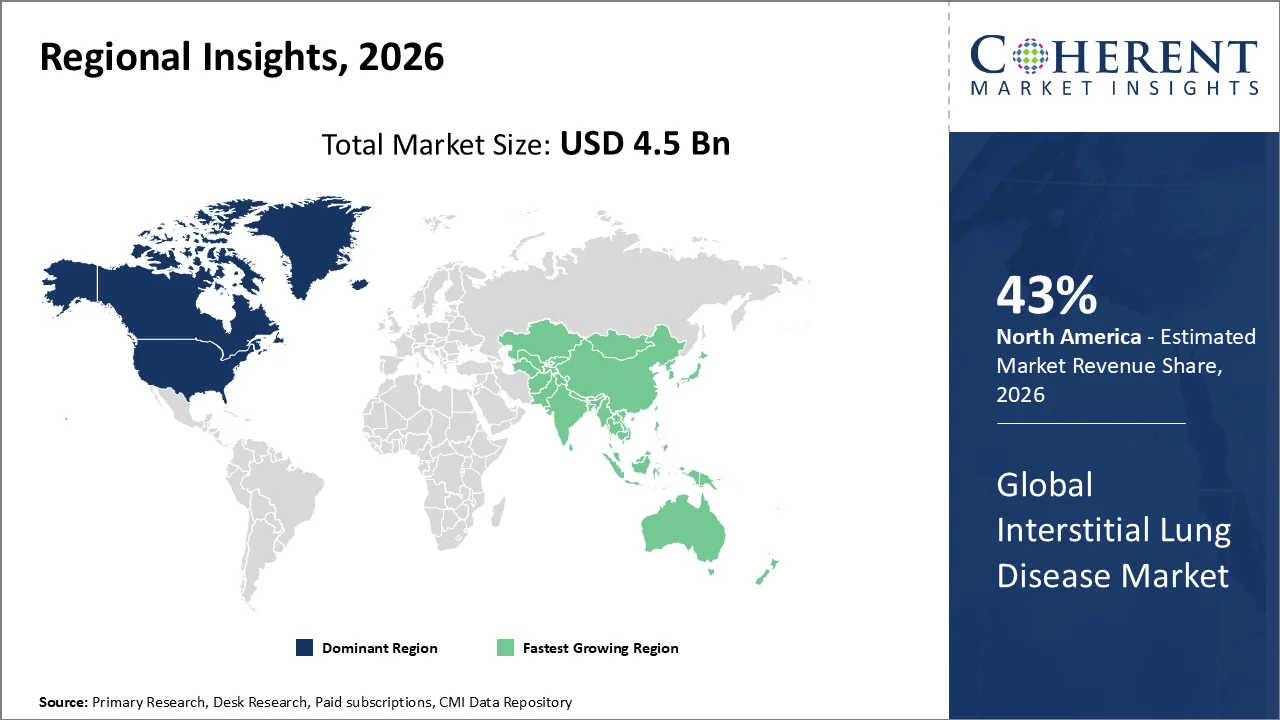
- North America is expected to acquire the prominent share of 43% in 2026. The region’s growth is owing to the advanced healthcare infrastructure, high awareness, strong pulmonology networks, early drug adoption, favorable reimbursement systems, and active clinical research in interstitial lung disease. According to MedlinePlus Genetics, about 30,000 to 40,000 new IPF cases are diagnosed annually in the U.S., reinforcing demand for advanced ILD therapeutics.
Segmental Insights
Why is Idiopathic Pulmonary Fibrosis Segment Acquiring the Largest Share?
On the basis of disease type, the idiopathic pulmonary fibrosis segment is projected to account for the largest Interstitial Lung Disease Market share of 42.5% in 2026. The segment’s growth is owing to its progressive nature, limited curative options, high reliance on specialist diagnosis, and strong clinical focus on slowing lung function decline. The U.S. FDA states that IPF is a rare, serious, progressive disease with no cure and limited treatment options, and is diagnosed most often in people aged 60 to 70 years.
In April 2026, Insilico Medicine announced the IND clearance from the CDE for its Rentosertib inhalation solution, mainly designed for targeted lung delivery in IPF. This AI-discovered therapy, following positive Phase IIa oral results, aims to improve pulmonary exposure, lower systemic side effects, and advance disease-modifying treatment options for the IPF patients.
- Current Industry Events of 2026
- Market Size Estimation
- Regional Breakdown
- Competitive Landscape
- Customer Intelligence
- Segmental Analysis
- Pricing Analysis
- Key Market Drivers, Challenges & Future Trends
- Customized Insights Section
Anti-fibrotic Medication hold the Largest Market Share
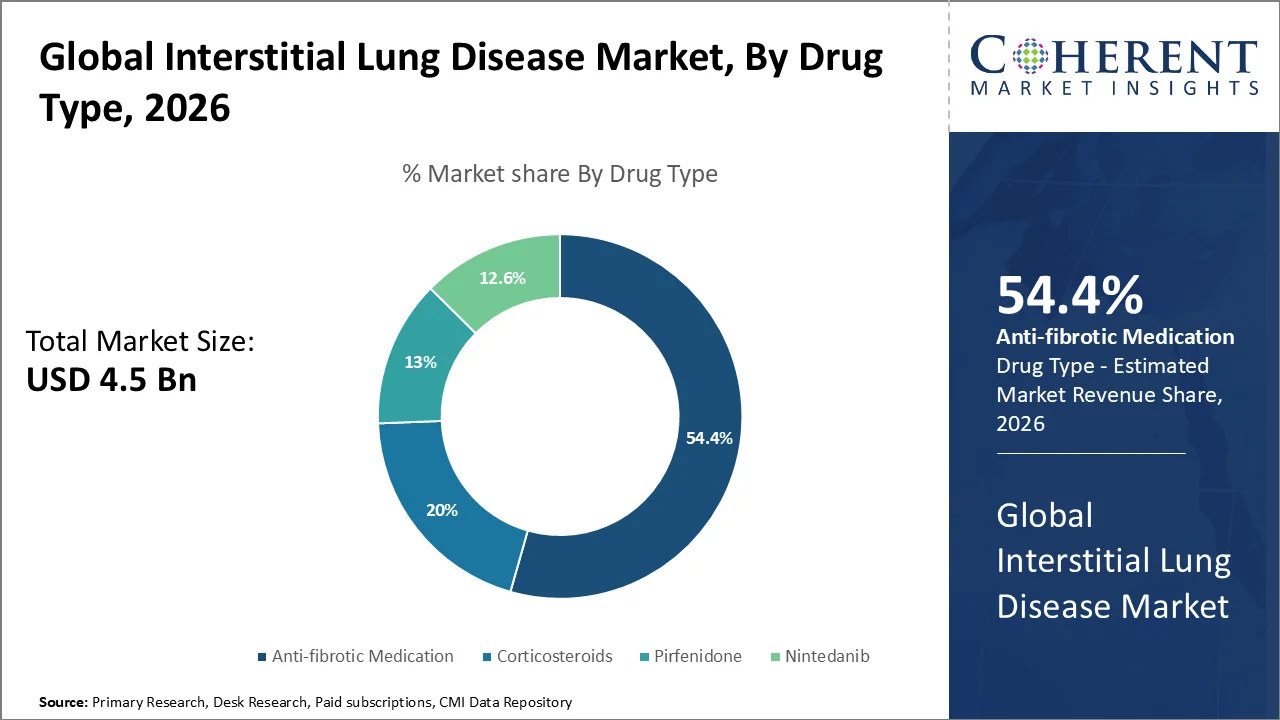
On the basis of drug type, the anti-fibrotic medication segment lead with a major 54.4% share in 2026. The growth is owing to the established clinical role of nintedanib and pirfenidone in slowing progressive lung fibrosis. These therapies are widely prescribed in hospital and specialty-care settings because ILD treatment requires physician-led monitoring, dose adjustment, and safety evaluation.
The European Medicines Agency states that Ofev (nintedanib) is effective at slowing worsening lung function in adult patients with IPF, systemic sclerosis-associated ILD, and other progressive chronic fibrosing ILDs. The EMA also notes that Esbriet (pirfenidone) is used to treat adults with idiopathic pulmonary fibrosis.
Recent approvals are increasing competition within the anti-fibrotic medication segment. In April 2026, Cipla USA Inc. received U.S. FDA approval for generic nintedanib capsules in 100 mg and 150 mg strengths. This is expected to support wider access, increase prescription volume, and strengthen anti-fibrotic therapy adoption during the forecast period.
Market Drivers
Innovations in AI-enabled ILD Diagnosis are Transforming the Interstitial Lung Disease Market in Europe
The U.S. Interstitial Lung Disease Market is being transformed by AI-enabled imaging tools that support earlier identification of lung scarring on CT scans. ILD diagnosis often requires high-resolution computed tomography, pulmonary function testing, multidisciplinary review, and exclusion of alternative causes. AI tools are now being used to quantify fibrosis, flag suspicious CT findings, and support the referral pathways to specialist ILD centers. This is important because diagnostic delay can reduce treatment opportunities in progressive fibrosing diseases, where earlier anti-fibrotic therapy may help slow lung function decline.
In January 2025, IMVARIA Inc. announced U.S. FDA 510(k) clearance for ScreenDx, an AI-powered tool designed to assist clinicians in assessing CT imaging data for findings compatible with interstitial lung disease. IMVARIA stated that ScreenDx is a software-only device that uses artificial intelligence to analyze CT imaging data as adjunctive information in a referral pathway. This development is expected to strengthen adoption of AI-supported ILD screening across hospitals, imaging centers, and pulmonology networks in the U.S.
AI-powered HRCT Quantification: A Major Breakthrough in Interstitial Lung Disease Market
AI-powered high-resolution CT quantification is emerging as a major breakthrough in the Interstitial Lung Disease Market. Traditional ILD assessment relies extensively on radiologist interpretation, pulmonologist review, lung function testing, as well as multidisciplinary diagnosis. However, fibrosis extent and subtle radiological progression can be difficult to measure consistently across the serial CT scans. AI-powered platforms help quantify fibrosis extent, disease severity, and progression more objectively, thereby improving the clinical trial endpoints, patient monitoring, and treatment decisions.
According to Brainomix, its e-Lung platform is an FDA-cleared AI-powered imaging software platform that automatically identifies and quantifies abnormalities on CT lung scans. It allows the clinicians to identify subtle deterioration across multiple timepoints. In January 2026, Brainomix announced that its e-Lung AI imaging technology was selected as a co-primary endpoint in a Boehringer Ingelheim Phase 3 pulmonary fibrosis clinical trial. This marks the first time automated quantitative HRCT imaging biomarkers would serve as a co-primary endpoint in a Phase 3 ILD study.
Current Events and Their Impact
Current Event | Description and its Impact |
2026 U.S. Medicare Part D Redesign and Ofev Price Negotiation Pressure |
|
FDA Approval of New PDE4B Therapy Expands Regulated ILD Treatment Options
|
|
Interstitial Lung Disease Market Trends
- The rising adoption of antifibrotic therapies like nintedanib and pirfenidone is improving disease management and slowing lung-function decline in the progressive fibrosing ILDs.
- The growing use of high-resolution CT, pulmonary function testing, and multidisciplinary diagnosis is assisting in the improved early detection, treatment accuracy, and patient monitoring.
- The increasing clinical focus on progressive pulmonary fibrosis is expanding the treatment opportunities beyond idiopathic pulmonary fibrosis into broader ILD patient groups.
- The aging populations and rising chronic respiratory disease burden are increasing the ILD diagnosis rates worldwide. As of 2026, the published epidemiology data estimate ILD prevalence at around 6.3 to 71 cases per 100,000 population, while annual incidence ranges from 1.0 to 31.5 cases per 100,000 person-years. Idiopathic pulmonary fibrosis is still one of the most severe ILD forms and accounts for nearly 50% of reported idiopathic interstitial pneumonias.
- Reimbursement and national health system pathways are supporting the anti-fibrotic therapy adoption. The NICE TA747 recommends nintedanib for progressive fibrosing interstitial lung diseases in adults. Also, the NHS England funds anti-fibrotic treatments for ILD services. This strengthens the structured access through specialist centers as well as hospital pharmacies.
Regional Insights
North America Dominates Owing to the Advanced Pulmonology Infrastructure and Strong Access to Approved ILD Therapies
The North America region accounts for 43% of the market share in 2026. The region’s growth is owing to the advanced pulmonology networks, strong access to HRCT imaging, FDA-approved ILD therapies, higher diagnosis rates, and a strong clinical trial ecosystem. The U.S. remains the core market due to early regulatory approvals and rapid adoption of specialty drugs.
The CDC MMWR reported 67,843 IPF deaths among U.S. workers in 2022, thereby highlighting the public-health relevance of IPF mortality and occupational exposure assessment.
In September 2025, AllRock Bio announced a $50 million Series A funding round to advance its lead pan-ROCK inhibitor, ROC-101, into Phase 2a clinical development. The program targets pulmonary arterial hypertension and pulmonary hypertension associated with interstitial lung disease (ILD-PH), addressing a major unmet need in cardiopulmonary and fibrotic diseases.
Asia Pacific Interstitial Lung Disease Market Trends
Asia Pacificis expected to witness strong growth in Interstitial Lung Disease Market over the forecast period. The region’s growth is owing to the rising diagnosis in China, India, and Japan, expanding access to anti-fibrotic drugs, increasing specialist pulmonology centers, and improving regulatory pathways for novel therapies.
A PLOS One study estimated India’s crude annual ILD incidence at 10.1–20.2 per 100,000 and prevalence at 49.0–98.1 per 100,000 in the studied region. These trends support higher APAC growth through diagnosis, specialist care, and drug access.
In January 2025, Asian Hospital and Medical Center launched the Interstitial Lung Disease (ILD) Center under its Asian Institute of Respirology. The initiative, supported by Boehringer Ingelheim Philippines, aims to improve multidisciplinary diagnosis and management of ILD and enhance specialized respiratory care in the country.
Early FDA Approvals are Accelerating the Interstitial Lung Disease Market in United States
The United States Interstitial Lung Disease Market is driven by the early FDA approvals, high use of specialty pharmacies, and strong clinical research. The country has advanced hospital infrastructure, with the American Hospital Association reporting 6,100 U.S. hospitals in 2026.
Recent innovation is reshaping the U.S. treatment landscape. In September 2025, Boehringer Ingelheim announced the U.S. FDA approval of JASCAYD (nerandomilast), the first new treatment option for idiopathic pulmonary fibrosis (IPF) in over a decade. The oral therapy targets IPF, a progressive interstitial lung disease, and works by slowing lung function decline through a novel antifibrotic and immunomodulatory mechanism.
Japan Interstitial Lung Disease Market Trends
Japan is expected to be a key Asia Pacific growth contributor due to its older population, strong specialty-care infrastructure, and early access to innovative pulmonary fibrosis therapies. The WHO notes that in Japan, around 30% of the population is already over 60 years old, which is highly relevant because IPF is most often diagnosed in older adults.
In May 2026, Boehringer Ingelheim announced that Japan’s MHLW approved Jascayd (nerandomilast) for adults with IPF and PPF. The company stated that the approval enables access to the first oral PDE4B inhibitor with anti-fibrotic and immunomodulatory effects authorized for these indications.
Who are the Major Companies in Interstitial Lung Disease Industry
Some of the major key players in Interstitial Lung Disease Market are MSD (Merck), Liminal Biosciences, Glenmark Pharma, J.B. Chemicals & Pharmaceuticals, Boehringer Ingelhim International GmbH, F. Hoffmann-La Roche Ltd, Inc., and Cipla.
Key News
- In May 2026, Cereno Scientific announced that the first healthy volunteer was dosed in a Phase I PK bridging study of CS014. The study aims to support development of treatment for pulmonary hypertension associated with interstitial lung disease (PH-ILD), with a Phase IIb trial planned for Q1 2027.
- In January 2026, JAMP Pharma Group launched the PrJAMP Nintedanib in Canada as a generic antifibrotic therapy for interstitial lung diseases. The treatment is indicated for idiopathic pulmonary fibrosis, systemic sclerosis-associated ILD, and other progressive fibrosing ILDs, aiming to improve access to cost-effective care options.
Market Report Scope
Interstitial Lung Disease Market Report Coverage
| Report Coverage | Details | ||
|---|---|---|---|
| Base Year: | 2025 | Market Size in 2026: | USD 4.5 Bn |
| Historical Data for: | 2020 To 2024 | Forecast Period: | 2026 To 2033 |
| Forecast Period 2026 to 2033 CAGR: | 6.8% | 2033 Value Projection: | USD 7.20 Bn |
| Geographies covered: |
| ||
| Segments covered: |
| ||
| Companies covered: | MSD (Merck), Liminal Biosciences, Glenmark Pharma, J.B. Chemicals & Pharmaceuticals, Boehringer Ingelhim International GmbH, F. Hoffmann-La Roche Ltd, Inc., and Cipla. | ||
| Growth Drivers: |
| ||
| Restraints & Challenges: |
| ||
Analyst Opinion
- Interstitial lung disease is driven by rising clinical need, especially among aging populations and patients with autoimmune or occupational exposure risks. IPF prevalence estimates vary widely by region, showing strong unmet demand for earlier diagnosis and long-term disease management.
- Idiopathic pulmonary fibrosis remains one of the most commercially important ILD types. In the U.S., an annualized age-adjusted IPF death rate of 7.1 per 100,000 persons, with the highest burden among adults aged 75 years and above.
- Interstitial lung disease treatment demand is increasing as antifibrotic therapies become more central to care. FDA-approved options such as nintedanib, pirfenidone, and newer antifibrotic agents help slow lung scarring, supporting wider drug adoption, longer treatment duration, and stronger growth across hospital, specialty clinic, and pharmacy channels.
Speak to the analyst
Want personalized insights?
Take the findings above to one of our principal consultants, or have the report rebuilt around the segments, geographies and competitors you actually track.
Market Segmentation
- By Disease Type (Revenue, USD Bn, 2021-2033)
- Interstitial Pneumonia
- Idiopathic Pulmonary Fibrosis
- Nonspecific Interstitial Pneumonitis
- Hypersensitivity Pneumonitis
- Cryptogenic Organizing Pneumonia (COP)
- Sarcoidosis
- Acute Interstitial Pneumonitis
- By Drug Type (Revenue, USD Bn, 2021-2033)
- Corticosteroids
- Anti-fibrotic Medication
- Pirfenidone
- Nintedanib
- By Distribution Channel (Revenue, USD Bn, 2021-2033)
- Hospital Pharmacies
- Retail Pharmacies
- Online Pharmacies
- Global Interstitial Lung Disease Market, By Region (Revenue, USD Bn, 2021-2033)
- North America
- U.S.
- Canada
- Latin America
- Brazil
- Mexico
- Argentina
- Rest of Latin America
- Europe
- Germany
- U.K.
- France
- Italy
- Spain
- Russia
- Rest of Europe
- Asia Pacific
- China
- India
- Japan
- Australia
- South Korea
- ASEAN
- Rest of Asia Pacific
- Middle East
- GCC
- Israel
- Rest of Middle East
- Africa
- South Africa
- Central Africa
- North Africa
- North America
- Key Players
- MSD (Merck)
- Liminal Biosciences
- Glenmark Pharma
- Chemicals & Pharmaceuticals
- Boehringer Ingelhim International GmbH
- Hoffmann-La Roche Ltd.
- Cipla
Sources
Primary Research Interviews
- Pulmonologists and respiratory disease specialists
- Interstitial lung disease specialists
- Rheumatologists managing connective tissue disease-associated ILD
- Hospital administrators and respiratory care department heads
- Pharmaceutical distributors and specialty drug suppliers
- Key opinion leaders (KOLs) in pulmonology and rare lung diseases
Databases
- World Health Organization (WHO)
- Centers for Disease Control and Prevention (CDC)
- National Institutes of Health (NIH)
- National Heart, Lung, and Blood Institute (NHLBI)
- Organisation for Economic Co-operation and Development (OECD)
- ClinicalTrials.gov
Magazines
- Pulmonology Advisor
- Respiratory Therapy Magazine
- CHEST Physician
- European Respiratory Society News
- Healthcare Business Today
Journals
- American Journal of Respiratory and Critical Care Medicine
- The Lancet Respiratory Medicine
- European Respiratory Journal
- CHEST Journal
- Respiratory Medicine
- BMJ Open Respiratory Research
Newspapers
- The New York Times
- The Guardian
- The Wall Street Journal
- Reuters
- Bloomberg News
Associations
- American Thoracic Society
- European Respiratory Society
- American College of Chest Physicians
- Pulmonary Fibrosis Foundation
- British Thoracic Society
- American Lung Association
Public Domain Sources
- Company Annual Reports and Investor Presentations
- Government Health Ministry Publications
- Clinical Trial Registries Such as ClinicalTrials.gov
- FDA Drug Approval Databases
- European Medicines Agency Publications
- National Health Service Respiratory Disease Publications
Proprietary Elements
- CMI Data Analytics Tool, Proprietary CMI Existing Repository of Information for Last 10 Years
Get access to 250+ pages report
Every segment, forecast, competitor profile and data table behind the analysis above — available for instant download.
- ESOMAR Member
- ISO 9001:2015 Certified
- D-U-N-S Registered
- GDPR & CCPA Compliant
Missing comfort of reading report in your local language? Find your preferred language:
Transform your Strategy with Exclusive Trending Reports
Frequently Asked Questions
The Interstitial Lung Disease Market is expected to reach USD 7.20 Billion in 2033.
The low disease awareness, late diagnoses, the high costs of targeted therapies, and clinical trial complexities are the key factors hampering growth of the market.
The aging global population, increased prevalence of autoimmune and connective tissue diseases, rising environmental pollution, and wider adoption of precision therapeutics is boosting the demand for Interstitial Lung Disease.
The Interstitial Lung Disease Market is anticipated to grow at a CAGR of 6.8% between 2026 and 2033.
Among regions, North America is expected to account for a largest market share in the global Interstitial Lung Disease Market over the forecast period.
The market outlook remains positive due to rising diagnosis rates, expanding antifibrotic therapy adoption, improving pulmonary care infrastructure, clinical pipeline advances, and growing focus on long-term ILD management globally.
The Interstitial Lung Disease Market encompasses therapies, diagnostics, and care services used to detect, treat, and manage progressive lung scarring conditions across healthcare settings.