

North America Synthetic Opioids Market Analysis & Forecast: 2026-2033
North America Synthetic Opioids Market size is estimated to be valued at USD 96.23 Bn in 2026 and is expected to reach USD 112.07 Bn in 2033, exhibiting a compound annual growth rate (CAGR) of 2.2% from 2026 to 2033.
Key Takeaways
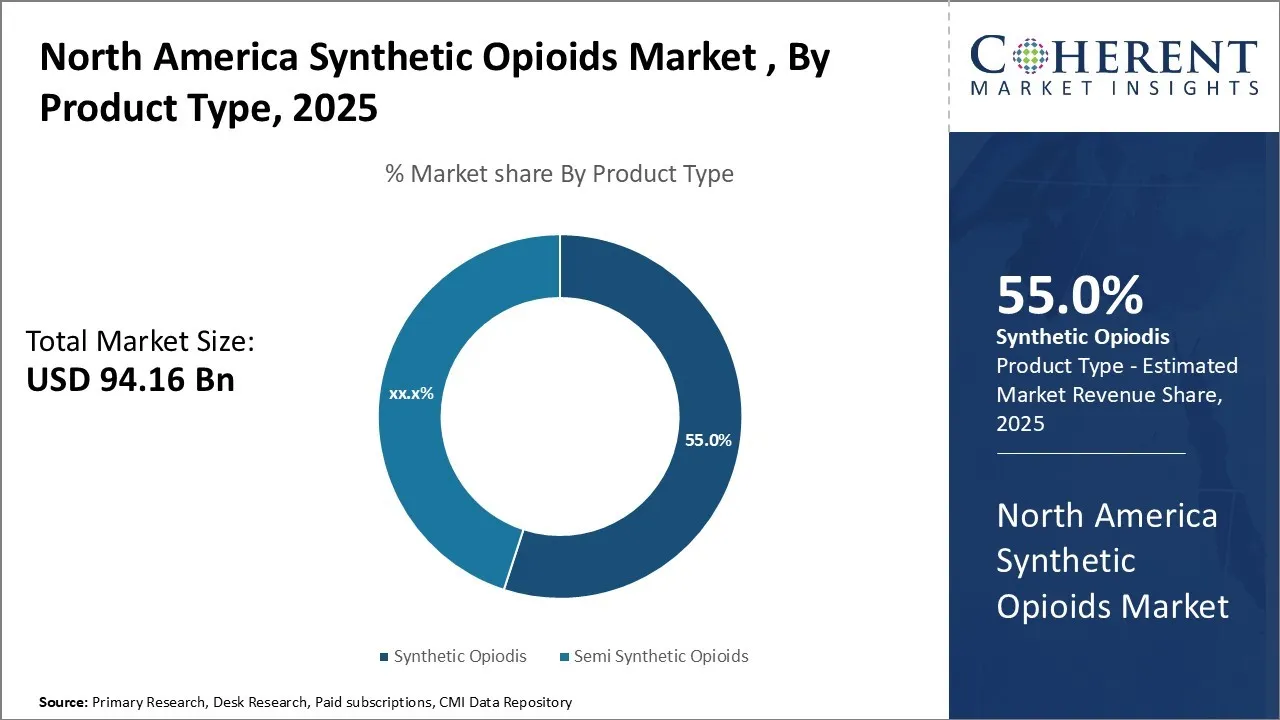
- By Product Type, the Synthetic Opioids Segment is estimated to reach 56.0% share in 2026 of North America market outlook owing to its efficacy in controlling pain and clinical usage in both acute and chronic pain management.
- By Country, the United States and is expected to lead the regional market with a projected share of 60.1% in 2026, owing to the rising rates of chronic pain conditions and access to healthcare services.
Market Overview
The North America Synthetic Opioids industry is steadily growing due to the increasing prevalence of chronic pain and cancer-related conditions. Notable synthetic opioids such as methadone and meperidine are heavily utilized for pain relief at the oncology and post-surgical care units due to their efficiency in managing moderate to severe pain.
The rising incidence of cancer is one of the major market drivers. For instance, the American Cancer Society anticipates more than two million new cancer cases in the US in 2026 and a large portion of these patients will require efficient pain relief during treatment and palliative care. As a result, hospitals have become the primary distribution channel as they provide a controlled environment for monitoring and administering opioids.
Current Events and Its Impact on the North America Synthetic Opioids Market
Event | Description and Impact |
Geopolitical Shifts in Precursor Chemical Regulation |
|
Law Enforcement/Tech-Driven Supply Chain Disruptions |
|
Public Health Policy Transformations |
|
Segmental Insights
- Current Industry Events of 2026
- Market Size Estimation
- Regional Breakdown
- Competitive Landscape
- Customer Intelligence
- Segmental Analysis
- Pricing Analysis
- Key Market Drivers, Challenges & Future Trends
- Customized Insights Section
North America Synthetic Opioids Market Insights, By Product Type
By Product Type, the Synthetic Opioids segment is projected to hold a dominant share of 56% in the North America market value in 2026. This is because of the widespread cancer cases in the region, increasing the demand for effective pain management.
Synthetic opioids are often cited to have the utmost efficacy in relieving moderate to severe pain due to cancer. They are commonly used in practice because of their quick onset and strong analgesic effects. The growth of this segment is also driven by the constant development of synthetic forms designed to reduce potential for abuse while retaining adequate clinical utility.
North America Synthetic Opioids Market Insights, By Application
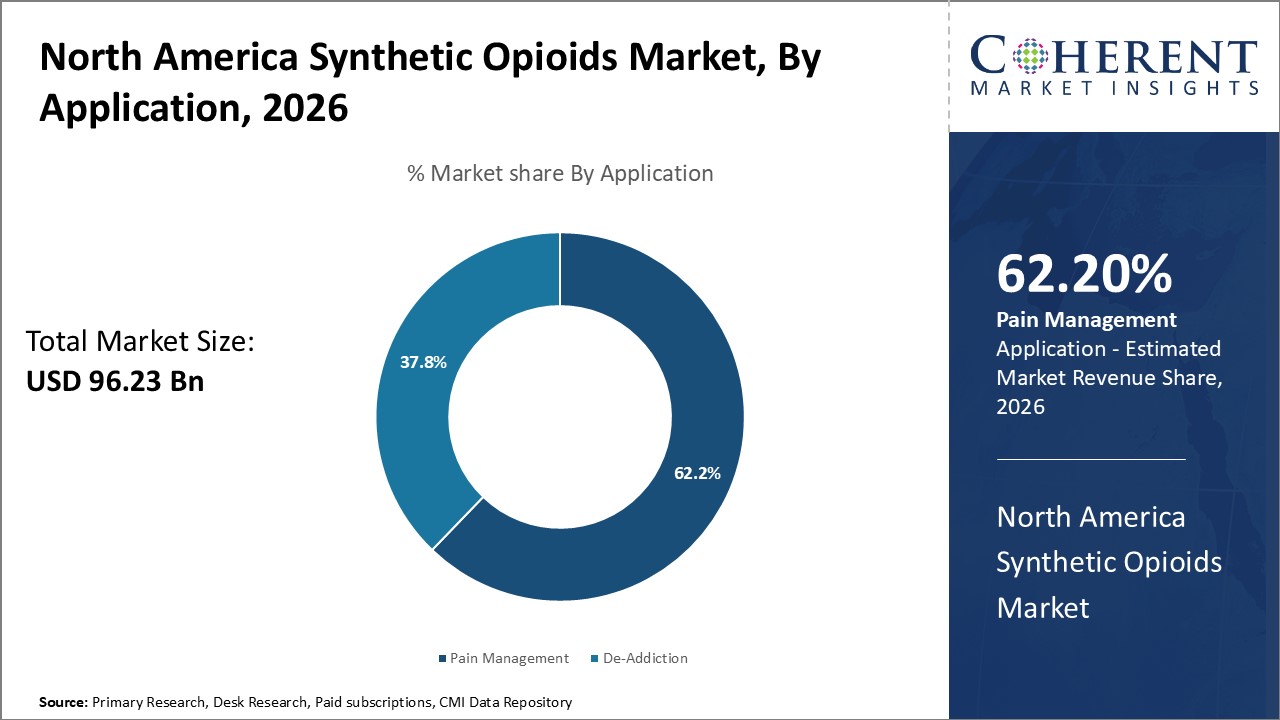
By Application, the Pain Management segment is expected to lead the North America Synthetic Opioids Market demand, accounting for the largest share in 2026. This functionality is guided by the burdensome arthritis, lower back pain, and neuropathy conditions in conjunction with the aging population in North America.
Chronic pain has a dire effect on a patient’s quality of life, productivity, and in turn, increases the use of opioids – both prescription and synthetic – being used in multi-modal pain management plans. This further aggravates the situation on account of post-operative pain management policies, palliative treatment programs, especially those concerning oncology patients.
While the De-addiction segment is growing, it is still surrounded by stigma, difficult access to treatment facilities, and stringent regulations, which limits its market share in the near term.
North America Synthetic Opioids Market Insights, By Distribution Channel
By Distribution Channel, the Hospitals segment is projected to dominate the market by 2026. Hospitals have maintained their dominance in this service area due to the expansion modules of hospital infrastructure, with a greater focus on oncology units, as well as the increasing trend of managing cancer and post-surgical pain with clinical supervision through synthetic opioids.
Centralized purchasing and administrational control, on the other hand, enable institutions to reduce the misuse and diversion risks. Ordinarily, patients at these facilities are carefully monitored and provided comprehensive plans, which favor systematic treatment with opioids.
In contrast, coverage of the Retail Outlets segment is particularly noteworthy; however, it is heavily controlled to reduce inappropriate dispensing of opioids. More regulation control and review of prescriptions has resulted in a shift of greater proportions of opioid distribution to hospitals.
North America Synthetic Opioids Market: Regional Insights
Among countries, the U.S. is expected to remain as the dominant region in the North America synthetic opioids market trend through the forecast period. The US market share is 60.1% because of the greater burden of chronic pain in the country. As published data by Center for Disease Control and Prevention remarked on April 14, 2026, 20.9% of adults in the United States (approximately 51.6 million individuals) were suffering from chronic pain in 2021 and of these, 6.9% (that is, 17.1 million people) had high-impact chronic pain.
Market Report Scope
North America Synthetic Opioids Market Report Coverage
| Report Coverage | Details | ||
|---|---|---|---|
| Base Year: | 2025 | Market Size in 2026: | USD 96.23 Bn |
| Historical Data for: | 2020 To 2024 | Forecast Period: | 2026 To 2033 |
| Forecast Period 2026 to 2033 CAGR: | 2.2% | 2033 Value Projection: | USD 112.07 Bn |
| Geographies covered: |
| ||
| Segments covered: |
| ||
| Companies covered: | Johnson & Johnson Services, Inc., Purdue Pharma L.P., Hikma Pharmaceuticals PLC, AbbVie Inc., Sanofi, Sun Pharmaceutical Industries Ltd, Pfizer, Inc., AstraZeneca Plc., Mallinckrodt Pharmaceuticals, Teva Pharmaceutical Industries Ltd., Endo Pharmaceuticals Inc., and Boehringer Ingelheim International GmbH. | ||
| Growth Drivers: |
| ||
| Restraints & Challenges: |
| ||
North America Synthetic Opioids Market – Driver
- Launching New Strategy by Government Organizations
Increasing launches of new strategy by government organization, in order to prevent global crisis of synthetic opioids is expected to drive the market growth over the forecast period. For instance, in November 2021, United Nations Office on Drugs and Crime (UNODC), a government organization, launched a new strategy to prevent global crisis of synthetic opioids.
This new strategy will help policymakers to introduce effective policy directions and strategies, and to provide access to treatment in different parts of the world. This strategy will also help to introduce new policy directions to interrupt the manufacture and trafficking of synthetic drugs.
Analysts’ Views on North America Synthetic Opioids Market
- The North America synthetic opioids market remains highly dynamic and multifaceted, shaped by both medical demand and public health concerns.
- Rising chronic pain prevalence—including conditions such as cancer, arthritis, and post-surgical recovery—continues to be a major driver of opioid prescriptions across the region.
- Increased awareness of the fast-acting pain relief benefits offered by synthetic opioids is further accelerating their adoption in clinical settings.
- However, the market is constrained by growing concerns over addiction, misuse, and overdose deaths, intensifying pressure from public health authorities and prompting tighter regulatory oversight.
- The opioid epidemic has resulted in stricter prescription guidelines, with health agencies in both the U.S. and Canada pushing for greater accountability and risk mitigation.
- Alternative pain management therapies, including non-opioid pharmaceuticals and physical rehabilitation programs, are gaining traction and may challenge long-term opioid demand.
- Despite these restraints, R&D investment into abuse-deterrent formulations (ADFs) and other safety-enhancing innovations offers strong potential for market revitalization.
- The United States leads the regional market, supported by robust healthcare infrastructure, high healthcare spending, and a large base of chronic pain patients.
- Canada is emerging as the fastest-growing sub-market, fueled by expanding access to synthetic opioids, favorable regulatory reforms, and growing public health investments.
North America Synthetic Opioids Market: Key Developments
- In May 2025, Johnson & Johnson announced the launch of a next-generation abuse-deterrent extended-release synthetic opioid formulation in the U.S. market. This product aims to reduce misuse while maintaining clinical efficacy for chronic pain patients.
- In February 2025, the U.S. Food and Drug Administration (FDA) granted Fast Track Designation to a synthetic opioid under development by Collegium Pharmaceutical, aimed at treating cancer-related breakthrough pain with enhanced safety features.
- In January 2025, Health Canada updated its opioid prescribing guidelines, incorporating provisions for improved access to synthetic opioids in palliative and end-of-life care settings. The revision is expected to increase synthetic opioid utilization in Canadian healthcare systems.
Market Segmentation
- North America Synthetic Opioids Market, By Product Type (Revenue, USD Bn, 2021 - 2033)
- Synthetic Opioids
- Methadone
- Fentanyl
- Meperidine
- Semi Synthetic Opioids
- Hydrocodane
- Oxymorphone
- Oxycodone
- Hydromorphone
- Buprenorphine
- North America Synthetic Opioids Market, By Application (Revenue, USD Bn, 2021 - 2033)
- Pain Management
- De-Addiction
- North America Synthetic Opioids Market, By Distribution Channel (Revenue, USD Bn, 2021 - 2033)
- Retail Outlets
- Hospitals
- North America Synthetic Opioids Market, By Country (Revenue, USD Bn, 2021 - 2033)
- U.S.
- Canada
- Company Profiles
- Johnson & Johnson Services, Inc.
- Purdue Pharma L.P.
- Hikma Pharmaceuticals PLC
- AbbVie Inc.
- Sanofi
- Sun Pharmaceutical Industries Ltd
- Pfizer, Inc.
- AstraZeneca Plc.
- Mallinckrodt Pharmaceuticals
- Teva Pharmaceutical Industries Ltd.
- Endo Pharmaceuticals Inc.
- Boehringer Ingelheim International GmbH.
Sources
Primary Research Interviews
- DEA (Drug Enforcement Administration) officials
- FDA (Food and Drug Administration) regulatory experts
- Pharmaceutical industry executives (e.g., abuse-deterrent opioid developers)
- Pain management healthcare providers
- Others
Databases
- National Center for Biotechnology Information (NCBI)
- CDC WONDER (Centers for Disease Control and Prevention)
- IBISWorld Pharmaceuticals and Healthcare sector data
- Others
Magazines
- Pharmaceutical Executive
- Pain Management Today
- Others
Journals
- Journal of Pain Research
- American Journal of Public Health
- Others
Newspapers
- The New York Times
- The Washington Post
- Others
Associations
- American Cancer Society
- American Pharmacists Association
- Others
Public Domain Sources
- DEA National Drug Threat Assessment reports
- FATF (Financial Action Task Force) publications on opioid trafficking
- New York State Comptroller reports on overdose fatalities
- FDA.gov (drug approval and safety data)
- Others
Proprietary Elements
- CMI Data Analytics Tool
- Proprietary CMI Existing Repository of information for last 8 years
*Definition: Synthetic opioids are drugs that are synthesised in a laboratory, and have the same pain-relieving effects as natural opioids by acting on the same brain receptors. Natural opioids, on the other hand, are organic compounds that are taken from the seed pod of specific poppy plant species. Some synthetic opioids including fentanyl and methadone are permitted for use in medicine.
Get access to 250+ pages report
Every segment, forecast, competitor profile and data table behind the analysis above — available for instant download.
- ESOMAR Member
- ISO 9001:2015 Certified
- D-U-N-S Registered
- GDPR & CCPA Compliant
Missing comfort of reading report in your local language? Find your preferred language:
Transform your Strategy with Exclusive Trending Reports
Frequently Asked Questions
The North America Synthetic Opioids Market size is estimated to be valued at USD 96.23 Bn in 2026, and is expected to reach USD 112.07 Bn by 2033.
The CAGR of the North America Market is projected to be 2.2% from 2026 to 2033.
Increasing launches of new strategy by government organization, in order to prevent global crisis of synthetic opioids is expected to drive the North America market growth.
Pain management is the leading application segment in the market.
Increasing side effects due to over dose of the opioids is expected to hinder the market growth over the forecast period.
Major players operating in the market include Johnson & Johnson Services, Inc., Purdue Pharma L.P., Hikma Pharmaceuticals PLC, AbbVie Inc., Sanofi, Sun Pharmaceutical Industries Ltd, Pfizer, Inc., AstraZeneca Plc., Mallinckrodt Pharmaceuticals, Teva Pharmaceutical Industries Ltd., Endo Pharmaceuticals Inc., and Boehringer Ingelheim International GmbH.