

LATAM Fabry Disease Market Size and Share Analysis: 2026 - 2033
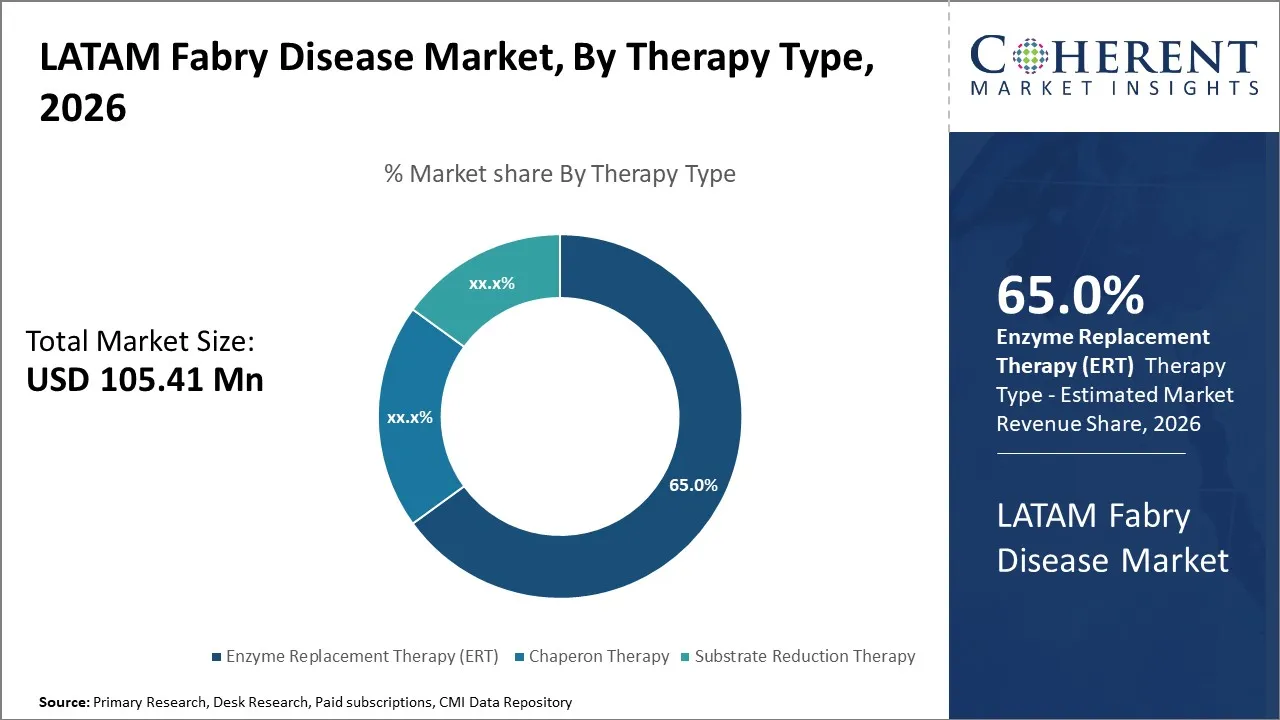
The LATAM fabry disease market size is expected to reach approximately USD 105.41 Mn in 2026 and USD 165.92 Mn by 2033, growing at a CAGR of 6.9% throughout the forecast period (2026-2033).
Key Takeaways from the LATAM Fabry Disease Market Report
- Enzyme Replacement Therapy (ERT) main a highly sought-after therapy type, accounting for about 65% of the market share in 2026, owing to stronger physician familiarity and broader clinical use.
- Parenteral are expected to remain leading route of administration segment accounting for 68% in the respiratory disposables market revenue in 2026, as the IV formulations allow accurate dosing, ensure systemic bioavailability and physician oversight
- The hospitals pharmacies segment registered its dominance over the LATAM fabry disease market with share of 70% in 2026, owing to high volume hospital admissions and high requirement for continuous treatment.
- Brazil is projected to dominate the LATAM fabry disease market in 2026, with a share of over 40% due to strong presence of leading key players.
LATAM Fabry Disease Market Overview
Fabry disease is a rare inherited disorder causing fat buildup and organ damage by the deficiency of an enzyme called alpha-galactosidase A. This enzyme normally breaks down fatty substances called glycosphingolipids. Fabry disease is caused by an enzyme deficiency called alpha-galactosidase which damages the organ over time. The LATAM fabry disease market is gaining strategic importance due to large untapped patient population ad strong government support. Rising awareness & diagnosis of the fabry disease in the LATAM region has driven the growth of the market. Moreover, due to growing access to expensive therapies and improving healthcare systems has driven the market growth.
Current Events and Their Impact on the LATAM Fabry Disease Market
Current Event | Description and its Impact |
Expansion of Biosimilar in LATAM |
|
Increasing Adoption of Genetic Testing |
|
Emergence of Oral Treatments and Gene Therapy |
|
Segmental Insights
- Current Industry Events of 2026
- Market Size Estimation
- Regional Breakdown
- Competitive Landscape
- Customer Intelligence
- Segmental Analysis
- Pricing Analysis
- Key Market Drivers, Challenges & Future Trends
- Customized Insights Section
LATAM Fabry Disease Market Insights, By Therapy Type - Enzyme Replacement Therapy (Agalsidase Beta (Fabrazyme) Holds Dominant Therapy Type in the Market
Based on therapy type, Enzyme Replacement Therapy (Agalsidase Beta (Fabrazyme) is expected to lead the market, accounting for a revenue share of 65% in 2026. Enzyme Replacement Therapy (Agalsidase Beta (Fabrazyme) is the primary and most established treatment for fabry disease. Due to the limited availability of the effective alternatives the segment dominates the market. Fabrazyme is manufactured by Sanofi Genzyme, a company that leads in manufacturing treatments for rare diseases and has strong distribution network, which ensures better availability and adoption across countries like Brazil and Argentina, which supports its dominance in the market. The enzyme replacement therapy (Agalsidase Beta (Fabrazyme) has early treatment benefits due to early initiation of Fabrazyme improves outcomes and slows disease progression. Improved public system positioning and reimbursement in important LATAM markets. Alfagalsidase and betagalsidase are the main treatment options under Brazil's SUS according to the modified Fabry protocol; migalastat was not included in SUS by the final decision made on May 1, 2025. The domination of the ERT market in the area is heavily supported by this type of payer arrangement.
LATAM Fabry Disease Market Insights, By Route of Administration - Parenteral to Remain Leading Route of Administration of Fabry Disease Treatment
By route of administration, parenteral segment is slated to account for a prominent market share of 68% in 2026. The leading treatments like Fabrazyme are large biologic enzymes which cannot survive the digestive system if taken orally and must be administered via parenteral route, making it the dominant mode. As the parenteral route of administration provides higher bioavailability & direct action the segment dominates the market. IV administration delivers the enzyme directly into the bloodstream and ensure rapid distribution to affected organs and hence it is the number one clinician choice. Physicians prefer the parenteral route of administration for the safety and efficacy, especially in severe cases.
LATAM Fabry Disease Market Insights, By Distribution Channel - Growing Need for Controlled Biologic Administration Elevates Hospital Pharmacy Preference
Based on distribution channel, hospital pharmacies segment led the LATAM fabry disease market with share of 70% in 2026. Fabry disease is primarily treated utilizing enzyme replacement therapy (ERT), which is administered intravenously in hospitals. All the facilities required for the therapy are only available in the hospital settings. Hospital pharmacies are equipped with specialized storage systems and trained staff, ensuring safe handling of high-cost orphan drugs. In hospitals the patient gets close clinical monitoring and patient safety which drives the growth of the market over the forecast period. Hence, due to the combination of clinical, logistical, and regulatory factors linked to the nature of this rare disease and its treatment supports the dominance of the hospital pharmacy segment in the Latin America fabry disease market.
Regional Insights
Brazil Fabry Disease Market Trends
The Brazil country dominates the LATAM fabry disease market due to the large patient pool and presence of advanced infrastructure for the diagnosis of the fabry disease. Stronger screening momentum also benefits Brazil, which helps expand the diagnosed population. Brazil leads the LATAM Fabry disease market because it has more diagnosed patients than most other Latin American nations, a broader infrastructure for treating rare diseases, approved Fabry therapies, stronger clinical standardization, and growing screening programs, all of which support higher treatment uptake.
LATAM Fabry Disease Market News
- In March 2026, Chiesi USA, Inc., pharmaceutical company and Protalix BioTherapeutics, Israeli pharmaceutical company presented a unique 2 mg/kg every-4-weeks (E4W) dosage schedule for Elfabrio (pegunigalsidase alfa) for stable adults, in an effort to lessen the burden of care following European Commission (EC) approval in March 2026. Protalix affirmed continuous supply contracts with Fiocruz, Brazil.
- In September 2025, Agalzyme, a biosimilar of agalsidase beta, has been licensed by Argentina as the first enzyme replacement medication for Fabry disease in Latin America. This is a significant development in the availability of treatment for this uncommon condition.
Ongoing Clinical Trial for the LATAM Fabry Disease Market
Trial ID / Study | Therapy | Sponsor | Phase | Confirmed LATAM countries/sites |
NCT05206773 (PERIDOT) | Venglustat | Sanofi | Phase 3 | Argentina, Brazil, Mexico. Public listing shows active LATAM sites in Pergamino, Quilmes, La Rioja (Argentina); Porto Alegre, São Paulo (Brazil); Monterrey, Ciudad de Mexico (Mexico). |
NCT05843916 (SMILE / BIO-AGA-Fase III-001) | Agalsidase beta biosimilar (Agalzyme / AGA BETA BS) | Biosidus | Phase 3 | Argentina-linked biosimilar program from Biosidus; Veeva lists the study as Completed and gives end date: Sep 19, 2024. In Apr 2025, Biosidus said the study met its primary endpoint at 26 weeks. |
NCT01218659 (ATTRACT) | Migalastat vs ERT | Amicus | Phase 3 | Network of Care lists the trial as Completed and shows a Brazil site in São Paulo. |
Market Report Scope
LATAM Fabry Disease Market Report Coverage
| Report Coverage | Details | ||
|---|---|---|---|
| Base Year: | 2025 | Market Size in 2026: | USD 105.41 Mn |
| Historical Data for: | 2020 To 2024 | Forecast Period: | 2026 To 2033 |
| Forecast Period 2026 to 2033 CAGR: | 6.9% | 2033 Value Projection: | USD 165.92 Mn |
| Geographies covered: |
| ||
| Segments covered: |
| ||
| Companies covered: | Amicus Therapeutics, Inc., Sanofi-Aventis U.S. LLC, GlaxoSmithKline plc, Mendelics, Takeda Pharmaceuticals U.S.A., Inc, Teva pharmaceutical Industries Ltd, Pfizer Inc., Novartis AG, Moderna Therapeutics Inc, and Resverlogix | ||
| Growth Drivers: |
| ||
| Restraints & Challenges: |
| ||
LATAM Fabry Disease Market Drivers
Increasing Regulatory Approval of Drug Products for the Marketing Purpose
Increasing regulatory approval of drug products for marketing purposes directly accelerate the LATAM Fabry disease market. Enzyme replacement therapy (ERT) and oral chaperone therapy are currently approved treatments for Fabry disease. Increasing number of regulatory approvals increase the amount of treatment alternatives accessible for the LATAM market, enabling doctors to match therapy to patient profile, age, mutation status, and administration preference. This enhances adoption and expands the pool of patients who can be treated, particularly in cases where oral medications like migalastat can lessen infusion reliance for qualified individuals. The fact that migalastat clinical use was approved in Brazil is also mentioned in Brazil-specific Fabry guidelines, demonstrating how local approval expands actual therapy access rather than maintaining treatment theory. For instance, on March 18, 2026, Protalix BioTherapeutics announced that its sales to Fundación Oswaldo Cruz (Fiocruz) in Brazil rose to USD11.1 million for the entire fiscal year 2025 from roughly USD11.07 million in 2024, demonstrating the ongoing collaboration for the treatment of Fabry and Gaucher disease in the area. In March 2026, Protalix revealed that its sales to Fiocruz, Brazil, had surged in 2025, underscoring the continued collaboration for Fabry therapy in the area.
LATAM Fabry Disease Market Trends
Key LATAM Countries' Clinical-Trial Activity Maintains the Region's Commercial Relevance
The Biosidus phase 3 biosimilar program and other ongoing research activities in region including Brazil, Argentina, and Mexico are examples of recent Fabry development effort in LATAM region. By raising physician awareness, increasing future therapy possibilities, and assisting regional centers in gaining expertise with more recent medicines, this promotes growth.
Localization of Regional Supplies and Import substitution
LATAM buyers often want more stable pricing, shorter lead times, and less dependence on imported specialty chemicals. This creates space for toll production, regional warehousing, and local blending of polyurethane, EVA, polyolefin, acrylic, and reactive hot-melt fabric adhesives. This is reinforced by the larger regional drive for industrial modernization and local manufacturing
Analyst Opinion (Expert Opinion)
- LATAM fabry disease market growth is driven by the expanding access to enzyme replacement therapy and supportive treatment options increases the demand. The increasing availability of enzyme replacement therapies, along with supportive care for cardiac, renal, and neurological complications associated with Fabry disease, is strengthening the therapy landscape in Latin America. Healthcare providers are increasingly emphasizing timely therapeutic intervention to slow disease progression and improve patient outcomes, thereby supporting market expansion.
- The increasing awareness and early diagnosis of Fabry disease drives the market growth. Due to increased focus on rare disease screening, physician education, and improved diagnostic pathways across Latin America remains a major growth catalyst for the LATAM Fabry disease market. As awareness among healthcare professionals and patient communities improves, the identification of undiagnosed and misdiagnosed cases is increasing, which is steadily supporting treatment demand across the region.
- Improving rare disease policies and reimbursement support boost long-term demand. According to analyst opinions, the gradual strengthening of orphan disease frameworks, public healthcare inclusion, and reimbursement support in several Latin American countries is accelerating market growth. Expanding policy focus on rare disorders, along with efforts to improve access to high-cost specialty therapies, is anticipated to create favorable long-term opportunities for the Fabry disease market in the region.
- Focus on multidisciplinary disease management and precision diagnosis fuels market development and has driven the market growth. The increasing emphasis on family screening, genetic testing, and multidisciplinary management of Fabry disease is expanding the overall treatment ecosystem in Latin America. The rising demand for comprehensive care involving nephrologists, cardiologists, neurologists, and genetic specialists is creating additional growth opportunities for therapy providers and healthcare systems addressing Fabry disease.
Speak to the analyst
Want personalized insights?
Take the findings above to one of our principal consultants, or have the report rebuilt around the segments, geographies and competitors you actually track.
LATAM Fabry Disease Market Segmentation
- By Therapy Type ( Revenue, USD Mn, 2020 - 2033)
- Enzyme Replacement Therapy
- Agalsidase Beta (Fabrazyme)
- Agalsidase Alfa (Replagal)
- Pegunigalsidase Alfa (PRX-102, Phase III)
- Chaperon Therapy
- Migalastat (Galafold Phase III)
- Substrate Reduction Therapy
- Lucerastat (Phase III)
- Venglustat (Phase III)
- Enzyme Replacement Therapy
- By Route of Administration Insights (Revenue, USD Mn, 2020 - 2033)
- Oral
- Parental
- By Distribution Channel Insights ( Revenue, USD Mn, 2020 - 2033)
- Hospitals Pharmacies
- Retail Pharmacies
- Online pharmacies
- By Country Insights ( Revenue, USD Mn, 2020 - 2033)
- Brazil
- Mexico
- Argentina
- Rest of Latin America
- Key Players
- Amicus Therapeutics, Inc.
- Sanofi-Aventis U.S. LLC
- GlaxoSmithKline plc
- Mendelics
- Takeda Pharmaceuticals U.S.A., Inc
- Teva pharmaceutical Industries Ltd
- Pfizer Inc.
- Novartis AG
- Moderna Therapeutics Inc
- Resverlogix
Sources
Primary Research Interviews
- Interviews with Fabry disease specialists to understand diagnosis trends, treatment practices, and unmet needs in the LATAM Fabry disease market.
- Insights from nephrologists, cardiologists, neurologists, and pediatric specialists on disease burden, major complications, and patient management patterns.
- Discussions with geneticists and diagnostic experts to assess genetic screening, enzyme testing, and early diagnosis opportunities across Latin America.
- Interviews with hospital pharmacists, distributors, regulatory experts, and patient advocacy groups to evaluate treatment access, reimbursement, supply trends, and awareness levels in the region.
Databases
- PubMed — Biomedical and clinical literature on Fabry disease, lysosomal storage disorders, diagnosis, and treatment outcomes.
- Orphanet — Rare disease database covering Fabry disease epidemiology, disease overview, and orphan drug information.
- Scopus — Multidisciplinary scientific literature on Fabry disease, genetics, nephrology, cardiology, and rare disease management.
- ClinicalTrials.gov — Registry of clinical trials related to Fabry disease therapies, rare disease studies, and pipeline developments.
Magazines
- Rare Disease Advisor
- Pharmaceutical Technology
- BioPharm International
- Pharma Manufacturing
- European Pharmaceutical Review
- Genetic Engineering & Biotechnology News
Journals
- Genetics in Medicine
- Pediatric Nephrology
- Journal of Inherited Metabolic Disease
- Molecular Genetics and Metabolism
- Orphanet Journal of Rare Diseases
- Clinical Genetics
Newspapers
- Financial Times — Reports on rare disease drug access, policy developments, and healthcare investments.
- The New York Times — Health and science coverage relevant to rare diseases and genetic disorders.
- Reuters — Coverage on rare disease drugs, regulatory approvals, and Fabry disease therapy developments.
- The Wall Street Journal — News on biopharmaceutical companies, orphan drugs, and specialty treatment markets.
- The Economic Times — Coverage on pharmaceutical industry trends and healthcare developments.
Associations
- Fabry International Network (FIN)
- National Organization for Rare Disorders (NORD)
- EURORDIS
- Pan American Health Organization (PAHO)
- Sociedade Latino-Americana de Erros Inatos do Metabolismo e Triagem Neonatal (SLEIMPN)
Public Domain Sources
- World Health Organization (WHO) — Rare disease and healthcare system data relevant to diagnosis and treatment access.
- ANVISA, Brazil — Regulatory information on Fabry disease therapies and orphan drug approvals.
- COFEPRIS, Mexico — Drug approval and regulatory updates relevant to rare disease treatments.
- Pan American Health Organization (PAHO) — Regional healthcare, public health, and Latin America rare disease insights.
- ANMAT, Argentina — Public regulatory data on specialty drugs and orphan therapies.
- INVIMA, Colombia — Regulatory and product approval information for rare disease treatments.
Proprietary Elements
- CMI Data Analytics Tool
- Proprietary CMI Existing Repository of Information for the Last 8 Years
Get access to 250+ pages report
Every segment, forecast, competitor profile and data table behind the analysis above — available for instant download.
- ESOMAR Member
- ISO 9001:2015 Certified
- D-U-N-S Registered
- GDPR & CCPA Compliant
Missing comfort of reading report in your local language? Find your preferred language:
Transform your Strategy with Exclusive Trending Reports
Frequently Asked Questions
The LATAM market is estimated to be valued at USD 105.41 Mn in 2026.
The LATAM fabry disease market value is expected to reach USD 165.92 Mn by 2033.
The global market is poised to exhibit a CAGR of 6.9% from 2026 to 2033.
Major growth factors include increasing regulatory approval of drug products for the marketing purpose and increasing prevalence of patients with fabry disease.
Lack of proper treatment for fabry disease
Some major companies in the Amicus Therapeutics, Inc., Sanofi-Aventis U.S. LLC, GlaxoSmithKline plc, Mendelics, Takeda Pharmaceuticals U.S.A., Inc, Teva pharmaceutical Industries Ltd, Pfizer Inc., Novartis AG, Moderna Therapeutics Inc, and Resverlogix
Brazil, with 40% share in 2026, is expected to lead the market during the forecast period.