

Latin America Bone Graft and Substitutes Market Size and Trends - 2026 to 2033
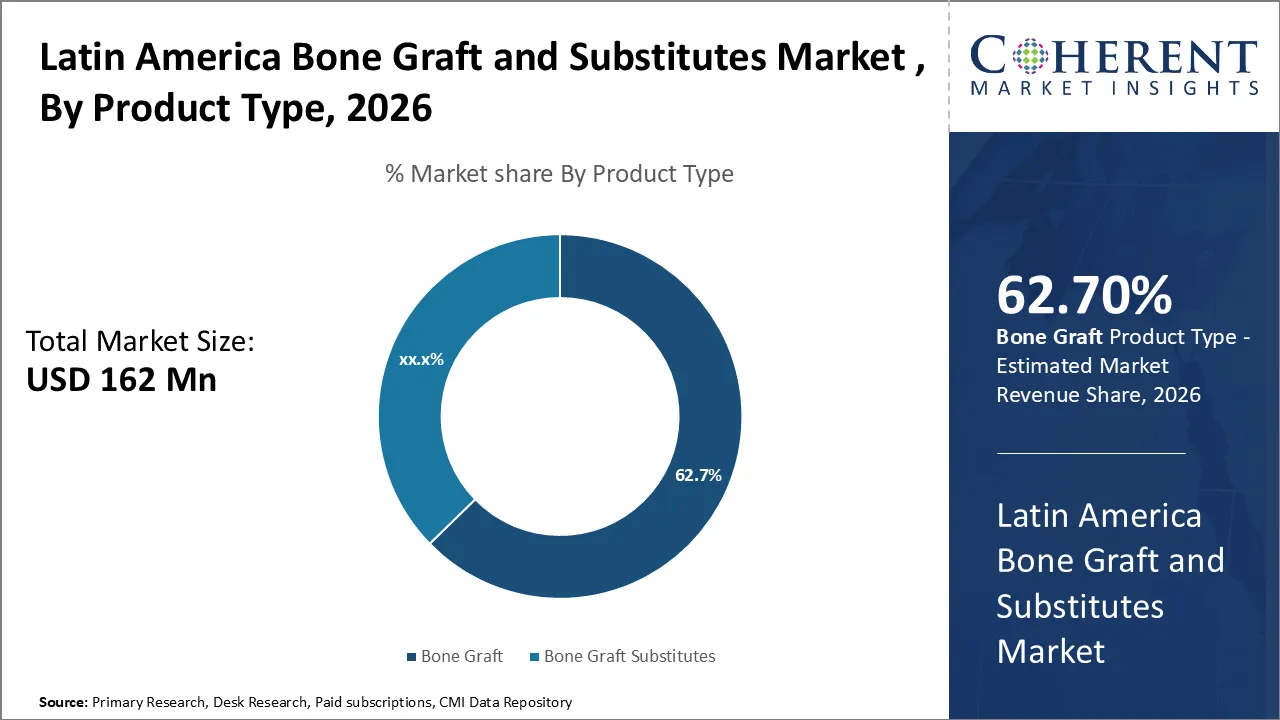
The Latin America Bone Graft and Substitutes Market is estimated to be valued at USD 162 Mn in 2026 and is expected to reach USD 258 Mn by 2033, growing at a compound annual growth The rate (CAGR) of 6.9% from 2026 to 2033.
Key Takeaways
- Based on Product Type, the Bone Graft segment is expected to lead the market with 62.70% share in 2026, due to its clinician familiarity, high orthopedic adoption, and established tissue bank availability.
- Based on Application, the Spinal Fusion segment is expected to hold 56.20% share of the market in 2026 supported by high procedural volumes across Brazil, Mexico, and Argentina.
- Based on Country, Brazil is set to lead the market with 36.30% share in 2026. While, Peru is anticipated to be the fastest growing region.
Market Overview
The Latin America bone graft and substitutes market is advancing significantly driven by its critical role in facilitating bone regeneration and structural repair during complex orthopedic, spinal, and dental procedures. The increasing demand for cutting-edge regenerative solutions in minimally invasive surgeries and the growth of specialized surgical centers are key factors for the growth. Tightening clinical safety standards and the rising prevalence of degenerative bone diseases, particularly in aging populations across Brazil and Mexico, are expected to drive market growth over the forecast period.
Latin America bone graft and substitutes are high-performance biological or synthetic materials mainly categorized as allografts, xenografts, or synthetic systems to deliver a scaffold for new bone growth. These solutions allow surgeons to address subtle anatomical voids with superior osteoconductive and osteoinductive properties playing a crucial role in modern healthcare sectors such as trauma surgery, neurosurgery, and orthopedics.
Current Events and Its Impacts on the Latin America Bone Graft and Substitutes Market
Current Event | Description and the Impact |
Economic and Healthcare Infrastructure Trends
|
|
Technological Innovations and R&D Advances |
|
Demographic and Epidemiological Shifts |
|
Segmental Insights
- Current Industry Events of 2026
- Market Size Estimation
- Regional Breakdown
- Competitive Landscape
- Customer Intelligence
- Segmental Analysis
- Pricing Analysis
- Key Market Drivers, Challenges & Future Trends
- Customized Insights Section
Latin America Bone Graft and Substitutes Market Insights By, Product Type – Bone Graft Leads Due to its Clinician Familiarity
In terms of product type, the bone graft segment contributes the highest share of 62.70% in 2026 of the Latin America bone graft and substitutes market. This is owing to its established clinical track record and superior biological performance. The clinicians in the region are favoring allografts and autografts for their natural osteoinductive and osteoconductive properties, as they are essential for complex skeletal reconstructions. The traditional bone grafts remain the primary choice for surgeons dealing with large segmental defects and high-risk non unions. This growth is also fueled by the growing network of regional tissue banks and improvements in pressing technologies that enhance graft safety and minimize immunogenic responses. As a result, the segment maintains a robust market share owing to its proven reliability to deliver predictable and reproducible patient outcomes in regenerative surgical applications.
Latin America Bone Graft and Substitutes Market Insights By, Application – Spinal Fusion Leads with High Procedural Volumes
In terms of application, the spinal fusion segment contributes the highest share of 56.20% in the Latin America bone graft and substitutes market in 2026. This is driven by a rising geriatric population and an increase in degenerative disc diseases across Latin America. The transition toward minimally invasive surgical techniques has resulted in a surge in demand for specialized bone graft substitutes designed to promote rapid vertebral fusion. The segment benefits from high procedural volumes in major urban healthcare hubs where spinal disorders linked to sedentary lifestyles and obesity are prevalent. Furthermore, the integration of advanced fixation devices with bioactive scaffolds has improved the success rates of spondylosyndesis procedures. The continuous investment in specialized orthopedic training and the expansion of private healthcare facilities ensure that spinal fusion remains the primary revenue generator for the bone graft and substitutes market.
Country Insights
Brazil Bone Graft and Substitutes Market Analysis & Trends
Brazil is set to lead the Latin America bone graft and substitutes market with a share of 36.30% owing to its vast healthcare and infrastructure and a high concentration of specialized orthopedic and dental practitioners. The country boasts one of the world's largest dental implant markets, thus serving as a major catalyst for bone graft consumption. The country’s prominence is also fueled by a strong domestic manufacturing base and protective regulatory policies that favor local production of synthetic materials. In addition, the increasing accessibility of complex surgeries through the public healthcare system (SUS) and a growing private insurance sector broaden the patient base for bone grafting procedures. With ongoing strategic collaborations and significant R&D investments, Brazil continues to serve as the regional powerhouse for orthobiologic innovation and market expansion.
Peru Bone Graft and Substitutes Market Analysis & Trends
Peru is likely to experience the fastest growth over the forecast period. This is owing to ongoing healthcare system reforms and improving macroeconomic fundamentals. The country is witnessing an increase in private medical investments and an influx of international medical technology providers looking to capitalize on underserved provincial markets. The increased awareness of advanced dental aesthetics and a growing volume of trauma-related orthopedic surgeries are propelling the demand for cost-effective synthetic grafts. In addition, the ongoing government efforts to modernize surgical outcomes and broaden the footprint of specialized clinics in Lima and major cities are speeding up product adoption. This rising demand emerging from a limited baseline highlights Peru’s potential as a fast-growing market for bone graft and substitute solutions.
Market Report Scope
Latin America Bone Graft and Substitutes Market Report Coverage
| Report Coverage | Details | ||
|---|---|---|---|
| Base Year: | 2025 | Market Size in 2026: | USD 162 Mn |
| Historical Data for: | 2020 To 2024 | Forecast Period: | 2026 To 2033 |
| Forecast Period 2026 to 2033 CAGR: | 6.9% | 2033 Value Projection: | USD 258 Mn |
| Geographies covered: |
| ||
| Segments covered: |
| ||
| Companies covered: | RTI Surgical, Inc., NuVasive, Inc., Exactech, Inc., Medtronic Plc., LifeNet Health, Zimmer Biomet Holdings, Inc., Stryker Corporation, Johnson & Johnson, Orthofix International N.V., Ace Surgical Supply Co., Inc., and Novabone Product, LLC | ||
| Growth Drivers: |
| ||
| Restraints & Challenges: |
| ||
Latin America Bone Graft and Substitutes Market Drivers
Increasing number of orthopedic and dental surgeries
The increasing volume of orthopedic and spinal surgeries acts as the primary catalyst for the Latin American bone graft and substitutes market growth. A rising geriatric population across Brazil and Mexico substantially increases the prevalence of degenerative disc diseases and osteoporosis-related fractures, necessitating surgical interventions that rely on advanced grafting materials. The surgeons are adopting minimally invasive techniques that utilize specialized bone void fillers and synthetic scaffolds to speed up patient recovery and improve vertebral fusion success rates. In addition, the high rates of road traffic accidents and sports injuries in the region are propelling a surge in trauma-related reconstructive surgeries. As healthcare infrastructure expands and specialized orthopedic clinics proliferate, the continued demand for high-performance orthobiologics ensures a steady upward trajectory for the regional market throughout the forecast period.
Analyst Opinion (Expert Opinion)
The Latin America Bone Graft and Substitutes Market is exhibiting steady structural expansion, supported by rising surgical volumes, demographic shifts, and improvements in healthcare delivery across the region. Orthopedic and dental procedures remain the primary demand generators, with spinal fusion, trauma reconstruction, and dental implantology accounting for a significant share of graft utilization. Regional procedure volumes have increased consistently, driven by higher incidence of degenerative bone disorders, road traffic injuries, and age-related skeletal conditions.
Material preference patterns indicate strong adoption of allografts in orthopedic applications, supported by clinical familiarity and availability through established tissue banks. At the same time, synthetic bone graft substitutes are gaining traction, particularly in dental and minimally invasive procedures, due to controlled composition, reduced disease transmission risk, and predictable resorption profiles. Xenografts continue to play an important role in dental reconstruction, especially in implant-supported restorations.
From a geographic standpoint, Brazil represents the largest procedural base in Latin America, supported by its high concentration of hospitals, dental clinics, and trained orthopedic specialists. Mexico, Argentina, and Colombia follow, benefiting from expanding private healthcare infrastructure and increasing adoption of advanced regenerative techniques. Public and private investments in surgical capacity, combined with rising patient awareness of bone regeneration therapies, are reinforcing market demand.
Overall, clinical adoption trends, expanding surgical indications, and material innovation are positioning the Latin America bone graft and substitutes market for sustained, procedure-led growth across orthopedic and dental specialties.
Speak to the analyst
Want personalized insights?
Take the findings above to one of our principal consultants, or have the report rebuilt around the segments, geographies and competitors you actually track.
Latin America Bone Graft and Substitutes Industry News
- In May 2025, Xtant Medical Holdings, Inc. made the announcement of the commercial release of OsteoFactor ProTM. This product is an allogeneic growth factor cocktail that occurs naturally and is intended to enhance bone repair and improve surgical outcomes in various orthopedic and spine surgeries.
- In April 2024, Geistlich, a specialist in regeneration, has agreed to acquire Bionnovation Biomedical, a Brazilian medical technology company. This acquisition will add a new family of brands and products to its global portfolio.
Market Segmentation
- Product Type Insights (Revenue, USD Mn, 2026 - 2033)
- Bone Graft
- Allografts
- Xenografts
- Bone Graft Substitutes
- Ceramics
- Composites
- Polymers
- Bone Morphogenetics Proteins
- Others
- Bone Graft
- Application Insights (Revenue, USD Mn, 2026 - 2033)
- Spinal Fusion
- Dental Bone Grafts
- Craniomaxillofacial
- Joint Reconstruction
- Trauma
- Country Insights (Revenue, USD Mn, 2026 - 2033)
- Colombia
- Peru
- Chile
- Rest of Latin America
- Key Players Insights
- RTI Surgical, Inc.
- NuVasive, Inc.
- xactech, Inc.
- Medtronic Plc.
- LifeNet Health
- Zimmer Biomet Holdings, Inc.
- Stryker Corporation
- Johnson & Johnson
- Orthofix International N.V.
- Ace Surgical Supply Co., Inc.
- Novabone Product, LLC
Sources
Primary Research Interviews
- Orthopedic Surgeons & Spine Surgeons
- Dental Implantologists & Maxillofacial Surgeons
- Hospital Procurement Managers & Biomedical Engineers
- Bone Graft & Biomaterials Manufacturers
- Regenerative Medicine & Tissue Engineering Specialists
- Healthcare Distributors & Channel Partners
- Others
Databases
- Bloomberg Terminal
- Thomson Reuters Eikon
- IQVIA Database
- Others
Magazines
- Orthopedics Today
- Medical Device Network
- Becker’s Spine Review
- Latin America Medical Device Magazine
- BioMed Technology Today
- Others
Journals
- Journal of Orthopaedic Research
- Journal of Bone and Mineral Research
- Clinical Orthopaedics and Related Research
- Journal of Biomaterials Applications
- International Journal of Oral & Maxillofacial Surgery
- Others
Newspapers
- Financial Times
- Reuters
- Bloomberg News
- El País (Latin America Edition)
- The Wall Street Journal
- Others
Associations
- Latin American Society of Orthopedics and Traumatology (SLAOT)
- International Society of Orthopaedic Surgery and Traumatology (SICOT)
- American Academy of Orthopaedic Surgeons (AAOS)
- International Osteoporosis Foundation (IOF)
- Latin American Federation of the Orthopaedic Industry (FLEBO)
- Others
Public Domain Sources
- World Health Organization (WHO)
- Pan American Health Organization (PAHO)
- U.S. Food & Drug Administration (FDA) – Medical Devices Database
- Brazilian Health Regulatory Agency (ANVISA)
- World Bank Open Data
- National Institutes of Health (NIH)
- Others
Proprietary Elements
- CMI Data Analytics Tool
- Proprietary CMI Existing Repository of Information for the Last 8 Years
Get access to 250+ pages report
Every segment, forecast, competitor profile and data table behind the analysis above — available for instant download.
- ESOMAR Member
- ISO 9001:2015 Certified
- D-U-N-S Registered
- GDPR & CCPA Compliant
Missing comfort of reading report in your local language? Find your preferred language:
Transform your Strategy with Exclusive Trending Reports
Frequently Asked Questions
The Latin America Bone Graft and Substitutes Market is estimated to be valued at USD 162 Mn in 2026, and is expected to reach USD 258 Mn by 2033.
The CAGR of the Latin America Bone Graft and Substitutes Market is projected to be 6.9% from 2026 to 2033.
Increasing number of orthopedic surgeries in Latin America is one of the major factors driving the growth of the Latin America Bone Graft and Substitutes Market.
Risks associated with surgery failure and graft failure is one of the major factors hampering the growth of the Latin America Bone Graft and Substitutes Market.
In terms of product type, the bone graft segment is estimated to dominate the market revenue share in 2026.
RTI Surgical, Inc., NuVasive, Inc., Exactech, Inc., Medtronic Plc., LifeNet Health, Zimmer Biomet Holdings, Inc., Stryker Corporation, Johnson & Johnson, Orthofix International N.V., Ace Surgical Supply Co., Inc., and Novabone Product, LLC are the major players.
Brazil is expected to lead the Latin America Bone Graft and Substitutes Market in 2026.