

Latin America Continuous Glucose Monitoring Device Market Analysis & Forecast 2026-2033
The Latin America continuous glucose monitoring device market was valued at USD 394.9 Mn in 2026 and is forecast to reach a value of USD 1,100.9 Mn by 2033 at a CAGR of 15.8% between 2026 and 2033.
Key Takeaways
- Based on Component Type, the sensor segment is expected to hold 47.3% share in 2026.
- Based on End User, the homecare segment is expected to lead the market with 57.8% share in 2026.
Market Overview
Continuous glucose monitoring devices have the potential to improve clinical outcomes for avoiding hypo/hyperglycemic events, an outcome of uncontrolled diabetes, which can arise due to skipped insulin dose. The currently available CGM (continuous glucose monitoring) devices display the glucose level, thus becoming a vital tool to predict the future events of hypo- and hyperglycemia. Moreover, the device is more convenient for type 1 diabetic patients, as it requires continuous monitoring of glucose for administration of insulin on regular basis. Thus, use and benefits of CGM (continuous glucose monitoring) device in controlling both type 1 diabetes and hypoglycemia & hyperglycemia is expected to drive the market growth.
Current Events and their Impacts on the Latin America Continuous Glucose Monitoring Device Market
Current Event | Description and its Impact |
Technological Advancements and Innovation |
|
Public Health Initiatives and Diabetes Prevalence |
|
Is Latin America’s Diabetes Burden Growing with 35 Million Adults Affected
Country/Region | Adults with Diabetes (millions) | Prevalence (%) |
Brazil | 16.6 | 10.6% |
Mexico | 13.6 | 16.4% |
Argentina | 4.3 | 14.0% |
Chile | ~2.0 | 12.0% (est.) |
Colombia | ~2.5 | 9.0% (est.) |
Peru | ~1.8 | 8.5% (est.) |
Other SACA | ~4.9 | 9–12% (avg.) |
Total (SACA) | 35.0 | ≈10% |
- Current Industry Events of 2026
- Market Size Estimation
- Regional Breakdown
- Competitive Landscape
- Customer Intelligence
- Segmental Analysis
- Pricing Analysis
- Key Market Drivers, Challenges & Future Trends
- Customized Insights Section
Segmental Insights
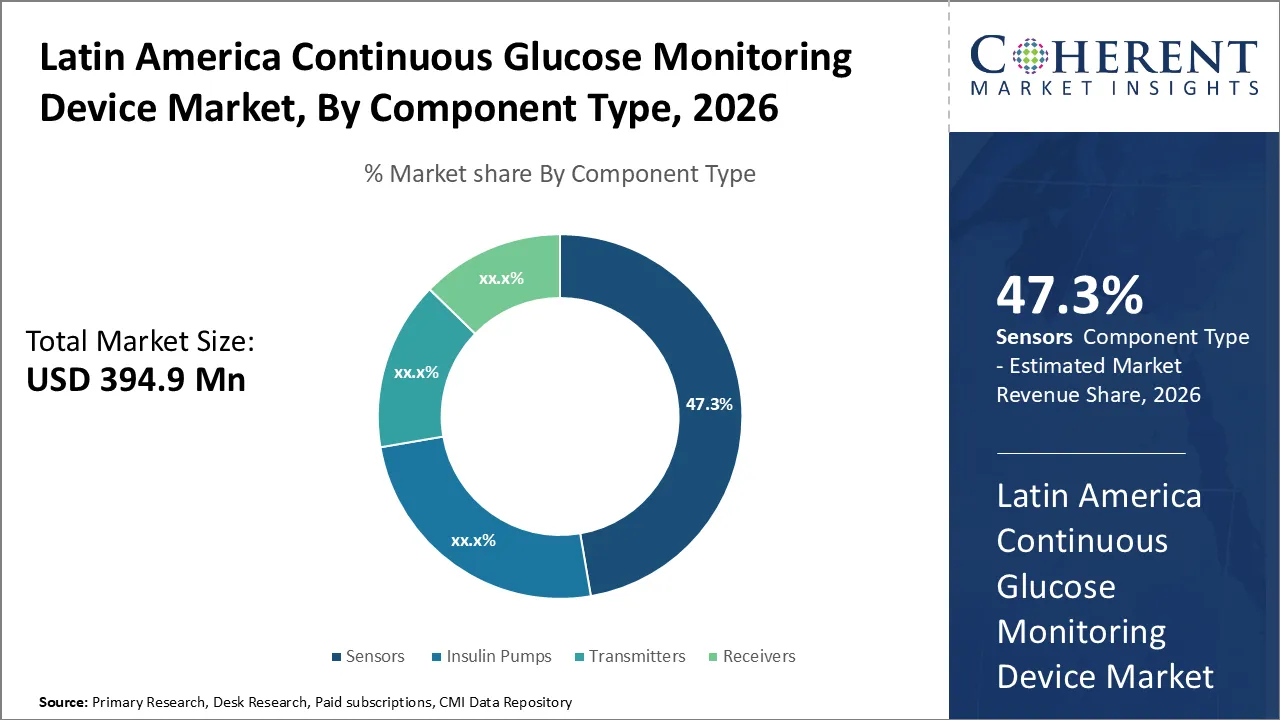
Latin America Continuous Glucose Monitoring Device Market Insights, By Component Type: Sensors lead the market as the indispensable, frequently replaced core of CGM systems.
In terms of component type, the sensor segment is expected to hold 47.3% share in 2026, because they are the only thing that can continuously measure glucose levels in interstitial fluid. Their regular replacement cycle guarantees steady income, and new features like longer wear time, better accuracy, and fewer calibration needs make them essential for patients and healthcare providers throughout Latin America.
Latin America Continuous Glucose Monitoring Device Market Insights, By End User: Homecare dominates as patients increasingly adopt self‑monitoring solutions, reflecting the shift toward convenient, patient‑centric diabetes management
In terms of end use, the homecare segment is expected to lead the market with 57.8% share in 2026, because they want to be able to monitor and manage their condition from home. People can easily keep track of their glucose levels as they are becoming more aware of them, they are becoming more affordable, and they can be used with smartphones. This change is part of a bigger trend toward patient-centered care, which means less reliance on hospitals and clinics and better management of daily life.
For instance, in September 2025, Glooko acquired Monarch Medical Technologies to make its diabetes management platform larger. The deal adds Monarch's EndoTool system, which makes Glooko's hospital-to-home care model even better. Since Glooko works with data from CGM devices like Abbott's FreeStyle Libre, the purchase indirectly supports the use of CGM in home care, even in new markets like Brazil.
Latin America Continuous Glucose Monitoring Device Market Outlook Country-Wise
Brazil Latin America Continuous Glucose Monitoring Device Market Trends
Brazil is the largest customer base for CGM devices in Latin America because it has a large diabetic population and the government is working hard to improve diabetes care. Brazil is likely to stay the biggest driver of growth in the regional market because its healthcare infrastructure is growing and digital health solutions are being adopted quickly.
For instance, in June 2025, GlucoTrack's implantable Continuous Blood Glucose Monitor had good results in Brazil's first-in-human study. The trial, which took place in late 2024 and early 2025, showed that it was very accurate, could reliably collect data, and was safe. These results show that the device could help Brazil's diabetes care and continuous glucose monitoring.
Mexico Latin America Continuous Glucose Monitoring Device Market Trends
Mexico is a great place for CGM devices to grow because there are a high prevalence of diabetes and growing awareness about advanced monitoring solutions. Investments in private healthcare and more insurance coverage are making it easier to get care. At the same time, urban areas are driving adoption through modern clinics and digital health integration. All of these things make Mexico a major player in regional demand.
Market Report Scope
Latin America Continuous Glucose Monitoring Device Market Report Coverage
| Report Coverage | Details | ||
|---|---|---|---|
| Base Year: | 2025 | Market Size in 2026: | USD 394.9 Mn |
| Historical Data for: | 2020 To 2024 | Forecast Period: | 2026 To 2033 |
| Forecast Period 2026 to 2033 CAGR: | 15.8% | 2033 Value Projection: | USD 1,100.9 Mn |
| Geographies covered: |
| ||
| Segments covered: |
| ||
| Companies covered: | Medtronic Plc., Abbott, F. Hoffmann-La Roche AG., Johnson & Johnson, Senseonics, Inc, Dexcom, Inc, Insulet Corporation, Tandem Diabetes Care, Inc, Roche Diagnositics, Lifescan, Bayer Health Care, AgaMatrixc Inc., Arkray Inc., and Nova Biomedical Corporation | ||
| Growth Drivers: |
| ||
| Restraints & Challenges: |
| ||
Latin America Continuous Glucose Monitoring Device Market Driver
Rising Diabetes Prevalence
The rising number of people with diabetes in Latin America is a major factor for advanced monitoring technologies are becoming more popular. CGM devices are becoming essential tools for improving patient outcomes and lowering complications as millions of individuals require constant care. The rise in cases is directly driving the Latin America continuous glucose monitoring device market growth, driven by healthcare systems and patients are becoming more aware of how tracking glucose levels in real time can help control diseases and improve long-term health.
Shift Toward Preventive Healthcare
There is a strong push in Latin America toward preventive healthcare, which puts strong emphasis on early detection and proactive management. Patients and providers can spot trends, avoid emergencies, and tailor treatment plans due to continuous glucose monitoring. This change in culture and systems is greatly increasing the Latin America Continuous Glucose Monitoring Devices market demand. People demand easy-to-use, dependable, and tech-based ways to manage chronic conditions while cutting down on hospital visits and overall healthcare costs.
Latin America Continuous Glucose Monitoring Device Market Opportunity
Integration with Digital Health Ecosystems
Telemedicine and mobile health applications are growing quickly in Latin America, which makes it easier for CGM devices to work well with digital healthcare platforms. Patients can see real-time information about their glucose levels by connecting their monitoring data to apps and telehealth services. Providers can also track progress and change treatments from a distance. This combination makes patients more involved, cuts down on hospital visits, and helps with personalized care. This kind of integration is expected to make the Latin America continuous glucose monitoring device market forecast a lot stronger, which will lead to more people using the devices and new ideas.
Analyst Opinion (Expert Opinion)
As diabetes care improves in Latin America, the market for continuous glucose monitoring (CGM) devices is getting stronger. CGM solutions that allow to track your glucose levels in real time are gaining traction, especially among people with insulin-dependent diabetes and those who need tighter glycemic control. Adoption is highest in big cities in Brazil, Argentina, and Colombia, where better healthcare infrastructure and private sector involvement make it easier for people to get advanced monitoring technologies. Regulatory approvals for the best CGM systems have made it possible to use them in both clinical and outpatient setting, making these devices a part of diabetes management plans.
Standalone CGM units are believed to make up most of the devices on the market. However, integrated CGM-insulin delivery combinations are becoming a fast-growing segment because they are easy to use and can be used with other treatments. Brazil has one of the most developed CGM markets in the region, thanks to a large number of diabetics and a regulatory environment that is getting better. A greater number of individuals are becoming aware of and prefer continuous monitoring over traditional finger-prick testing, due to growing emphasis on early intervention and reducing long-term complications.
In short, the Latin America CGM market is moving toward more widespread use of advanced diabetes monitoring technologies. This is happening because of clinical needs, progress in regulations, and more awareness among consumers.
Speak to the analyst
Want personalized insights?
Take the findings above to one of our principal consultants, or have the report rebuilt around the segments, geographies and competitors you actually track.
Latin America Continuous Glucose Monitoring Device Market: Key Developments
- In August 2025, At the G7 Summit 2025, Sibionics showcased its GS1 continuous glucose monitoring sensor, which is a new way to help people with diabetes in Brazil. The GS1 uses advanced sensor technology to send real-time glucose data, with the goal of improving patient outcomes and making the technology more widely available. This is a big step forward for healthcare solutions that use sensors.
Market Segmentation
- By Component Type
- Transmitters
- Receivers
- Insulin Pumps
- Sensors
- By End User
- Hospitals & Clinics
- Homecare
- Others (Ambulatory Surgical Centers, and Academic Institutes)
- By Region
- Mexico
- Argentina
- Uruguay
- Brazil
- Colombia
- Chile
- Peru
- Rest of Latin America
- Key Players
- Medtronic Plc.
- Abbott
- Hoffmann-La Roche AG.
- Johnson & Johnson
- Senseonics, Inc
- Dexcom, Inc
- Insulet Corporation
- Tandem Diabetes Care, Inc
- Roche Diagnositics
- Lifescan
- Bayer Health Care
- AgaMatrixc Inc.
- Arkray Inc.
- Nova Biomedical Corporation
Sources
Primary Research Interviews
- Continuous Glucose Monitoring Device Manufacturers
- Medical Device Distributors & Suppliers
- Endocrinologists & Diabetes Care Specialists
- Hospital & Clinic Procurement Managers
- Healthcare Technology Consultants
- Others
Databases
- Bloomberg Terminal
- Thomson Reuters Eikon
- IHS Markit
- Others
Magazines
- Medical Device and Diagnostic Industry (MD+DI)
- Diabetes Technology & Therapeutics Magazine
- MedTech Outlook
- Healthcare Innovation Magazine
- Others
Journals
- Journal of Diabetes Science and Technology
- Diabetes Care
- Journal of Medical Devices
- International Journal of Endocrinology
- Others
Newspapers
- Financial Times
- The Wall Street Journal
- Reuters
- Bloomberg News
- Others
Associations
- Latin American Diabetes Association (ALAD)
- International Diabetes Federation (IDF) – Latin America Chapter
- Medical Device Manufacturers Association (MDMA)
- Latin American Society for Pediatric Endocrinology (LASPE)
- Others
Public Domain Sources
- World Health Organization (WHO) – Diabetes Program
- Pan American Health Organization (PAHO)
- Latin American Health Observatory (OPAS)
- National Health Ministries of Brazil, Mexico, Argentina, Chile, Colombia
- Others
Proprietary Elements
- CMI Data Analytics Tool
- Proprietary CMI Existing Repository of Information for the Last 8 Years
Get access to 250+ pages report
Every segment, forecast, competitor profile and data table behind the analysis above — available for instant download.
- ESOMAR Member
- ISO 9001:2015 Certified
- D-U-N-S Registered
- GDPR & CCPA Compliant
Missing comfort of reading report in your local language? Find your preferred language:
Transform your Strategy with Exclusive Trending Reports
Frequently Asked Questions
The global Latin America Continuous Glucose Monitoring Device Market size was valued at USD 394.9 Mn in 2026 and is expected to reach USD 1,100.9 Mn in 2033.
Rising diabetes prevalence and shift toward preventive healthcare are expected to boost growth of the market over the forecast period.
Sensors is the leading component type segment in the market.
The major factors hampering growth of the market include high cost of devices and limited reimbursement policies.
Major players operating in the market include Medtronic Plc., Abbott, F. Hoffmann-La Roche AG., Johnson & Johnson, Senseonics, Inc, Dexcom, Inc, Insulet Corporation, Tandem Diabetes Care, Inc, Roche Diagnositics, Lifescan, Bayer Health Care, AgaMatrixc Inc., Arkray Inc., and Nova Biomedical Corporation.