

Local Anesthesia Drugs Market Size and Forecast – 2026 to 2033
The Local Anesthesia Drugs Market is estimated to be valued at USD 5.3 Bn in 2026 and is expected to reach USD 8.7 Bn by 2033, exhibiting a compound annual growth rate (CAGR) of 4.1% from 2026 to 2033.
Key Takeaways
- By Drug Type, Lidocaine holds the largest market share of 42.6% in 2026 owing to its increasing number of surgical procedures.
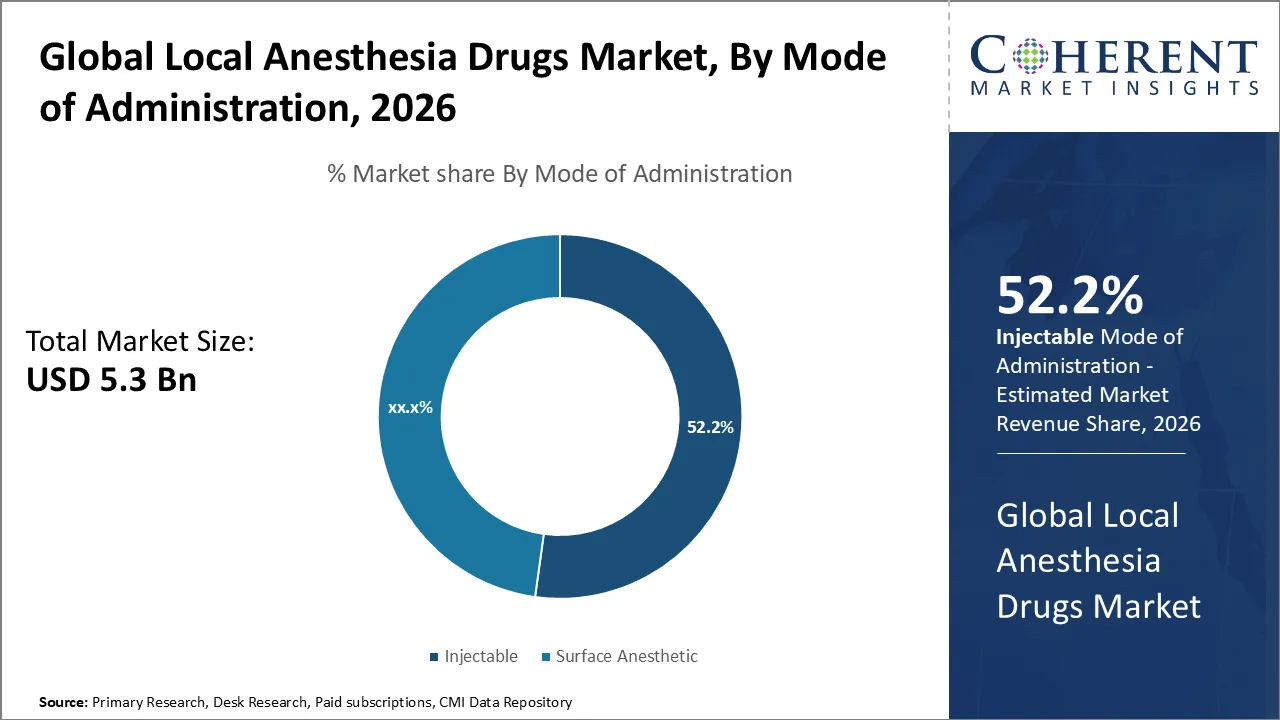
- By Mode of Administration, Injectable expected to hold largest market share of 52.2% in 2026 owing to the rising number of surgical procedures.
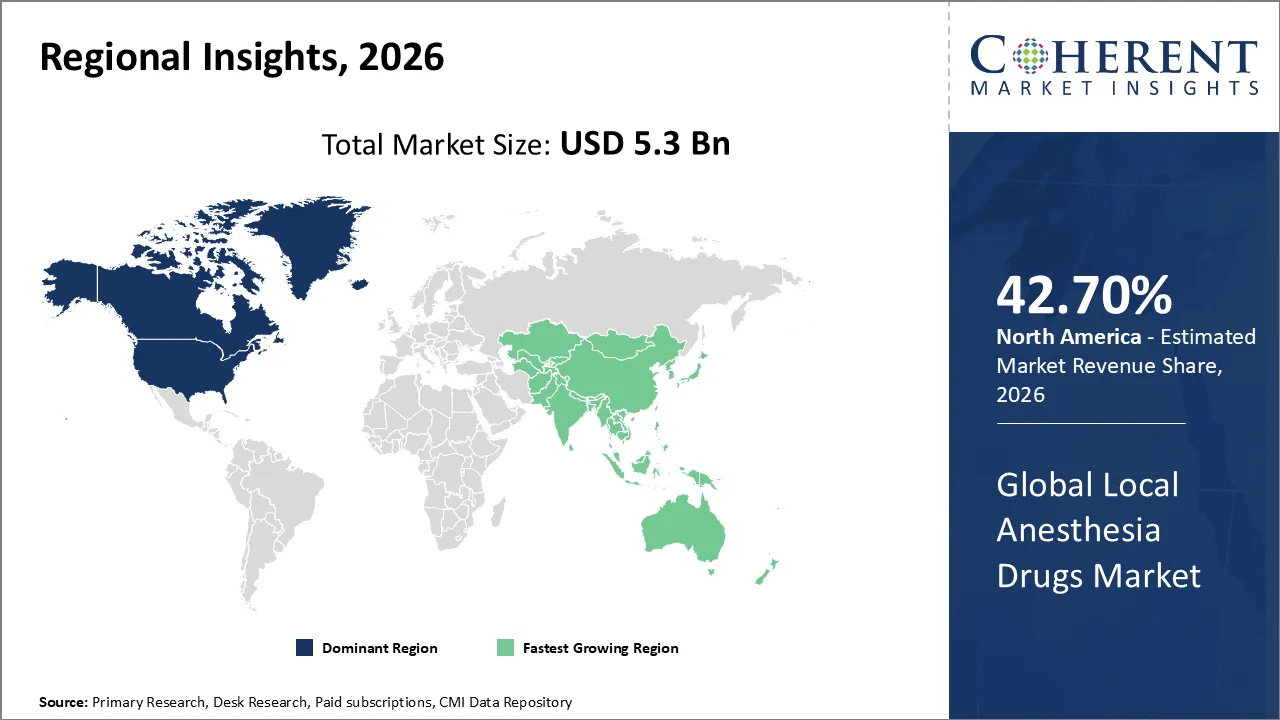
- By Region, North America dominates the overall market with an estimated share of 42.7% in 2026 owing to the advanced healthcare infrastructure.
Market Overview
The rising number of surgical, dental, and cosmetic procedures worldwide is driving steady growth in the Local Anesthesia Drugs Market. Healthcare professionals widely use local anesthetics to provide temporary pain relief during minor and major medical procedures while keeping patients conscious. Increasing demand for minimally invasive procedures, continuous advancements in anesthetic formulations, and expanding healthcare infrastructure are further supporting market growth. In addition, the growing aging population and the rising prevalence of chronic diseases that require surgical treatment are increasing the demand for local anesthesia drugs across hospitals, clinics, and ambulatory surgical centers.
Current Events and their Impact on the Local Anesthesia Drugs Market
Current Events | Description and its impact |
Geopolitical and Regulatory Developments |
|
Technological Innovations in Drug Delivery Systems |
|
Public Health and Pandemic-Related Changes |
|
Segmental Insights
- Current Industry Events of 2026
- Market Size Estimation
- Regional Breakdown
- Competitive Landscape
- Customer Intelligence
- Segmental Analysis
- Pricing Analysis
- Key Market Drivers, Challenges & Future Trends
- Customized Insights Section
Local Anesthesia Drugs Market Insights, By Mode of Administration: Injectable contribute the highest share of the market owing to its technological advancements in drug delivery.
Injectable expected to hold largest market share of 52.2% in 2026. The injectable segment drives growth in the Local Anesthesia Drugs Market by delivering precise and rapid pain control during medical procedures. Physicians frequently use injectable anesthetics for nerve blocks, surgical procedures, and dental treatments because these formulations provide targeted and dependable anesthesia. The rising number of hospital-based procedures and emergency treatments further increases the demand for injectable options. In addition, healthcare providers continue to adopt improved injection techniques, while the availability of skilled professionals supports the ongoing use of injectable local anesthetics in clinical environments.
Local Anesthesia Drugs Market Insights, By Drug Type: Lidocaine contributes the highest share of the market owing to its Growth of ambulatory surgical centers & outpatient care.
Lidocaine holds the largest market share of 42.6% in 2026. The rapid onset of action, proven reliability, and broad clinical acceptance of lidocaine drive its demand in the Local Anesthesia Drugs Market. Healthcare professionals commonly select lidocaine for dental treatments, dermatological procedures, and minor surgeries because it provides effective localized pain control. The growing number of outpatient treatments and diagnostic procedures further increases its use. Moreover, manufacturers offer lidocaine in various formulations, including injectable and topical forms, which improves accessibility. Its affordability and versatility also encourage hospitals, clinics, and ambulatory care centers to adopt it widely for pain management during medical procedures. For instance, in August 2025, Avenacy launched its first Lidocaine Hydrochloride Injection, USP in the U.S., a FDA-approved generic equivalent of XYLOCAINE for local or regional anesthesia and pain relief.
Regional Insights
North America Local Anesthesia Drugs Market Trends
North America dominates the overall market with an estimated share of 42.70% in 2026. The North America Local Anesthesia Drugs Market shows dynamic trends as healthcare providers increasingly prefer outpatient and same-day surgical procedures. Providers actively adopt advanced anesthetic formulations that deliver longer-lasting pain relief and enhanced safety. Rising use of local anesthesia in dental care and cosmetic dermatology further drives market demand. Hospitals and surgical centers implement technology-assisted anesthesia delivery systems to improve precision and patient comfort, while pharmaceutical companies continue innovating and refining formulations to meet evolving clinical needs. For instance, in October 2025, Glenmark Pharmaceuticals’ U.S. arm launched Ropivacaine Hydrochloride Injection single-dose vials, a bioequivalent generic alternative to Fresenius Kabi’s Naropin.
Asia Pacific Local Anesthesia Drugs Market Trends
The Asia Pacific Local Anesthesia Drugs Market is growing rapidly as healthcare access expands across the region. Hospitals, dental clinics, and ambulatory surgical centers are investing heavily, boosting demand for local anesthetics. Increasing awareness of minimally invasive procedures and cosmetic treatments drives the use of advanced anesthetic formulations. Governments and private healthcare providers actively promote modern pain management practices, while pharmaceutical companies introduce affordable and versatile products. Together, these efforts accelerate the widespread adoption of local anesthesia in medical and dental procedures throughout the region.
United States Local Anesthesia Drugs Market Trends
The United States Local Anesthesia Drugs Market is expanding as healthcare providers focus more on minimally invasive and outpatient procedures. Hospitals and clinics use advanced formulations to provide faster onset and longer-lasting pain relief. Rising demand in dental treatments, cosmetic dermatology, and elective surgeries further drives growth. Healthcare facilities incorporate technology-assisted delivery systems to enhance precision and patient comfort, while pharmaceutical companies actively launch innovative products and improved formulations, increasing accessibility and delivering effective pain management across diverse medical and dental settings. For instance, Hikma Pharmaceuticals PLC has launched COMBOGESIC IV in the U.S., an opioid-free intravenous pain relief injection that combines acetaminophen and ibuprofen.
India Local Anesthesia Drugs Market Trends
The India Local Anesthesia Drugs Market is growing as healthcare providers expand infrastructure and improve access in both urban and rural areas. Hospitals, dental clinics, and outpatient centers are investing in local anesthetics, increasing their adoption. Rising awareness of painless dental procedures, cosmetic treatments, and minimally invasive surgeries drives further demand. Healthcare professionals apply modern anesthetic formulations and advanced delivery techniques to enhance patient comfort and treatment efficiency, while pharmaceutical companies actively offer affordable, high-quality products, accelerating the widespread use of local anesthesia across medical and dental procedures throughout the country.
Local Anesthesia Drugs Market Trend
Rising Preference for Minimally Invasive Procedures
Healthcare providers are increasingly favoring minimally invasive and outpatient procedures, boosting the use of local anesthesia. Patients benefit from reduced recovery time and lower risk compared to general anesthesia. This trend drives demand for anesthetics with rapid onset, predictable effects, and ease of administration, encouraging hospitals and clinics to adopt innovative formulations for both surgical and dental applications.
Advancements in Formulations and Delivery Systems
Pharmaceutical companies focus on developing advanced local anesthetic formulations, including extended-release injectables, topical gels, and patches. Technology-assisted delivery systems, such as computer-controlled injection devices and ultrasound-guided nerve blocks, enhance precision, patient comfort, and safety. These innovations cater to growing procedural demands while improving clinician control over dosage and efficacy.
Market Report Scope
Local Anesthesia Drugs Market Report Coverage
| Report Coverage | Details | ||
|---|---|---|---|
| Base Year: | 2025 | Market Size in 2026: | USD 5.3 Bn |
| Historical Data for: | 2020 To 2024 | Forecast Period: | 2026 To 2033 |
| Forecast Period 2026 to 2033 CAGR: | 4.1% | 2033 Value Projection: | USD 8.7 Bn |
| Geographies covered: |
| ||
| Segments covered: |
| ||
| Companies covered: | Septodont, Pfizer Inc., Pacira BioSciences, Inc., B. Braun Melsulgen AG, Glenmark Pharmaceutical Ltd., Fresenius SE & Co. KgaA, Hikma Pharmaceuticals PLC, Teva Pharmaceutical Industries Ltd. | ||
| Growth Drivers: |
| ||
| Restraints & Challenges: |
| ||
Local Anesthesia Drugs Market News
- In April 2025, Avenacy, a specialty pharmaceutical company focused on essential injectable medicines, announced the U.S. launch of Propofol Injectable Emulsion, USP, approved by the U.S. Food and Drug Administration as a therapeutic generic equivalent to Diprivan.
- In September 2025, the Moscow Endocrine Plant announced plans to begin producing two new anaesthesia drugs.
Analyst Opinion (Expert Opinion)
- Local Anesthesia Drugs market has moved beyond traditional, commodity‑type utilization into a space shaped by clinical performance metrics and procedural efficiency. Injectable anesthetics still dominate usage, with nearly three‑quarters of procedures relying on these formulations, underscoring their central role in operative workflows across dental, surgical, and outpatient settings. This is not incidental but indicative of clinician preference for rapid onset and consistent pain blockade, particularly as outpatient volumes increase and procedural throughput becomes a priority.
- Despite this entrenched position, the market’s evolution is increasingly driven by formulation innovation rather than volume alone. For example, the U.S. approval of polymer‑based bupivacaine providing up to 72 hours of analgesia directly challenges longstanding opioid use patterns and shifts purchasing decisions within hospital formularies. Competing generics for complex injectables — such as liposomal bupivacaine — have eroded single‑supplier constraints that historically slowed adoption, forcing incumbent manufacturers to refine product attributes rather than rely on pricing or legacy branding.
- However, adoption dynamics vary by modality and clinical context. While surface anesthetics and advanced delivery systems (such as computerized injection or ultrasound guidance) are expanding in dermatology and ophthalmic applications, these segments still represent a smaller fraction of total utilization compared with deep tissue anesthesia. The disparity highlights an unmet emphasis on non‑injectable options, despite clear evidence that patient preference and comfort ratings significantly influence procedural satisfaction and clinic throughput.
- Competitive pressures are intensifying as regional health systems recalibrate reimbursement and safety protocols. For instance, product substitution trends in Europe and targeted reimbursement models tie formulary positioning to clinical outcomes — such as readmission rates — shifting decision‑making away from cost‑per‑dose to value‑based considerations. In emerging markets, government schemes and insurance frameworks influence which anesthetics become standard of care, with legacy agents still prevalent where advanced formulations lack coverage.
Speak to the analyst
Want personalized insights?
Take the findings above to one of our principal consultants, or have the report rebuilt around the segments, geographies and competitors you actually track.
Market Segmentation
- By Drug Type
- Bupivacaine
- Lidocaine
- Benzocaine
- Ropivacaine
- Prilocaine
- Chloroprocaine
- Others
- By Mode Of Administration
- Injectable
- Surface Anesthetic
- By Regional Insights
- North America
- U.S.
- Canada
- Latin America
- Brazil
- Argentina
- Mexico
- Rest of Latin America
- Europe
- Germany
- U.K.
- Spain
- France
- Italy
- Russia
- Rest of Europe
- Asia Pacific
- China
- India
- Japan
- Australia
- South Korea
- ASEAN
- Rest of Asia Pacific
- Middle East
- GCC Countries
- Israel
- Rest of Middle East
- Africa
- South Africa
- North Africa
- Central Africa
- North America
- Key Players Insights
- Septodont
- Pfizer Inc.
- Pacira BioSciences, Inc.
- Braun Melsulgen AG
- Glenmark Pharmaceutical Ltd.
- Fresenius SE & Co. KgaA
- Hikma Pharmaceuticals PLC
- Teva Pharmaceutical Industries Ltd.
Sources
Primary Research interviews
- Key opinion leaders (KOLs) in anesthesiology and pain management
- Heads of pharmacy and procurement at tertiary care hospitals
- Dental surgeons and outpatient surgical center administrators
- Clinical directors of ambulatory surgery units
- Anesthesia nurses and procedural technologists
Databases
- U.S. Food and Drug Administration (Drugs@FDA) database
- National Institutes of Health (NIH) drug information
- WHO Anatomical Therapeutic Chemical (ATC) classification system
- PubChem and NLM ChemIDplus chemical databases
- ClinicalTrials.gov procedural anesthesia records
Magazines
- Anesthesiology News
- Dental Economics
- Becker’s ASC Review
- OR Manager Magazine
- Pain & Central Nervous System Week
Journals
- Anesthesiology (American Society of Anesthesiologists)
- Journal of Clinical Anesthesia
- Regional Anesthesia & Pain Medicine
- Journal of Dental Research
- Pain Medicine
Newspapers
- The New York Times – Health Section
- The Washington Post – Health & Science
- The Guardian – Health
- The Times of India – Health News
- The Hindu – Health and Medicine
Associations
- American Society of Anesthesiologists (ASA)
- International Anesthesia Research Society (IARS)
- American Dental Association (ADA)
- World Dental Federation (FDI)
- Pain Management Nursing Association (PMNA)
Public Domain sources
- U.S. Centers for Disease Control and Prevention (CDC) procedure and pain management data
- National Health Services (NHS) clinical guidelines on anesthesia
- World Health Organization (WHO) treatment and surgical care guidelines
- Government health ministry publications (e.g., MoHFW India)
- Open access clinical guideline repositories (e.g., NICE, NIH Consensus Statements)
Proprietary Elements
- CMI Data Analytics Tool
- Proprietary CMI Existing Repository of information for last 8 years
Get access to 250+ pages report
Every segment, forecast, competitor profile and data table behind the analysis above — available for instant download.
- ESOMAR Member
- ISO 9001:2015 Certified
- D-U-N-S Registered
- GDPR & CCPA Compliant
Missing comfort of reading report in your local language? Find your preferred language:
Transform your Strategy with Exclusive Trending Reports
Frequently Asked Questions
The Local Anesthesia Drugs Market is estimated to be valued at USD 5.3 Bn in 2026 and is expected to reach USD 8.7 Bn by 2033.
Increase in development and approvals of novel local anesthesia drugs and increasing number of surgeries are fueling the growth of the market.
The Lidocaine segment is the leading drug type segment in the market.
Side effects of anesthetic drugs and regulatory framework are some major factors restraining growth of the market.
Major players operating in the market are Septodont, Pfizer Inc., Pacira BioSciences, Inc., B. Braun Melsulgen AG, Glenmark Pharmaceutical Ltd., Fresenius SE & Co. KgaA, Hikma Pharmaceuticals PLC, Teva Pharmaceutical Industries Ltd., among others.