

Micro Packaging Market Size and Forecast — 2026-2033
Overview
The creation of an impermeable layer of just few millimeters thick by using nano-particles is known as micro packaging. The flexibility, isolation, and cost effectiveness provided by this technique makes it an appealing packaging technique. Micro packaging has been employed in food, beverages, and pharmaceutical industries. The leaking of oxygen into the package results in increased rate of oxidation, which will reduce the shelf life of the product. Also, contamination from dust and pathogens will affect food quality.
The major drivers are the advantages of food, beverages, and pharmaceuticals lasting longer, coupled with remaining free from any contamination. The major challenges are leaching of nano-particles into the food stream. Investment in R&D is required to examine effects of nano-particles on human health. Also, expensive manufacturing technology and lack of technical know-how has hindered the market growth.
Micro Packaging Market Size and Forecast – 2026 – 2033
The Micro Packaging Market size is estimated to be valued at USD 16.21 billion in 2026 and is expected to reach USD 30.59 billion by 2033, exhibiting a compound annual growth rate (CAGR) of 9.5% from 2026 to 2033.
Key Takeaways
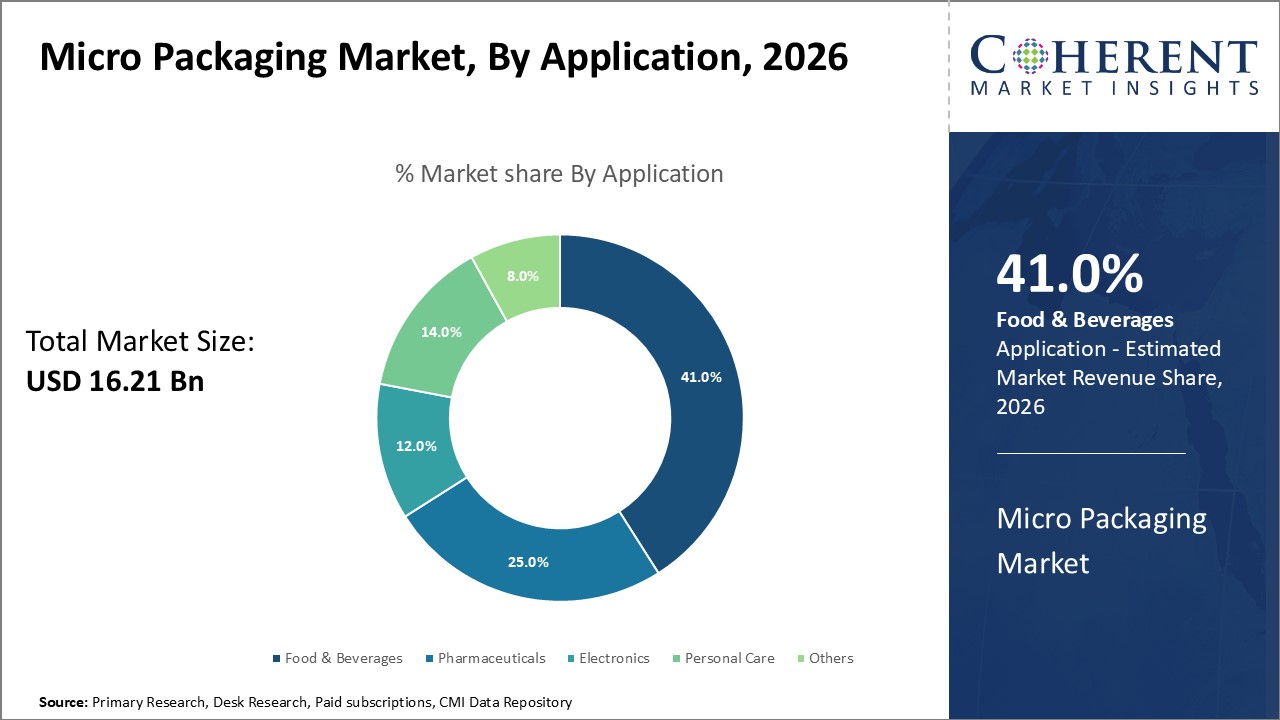
The Food & Beverages segment holds a commanding industry share, led by convenience trends and consumer demand for reduction in single-use plastics, contributing to 41% of market revenue.
Bioplastics prevail as the leading packaging material, offering sustainable solutions capturing 37% market share and driving industry trends.
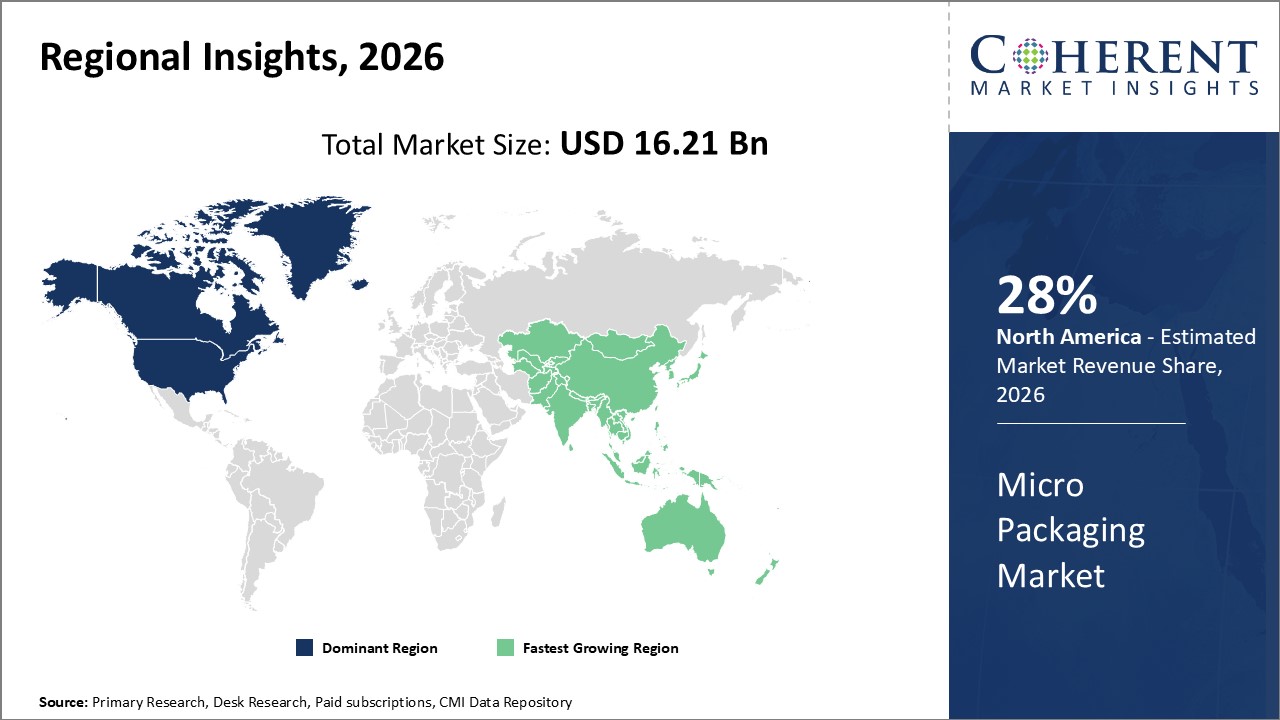
North America dominates the market share with over 28%, propelled by advanced material innovations and stringent regulations on packaging waste.
Asia Pacific emerges as the fastest-growing region with significant CAGR fueled by rising pharmaceutical packaging demand and government sustainability initiatives.
Micro Packaging Market – Segmentation Analysis
Analysis of the Micro Packaging Market, By Application
Pharmaceuticals, Food & Beverages, Electronics, Personal Care, and Others are the market segments based on application, with Food & Beverages holding a dominant market share of 41%. The consumer preference for smaller packaging that improves convenience and lowers waste is driving the Food & Beverages industry. Micro pouches and films that are lightweight greatly extend shelf life and preserve freshness. The pharmaceutical industry comes in second, driven by the need for child-resistant, tamper-evident packaging that maintains product integrity at the best dosages for patient safety.
Analysis of the Micro Packaging Market, By Packaging Material
The market for packaging materials is divided into four segments: bioplastics, polypropylene (PP), polyethylene terephthalate (PET), polyvinyl chloride (PVC), and others. Bioplastics hold a dominant market share. Because of growing consumer and governmental push for sustainable alternatives to conventional plastics, bioplastics are in the lead. Due to its enhanced performance characteristics and cost-effectiveness, polylactic acid (PLA) and other biodegradable polymers have become widely used.
Analysis of the Micro Packaging Market, By Form
Form-wise, the market is divided into Film, Pouches, Sachets, Blister Packs, and Others; Pouches hold the largest market share. Pouches have the best market position because of their unparalleled ease and versatility in a variety of industries. By using less material and less food, their ability to include stand-up and resalable characteristics fits in nicely with the environmental mission.
Micro Packaging Market Insights, By Geography
Micro packaging Market Analysis and Trends in North America
North America is clearly the leading region in terms of regional analysis, holding about 28% of the market for micro packaging. Established industry participants, strict environmental laws, and pro-sustainability government initiatives are the causes of this dominance.
Analysis and Trends of the Asia Pacific Micro Packaging Market
Asia Pacific, on the other hand, has the fastest CAGR because of the large pharmaceutical and food and beverage sectors, which are bolstered by government incentives in nations like South Korea and Japan and have a CAGR of over 10%.
Micro Packaging Market Outlook for Key Countries
Analysis and Trends of the United States Micro Packaging Market
Rapidly changing sustainability regulations and large R&D expenditures by industry leaders like Amcor Limited and Berry Global Inc. are the main drivers of the Micro packaging market in the USA. The widespread use of pharmaceutical Micro packaging solutions by American businesses increased by 18% in 2025, indicating a need to adhere to FDA packing guidelines. Additionally, by focusing on lowering the use of single-use plastics, North America maintains strong business growth and encourages innovation in bioplastics and active packaging, which together provide more than 35% of Micro packaging revenue.
Trends and Analysis for Micro packaging Market in Germany
Strong government measures aimed at circular economy packaging are driving Germany's Micro packaging market. Leading bio-based film innovators that support the nation's strict EU environmental laws are Mondi Group and Constantia Flexibles. In order to guarantee product safety and compliance, Germany's well-established pharmaceutical industry also uses cutting-edge micro packaging, increasing its market share in Europe, which is now estimated at 22%.
Analyst Opinion
The revenue of the Micro packaging industry has been significantly impacted by the rise in demand for environmentally friendly packing materials; in 2025, the production capacity of biodegradable polymers increased by 28% year over year. This pattern suggests that consumers, particularly in North America and Europe, are increasingly choosing environmentally friendly products.
As seen by the pharmaceutical industry's adoption of micro packaging solutions in 2026, technological developments in packaging precision have decreased material waste in production facilities by up to 16%, promoting increased packaging efficiency and cost-effectiveness.
The demand for robust, lightweight micro packaging that protects products during transportation has increased due to the increasing use of e-commerce platforms. This has helped to explain the 22% increase in micro packaging exports from Asia Pacific in the most recent fiscal year.
Micro packaging's adoption in the Asia Pacific area has been accelerated by regulatory frameworks requiring minimal packaging waste in South Korea and Japan. As a result, the market shares of eco-friendly micro packaging products in these nations increased by 12% in early 2026.
- Current Industry Events of 2026
- Market Size Estimation
- Regional Breakdown
- Competitive Landscape
- Customer Intelligence
- Segmental Analysis
- Pricing Analysis
- Key Market Drivers, Challenges & Future Trends
- Customized Insights Section
Market Scope
| Report Coverage | Details | ||
|---|---|---|---|
| Base Year: | 2025 | Market Size in 2026: | USD 16.21 billion |
| Historical Data for: | 2020 To 2024 | Forecast Period: | 2026 To 2033 |
| Forecast Period 2026 to 2033 CAGR: | 9.5% | 2033 Value Projection: | USD 30.59 billion |
| Geographies covered: |
| ||
| Segments covered: |
| ||
| Companies covered: | Amcor Limited, Sealed Air Corporation, Berry Global Inc., Mondi Group, Constantia Flexibles Group GmbH, Huhtamaki Oyj, WestRock Company, Sonoco Products Company, Coveris Holdings S.A., Printpack, Inc., ProAmpac LLC. | ||
| Growth Drivers: |
| ||
Growth factors
Governments throughout the world are enforcing stringent packaging waste reduction regulations, and the growing desire for sustainability in packaging bioplastics account for 38% of the material market share are major growth drivers.
The F&B industry, where freshness and mobility are critical, has grown by 23% thanks to innovations in lightweight, space-saving formats like micro pouches.
Furthermore, adoption has accelerated, especially in industrialized nations, because to the growing demands of the pharmaceutical industry for child-resistant and tamper-evident micro packaging.
E-commerce's explosive growth has further boosted market revenue by requiring effective Micro packaging solutions that are logistics-optimized and lower transportation costs.
Micro Packaging Market Development
- In April 2026, French dermocosmetics brand Laboratoire SVR launched three new treatments with Aptar Beauty’s highly protective Micro airless in full plastic. Aptar Beauty, a world leader in dispensing systems, designed, produced, and modified the Micro airless, which is ideal for delicate dermatological beauty formulas.
Market Trends
Micro packaging is increasingly influenced by emerging trends like the integration of smart packaging technologies, including QR codes and NFC chips for enhanced traceability and consumer engagement, first widely adopted by electronics manufacturers in 2025. Release liners are critical in creating pressure-sensitive labels; these are commonly employed in packaging for branding and identification and tamper-evident purposes.
There is also a distinct market shift towards circular economy models featuring recyclable and compostable micro packaging, substantially adopted across European markets where government mandates incentivized a 30% growth in circular packaging solutions last year.
Additionally, automation and AI-powered manufacturing lines are increasing the accuracy and productivity of Micro packaging, especially in the pharmaceutical application sector.
Key Players
Amcor Limited
Berry Global Inc.
Mondi Group
Constantia Flexibles Group GmbH
Huhtamaki Oyj
WestRock Company
Sonoco Products Company
Coveris Holdings S.A.
Printpack, Inc.
ProAmpac LLC
A 16% reduction in carbon footprint through improved manufacturing processes is the result of several market businesses, including Amcor Limited and Sealed Air Corporation, significantly increasing their investment in research and development for bio-based micro packaging by 2025. By strategically acquiring smaller packaging companies, Berry Global has expanded its footprint throughout North America and increased its market share in micro packaging solutions by 11% in the previous year.
Market Prospects for Micro Packaging
Asia Pacific is the fastest growing region in the micro packaging market. The burgeoning food and beverage industry has contributed to market growth, due to large amount of time spent by goods in transit and long shelf lives in products is vital. Moreover, India and China are hubs for manufacture of pharmaceuticals, which are then sold in Europe and North America.
North America is major supplier of pork and beef to China, the use of micro packaging helps keep the meat fresh during transit. China is projected to import 3 million tons of pork in 2017. Due to recent meat quality issues in China, it is vital for meat packagers to employ techniques to ensure freshness. This will allow for consolidation of market share in Chinese market.
Middle East is witnessing growing demand for food due to rising tourism and high disposable incomes. Moreover, in an attempt to reduce reliance on food imports, investments in food and packaging sector are projected to rise. Africa is a fledgling market and is not expected to boost the micro packaging industry in the forecast period.
In Latin America, Brazil, Mexico, and Argentina are among the largest producers of generic drugs. The drugs are exported to almost 40 countries. Nano packaging ensures their quality during storage and trans-Atlantic travel. This will boost the micro packaging industry in the region.
Historical Analysis
The European Union (EU) in 2017 awarded the NanoPack consortium US$ 8.8 million (€7.7 million) to develop anti-microbial surfaces to improve shelf life of products. The consortium was led by Technion-Israel Institute of Technology and had seventeen more partner organizations.
According to the historical analysis, the micro packaging market gradually changed as a result of both shifting customer demands and technology advancements. Basic containment and protection were the main goals of packing at first, and early materials like paperboard and metal changed with time. In the middle of the 20th century, the convenience factor was enhanced by the creation of flexible packaging methods, such as collapsible tubes.
During the 1960s and 1970s, micro-packaging emerged as a revolutionary concept, enabled the production of smaller, more portable packages that catered to diverse sectors like pet food and cosmetics. This period marked significant advances in material science and manufacturing technologies, allowed for more precise, smaller-scale packaging formats. Entering the 21st century, the focus shifted towards sustainability, smart packaging, and e-commerce compatibility, reflected broader trends in consumer preferences and regulatory pressures.
Despite early challenges like costly manufacturing technologies and technical know-how gaps, the market steadily expanded, was driven by innovations that offered enhanced protection, convenience, and environmental benefits. The historic trajectory highlighted a dynamic interplay between technology advancement, market demand, and regulatory influence shaping the micro packaging industry's then-current and future landscape.
Sources
Primary Research interviews:
FMCG companies (food & beverages, personal care, pharma)
Retail chains & supermarkets
Packaging machinery providers
Databases:
Wiley Online Library
PubMed
ScienceDirect
Magazines:
Flexible Packaging Magazine
Packaging Digest
Plastics Today
Journals:
International Journal of Food Packaging
Journal of Polymers and the Environment
Nanotechnology Journal
Newspapers:
The Guardian (Sustainable Business)
The Hindu Business Line
The Wall Street Journal
Associations:
- European Packaging Institute
Indian Institute of Packaging (IIP)
Sustainable Packaging Coalition (SPC)
Get access to 250+ pages report
Every segment, forecast, competitor profile and data table behind the analysis above — available for instant download.
- ESOMAR Member
- ISO 9001:2015 Certified
- D-U-N-S Registered
- GDPR & CCPA Compliant
Missing comfort of reading report in your local language? Find your preferred language:
Transform your Strategy with Exclusive Trending Reports
Frequently Asked Questions
Leading companies include Amcor Limited, Sealed Air Corporation, Berry Global Inc., and Mondi Group, which collectively hold significant market share owing to their innovation and global reach.
The Micro Packaging market size is expected to grow from USD 16.21 billion in 2026 to USD 30.59 billion by 2033, reflecting robust market growth driven by sustainability and technological adoption.
The Food & Beverages sector represents the largest growth opportunity due to increasing demand for convenient, eco-friendly packaging formats and stringent food safety requirements.
Trends such as smart packaging integration, circular economy models, and AI-enabled production are anticipated to redefine market dynamics by 2030 with faster adoption in Europe and North America.
Highly competitive with innovation-centric market players focusing on sustainability and cost efficiency, challenges include regulatory compliance complexities and fluctuating raw material costs.
Companies frequently employ acquisition strategies, strategic R&D investments, and geographical expansion to capture market share and respond agilely to evolving demands.