

Middle East and Asia Pacific Biotechnology Market Analysis & Forecast 2026-2033
The Middle East and Asia Pacific biotechnology market is estimated to be valued at USD 718.5 Bn in 2026 and expected to reach USD 1,080 Bn by 2033, witnessing a CAGR of 14.2% over the forecast period (2026-2033).
Key Takeaways
- Based on Technology, the cell-based assays segment is expected to lead the market with 37.4% share in 2026.
- Based on Application, the molecular biology segment is expected to hold 32.8% share of the market in 2026.
- Based on End User, the biotechnology & pharmaceutical companies segment is projected to hold 52.6% share of the market in 2026.
Market Overview
Biotechnology is biology-based technology that uses cellular and bimolecular processes to create technologies and products that improve the human lives and the health of the planet. Microorganisms' biological processes have been used for over 6,000 years to produce food products such as bread and cheese, as well as to preserve dairy products.
Biotechnology deals with the application of biological knowledge and techniques pertaining to molecular, cellular, and genetic processes to develop significantly improved products and services. Biotechnology products and processes have ensured ease of living, improved health care, agriculture output, created livelihood opportunities, and others.
Current Event and their Impacts on the Middle East and Asia Pacific Biotechnology Market
Current Event | Description and its Impact |
Regulatory Harmonization and Approval Processes Evolution |
|
Artificial Intelligence Integration in Drug Discovery |
|
Are Middle East and Asia Pacific investments redefining global biotechnology’s future?
Region | Initiative / Program | Investment Amount | Year / Timeline | Focus Areas | Strategic Impact |
Middle East | Saudi Arabia – Vision 2030 Biotech & Life Sciences | $3.5 billion | 2020–2030 | Biotech infrastructure, genomic medicine, healthcare innovation | Builds national biotech hubs, reduces reliance on imports, strengthens food security and healthcare independence |
Asia Pacific | China – National Biotech R&D Investment | $24 billion | 2024 | Genomics, cell therapy, biopharma manufacturing | Positions China as a global leader in precision medicine, accelerates drug discovery, and expands biotech exports |
Middle East | UAE – Dubai Biotech & Life Sciences Zone (WHX 2026) | Multi‑billion regional initiative | 2026 launch | Biotech startups, pharma innovation, AI in healthcare | Establishes Dubai as a Middle Eastern biotech hub, attracting global collaborations |
Asia Pacific | India – Biosimilars & Biopharma Expansion | Projected $12 billion market by 2030 | 2025–2030 | Affordable biologics, clinical trials, vaccine manufacturing | Makes India a global leader in biosimilars, expanding access to biologics worldwide |
Asia Pacific | Singapore – Biotech Startup Ecosystem | 400+ startups by 2025 | Ongoing | RNA therapeutics, cell therapy, AI‑driven drug discovery | Strengthens Singapore’s role as a regional innovation hub with advanced biotech infrastructure |
- Current Industry Events of 2026
- Market Size Estimation
- Regional Breakdown
- Competitive Landscape
- Customer Intelligence
- Segmental Analysis
- Pricing Analysis
- Key Market Drivers, Challenges & Future Trends
- Customized Insights Section
Segmental Insights
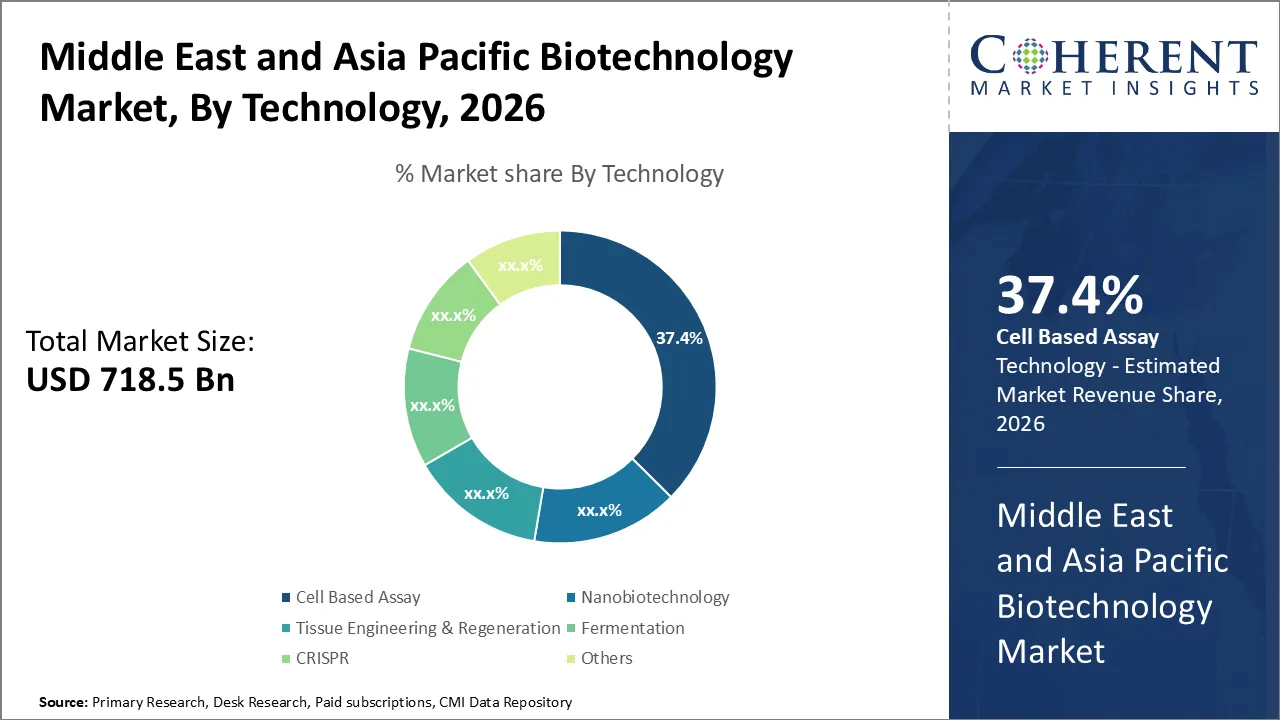
Middle East and Asia Pacific Biotechnology Market Insights, By Technology: Cell-based assays dominate through widespread use in drug discovery and toxicity testing
In terms of technology, the cell-based assays segment is expected to lead the market with 37.4% share in 2026. Cell-based assays are the most common type of test because they are essential for finding new drugs, testing for toxicity, and precision medicine. They provide reliable in-vitro models for testing the safety and effectiveness of treatments, which speeds up the process of getting them into clinical trials. Asia Pacific is the leader in adoption, with pharmaceutical companies using these tests in the development of biologics and personalized treatment plans.
Middle East and Asia Pacific Biotechnology Market Insights, By Application: Molecular biology drives innovation by supporting gene synthesis, protein expression, and antibody development
In terms of application, the molecular biology segment is expected to hold 32.8% share of the market in 2026, as they support gene synthesis, protein expression, and antibody development. They are the building blocks for advanced biomanufacturing, diagnostics, and therapeutics. Asia Pacific's big investments in genomics and proteomics research ensures leadership. At the same time, labs in the Middle East are using molecular biology tools to deal with chronic diseases.
For instance, in January 2026, Molecular biology is used by the A*STAR Bioprocessing Technology Institute (BTI) in Singapore to push biotechnology forward. It works on RNA therapeutics, mRNA BioFoundry, antibody-drug conjugates, and iPSC research, among other things. These programs focus on gene expression, protein engineering, and nucleic acid technologies, making Singapore a leader in using molecular biology to help biotech grow.
Middle East and Asia Pacific Biotechnology Market Insights, By End User: Biotechnology and pharmaceutical companies dominate driving commercialization and large-scale adoption
In terms of end user, the biotechnology & pharmaceutical companies segment is projected to hold 52.6% share of the market in 2026, drives the commercialization and growth of biotech innovations. Their investments in making biologics, making antibodies, and running trials for regenerative medicine make sure they stay on top. Their role is strengthened by strategic partnerships with global companies and government-backed initiatives. By 2026, they will be the main force behind the growth of biotechnology.
For instance, in January 2026, At the World Health Expo 2026, which was be held at the Dubai Exhibition Centre, WHX Dubai opened a special Biotech & Life Sciences Zone. The initiative shows how biotechnology is growing in the region. It drew 235,000 visitors and 4,300 exhibitors, making Dubai the Middle Eastern center for new ideas in biotechnology and pharmaceuticals.
Market Report Scope
Middle East and Asia Pacific Biotechnology Market Report Coverage
| Report Coverage | Details | ||
|---|---|---|---|
| Base Year: | 2025 | Market Size in 2026: | USD 718.5 Bn |
| Historical Data for: | 2020 To 2024 | Forecast Period: | 2026 To 2033 |
| Forecast Period 2026 to 2033 CAGR: | 14.2% | 2033 Value Projection: | USD 1,080 Bn |
| Geographies covered: |
| ||
| Segments covered: |
| ||
| Companies covered: | Abbott Laboratories, Pfizer Inc., Abbvie Inc., Biocon, F. Hoffmann-La Roche Ltd., PerkinElmer, Inc., Astrazeneca Plc., Illumina, Inc., Sanofi S.A., Qiagen, Twist Bioscience, Thermo Fisher Scientific Inc., Biointron, Merck & Co., Inc., Sino Biological Inc., GeneWiz (Azenta Life Sciences), Danaher Corporation, and Synbio Technologies. | ||
| Growth Drivers: |
| ||
| Restraints & Challenges: |
| ||
Middle East and Asia Pacific Biotechnology Market Driver
Healthcare Investment & Infrastructure
To make biotech ecosystems stronger, governments in the Middle East and Asia Pacific are spending a significantly increasing budget on healthcare. This money will be used to build advanced hospitals, labs, and biotech parks that encourage new ideas and working together. The growth of research infrastructure makes it possible to develop biopharmaceuticals, diagnostics, and genomic applications more quickly. These efforts are directly helping the growth of the Middle East and Asia Pacific biotechnology market. Better facilities attract global partnerships and speed up the commercialization of cutting-edge biotech solutions.
Government & Private R&D Initiatives
Both regions have strategic policies that actively support biopharmaceutical manufacturing and genomic research, which makes it easier for new ideas to grow. Governments are giving companies incentives, and private companies are investing heavily in clinical trials and biotech startups. Public-private partnerships are closing the gap between business and academia, making sure that new ideas get to market quickly. This synergy is driving up demand in the Middle East and Asia Pacific biotechnology market, as new therapies, vaccines, and precision medicine solutions meet the growing healthcare needs of a wide range of people.
Middle East and Asia Pacific Biotechnology Market Opportunity
Genomics & Precision Medicine
Advanced sequencing technologies and bioinformatics platforms are in high demand because of national genomic projects in the Middle East, like the Qatar Genome Project. The goals of these programs are to map genetic diversity, make disease prediction better, and help precision medicine that is tailored to specific populations. At the same time, Japan and South Korea are leading the way in adopting precision medicine in the Asia Pacific region. They are doing this by integrating genomics into mainstream healthcare systems with strong infrastructure and government support. These efforts are helping to create personalized therapies and making the Middle East and Asia Pacific biotechnology market forecast for steady growth even stronger.
Analysis Opinion (Expert Opinion)
- Asia Pacific: Big investments in genomics, biopharmaceutical manufacturing, and regenerative medicine are helping biotechnology move forward in Asia Pacific. China spent more than $30 billion on biopharmaceutical research and development in 2025. This was made possible by more than 1,000 biotech startups that focused on cell therapy and AI-driven drug discovery. Japan has more than 200 active clinical trials in regenerative medicine. South Korea's biosimilar exports went up by 15% year-on-year, which shows that biologics and precision medicine are doing well in the region.
- Middle East: Strategic diversification policies are speeding up the use of biotechnology. For example, Saudi Arabia has set aside $5 billion under Vision 2030 for biotech infrastructure, and the UAE has set up genomic research centers to help precision medicine move forward. The rising number of chronic diseases, especially diabetes, which affects more than 20% of adults in Gulf countries, is driving up the need for biotech solutions. Partnerships with multinational pharmaceutical companies are making it easier for local companies to make more products. This is making the region a new center for making biopharmaceuticals and advanced therapeutics.
Recent Developments
- In March 2026, the FDA provided Hemab Therapeutics in Cambridge and Copenhagen Breakthrough Therapy Designation for Sutacimig in Glanzmann thrombasthenia. This rare inherited bleeding disorder lacks effective prophylactic treatments. The designation speeds up development and indicates that Hemab is a leader in biotech innovation in coagulation biology and new treatments for hematologic conditions that do not receive enough attention.
- In March 2026, Roche invested USD 481 million over five years on South Korea's biotech industry. This will improve the infrastructure for clinical trials, the development of biopharmaceuticals, and partnerships with local companies. This project, which works with the Ministry of Health and Welfare, makes South Korea a growing center for biotechnology and pharmaceutical innovation in Asia.
Market Segmentation
- By Technology
- Nanobiotechnology
- Tissue Engineering and Regeneration
- Fermentation
- Cell Based Assay
- CRISPR
- Others
- By Application
- Molecular Biology
- Gene Synthesis
- Gene Editing
- Mammalian Protein Expression
- Recombinant Antibody Expression
- Peptide Synthesis
- Protein Expression
- Monoclonal and Polyclonal Antibody Generation
- Others
- By End User
- Biotechnology & Pharmaceutical Companies
- Research Institutes & Laboratories
- Academic Institutions
- Others
- By Region
- Asia Pacific
- China
- India
- Japan
- Australia
- South Korea
- ASEAN
- Rest of Asia Pacific
- Middle East
- GCC
- Israel
- Rest of Middle East
- Asia Pacific
- Key Players
- Abbott Laboratories
- Pfizer Inc.
- Abbvie Inc.
- Biocon
- Hoffmann-La Roche Ltd.
- PerkinElmer, Inc.
- Astrazeneca Plc.
- Illumina, Inc.
- Sanofi S.A.
- Qiagen
- Twist Bioscience
- Thermo Fisher Scientific Inc.
- Biointron
- Merck & Co., Inc.
- Sino Biological Inc.
- GeneWiz (Azenta Life Sciences)
- Danaher Corporation
- Synbio Technologies.
Sources
Primary Research Interviews
- Biotechnology Manufacturers
- Biotechnology Research Institutes
- Biopharmaceutical Companies
- Biotechnology Consultants
- Government Health and Biotech Agencies
- Others
Databases
- Bloomberg Terminal
- Thomson Reuters Eikon
- IHS Markit
- Euromonitor International
- Others
Magazines
- BioTechniques
- Biotechnology Journal
- Pharma Times
- Genetic Engineering & Biotechnology News (GEN)
- Biotech International
- Others
Journals
- Biotechnology Advances
- Journal of Biotechnology
- International Journal of Biological Macromolecules
- Biotechnology and Bioengineering
- Biotechnology Letters
- Others
Newspapers
- The Financial Times
- The Wall Street Journal
- Reuters
- The Economic Times
- Business Standard
- Others
Associations
- Asian Biotechnology Development Council (ABDC)
- Biotechnology Innovation Organization (BIO)
- Biotechnology Industry Organization (BIO)
- BioAsia
- BioPharma Asia
- Others
Public Domain Sources
- World Health Organization (WHO)
- United Nations Conference on Trade and Development (UNCTAD)
- International Food Policy Research Institute (IFPRI)
- Food and Agriculture Organization (FAO)
- National Institutes of Health (NIH)
- Others
Proprietary Elements
- CMI Data Analytics Tool
- Proprietary CMI Existing Repository of Information for the Last 8 Years
Get access to 250+ pages report
Every segment, forecast, competitor profile and data table behind the analysis above — available for instant download.
- ESOMAR Member
- ISO 9001:2015 Certified
- D-U-N-S Registered
- GDPR & CCPA Compliant
Missing comfort of reading report in your local language? Find your preferred language:
Transform your Strategy with Exclusive Trending Reports
Frequently Asked Questions
The global Middle East and Asia Pacific Biotechnology Market size was valued at USD 718.5 Bn in 2026 and is expected to reach USD 1,080 Bn in 2033.
Abbott Laboratories, Pfizer Inc., Abbvie Inc., Biocon, F. Hoffmann-La Roche Ltd., PerkinElmer, Inc., Astrazeneca Plc., Illumina, Inc., Sanofi S.A., Qiagen, Twist Bioscience, Thermo Fisher Scientific Inc., Biointron, Merck & Co., Inc., Sino Biological Inc., GeneWiz (Azenta Life Sciences), Danaher Corporation, and Synbio Technologies are some of the prominent players operating in the market.
Healthcare investment & infrastructure and government & private R&D initiatives, which are expected to drive the market growth.