

Gene Synthesis Market Size and Forecast — 2026-2033
The Global Gene Synthesis Market size is estimated to be valued at USD 3.16 billion in 2026 and is expected to reach USD 7.29 billion by 2033, exhibiting a compound annual growth rate (CAGR) of 12.7% from 2026 to 2033.
Overview
Gene synthesis products involve custom-designed DNA sequences created using automated oligonucleotide assembly and cloning technologies. These synthetic genes are optimized for expression in various host systems and are used in research, biopharmaceutical production, and synthetic biology. Modern gene synthesis kits and services offer rapid turnaround times, error correction, codon optimization, and plasmid delivery options, enabling precise control over genetic engineering applications.
Key Takeaways
The therapeutics application segment retains its dominance, accounting for over 41% of market revenue in 2026, driven by gene therapy and personalized medicine development.
In the product domain, oligonucleotides lead with a 46% industry share due to their widespread use in diagnostics and therapeutics.
Regionally, North America holds the largest market share of approximately 37%, accountable to a mature biotech ecosystem and supportive government policies.
Asia Pacific is the fastest-growing region, displaying a CAGR above 14%, backed by expanding manufacturing capabilities and R&D spending, especially in China and India. Europe maintains a steady growth rate due to stringent regulatory standards fostering high-quality synthesis services.
Gene Synthesis Market Segmentation Analysis
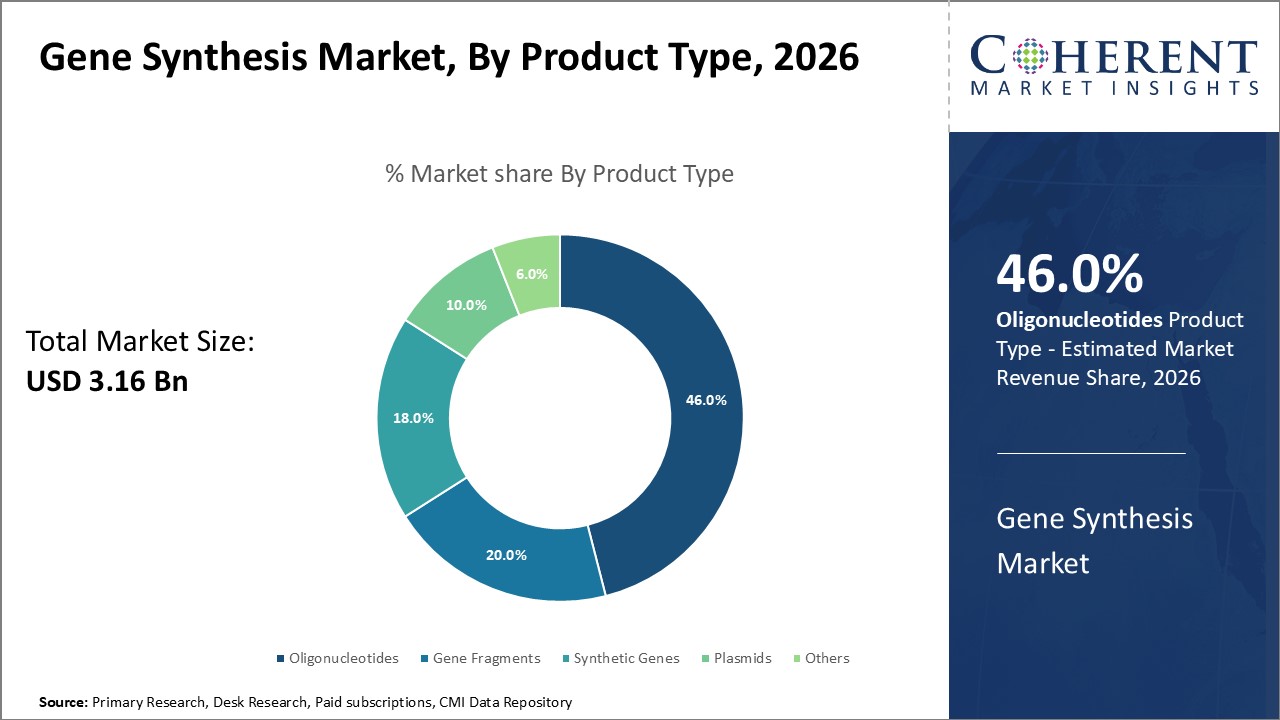
Gene Synthesis Market Insights, By Product Type
Oligonucleotides dominate the market share. This dominance is attributed to their extensive application in diagnostics and therapeutic development, supported by continuous improvements in synthesis accuracy and scalability. The fastest-growing subsegment is Synthetic Genes, showing accelerated demand due to their critical role in gene therapy and synthetic biology research, fueled by advancements in gene editing techniques. Gene Fragments are widely used for cloning and sequencing applications, while Plasmids support gene delivery and recombinant protein production; these segments maintain steady growth in research and industrial biotechnology.
Gene Synthesis Market Insights, By Application
Therapeutics is the dominating subsegment, driven by the rise in gene therapies and personalized medicine, which demand custom synthetic genes with high precision and traceability. Agricultural Biotechnology, exhibiting the fastest growth, benefits from increasing adoption of genetically engineered crops designed for enhanced yield and environmental resilience, particularly in emerging economies. Diagnostics remain a vital segment due to expanding molecular diagnostics and pathogen detection, while Research & Development underpins innovation across biosciences with consistent demand for specialized synthesis services.
Gene Synthesis Market Insights, By Technology
Chemical Synthesis remains the dominant technology due to its well-established processes, scalability, and cost-effectiveness for standard gene constructs. Enzymatic Synthesis is the fastest-growing technology, favored for its superior fidelity and eco-friendly processes, leading to wider adoption in therapeutics and complex gene assembly tasks. Bioinformatics-Aided Synthesis integrates computational tools to optimize design and assembly, providing enhanced accuracy and reducing costly errors, contributing to incremental market growth and driving innovation in gene synthesis workflows.
Gene Synthesis Market Trends
The gene synthesis market is witnessing a significant trend towards integrating artificial intelligence and automation to streamline gene design and synthesis workflows, which accelerates innovation cycles and reduces operational costs.
For example, in 2025, emerging companies utilizing AI-assisted gene assembly reported productivity gains surpassing 31%, signifying a key shift from conventional methods.
Furthermore, the rise of regional synthesis hubs in the Asia Pacific, supported by government grants and growing R&D ecosystems, is decentralizing production away from traditional North American and European leaders.
Within biologics, demand for synthetic genes used in next-generation vaccines and therapeutic proteins has surged over 21% in 2026, illustrating expanding downstream applications driving industry trends.
Gene Synthesis Market Insights, By Geography
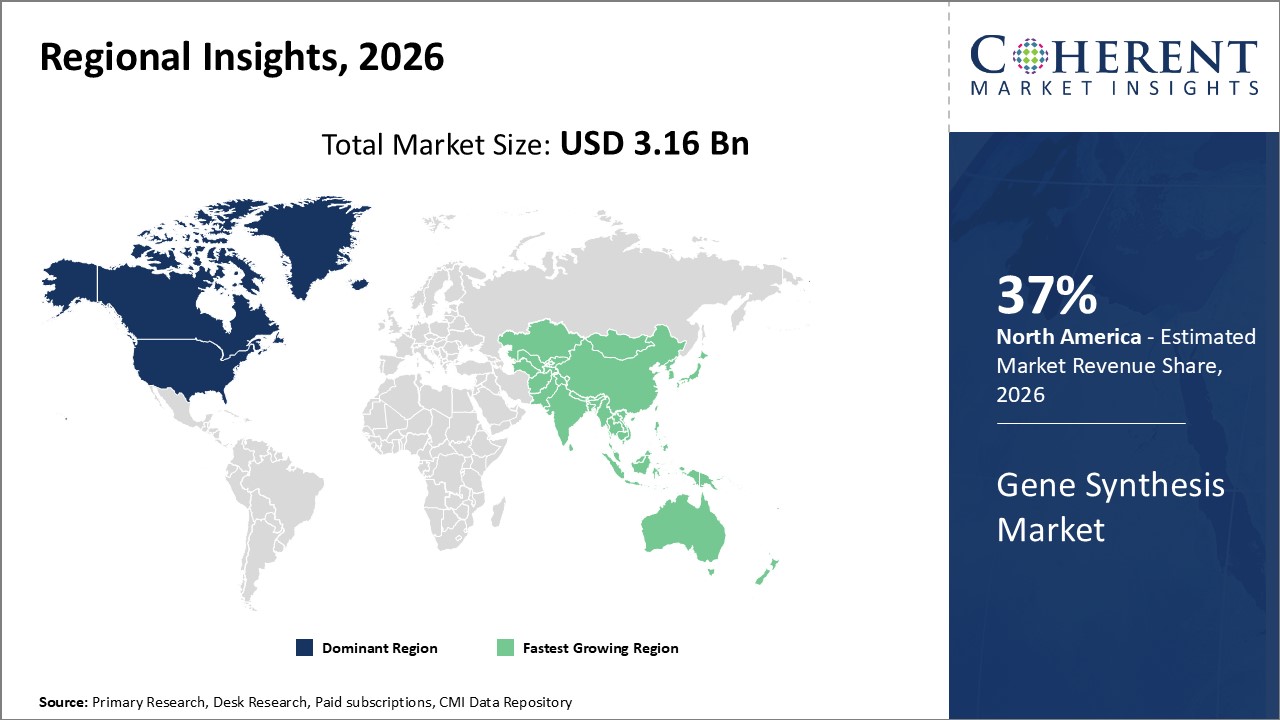
North America Gene Synthesis Market Analysis and Trends
In North America, the dominance in the Gene Synthesis market is reinforced by an advanced biotech ecosystem, extensive research infrastructure, and favorable regulatory frameworks. These factors collectively contribute to the region’s approximate 37% market share. Market growth is propelled by strong government funding and the presence of major market companies, such as Thermo Fisher Scientific and Twist Bioscience, which continuously innovate to maintain competitive advantages.
Asia Pacific Gene Synthesis Market Analysis and Trends
Meanwhile, the Asia Pacific exhibits the fastest growth with a CAGR exceeding 14%, attributed to escalating synthetic biology investments, expanding biopharma manufacturing, and increasing agricultural biotech applications. China and India are spearheading this rise, supported by growing market companies expanding local production and an increase in export-oriented gene synthesis services.
Gene Synthesis Market Outlook for Key Countries
USA Gene Synthesis Market Analysis and Trends
The USA's gene synthesis market remains the largest globally, supported by a strong presence of top-tier companies and leading research institutions. In 2026, the country accounted for nearly 60% of North America’s synthetic gene revenue, driven by substantial clinical trials in gene therapies and sustained government investments exceeding USD 300 million annually. Innovations such as microarray-based oligonucleotide synthesis developed in US labs have set global quality benchmarks, further solidifying the country’s market leadership and influencing business growth strategies worldwide.
China Gene Synthesis Market Analysis and Trends
China’s market is rapidly expanding, propelled by government initiatives like the 14th Five-Year Plan prioritizes synthetic biology as a key technology. Local gene synthesis companies have increased production capacity by over 35% since 2023, fulfilling both domestic demand and significant export orders. Collaborations between academic institutions and industry players have resulted in accelerated product development cycles, bolstering the country’s fast-growing market share within the Asia Pacific.
Analyst Opinion
Innovation in High-Fidelity Synthesis Technologies: Advancements in enzymatic gene synthesis methods in 2025 have pushed error rates down by nearly 41%, enabling higher reliability suitable for therapeutic applications. This improvement has raised the market share of high-precision gene synthesis products to approximately 53%, enhancing demand from pharmaceutical developers engaged in precision medicine.
Expansion in Agricultural Biotechnology Applications: The adoption of synthetic genes to create genetically modified crops resistant to climate stresses increased by 28% across the Asia Pacific in 2026, according to agricultural import-export data. This demand has become a significant driver supporting market revenue growth in emerging economies.
Rise of On-Demand Gene Synthesis Services: The proliferation of cloud-based gene design platforms has reduced turnaround time by 35-41% year-on-year since 2023, facilitating just-in-time synthesis requests. This trend boosts market dynamics by fostering a shift from bulk ordering towards flexible, custom design-centric business growth, influencing market growth strategies across regions.
Increasing Investment in Synthetic Biology Startups: Over USD 1 billion in venture capital was infused into synthbio enterprises in North America in 2025, signaling heightened industry interest that translates directly into greater demand for synthetic gene products as fundamental research tools.
- Current Industry Events of 2026
- Market Size Estimation
- Regional Breakdown
- Competitive Landscape
- Customer Intelligence
- Segmental Analysis
- Pricing Analysis
- Key Market Drivers, Challenges & Future Trends
- Customized Insights Section
Market Scope
| Report Coverage | Details | ||
|---|---|---|---|
| Base Year: | 2025 | Market Size in 2026: | USD 3.16 billion |
| Historical Data for: | 2020 To 2024 | Forecast Period: | 2026 To 2033 |
| Forecast Period 2026 to 2033 CAGR: | 12.7% | 2033 Value Projection: | USD 7.29 billion |
| Geographies covered: |
| ||
| Segments covered: |
| ||
| Companies covered: | Twist Bioscience, GenScript, Thermo Fisher Scientific, Eurofins Genomics, Bioneer Corporation, IDT (Integrated DNA Technologies), Synbio Technologies, GeneArt (a Thermo Fisher brand), Biomatik, Genewiz (part of Azenta Life Sciences), Sangon Biotech, Agilent Technologies, Synthace. | ||
| Growth Drivers: |
| ||
Gene Synthesis Market Growth Factors
Increasing demand for synthetic therapeutics has been among the primary market growth drivers, highlighted by the rise in gene therapies approved in the US and Europe, doubling clinical trial initiations from 2023 to 2026. Cost reduction due to automation of synthesis processes has accelerated uptake in R&D applications, particularly within academic and biotech startups, evidenced by a 30% decrease in synthesis costs reported in 2025. Governmental initiatives promoting synthetic biology infrastructure development, especially in North America and the Asia Pacific, have spurred investment flows exceeding USD 500 million in 2025 alone. Additionally, growing agricultural biotechnology adoption in Latin America and Asia is fostering new uses for gene synthesis, with a reported 25% growth in genetically engineered crop submissions worldwide.
Gene Synthesis Market Development
In June, 2025: GenScript Biotech launched the FLASH Gene service, a fast sequence-to-plasmid (S2P) service that includes gene synthesis, cloning, and plasmid preparation. It boasts a four-business-day turnaround for standard sequences and uses a flat-rate pricing model that starts at USD 89 for sequences up to 1000 bp. This service is designed to be an ultra-fast and cost-effective option for researchers.
In May 2026, Ansa Biotechnologies launched an Early Access Program for its 50 kilobase (kb) long-fragment DNA synthesis, based on its proprietary enzymatic technology. This program was initially offered to select academic and industrial partners in North America and includes plans for wider commercial availability by the end of 2026.
Key Players
Leading Companies of the Market
Twist Bioscience
GenScript
Thermo Fisher Scientific
Eurofins Genomics
Bioneer Corporation
IDT (Integrated DNA Technologies)
Synbio Technologies
GeneArt (a Thermo Fisher brand)
Biomatik
Genewiz (part of Azenta Life Sciences)
Sangon Biotech
Agilent Technologies
Synthace
Competitive strategies include Twist Bioscience’s expansion of silicon-based synthesis platforms in 2025, leading to a 20% increase in synthesis throughput and a corresponding revenue jump of 18%. GenScript strategically entered agricultural biotech in 2026, fueling revenue diversification by 12% and advancing market penetration in the Asia Pacific.
Gene Synthesis Market Future Outlook
The future of gene synthesis products lies in faster, fully automated benchtop instruments and AI-driven sequence design platforms. Emerging technologies such as enzymatic DNA synthesis and microarray-based assembly will enable longer and more complex constructs with minimal errors. The combination of machine learning and bioinformatics will streamline sequence optimization for specific expression systems, while integrated plasmid delivery and cloning services will reduce turnaround times. In addition, the growing demand for personalized medicine and synthetic biology will drive the creation of modular synthesis kits and cloud-connected systems capable of high-throughput gene assembly in clinical and industrial settings.
Gene Synthesis Market Historical Analysis
Gene synthesis products originated in the early 2000s as laboratory services relying on chemical oligonucleotide assembly methods. Initial products were expensive and error-prone, limiting their application to basic research. Over time, advances in enzymatic synthesis, high-throughput DNA assembly, and error-correction techniques made synthetic genes more accurate, longer, and cost-effective. The integration of automated platforms, software-based codon optimization, and cloning kits transformed gene synthesis from a manual process to an on-demand digital service. These products became essential tools in biotechnology, vaccine development, and synthetic biology, enabling the rapid construction of custom DNA sequences.
Sources
Primary Research interviews:
Molecular Biologists
Genetic Engineers
Research Lab Managers
Biotech Product Developers
Databases:
NCBI Gene Database
GenBank
Magazines:
Genetic Engineering & Biotechnology News
BioTechniques
Nature Biotechnology
Lab Manager
Journals:
Nucleic Acids Research
Biotechnology Advances
Synthetic Biology
Journal of Molecular Biology
Newspapers:
The Economic Times (Biotech)
The Guardian (Science)
The New York Times (Health)
Business Standard (Life Sciences)
Associations:
American Society for Biochemistry and Molecular Biology (ASBMB)
Synthetic Biology Engineering Research Center (SynBERC)
European Federation of Biotechnology
International Society for Computational Biology
Get access to 250+ pages report
Every segment, forecast, competitor profile and data table behind the analysis above — available for instant download.
- ESOMAR Member
- ISO 9001:2015 Certified
- D-U-N-S Registered
- GDPR & CCPA Compliant
Missing comfort of reading report in your local language? Find your preferred language:
Transform your Strategy with Exclusive Trending Reports
Frequently Asked Questions
The market is led by companies such as Twist Bioscience, GenScript, Thermo Fisher Scientific, and Eurofins Genomics, which collectively hold substantial market shares. These players focus on technological innovation, enhanced production capacities, and strategic partnerships to maintain leadership.
The market is forecasted to grow from USD 3.16 billion in 2026 to USD 7.29 billion by 2033, driven by rising demand in therapeutics, agriculture, and industrial biotechnology.
The therapeutics sector presents the largest growth opportunity due to increasing gene therapy developments and personalized medicine, which are expanding the use of synthetic genes significantly.
Emerging trends include the adoption of AI in gene design, automation of synthesis processes, and expansion of decentralized manufacturing hubs, particularly in Asia Pacific, influencing market growth dynamics.
The competitive landscape is characterized by rapid innovations, with challenges around the high cost of synthesis, intellectual property issues, and regulatory constraints influencing market strategies.
Strategies such as partnerships with biotech startups, expansion of automated synthesis platforms, and entrance into agriculture biotech verticals are frequent approaches to capture growing market share.