

M-RNA Synthesis Service Market Analysis & Forecast
M-RNA Synthesis Service Market is estimated to be valued at USD 7,590.4 Mn in 2026 and is expected to reach USD 11,240.9 Mn in 2033, exhibiting a compound annual growth rate (CAGR) of 5.8% from 2026 to 2033.
Key Takeaways
- By Application, the vaccine production segment is projected to dominate the global M-RNA Synthesis Service Market with a 50.7% share in 2026.
- By Region, North America is expected to retain a dominant position in the global m-RNA synthesis service market, holding a 33.5% share in 2026.
Market Overview
The global M-RNA Synthesis Service Market is witnessing robust growth, driven by rising demand for personalized medicine, vaccines, and innovative drug development. The market is expanding rapidly due to advancements in synthetic biology and increased funding for mRNA-based therapies. Vaccine production remains the dominant application, while therapeutic and drug discovery uses are growing steadily. North America leads the market, supported by strong research infrastructure and government initiatives, while Asia Pacific emerges as a key growth region with expanding biotech capabilities and healthcare investments.
Current Events and its Impact on the M-RNA Synthesis Service Market
Current Event | Description and its impact |
Surge in Global mRNA Vaccine Initiatives |
|
Strategic Collaborations Among Biotech Companies |
|
Rising Regulatory Oversight in Genetic Therapies |
|
Pricing Analysis: M-RNA Synthesis Service Market
The pricing dynamics of the global M-RNA Synthesis Service Market are influenced by various factors including reagent and enzyme costs, labor intensity, equipment maintenance, and scale of synthesis. In 2025, the market is projected to witness moderate price increases, primarily due to rising costs of high-purity nucleotides, modified enzymes, and custom oligonucleotide reagents essential for mRNA synthesis. The labor- and technology-intensive nature of GMP-grade synthesis, along with increasing quality control requirements, also contributes to higher service pricing, particularly for clinical and commercial-scale batches.
Growing demand from vaccine manufacturers, biopharma firms, and research institutions is driving pricing pressure, especially for fast-turnaround and high-fidelity synthesis services. Customization, regulatory compliance, and sterile manufacturing requirements further elevate service costs. Additionally, global supply chain constraints, such as raw material shortages and cold-chain logistics issues, are amplifying cost variability. However, ongoing investments in automation and continuous flow synthesis platforms are expected to gradually improve cost efficiency and help stabilize long-term pricing trends.
- Current Industry Events of 2026
- Market Size Estimation
- Regional Breakdown
- Competitive Landscape
- Customer Intelligence
- Segmental Analysis
- Pricing Analysis
- Key Market Drivers, Challenges & Future Trends
- Customized Insights Section
Role of emerging technologies in the M-RNA Synthesis Service Market
Emerging technologies are significantly reshaping the M-RNA Synthesis Service Market by improving process efficiency, scalability, and precision. Artificial Intelligence (AI) and machine learning are being integrated into mRNA sequence design, enabling rapid identification of optimal codon usage, secondary structure prediction, and antigen expression profiles. This accelerates the development of mRNA-based vaccines and therapeutics while enhancing their efficacy and safety profiles.
Automated synthesis platforms and microfluidics are streamlining production workflows by enabling high-throughput, small-volume synthesis with greater reproducibility and reduced human error. These technologies also support real-time monitoring and quality control, which are critical for maintaining GMP compliance. Additionally, advances in enzymatic synthesis methods and continuous flow processing are improving yield and reducing production costs.
Cloud-based bioinformatics tools further facilitate collaboration among researchers, supporting faster design iterations and regulatory documentation. Collectively, these innovations are enabling faster turnaround, cost optimization, and customization in mRNA synthesis services—strengthening their role in next-generation medicine development.
M-RNA Synthesis Service Market Trends
- Increasing Facility Expansion by Market Players
Major companies operating in the global M-RNA Synthesis Service Market are focused on organic growth strategies such as facility expansions, and this is expected to drive growth of the global M-RNA Synthesis Service Market over the forecast period.
For instance, in March 2021, Maravai LifeSciences, a global provider of life science reagents and services to researchers and biotech entrepreneurs, expanded its contract development and manufacturing organization (CDMO) capabilities at TriLink BioTechnologies, a division of Maravai LifeSciences, with the launch of its plasmid DNA (pDNA) manufacturing services.
TriLink's new plasmid services will provide customers the convenience of a single-source messenger RNA (mRNA) solution, manufactured with Current Good Manufacturing Practice (cGMP) capabilities, from plasmid synthesis through final release testing.
In May 2025, TriLink BioTechnologies® and Quantoom Biosciences signed a non-exclusive License and Supply Agreement for CleanCap® mRNA Capping Technology. This agreement allows Quantoom to integrate TriLink's patented capping technology into its Ntensify® (sa)mRNA production platform, aiming to accelerate RNA production and improve accessibility of therapeutics and vaccines.
- Increasing Prevalence of chronic and infectious diseases
Increasing prevalence of chronic and infectious diseases such as cancer, cytomegalovirus (CMV), HIV (human immunodeficiency virus), hepatitis, among others is expected to drive the market growth over the forecast period. For instance, according to the data provided by Breastcancer.org, in March 2022, an estimated 287,850 new cases of invasive breast cancer are expected to be diagnosed in women, in the U.S., along with 51,400 new cases of non-invasive (in situ) breast cancer in 2022.
Moreover, according to the Centers for Disease Control and Prevention, one out of every 200 babies is born with congenital cytomegalovirus (CMV) infection and around one out of five babies, in the U.S., is born with congenital CMV infection that will have long-term health problems such as mononucleosis or hepatitis (liver problem).
In April 2025, Ginkgo Bioworks announced a $29 million contract by ARPA-H to develop distributed manufacturing of essential medicines using wheat germ cell-free expression systems. While broader than just mRNA, this program aims to establish new manufacturing processes for biologic and small molecule active pharmaceutical ingredients (APIs), including potential applications for protein production relevant to mRNA therapies.
Challenges in the M-RNA Synthesis Service Market
- Technical and Logistics challenges
Technical and logistics challenges during the synthesis and storage of mRNA therapeutics is expected to hamper the market growth. mRNA vaccines are unstable at high temperatures that makes packaging and distribution difficult. Long-term storage and delivery of vaccines is important, as governments seeks to vaccinate rural and remote communities.
The vaccines have important workflow requirements including storage at very low and consistent temperatures. As a result, manufacturers must have access to reliable cold chain storage, which can be expensive to install, if it is not already in place. Moreover, other challenges associated with mRNAs include intrinsic instability, extremely large size, charge, and high chances of enzymatic degradation.
Segmental Insights
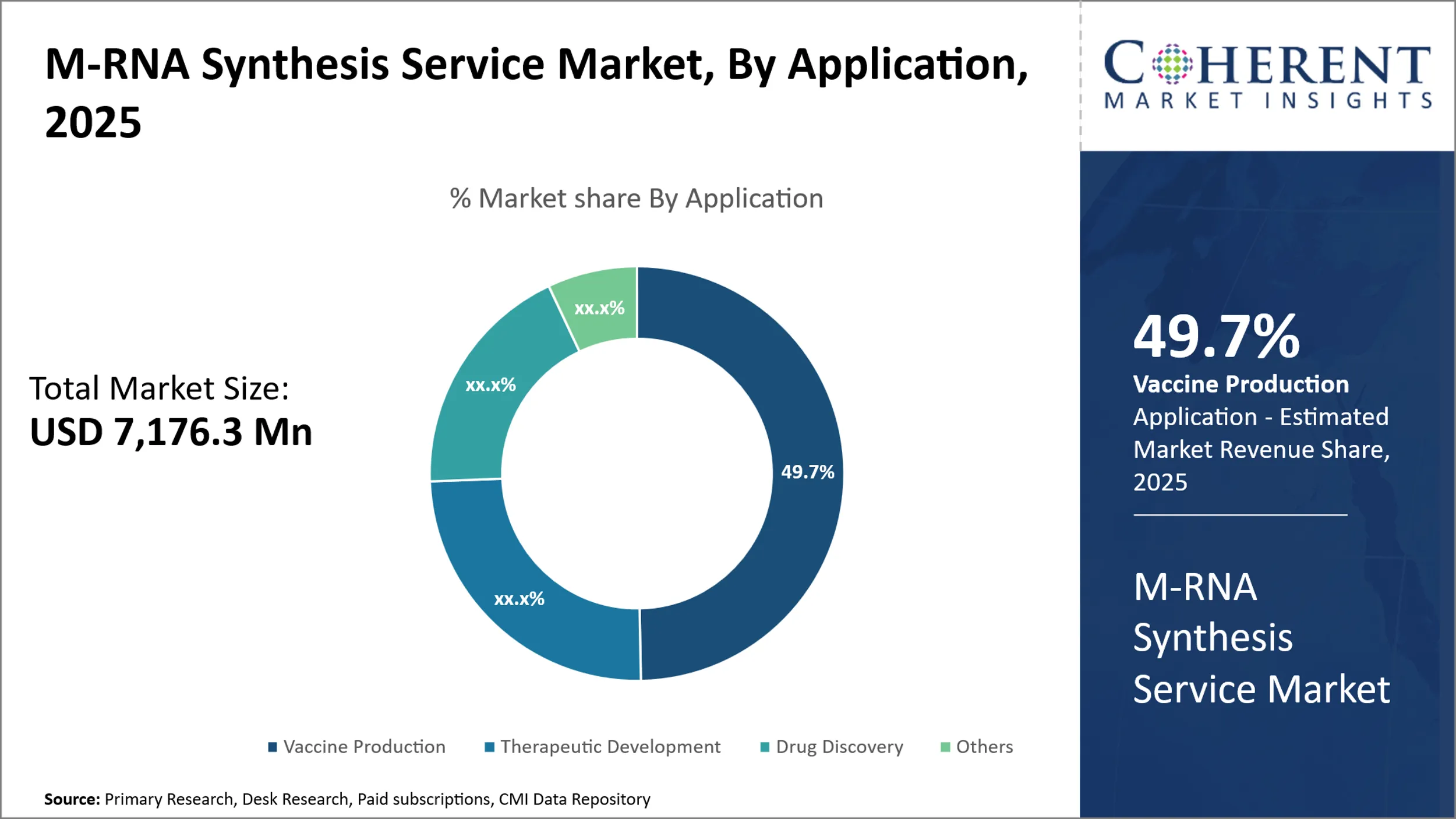
Global M-RNA Synthesis Service Market Insights, By Application
The vaccine production segment is projected to dominate the global M-RNA Synthesis Service Market with a commanding 50.7% share in 2026. This growth is primarily driven by the rising demand for rapid-response vaccines and intensified investments in pandemic preparedness worldwide. mRNA platforms offer unmatched speed and adaptability in vaccine development, making them the preferred choice for both infectious diseases and emerging health threats.
The combined contribution of minor segments including therapeutic development (24.7%), drug discovery (18.2%), and others (7.5%) highlights the growing versatility of mRNA technologies beyond vaccines. Therapeutic development is gaining traction owing to mRNA’s application in personalized cancer therapies, rare genetic disorder treatments, and regenerative medicine.
Drug discovery benefits from mRNA’s use in target identification, protein expression, and early-phase screening. Meanwhile, the “others” segment, which encompasses diagnostics, synthetic biology, and agricultural biotechnology, reflects a steady expansion of mRNA synthesis into diverse scientific domains. Collectively, these segments underscore the widening relevance and long-term potential of mRNA synthesis services across a broad spectrum of research and clinical applications.
Global M-RNA Synthesis Service Market – Regional Insights
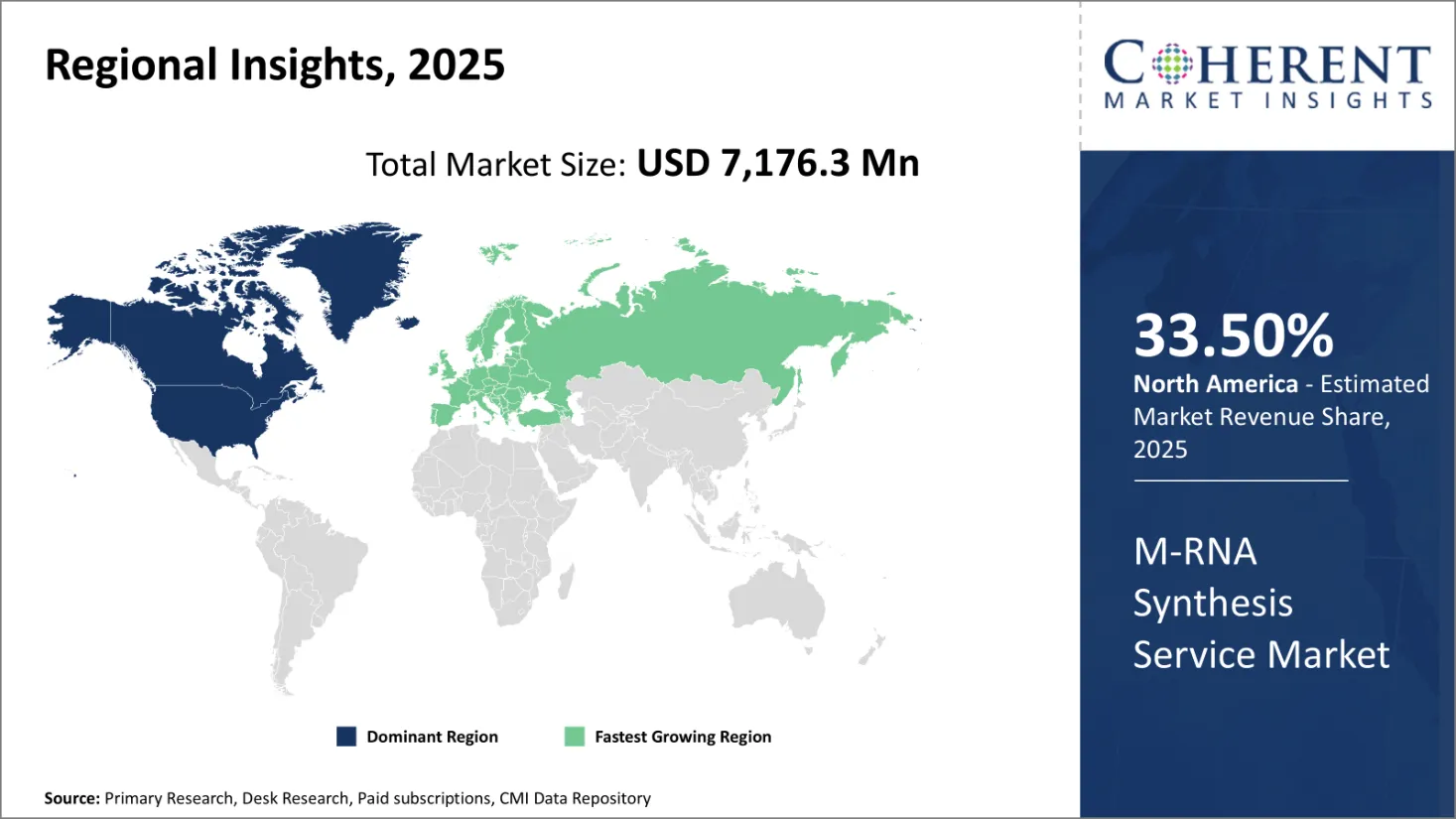
North America M-RNA Synthesis Service Market Trends and Analysis
North America is expected to retain a dominant position in the global M-RNA Synthesis Service Market , holding a 33.50% share in 2026. This regional leadership is driven by substantial government initiatives aimed at advancing mRNA technologies, a strong pharmaceutical and biotechnology ecosystem, and the presence of numerous contract research and manufacturing organizations (CROs and CDMOs).
The United States, in particular, benefits from extensive funding in mRNA R&D and a favourable regulatory framework that accelerates the development and commercialization of mRNA-based vaccines and therapeutics. These combined factors solidify North America's role as the leading hub for mRNA synthesis services globally.
Europe M-RNA Synthesis Service Market Trends and Analysis
Europe is poised to remain a key region in the M-RNA Synthesis Service Market, supported by a strong emphasis on ethical biotechnology development, public-private partnerships, and widespread adoption of personalized medicine. Countries such as Germany, France, and the United Kingdom are investing heavily in mRNA research for oncology, rare diseases, and chronic illnesses.
The region also benefits from robust academic-industry collaborations and EU-level funding programs that promote innovation in therapeutic development. Additionally, strict regulatory standards are encouraging the adoption of high-quality synthesis services for clinical-grade applications.
M-RNA Synthesis Service Market Dominating Countries
United States and Canada
The United States and Canada are leading the M-RNA Synthesis Service Market in North America, which is projected to hold a dominant 39.5% global share in 2026. The U.S. spearheads global innovation in mRNA research and development, supported by substantial federal funding, a mature pharmaceutical industry, and advanced biotech ecosystems. Its favorable regulatory environment accelerates clinical trials and product approvals.
Canada contributes through strategic investments in vaccine innovation and biotechnology infrastructure, offering strong support for mRNA-based therapeutics and diagnostic development across academic and industrial sectors.
Market Report Scope
M-RNA Synthesis Service Market Report Coverage
| Report Coverage | Details | ||
|---|---|---|---|
| Base Year: | 2025 | Market Size in 2026: | USD 7,590.4 Mn |
| Historical Data for: | 2020 To 2024 | Forecast Period: | 2026 To 2033 |
| Forecast Period 2026 to 2033 CAGR: | 5.8% | 2033 Value Projection: | USD 11,240.9 Mn |
| Geographies covered: |
| ||
| Segments covered: |
| ||
| Companies covered: | Maravai LifeSciences, Azenta US, Inc., Creative Biolabs, Becton, Dickinson And Company, Creative Biogene, Kaneka Corporation, Danaher, eTheRNA, Biomay AG, ApexBio Technology, RiboPro, F. Hoffmann-La Roche Ltd, System Biosciences, LLC., Aurigene Pharmaceutical Services Ltd., OZ Biosciences, Aldevron and GenScript | ||
| Growth Drivers: |
| ||
| Restraints & Challenges: |
| ||
Analyst Viewpoint of M-RNA Synthesis Service Market
- The global M-RNA Synthesis Service Market is witnessing robust growth, fuelled by the expanding application of mRNA technologies beyond vaccines to include therapeutics, diagnostics, and drug discovery. Analysts highlight the surge in demand for rapid and scalable synthesis solutions, especially in oncology and rare disease treatment, as a key growth catalyst. The market’s momentum is supported by increasing investments from biopharmaceutical companies and governments focused on pandemic preparedness and personalized medicine.
- Emerging innovations such as AI-assisted sequence optimization, enzymatic synthesis, and automated platforms are enhancing production efficiency and reducing turnaround time. Experts emphasize that technological advancement, coupled with strong intellectual property pipelines, is enabling service providers to offer tailored solutions that meet complex regulatory and clinical requirements. The growing adoption of contract manufacturing and research services is further accelerating market expansion.
- North America leads the global M-RNA Synthesis Service Market , driven by a strong biotech ecosystem, favourable regulatory environment, and substantial R&D funding. Meanwhile, Asia Pacific is rapidly gaining traction due to increasing clinical trial activity, supportive government policies, and growing biopharma manufacturing capabilities. Analysts expect continuous innovation, regional capacity building, and strategic partnerships to define the future trajectory of the M-RNA Synthesis Service Market .
M-RNA Synthesis Service Market : Key Development
- In April 2025, Thermo Fisher Scientific expanded its mRNA synthesis service capabilities by launching a high-throughput GMP-grade production platform. This move aims to meet the growing demand from biotech firms and pharmaceutical companies developing personalized cancer vaccines and rare disease treatments.
- In March 2025, BioNTech entered into a strategic partnership with a leading Asian CDMO to establish a dedicated mRNA synthesis facility in Singapore. This collaboration is expected to enhance regional manufacturing capacity and strengthen BioNTech’s global supply chain for mRNA-based therapeutics and vaccines.
- In February 2025, TriLink BioTechnologies introduced a next-generation CleanCap® mRNA synthesis technology that improves capping efficiency and mRNA stability. The innovation is designed to boost translational efficiency and reduce immunogenicity, making it attractive for therapeutic and vaccine developers.
- In January 2025, Ginkgo Bioworks announced a collaboration with Moderna to leverage AI-driven genomic tools for optimizing mRNA sequence design. This development aims to shorten R&D timelines and improve therapeutic efficacy.
- In December 2024, Aldevron significantly expanded its GMP manufacturing facility in North Dakota, increasing its production capacity for custom mRNA synthesis. This investment supports rising demand from clients engaged in early-stage and clinical-phase mRNA research and development.
Market Segmentation
- Global M-RNA Synthesis Service Market, By Application (Revenue, USD Mn, 2021 - 2033)
- Therapeutic Development
- Vaccine Production
- Drug Discovery
- Others
- Global M-RNA Synthesis Service Market, By Scale of Operation (Revenue, USD Mn, 2021 - 2033)
- Research
- Commercial
- Global M-RNA Synthesis Service Market By End User
- Biopharmaceutical Companies
- Contract research organizations (CROs)
- Others
- Global M-RNA Synthesis Service Market, By Region (Revenue, USD Mn, 2021 - 2033)
- North America
- By Country
- U.S.
- Canada
- By Country
- Latin America
- By Country
- Brazil
- Mexico
- Argentina
- Rest of Latin America
- By Country
- Europe
- By Country
- Germany
- U.K.
- France
- Italy
- Spain
- Russia
- Rest of Europe
- By Country
- Asia Pacific
- By Country
- China
- India
- Japan
- Australia
- South Korea
- ASEAN
- Rest of Asia Pacific
- By Country
- Middle East
- By Country
- GCC
- Israel
- Rest of Middle East
- By Country
- Africa
- By Country/Region
- South Africa
- Central Africa
- North Africa
- By Country/Region
- North America
- Company Profiles
- Maravai LifeSciences
- Azenta US, Inc.
- Creative Biolabs
- Becton, Dickinson And Company
- Creative Biogene
- Kaneka Corporation
- Danaher
- eTheRNA
- Biomay AG
- ApexBio Technology
- RiboPro
- F. Hoffmann-La Roche Ltd.
- System Biosciences, LLC
- Aurigene Pharmaceutical Services Ltd.
- OZ Biosciences
- Aldevron
- GenScript
Sources
The Stakeholders Consulted
- Biotech and pharmaceutical R&D directors and project managers
- Manufacturers and suppliers of mRNA synthesis kits and reagents
- Contract Development and Manufacturing Organizations (CDMOs) and CROs
- Academic researchers and principal investigators in molecular biology and genetics
- Regulatory affairs specialists from healthcare compliance bodies
- Health policy advisors and government public health agencies
- End-users from vaccine production units, oncology labs, and gene therapy development centers
Databases Opened
- U.S. National Institutes of Health (NIH) – Biomedical Research Database
- European Medicines Agency (EMA) – Advanced Therapies Regulatory Data
- World Health Organization (WHO) – Vaccine and Therapeutics Tracker
- ClinicalTrials.gov – Active mRNA Research and Trials
Magazines & Trade Publications
- Genetic Engineering & Biotechnology News (GEN)
- BioPharma Dive
- Nature Biotechnology Industry Briefs
- Pharmaceutical Technology Magazine
- The Scientist – Molecular Biology Section
Scientific and Industry Journals
- Molecular Therapy – Nucleic Acids
- Nucleic Acid Research
- Journal of Gene Medicine
- mRNA Journal
- Biotechnology Advances
Newspapers & Media Outlets
- The Wall Street Journal – Healthcare & Biotech
- Bloomberg – Pharmaceutical Innovation & Biotech
- Reuters – Drug Development & Life Sciences Coverage
- The Economic Times – Healthcare & Pharma Section
- Business Standard – Biotech Research and Innovation
Associations and Regulatory Bodies
- U.S. Food and Drug Administration (FDA) – CBER Division
- European Medicines Agency (EMA) – ATMP Committee
- International Society for Cell and Gene Therapy (ISCT)
- Biotechnology Innovation Organization (BIO)
- Indian Council of Medical Research (ICMR) – Vaccine and Biotech Division
Public Domain Sources
- U.S. Centers for Disease Control and Prevention (CDC) – mRNA Vaccine Data
- European Commission – Biopharmaceutical R&D Funding Reports
- WHO – Global Genomic Surveillance and mRNA Development Reports
- UNESCO – Global Scientific Research Trends in Biotechnology
- OECD Health Statistics – Biotech R&D Investments
Proprietary Research Elements
- CMI Data Analytics Tool
- Proprietary CMI Repository of Biotech Market Data (covering past 8 years)
- CMI Expert Interviews and Transcripts (focused on mRNA synthesis, vaccine manufacturing, and personalized medicine trends)
Get access to 250+ pages report
Every segment, forecast, competitor profile and data table behind the analysis above — available for instant download.
- ESOMAR Member
- ISO 9001:2015 Certified
- D-U-N-S Registered
- GDPR & CCPA Compliant
Missing comfort of reading report in your local language? Find your preferred language:
Transform your Strategy with Exclusive Trending Reports
Frequently Asked Questions
The M-RNA Synthesis Service Market size is estimated to be valued at USD 7,590.4 Mn in 2026, and is expected to reach USD 11,240.9 Mn by 2033.
The CAGR of the global Market is projected to be 5.8% from 2026 to 2033.
Increasing prevalence of chronic diseases and infections and increasing launches of solutions and facility expansion by key players in the market are expected to drive the market.
Vaccine Production is the leading application segment in the market.
The major factors that can hamper the Market include the technical and logistics challenges during the synthesis and storage of MRNA therapeutics.
Major players operating in the Market include Maravai LifeSciences, Azenta US, Inc., Creative Biolabs, Becton, Dickinson And Company, Creative Biogene, Kaneka Corporation, Danaher, eTheRNA, Biomay AG, ApexBio Technology, RiboPro, F. Hoffmann-La Roche Ltd, System Biosciences, LLC., Aurigene Pharmaceutical Services Ltd., OZ Biosciences, Aldevron and GenScript .