

Blood Clotting Factors Market Size and Share Analysis- 2026 To 2033
The Blood Clotting Factors Market size is anticipated to grow at a CAGR of 8.8% with USD 7.43 Bn in 2026 and is expected to reach USD 13.42 Bn in 2033. The primary drivers are defined by the increasing diagnosis of hemophilia and von Willebrand disease, wider adoption of prophylactic therapy, improved treatment access, and development of recombinant and extended-half-life clotting factors. According to the World Federation of Hemophilia, its latest Annual Global Survey reported a 6% increase in the global identification of people with hemophilia, indicating a growing diagnosed treatment population. This is strengthening demand for factor VIII, factor IX, von Willebrand factor, bypassing agents, and other replacement therapies across hospitals, hemophilia treatment centers, specialty clinics, and home-care settings globally.
Key Takeaways
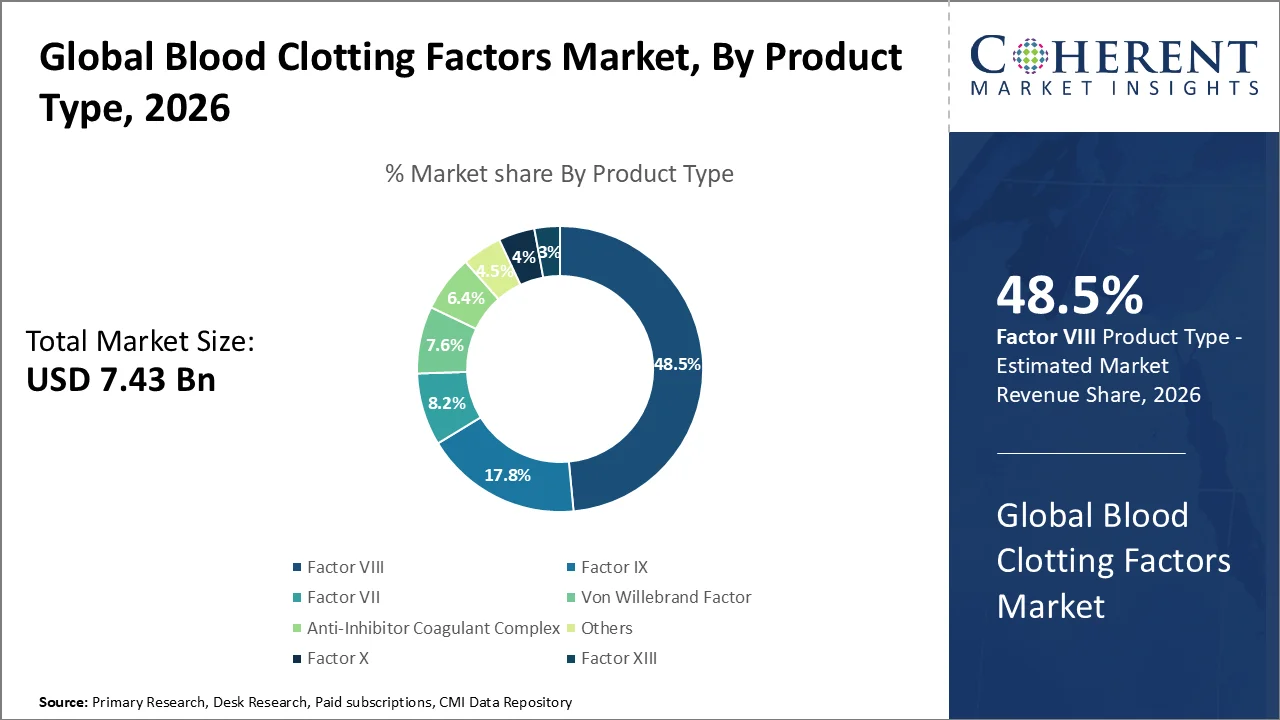
- The Factor VIII segment is likely to dominate the market with 48.5% in 2026. The segment’s growth is owing to the high prevalence of hemophilia A and sustained demand for prophylactic replacement therapy. Hemophilia A is three to four times more common than hemophilia B.
- The haemophilia segment is set to lead with 72.8% in 2026. The segment’s growth is owing to the lifelong treatment requirements and recurring factor administration. The World Federation of Hemophilia estimates 836,000 people worldwide have hemophilia.
- The recombinant segment is set to lead with 59.6% in 2026. The segment’s growth is owing to the improved pathogen safety, scalable manufacturing, and increasing adoption of extended-half-life factor concentrates for preventive treatment.
- The hospital pharmacies segment is set to lead with 55.4% in 2026. The segment’s growth is owing to the specialized hematology care, controlled product storage, emergency availability, and close monitoring of patients receiving high-cost factor therapies.
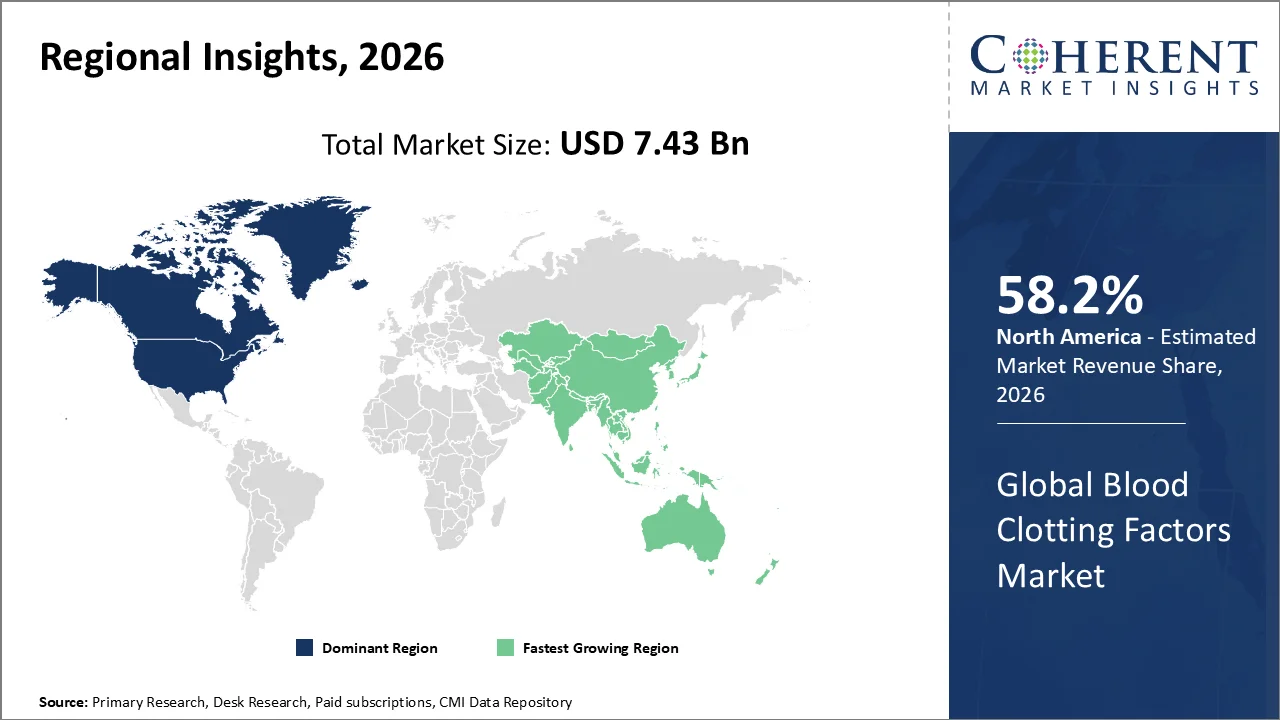
- North America is expected to acquire the prominent share of 58.2% in 2026. The region’s growth is owing to the advanced treatment infrastructure, strong reimbursement, high prophylaxis adoption, and product approvals. CDC estimates around 33,000 males are living with hemophilia in the U.S., supported by comprehensive treatment-center networks and specialist services.
Segmental Insights
Why is Factor VIII Segment Acquiring the Largest Share?
On the basis of product type, the Factor VIII segment is projected to account for the largest Blood Clotting Factors Market share of 48.5% in 2026. The segment’s growth is owing to the replacement requirements in patients with hemophilia A, particularly those with severe disease.
The FDA defines severe hemophilia as clotting-factor activity below 1%, a level associated with bleeding risk and prophylactic treatment demand. CDC data also indicate that approximately 1 in 5 people with hemophilia may develop an inhibitor during their lifetime, complicating conventional factor therapy and increasing the need for Factor VIII management, monitoring, and dosing strategies.
In June 2024, the European Commission authorized ALTUVOCT, an extended-half-life Factor VIII replacement therapy for patients of all ages with hemophilia A. The EMA states that ALTUVOCT is administered once weekly, compared with injections every two to four days for many authorized Factor VIII prophylactic products, improving convenience and potentially supporting adherence.
- Current Industry Events of 2026
- Market Size Estimation
- Regional Breakdown
- Competitive Landscape
- Customer Intelligence
- Segmental Analysis
- Pricing Analysis
- Key Market Drivers, Challenges & Future Trends
- Customized Insights Section
Haemophilia hold the Largest Market Share
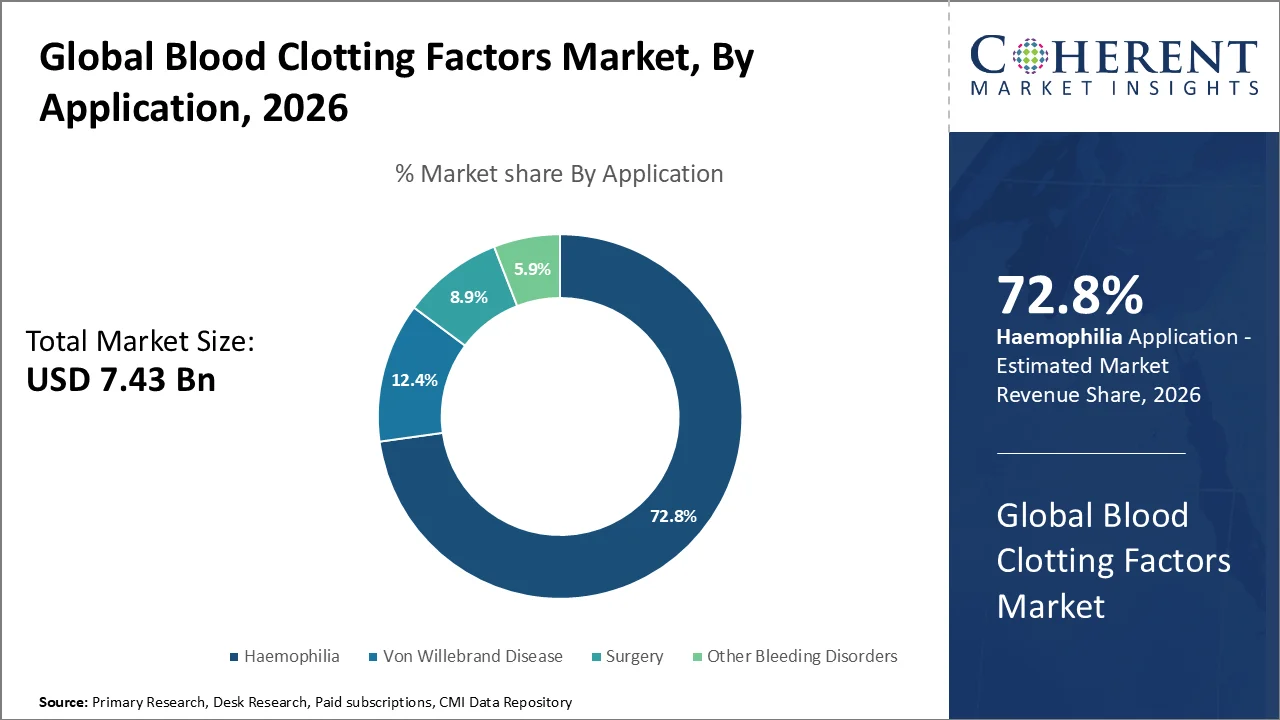
On the basis of application, the haemophilia segment lead with a major 72.8% share in 2026. The growth is owing to the lifelong demand for factor VIII and factor IX replacement, routine prophylaxis, perioperative management, and treatment of breakthrough bleeding.
The CDC reports that about one-third of babies diagnosed with haemophilia have no known family history, thereby highlighting the emergence of newly identified patients requiring treatment.
In September 2025, Novo Nordisk submitted a Biologics License Application to the FDA for Mim8, an investigational prophylactic therapy for hemophilia A with or without inhibitors. If approved, Mim8 would provide weekly, biweekly, or monthly dosing through a prefilled pen.
Market Drivers
Rising Innovations in Prophylactic Care Are Transforming the Blood Clotting Factors Market in the U.S.
The U.S. Blood Clotting Factors Market is undergoing a transition from episodic treatment toward individualized prophylaxis, extended half-life replacement therapy, and expanded indications covering broader patient age groups. Recombinant Factor VIII and Factor IX products allow clinicians to maintain higher trough-factor levels with fewer infusions. This may reduce treatment burden, improve adherence, and support the greater use of prophylaxis among children as well as adults.
In July 2026, the FDA issued an additional approval letter for WILATE, a human von Willebrand factor and coagulation Factor VIII complex manufactured by Octapharma. The FDA’s current indication includes on-demand treatment, perioperative bleeding management, and routine prophylaxis in adult and pediatric patients with von Willebrand disease. WILATE is also indicated for treatment and prophylaxis in patients aged 12 years and older with hemophilia A. The approval strengthens the availability of plasma-derived VWF/FVIII therapy across multiple inherited bleeding-disorder applications.
Extended Half-Life Recombinant Factor VIII: A Major Breakthrough in the Blood Clotting Factors Market
Extended half-life recombinant Factor VIII represents one of the most important technological advances in the Blood Clotting Factors Market. Conventional Factor VIII products may require intravenous administration several times per week because Factor VIII is rapidly cleared from circulation. Extended half-life products use technologies such as Fc fusion, PEGylation, albumin fusion, and von Willebrand factor–binding modifications to extend circulation time and maintain therapeutic factor activity.
In February 2023, Sanofi announced the FDA approval of ALTUVIIIO, a once-weekly factor VIII therapy for adults and children with hemophilia A. The treatment sustains near-normal factor activity for most of the week and substantially reduces bleeding compared with prophylactic therapies.
Current Events and Their Impact on the Blood Clotting Factors Market
Current Event | Description and its Impact |
2026 Medicare Clotting-Factor Furnishing Fee Update in the U.S.
|
|
EU Substances of Human Origin Regulation and Plasma-Supply Requirements |
|
Blood Clotting Factors Market Trends
- The growing adoption of recombinant and extended-half-life factor VIII and factor IX products reduces infusion frequency, improves convenience, and strengthens prophylactic uptake. Extended-half-life clotting-factor concentrates maintain factor levels longer as well as improve bleeding prevention.
- Preventive therapy is replacing on-demand administration, as regular factor replacement helps reduce spontaneous bleeding, joint damage, hospitalization, and disability. The World Federation of Hemophilia recommends prophylaxis as the standard of care for hemophilia.
- Personalized dosing based on pharmacokinetic profiles, body weight, bleeding history, and activity levels factor utilization as well as outcomes in treatment centers.
- The expanding diagnosis of inherited bleeding disorders is enlarging the patient population and demand for clotting-factor concentrates. The World Federation of Hemophilia’s 2024 survey received data from a record 135 national member organizations and reported a 6% increase in identified hemophilia patients. Improved registries, screening, and referral pathways is supporting the earlier treatment initiation in underserved markets.
- New non-factor and gene therapies are reshaping the treatment selection and increasing pressure on conventional factors. In March 2025, the FDA approved Qfitlia for patients aged 12 years and older with hemophilia A or B, with or without inhibitors, with dosing up to once every two months. CMS also raised the clotting-factor furnishing fee from $0.258 per unit in 2025 to $0.265 in 2026, thereby supporting reimbursement.
Regional Insights
North America Dominates Owing to the Advanced Treatment Infrastructure
The North America region accounts for 58.2% of the market share in 2026. The region’s growth is owing to treated population, comprehensive specialty care, reimbursement coverage, and product innovation.
CDC’s March 2024 profile identifies 139 hemophilia treatment centers across the United States and its territories, strengthening diagnosis, factor-level monitoring, inhibitor testing, and coordinated long-term care. CMS confirms that Medicare Part B covers blood clotting factors for eligible patients with factor VIII deficiency, factor IX deficiency, and von Willebrand disease, thereby supporting the treatment access.
In July 2025, Novo Nordisk announced FDA approval expanding Alhemo as a once-daily prophylactic treatment for patients aged 12 years and older with hemophilia A or B without inhibitors. The subcutaneous therapy significantly reduces bleeding rates and broadens treatment options.
Asia Pacific Blood Clotting Factors Market Trends
Asia Pacificis expected to witness strong growth in Blood Clotting Factors Market over the forecast period. The region’s growth is owing to large diagnosed population, wider prophylaxis access, and continued development of factor-replacement and gene-based therapies.
India’s Ministry of Health reported an estimated haemophilia caseload of 136,000, underscoring unmet need for Factor VIII, Factor IX, and bypassing products. Australia’s Therapeutic Goods Administration cited 3,127 people living with haemophilia A or B in the national registry, indicating sustained demand for recombinant and plasma-derived clotting factors.
In February 2026, Karnataka launched Kusuma Sanjeevini which provides free monthly emicizumab prophylaxis for haemophilia patients through 36 treatment centres. The programme targets about 1,000 patients, thereby aiming to prevent bleeding, reduce complications, as well as improve access to continuous preventive care across Karnataka.
Rising Inhibitor Cases and New Prophylactic Treatment Approvals are Accelerating the Blood Clotting Factors Market in United States
The United States Blood Clotting Factors Market is driven by the diagnosed haemophilia population, broader prophylaxis use, treatment centres, and innovation in bleeding prevention. The CDC reports that 15%–20% of people with inherited haemophilia A or B develop inhibitors that prevent replacement clotting factors from working effectively. This is increasing the demand for alternative factor products, bypassing agents, and monitoring services.
In March 2025, the FDA approved Qfitlia (fitusiran) for routine prophylaxis in patients aged 12 years and older with haemophilia A or B, with or without factor inhibitors. Its once-monthly or once-every-two-months dosing expands treatment choice and encourages competition, adoption, and investment in the United States haemophilia treatment ecosystem.
China Blood Clotting Factors Market Trends
China is emerging as a high-growth country for Blood Clotting Factors owing to the haemophilia population, unmet access needs, and expanding domestic biologics capacity. The official NHSA materials record 27,689 registered haemophilia patients nationwide in 2022, thereby highlighting the sustained demand for factor VIII, factor IX, and bypassing therapies.
In March 2026, Belief BioMed and Grand Life Sciences formed an exclusive commercialization partnership for BBM-H803 across Greater China. The collaboration combines gene-therapy development and commercialization capabilities to accelerate patient access to this investigational hemophilia A treatment.
Who are the Major Companies in Blood Clotting Factors Industry
Some of the major key players in Blood Clotting Factors Market are Shire Plc, Baxter International Inc., Grifols International SA, Roche AG, Bayer AG, Pfizer Inc., Novo Nordisk A/S, Octapharma AG, Biogen Idec, and Kedrion S.P.A.
Key News
- In June 2026, Pfizer announced FDA approval expanding HYMPAVZI for routine prophylaxis in hemophilia A or B patients aged six years and older, including those with inhibitors. The once-weekly subcutaneous therapy broadens treatment access and reduces bleeding-related burden for patients.
- In January 2026, Metagenomi announced its name change to Metagenomi Therapeutics, reflecting a sharper focus on gene-editing programs led by MGX-001 for hemophilia A. The company plans IND/CTA submissions in late 2026, supported by primate data and funding through 2027.
Market Report Scope
Blood Clotting Factors Market Report Coverage
| Report Coverage | Details | ||
|---|---|---|---|
| Base Year: | 2025 | Market Size in 2026: | USD 7.43 Bn |
| Historical Data for: | 2020 To 2024 | Forecast Period: | 2026 To 2033 |
| Forecast Period 2026 to 2033 CAGR: | 8.8% | 2033 Value Projection: | USD 13.42 Bn |
| Geographies covered: |
| ||
| Segments covered: |
| ||
| Companies covered: | Shire Plc, Baxter International Inc., Grifols International SA, Roche AG, Bayer AG, Pfizer Inc., Novo Nordisk A/S, Octapharma AG, Biogen Idec, and Kedrion S.P.A. | ||
| Growth Drivers: |
| ||
| Restraints & Challenges: |
| ||
Analyst Opinion
- Blood Clotting Factors Market growth is driven by medical need. Hemophilia occurs in about 1 in 5,000 male births, and repeated bleeding can cause chronic joint disease. Therefore, market growth reflects lifelong treatment requirements rather than short-term healthcare trends or discretionary demand.
- Factor VIII is the largest treatment category because hemophilia A is approximately four times as common as hemophilia B, thereby sustaining the broad demand for recombinant as well as plasma-derived factor VIII concentrates.
- Advanced factor replacement therapy is gaining substantial traction, as extended and ultra-long half-life products maintain clotting activity longer and reduce treatment burden. The World Federation of Hemophilia identifies prophylaxis as the standard of care for severe disease, while FDA-approved recombinant Factor VIII and IX products support bleeding prevention, perioperative management, and on-demand treatment. This is strengthening adoption across pediatric and adult patient populations across established and emerging markets.
Speak to the analyst
Want personalized insights?
Take the findings above to one of our principal consultants, or have the report rebuilt around the segments, geographies and competitors you actually track.
Market Segmentation
- By Product Type (Revenue, USD Bn, 2021-2033)
- Factor VII
- Factor VIII
- Factor IX
- Factor X
- Factor XIII
- Von Willebrand Factor
- Anti-Inhibitor Coagulant Complex
- Others
- By Application (Revenue, USD Bn, 2021-2033)
- Hemophilia
- Hemophilia A
- Hemophilia B
- Von Willebrand Disease (VWD)
- Surgery
- Other Bleeding Disorders
- Hemophilia
- By Technology (Revenue, USD Bn, 2021-2033)
- Plasma-derived
- Recombinant
- By Distribution Channel (Revenue, USD Bn, 2021-2033)
- Hospital Pharmacies
- Retail Pharmacies
- Online Pharmacies
- By Region (Revenue, USD Bn, 2021-2033)
- North America
- U.S.
- Canada
- Latin America
- Brazil
- Mexico
- Argentina
- Rest of Latin America
- Europe
- Germany
- U.K.
- France
- Italy
- Spain
- Russia
- Rest of Europe
- Asia Pacific
- China
- India
- Japan
- Australia
- South Korea
- ASEAN
- Rest of Asia Pacific
- Middle East
- GCC
- Israel
- Rest of Middle East
- Africa
- South Africa
- Central Africa
- North Africa
- North America
Sources
Primary Research Interviews
- Hematologists
- Coagulation specialists
- Hemophilia treatment center physicians
- Hospital pharmacists
- Hospital procurement managers
- Blood clotting factor manufacturers and distributors
- Key opinion leaders (KOLs) in hematology and bleeding disorders
Databases
- World Health Organization (WHO)
- Centers for Disease Control and Prevention (CDC)
- National Institutes of Health (NIH)
- U.S. Food and Drug Administration (FDA)
- European Medicines Agency (EMA)
- Organisation for Economic Co-operation and Development (OECD)
Magazines
- HemAware
- The Hematologist
- Pharmacy Times
- Pharmaceutical Technology
Journals
- Blood
- Journal of Thrombosis and Haemostasis
- Haemophilia
- Research and Practice in Thrombosis and Haemostasis
- The Lancet Haematology
Newspapers
- The New York Times
- The Guardian
- The Wall Street Journal
- Financial Times
Associations
- World Federation of Hemophilia
- International Society on Thrombosis and Haemostasis
- National Bleeding Disorders Foundation
- European Association for Haemophilia and Allied Disorders
- American Society of Hematology
Public Domain Sources
- Company Annual Reports and Investor Presentations
- Government Health Ministry Publications
- Regulatory Approval Databases
- Clinical Trial Registries such as ClinicalTrials.gov and the EU Clinical Trials Register
- National Hemophilia and Bleeding Disorder Registries
Proprietary Elements
- CMI Data Analytics Tool
- Proprietary CMI Existing Repository of Information for the Last 10 Years
Get access to 250+ pages report
Every segment, forecast, competitor profile and data table behind the analysis above — available for instant download.
- ESOMAR Member
- ISO 9001:2015 Certified
- D-U-N-S Registered
- GDPR & CCPA Compliant
Missing comfort of reading report in your local language? Find your preferred language:
Transform your Strategy with Exclusive Trending Reports
Frequently Asked Questions
The Blood Clotting Factors Market is expected to reach USD 13.42 Bn in 2033.
Major players operating in the global Blood Clotting Factors Market include Shire Plc, Baxter International Inc., Grifols International SA, Roche AG, Bayer AG, Pfizer Inc., Novo Nordisk A/S, Octapharma AG, Biogen Idec, and Kedrion S.P.A.
The high treatment costs, development of neutralizing inhibitors, and strict regulatory hurdles are the key factors hampering growth of the market.
The rising bleeding disorders, technological advancements, and increased research investments is boosting the demand for Blood Clotting Factors.
The Blood Clotting Factors Market is anticipated to grow at a CAGR of 8.8% between 2026 and 2033.
Among regions, North America is expected to account for a largest market share in the global Blood Clotting Factors Market over the forecast period.
The blood clotting factors market is the global healthcare industry sector focused on the production, distribution, and sale of therapeutic protein products—such as Factor VIII, Factor IX, and von Willebrand factor—used to treat bleeding disorders like hemophilia.