

Newborn Calf Serum Market Analysis & Forecast 2026-2033
The global newborn calf serum market is valued at USD 289.9 Mn in 2026 and is forecast to reach a value of USD 459.4 Mn by 2033 at a CAGR of 6.8% between 2026 and 2033.
Key Takeaways
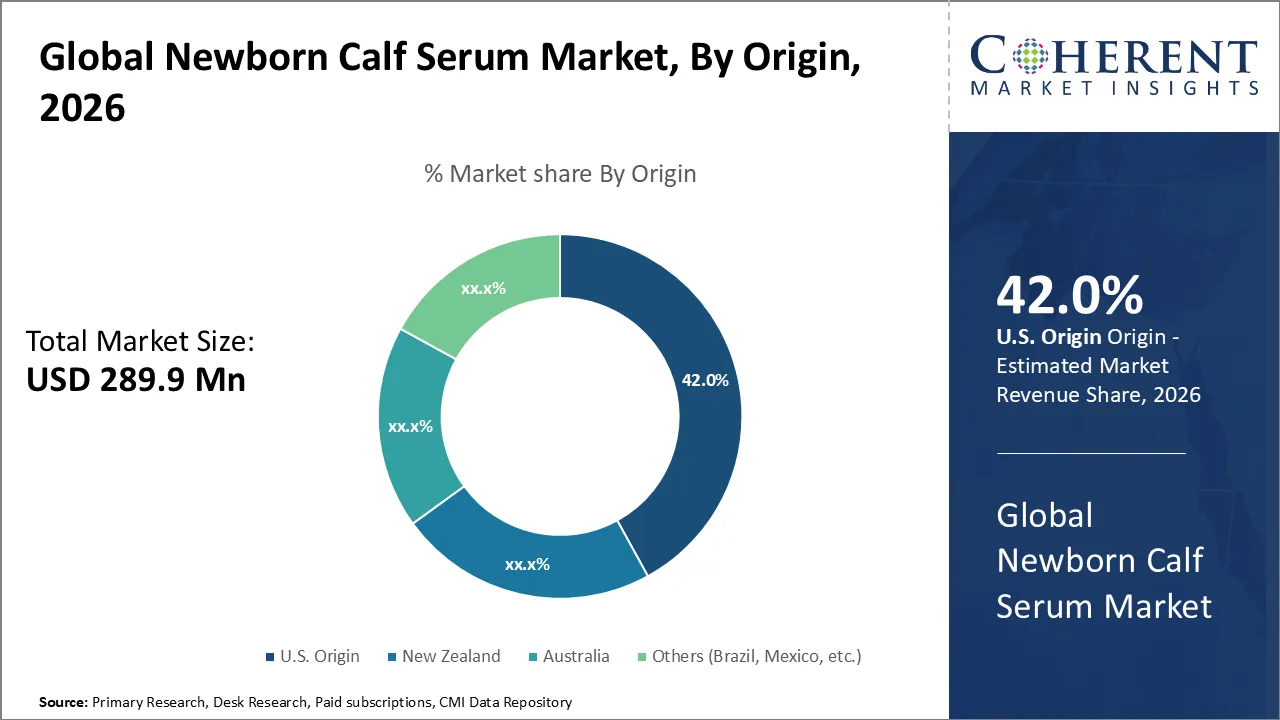
- Based on Origin, the U.S. origin segment is expected to hold 42% share of the market in 2026, with reliable supply and global regulatory acceptance.
- Based on Application, cell media culture segment is expected to lead the market with 55% share in 2026, through essential use in biologics and vaccine production.
- Based on End User, the biotechnology & pharmaceutical industries segment is projected to account for 60% share of the market in 2026, driven by large-scale R&D and clinical trials.
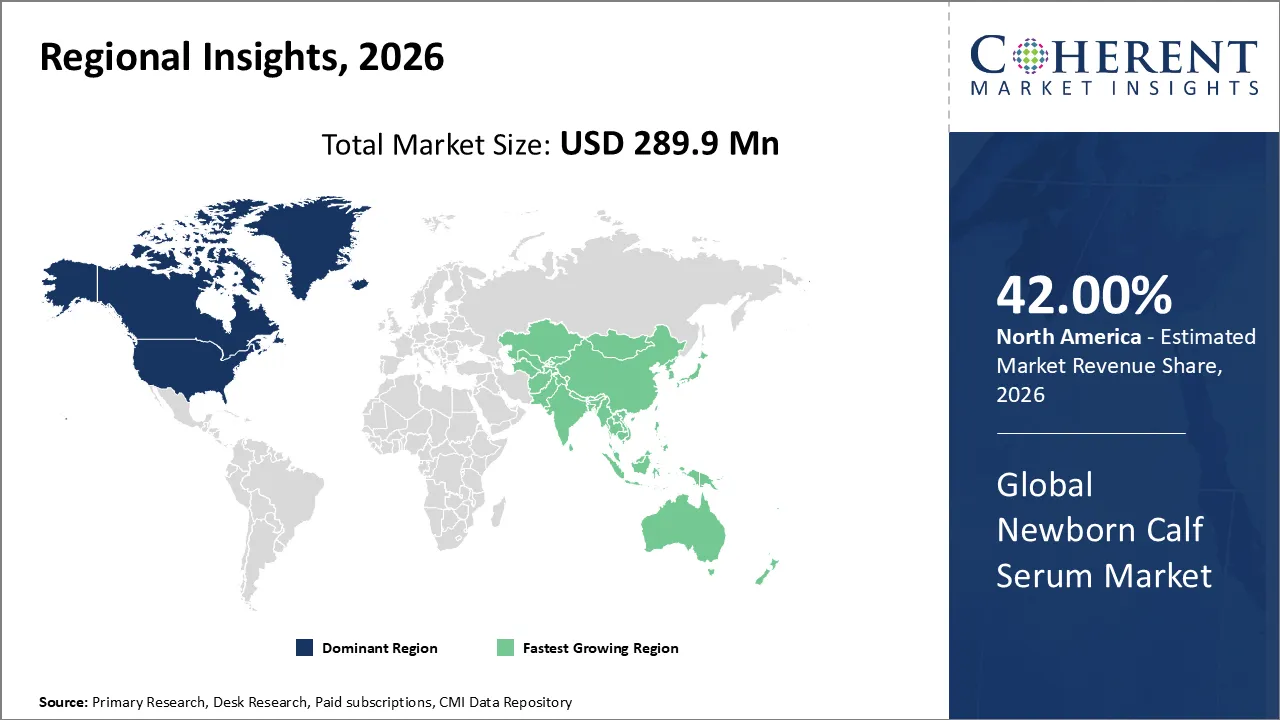
- Based on Region, North America is set to lead the newborn calf serum market with 42% share in 2026. While, Asia Pacific is anticipated to be the fastest growing region.
Market Overview
Newborn Calf Serum (NBCS) is developed from 3 to 10 days old calves. NBCS is cheaper and better in quality than fetal bovine serum. As newborn calf serum (NBCS) is more affordable and commonly available, it is preferred as a basal growth medium over fetal bovine serum. When a cell line is tough and cell attachment is a major concern during cell culture, newborn calf serum is often used. Some more advantages of newborn calf serum are
- NBCS performance is good where regular cell growth and cell maintenance are the objective
- NBCS is rich in antibodies used for the development of immune system
- NBCS contains a high proportion of immunoglobin and protein
- In mouse spermatogonial stem cells, use of NBCS increase the viability after cryopreservation
Current Events and their Impacts on Newborn Calf Serum Market
Current Event | Description and its Impact |
Regulatory and Ethical Pressures on Animal-Derived Products |
|
Biotechnology Innovation and Alternative Development |
|
How Does Newborn Calf Serum Compare to Emerging Alternatives?
Aspect | FBS (Newborn Calf Serum) | Alternatives (Serum-Free Media) |
Source | Blood from unborn calves | Recombinant proteins, plant-based, plasma |
Cost | USD 400–700 per liter | Often lower, scalable |
Ethical Concerns | High | None (animal-free) |
Scalability | Limited supply | Industrial-scale production |
Industry Adoption | Pharma, biotech, academia | Cultivated meat, dairy, pharma |
- Current Industry Events of 2026
- Market Size Estimation
- Regional Breakdown
- Competitive Landscape
- Customer Intelligence
- Segmental Analysis
- Pricing Analysis
- Key Market Drivers, Challenges & Future Trends
- Customized Insights Section
Segmental Insights
Which origin segment holds the largest share of the newborn calf serum market?
In terms of origin, the U.S. origin segment is expected to hold 42% share of the market in 2026, because it is made in large quantities, has consistent quality, and meets all regulatory requirements. Global pharmaceutical and biotech companies prefer it due to it is widely available and has well-established distribution networks. This ensures a reliable supply for important drug development and cell culture applications around the world.
Which application area emerges as the leading driver of the newborn calf serum market?
In terms of application, the cell media culture segment is expected to lead the market with 55% share in 2026, because there is a growing need for vaccine production, stem cell research, and biologics manufacturing. Since the serum is so important for cell growth and survival, it is essential for labs and drug companies, making it the most important part of modern biomedical research.
Which end-user group captures the greatest growth in the newborn calf serum market?
In terms of end user, the biotechnology & pharmaceutical industries segment is projected to account for 60% share of the market in 2026, due to the growing need for drug discovery, biologics, and advanced therapies. They are the main end users considering they need an extensive amount of research and development, clinical trials, and large-scale production. By 2026, they will be the most important players in the global serum market.
Regional Insights
North America Newborn Calf Serum Market Analysis & Trends
North America is expected to dominate the newborn calf serum market with 42% share in 2026. Strong biotech and pharmaceutical activity will drive demand for North America's Newborn Calf Serum Market in 2026. A lot of research and development in cell culture, regenerative medicine, and vaccine development drives consumption. Established suppliers, advanced purification technologies, and big investments in life sciences all help the region's market dominance by making sure it keeps growing.
Asia Pacific Newborn Calf Serum Market Analysis & Trends
Asia Pacific is expected to exhibit the fastest growth, because biotech is growing quickly in China, India, and South Korea. Adoption is driven by government programs, more pharmaceutical manufacturing, and cheaper production. Additional revenue is going into research on regenerative medicine and cell culture, which increases demand even more. This makes Asia-Pacific the fastest-growing region in the world.
Newborn Calf Serum Market Outlook Country-Wise
The U.S. Newborn Calf Serum Market Trends
The U.S. market for newborn calf serum will grow in 2026 because of its advanced biotech ecosystem, extensive pharmaceutical research and development, and strong focus on regenerative medicine. The U.S. is the biggest contributor to the market because it invests large amount in cell culture research, vaccine development, and established supply chains that make sure there is always demand.
China Newborn Calf Serum Market Trends
In 2026, the demand for newborn calf serum market in China is growing owing to the government is spending heavily on biotechnology, the pharmaceutical industry is growing, and there is a great support for research into regenerative medicine. China's ability to make things economically and its growing interest in cell culture applications are two of the main reasons why the regional market is growing.
Market Report Scope
Newborn Calf Serum Market Report Coverage
| Report Coverage | Details | ||
|---|---|---|---|
| Base Year: | 2025 | Market Size in 2026: | USD 289.9 Mn |
| Historical Data for: | 2020 To 2024 | Forecast Period: | 2026 To 2033 |
| Forecast Period 2026 to 2033 CAGR: | 6.8% | 2033 Value Projection: | USD 459.4 Mn |
| Geographies covered: |
| ||
| Segments covered: |
| ||
| Companies covered: | HiMedia Laboratories, Thermo Fisher Scientific Inc., Sartorius AG, Merck KGaA, Corning Inc., Atlas Biologicals, Inc., TCS Biosciences Ltd., Bovogen Biologicals Pty Ltd., Novus Biologicals, LLC, Capricorn Scientific, PAN-Biotech GmbH, Atlanta Biologicals, Inc., Rockey Mountain Biologicals, GE Healthcare, Serana, and Zhejiang Tianhang Biotechnology | ||
| Growth Drivers: |
| ||
| Restraints & Challenges: |
| ||
Newborn Calf Serum Market Driver
Increasing investments by market players in life science sector
The newborn calf serum market growth is greatly affected by greater resources being put into it by important companies in the life science field. Companies are investing funds into advanced research, cell culture technologies, and the development of biopharmaceuticals. This directly leads to more people using newborn calf serum. These investments not only help create new products, but they also increase production capacity to meet global demand.
Increasing product approvals by regulatory authorities
The newborn calf serum market demand is growing even faster because a growing number of products are being approved by regulatory bodies around the world. Approvals make sure that serum products meet strict safety and quality standards, which makes them more dependable for use in biotech and pharmaceutical settings. This regulatory support builds trust among researchers and manufacturers, which leads to more widespread use. As a result, the market benefits from faster commercialization of new products, better access, and stronger global competitiveness, which keeps it on the rise.
Newborn Calf Serum Market Opportunity
Biopharmaceutical Expansion
The newborn calf serum market forecast shows that biopharmaceutical growth is a big chance for the industry. Growth is being driven by the growing need for cell culture media in drug discovery, vaccine development, and regenerative medicine. Serum suppliers can expand their offerings by providing specialized, high-quality products that are designed for advanced therapeutic uses. This growth not only gives them a stronger competitive edge, but it also fits with the trend of more and more money being invested in life sciences around the world. As biopharma companies speed up innovation, the market benefits from steady demand and the chance for long-term growth.
Analyst Opinion (Expert Opinion)
- Industry Use and Demand Drivers: Many biotechnology and pharmaceutical researchers use Newborn Calf Serum (NCS) because it is full of nutrients that help cells grow in culture. Data shows that biotechnology companies and universities use the most, thanks to advances in genetic engineering, regenerative medicine, and diagnostic applications. It is essential for labs and contract research organizations because it helps cells live longer and grow faster.
- Insights by Region and Use: North America and Europe are the biggest consumers, thanks to their advanced research infrastructure. Asia-Pacific is growing quickly, owing to the growth of pharmaceutical manufacturing and government-backed research and development projects. Applications include finding new drugs, making vaccines, and doing diagnostic tests. The demand for precision medicine is growing. Statistical trends show that diagnostic labs and contract research organizations are consistently using NCS, which shows that it is an important resource for modern biomedical research.
Speak to the analyst
Want personalized insights?
Take the findings above to one of our principal consultants, or have the report rebuilt around the segments, geographies and competitors you actually track.
Market Segmentation
- Global Newborn Calf Serum Market, By Origin
- New Zealand Origin
- U.S. Origin
- Australia Origin
- Others (Brazil Origin, Mexico Origin, etc.)
- Global Newborn Calf Serum Market, By Application
- Drug Discovery
- Cell Media Culture
- Others
- Global Newborn Calf Serum Market, By End User
- Biotechnology & Pharmaceutical Industries
- Academic Institutes
- Others (Research labs and Diagnostic Labs, etc.)
- Global Newborn Calf Serum Market, By Region
- North America
- U.S.
- Canada
- Latin America
- Brazil
- Argentina
- Mexico
- Rest of Latin America
- Europe
- Germany
- U.K.
- Spain
- France
- Italy
- Russia
- Rest of Europe
- Asia Pacific
- China
- India
- Japan
- Australia
- South Korea
- ASEAN
- Rest of Asia Pacific
- Middle East
- GCC Countries
- Israel
- Rest of Middle East
- Africa
- South Africa
- North Africa
- Central Africa
- North America
- Global Newborn Calf Serum Market, Key Player
- HiMedia Laboratories
- Thermo Fisher Scientific Inc.
- Sartorius AG
- Merck KGaA
- Corning Inc.
- Atlas Biologicals, Inc.
- TCS Biosciences Ltd.
- Bovogen Biologicals Pty Ltd.
- Novus Biologicals, LLC
- Capricorn Scientific
- PAN-Biotech GmbH
- Atlanta Biologicals, Inc.
- Rockey Mountain Biologicals
- GE Healthcare
- Serana
- Zhejiang Tianhang Biotechnology
Sources
Primary Research Interviews
- Newborn Calf Serum Manufacturers
- Biotechnology Researchers
- Veterinary Clinics & Laboratories
- Pharmaceutical Companies
- Medical Device Manufacturers
- Others
Databases
- PubMed
- Scopus
- ClinicalTrials.gov
- Euromonitor International
- Others
Magazines
- Biotechnology Journal
- Veterinary Science Today
- Laboratory Animal Science News
- Pharmaceutical Technology Magazine
- Others
Journals
- Journal of Biotechnology
- Journal of Veterinary Science
- Cell Biology Journal
- Journal of Animal Science
- Others
Newspapers
- The New York Times - Health Section
- The Guardian – Health
- Reuters Health
- Bloomberg News
- Others
Associations
- American Association of Veterinary Laboratory Diagnosticians (AAVLD)
- Biotechnology Innovation Organization (BIO)
- World Health Organization (WHO)
- National Institutes of Health (NIH)
- Others
Public Domain Sources
- U.S. Food and Drug Administration (FDA)
- U.S. Department of Agriculture (USDA)
- World Health Organization (WHO)
- European Medicines Agency (EMA)
- National Institutes of Health (NIH)
- Others
Proprietary Elements
- CMI Data Analytics Tool
- Proprietary CMI Existing Repository of Information for the Last 8 Years
Get access to 250+ pages report
Every segment, forecast, competitor profile and data table behind the analysis above — available for instant download.
- ESOMAR Member
- ISO 9001:2015 Certified
- D-U-N-S Registered
- GDPR & CCPA Compliant
Missing comfort of reading report in your local language? Find your preferred language:
Transform your Strategy with Exclusive Trending Reports
Frequently Asked Questions
The global Newborn Calf Serum Market size is valued at USD 289.9 Mn in 2026 and is expected to reach USD 459.4 Mn in 2033.
Global newborn calf serum market is expected to exhibit a CAGR of 6.8% during the forecast period (2026-2033).
The market is estimated to be valued at USD 289.9 Mn in 2026.
HiMedia Laboratories, Thermo Fisher Scientific Inc., Sartorius AG, Merck KGaA, Corning Inc., Atlas Biologicals, Inc., TCS Biosciences Ltd., Bovogen Biologicals Pty Ltd., Novus Biologicals, LLC, Capricorn Scientific, PAN-Biotech GmbH, Atlanta Biologicals, Inc., Rockey Mountain Biologicals, GE Healthcare, Serana, and Zhejiang Tianhang Biotechnology are some of the prominent players operating in the market.
North America is the prominent region in the market.
Increasing investments by market players in life science sector, increasing product approvals by the regulatory authorities, increasing awareness related to cell culture-based vaccine, cheaper in price than fetal bovine serum, and rich in antibodies are some key factors which driving the growth of the market.