

Global Ontogenetic Market Size and Share Analysis - Growth Trends and Forecasts (2026 - 2033)
The Ontogenetic Market is anticipated to grow at a CAGR of 4.1% with USD 632.7 Mn in 2026 and is expected to reach USD 826.9 Mn in 2033. The Ontogenetic/Optogenetics Market is growing as neuroscience labs adopt precision light-based tools for neural circuit mapping, behavioral studies, and retinal research. For instance, in March 2026, National Institutes of Health (NIH) stated that the BRAIN Initiative supports next-generation devices to monitor or modulate neural circuits and advanced effector technologies such as optogenetic tools. In FY2026, the BRAIN Initiative was funded at USD 429 million, supporting neuroscience technology creation. Additionally, in March 2026, Allen Institute announced Neuropixels Opto, a probe with 960 sensors and 28 light emitters for simultaneous recording and optogenetic stimulation. This strengthens demand for LEDs, lasers, actuators, probes, and integrated neurophysiology platforms.
Source: NIH; Society for Neuroscience; allen institute
Key Takeaways
- Light-emitting Diode (LED) is expected to account the largest share of 58.4% in 2026, because it offers low-cost, compact, wavelength-flexible, and stable illumination for repeated neuroscience experiments. For instance, National Institutes of Health (NIH) BRAIN Initiative guidance posted in March 2026 highlights optogenetic tools for correcting dysfunctional brain circuits, while a 2026 Nature Communications study used a 3×5 LED array at 634 nm and 75 mW, supporting precise cortical stimulation adoption.
Source: NIH; Springer Nature Limited
- Channelrhodopsin will dominate with 52.3% in 2026, because it directly depolarizes neurons with millisecond precision, strong reproducibility, and wide availability in viral-vector toolkits. An EMBO Molecular Medicine study published in February 2026 reported engineered ChR2 variants enabling high-frequency neurostimulation at low light intensity. NIH also identifies optogenetic tools as important for circuit-level brain research, supporting broad research adoption.
- Neuroscience hold the dominant share of 46.8% in 2026 because the technology is mainly used to map, activate, and silence neural circuits with high temporal precision. For instance, in 2026, National Institutes of Health (NIH)’s BRAIN Initiative page, emphasizes advancing human neuroscience and circuit understanding. In March 2026, Allen Institute launched Neuropixels Opto, combining neural recording and optogenetic light delivery, strengthening neuroscience adoption.
Source: NIH; allen institute
- North America is expected to acquire the dominant share of 38.7% in 2026, due to strong NIH-backed neuroscience funding, advanced university labs, and early access to optogenetic tools. For instance, in March 2026, National Institutes of Health BRAIN Initiative guidance published highlighted optogenetic technologies for correcting dysfunctional brain circuits. In 2026, Allen Institute’s Neuropixels Opto platform combined high-resolution electrophysiology with optogenetic light delivery, supporting regional leadership.
Segmental Insights
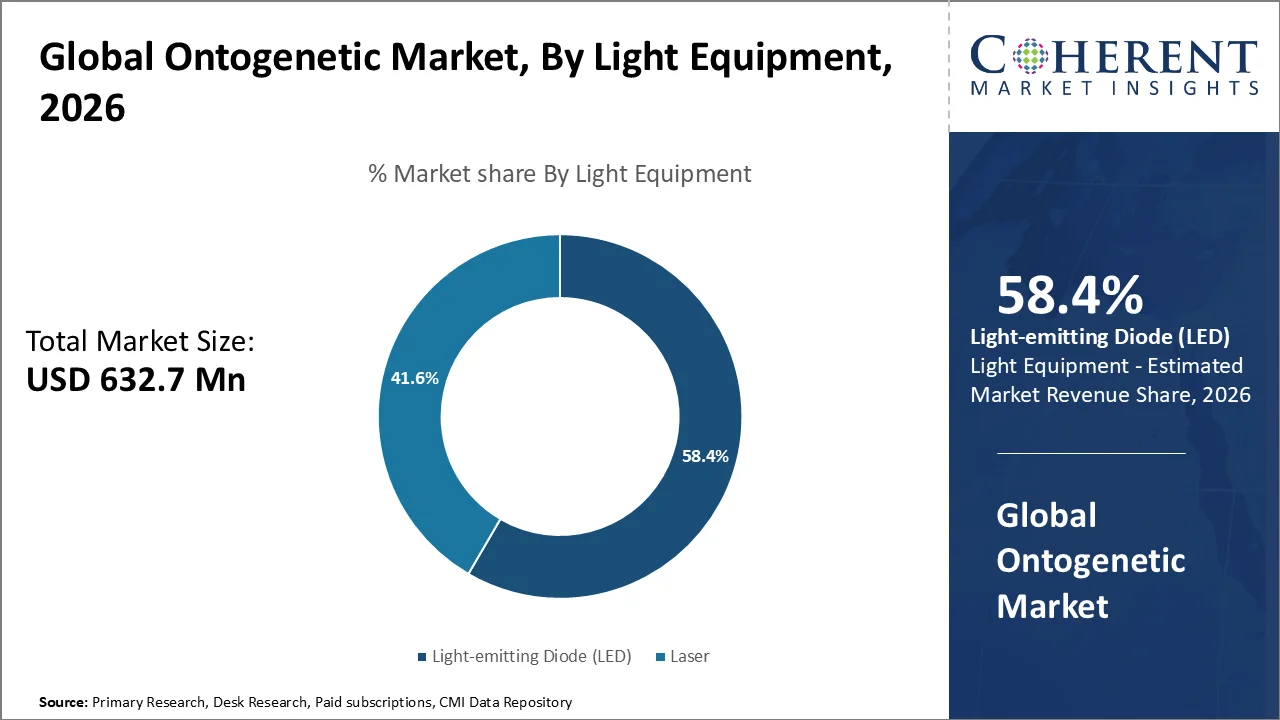
Why is Light-emitting Diode (LED) Acquiring the Largest Market Share?
Light-emitting Diode (LED) is projected to account for the largest share of global ontogenetic market in 2026, representing approximately volume. Light-emitting Diode (LED) is acquiring the largest market share in the Optogenetics Market because it offers cost-effective, compact, wavelength-specific, and easily programmable light delivery for routine neuroscience experiments. For instance, in 2026, Thorlabs, Inc., an American privately held optical equipment company states that its optogenetics LED systems cover 405 nm to 625 nm wavelengths, matching commonly used opsins for neuron stimulation or silencing. Doric Lenses’ LED drivers page, available in 2026, highlights 1-, 2-, and 4-channel programmable LED drivers with TTL modulation, analog modulation, and software-defined illumination sequences. In 2026, Nature Communications published an LED-based optogenetic neurophysiology platform using 4×4 and 3×5 LED arrays, showing large-scale patterned brain stimulation and cortical temperature change below 1°C, supporting LED adoption in advanced research.
- Current Industry Events of 2026
- Market Size Estimation
- Regional Breakdown
- Competitive Landscape
- Customer Intelligence
- Segmental Analysis
- Pricing Analysis
- Key Market Drivers, Challenges & Future Trends
- Customized Insights Section
Channelrhodopsin holds the Largest Market Share
Channelrhodopsin dominate the market, accounting for a significant 52.3% share in 2026. Channelrhodopsin holds the largest share because it is the most widely adopted excitatory optogenetic actuator for activating neurons with blue light, millisecond precision, and reliable membrane expression. Addgene notes that ChR2 was the first widely adopted optogenetic tool and is preferred for higher conductance and good membrane trafficking. For instance, National Institutes of Health (NIH) BRAIN Initiative guidance published in March 2026 highlighted optogenetic tools for precise correction of dysfunctional brain circuits. This supports continued ChR use in neuroscience, behavioral studies, and disease-model research.
Which Application segment dominates the market?
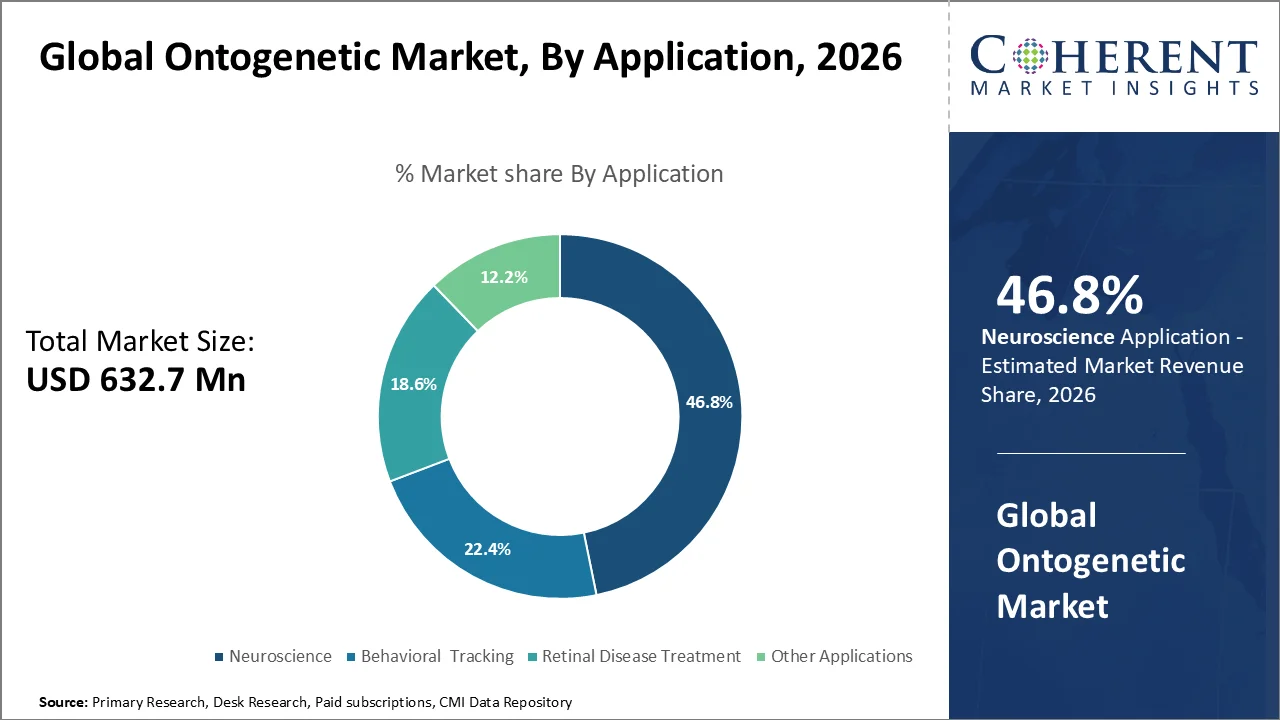
Neuroscience account for the largest share of 46.8% in 2026 due to because optogenetics is mainly used to study and control brain circuits with high cell-type and millisecond-level precision. Researchers use it widely in studies related to Parkinson’s disease, epilepsy, depression, memory, vision restoration, and neural connectivity. For instance, in March 2026, NIH’s BRAIN Initiative page, highlights optogenetic and chemogenetic tools for precise correction of dysfunctional brain circuits in neurological and neuropsychiatric conditions. Additionally, in March 2026, Allen Institute launched Neuropixels Opto, a tool that combines high-resolution electrophysiology with optogenetic light delivery to record, identify, and manipulate neuronal populations. This strengthens neuroscience as the leading application because researchers can observe and control brain activity in the same experiment.
Market Driver
Increasing prevalence of neurological disorders across the globe
Rising incidence of the neurological disorders globally has driven the global ontogenetic market growth over the forecast period. Increasing prevalence of neurological disorders is driving the Global Optogenetics Market by increasing demand for precise tools to study brain circuits, neuronal signaling, and disease mechanisms. For instance, in March 2024, WHO reported that over 3 billion people globally were living with neurological conditions in 2021, making these disorders the leading cause of illness and disability worldwide. This strengthens research use of optogenetics in epilepsy, Parkinson’s disease, dementia, retinal degeneration, and behavioral neuroscience. Furthermore, in April 2026, Britannica updated that optogenetics enables researchers to switch cells on/off with high precision in living animals. Additionally, in March 2026, Nanoscope Therapeutics highlighted its optogenetic MCO-010 therapy for retinal degenerative disease, showing continued clinical translation.
Rise in research and development and government initiatives
Increase in Research & Development and government initiatives for the ontogenetic has drive the market growth over the forecast period. Expanding funding for neural-circuit tools, light-based gene control, and precision brain research. For instance, in March 2025, the National Institutes of Health (NIH) BRAIN Initiative budget page, reported USD 321 million funding for FY2025, supporting brain-cell access, recording, modulation, and data tools used in optogenetics research. National Institutes of Health (NIH) also listed open BRAIN funding opportunities extending into June 2026–2027 for recording, modulation, and novel tools to probe cell- and circuit-specific brain processes. Additionally, in February 2026, DARPA’s Generative Optogenetics program stated that it aims to use light to direct DNA/RNA synthesis inside living cells, creating new R&D demand for optical systems, actuators, and neuroscience platforms.
AI-Enabled Neuro-Innovation and Precision Light Control Are Transforming the Ontogenetic Market
AI-enabled neuro-innovation and precision light control are transforming the Global Ontogenetic Market by improving real-time neural targeting, automated stimulation, and reproducible brain-circuit studies. For instance, in March 2026, National Institutes of Health (NIH) stated that BRAIN Initiative precision-therapy projects focus on advanced neural effector technologies, including optogenetic tools, to correct dysfunctional brain circuits. Additionally, in February 2026, DARPA’s Generative Optogenetics program highlighted light-directed DNA/RNA synthesis inside living cells, showing how optical control is moving beyond basic neuroscience into programmable biology. A 2026 Nature Communications study also noted that optogenetics enables cell-type-specific manipulation with high spatial and temporal precision. These advances increase demand for lasers, LEDs, opsins, imaging systems, and AI-linked closed-loop platforms for neuroscience, retinal disease, and drug-discovery research.
Current Events and Their Impact on the Ontogenetic Market
Current Event | Description and its Impact |
Favorable Regulatory Policies |
|
NIH BRAIN Initiative funding for neural recording and modulation tools |
|
DARPA Generative Optogenetics Program |
|
Ontogenetic Market Trends
- Expansion of optogenetic therapy into retinal diseases- Optogenetics is moving from laboratory neuroscience into clinical-stage retinal disease treatment. In March 2026, Nanoscope Therapeutics reported that its MCO-010 optogenetic therapy demonstrated clinically meaningful and statistically significant vision improvement in retinitis pigmentosa patients with severe vision loss. This shows growing use of optogenetics beyond research, especially in gene-agnostic vision restoration therapies.
Source: Nanoscope Therapeutics
- Shift toward LED and micro-LED based stimulation platforms- LED-based systems are becoming a major trend because they support compact, patterned, and scalable light delivery. In 2026, Nature Communications published a large-scale optogenetic neurophysiology platform using optical hardware scalable from single lasers to large LED arrays for patterned brain stimulation across multiple brain areas.
- Growing use in neuroscience and behavioral research- Optogenetics is increasingly used to understand neural circuits, behavior, memory, and brain disorders. The 2026 Gordon Research Conference on Optogenetic Approaches to Understanding Neural Circuits and Behavior highlights strong academic focus on using optogenetics for circuit-level brain research and behavioral studies.
- Development of ultra-sensitive opsins- Companies are developing improved light-sensitive proteins to reduce stimulation complexity and improve experimental performance. In September 2025, Science Corporation announced engineered channelrhodopsins that respond strongly to ambient indoor lighting, showing innovation in opsin sensitivity and supporting next-generation optogenetic applications.
- Rising adoption of wireless and implantable optogenetic devices- Wireless and implantable platforms are gaining attention because they allow optogenetic stimulation in freely moving animals and long-term experiments. In 2026, a published study presented chronically implantable μLED arrays with 100 micro-LEDs for high-intensity blue-light delivery, supporting precise spatiotemporal brain stimulation.
Regional Insights
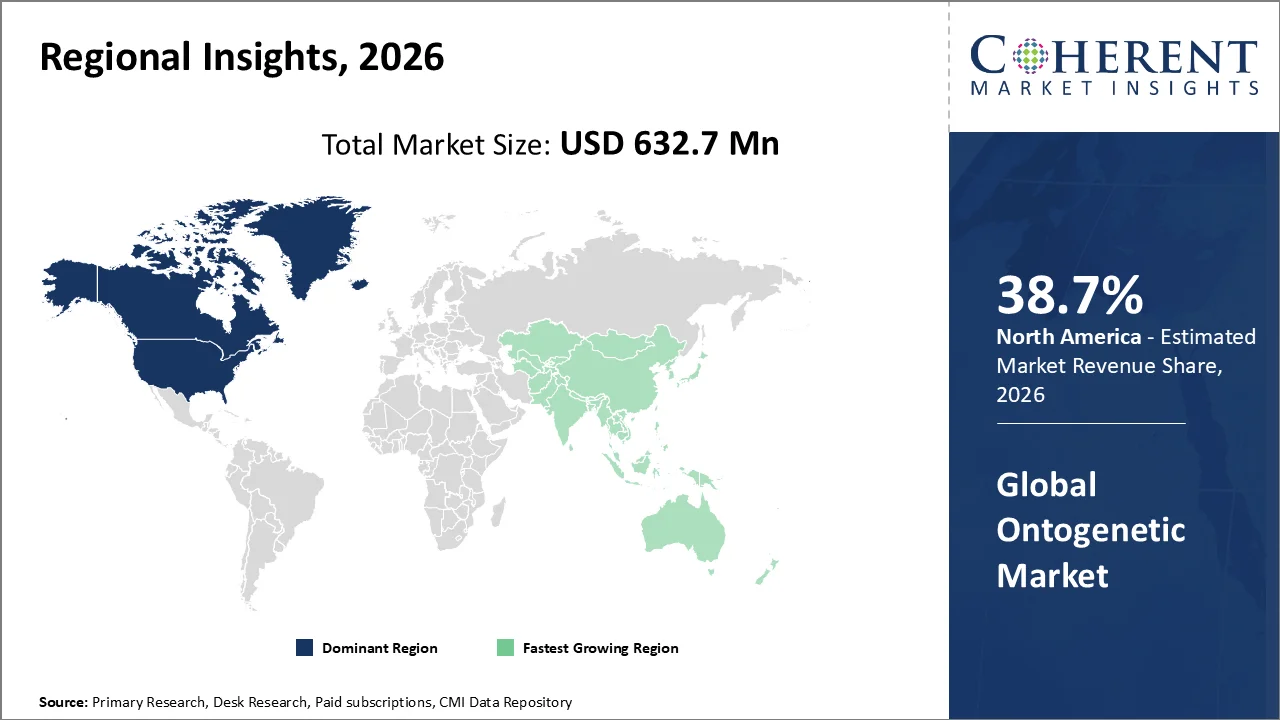
North America dominates owing to Advanced Healthcare Infrastructure
North America account 38.7% market share in 2026, due to strong U.S. neuroscience funding, advanced research infrastructure, and presence of specialized optogenetics tool manufacturers. For instance, in March 2025, NIH’s BRAIN Initiative budget page, reported US$321 million for FY2025, supporting platform tools, technology dissemination, and brain-behavior research relevant to optogenetics. Furthermore, in March 2026, NIH highlighted precision molecular circuit therapies using advanced neural effector technologies such as optogenetic and chemogenetic tools for correcting dysfunctional brain circuits. Additionally, research momentum is also visible in a Nature Communications article published on February 24, 2026, which introduced a large-scale optogenetic neurophysiology platform for non-human primate behavioral experiments, strengthening translational neuroscience in the region. Manufacturing support further reinforces dominance, as Canada-based Doric Lenses lists optogenetics products for in-vitro, acute, tethered, and wireless experiments on its 2026 website, while Addgene provides optogenetics plasmids and ready-to-use AAV preparations.
Asia Pacific Ontogenetic Market Trends
The Asia-Pacific region is poised to be as the fastest-growing region through 2026-2033, owing to rising neuroscience funding, expanding neurotechnology translation, and local availability of optogenetics instruments. For instance, in April 2026, Japan’s AMED published FY 2026 international collaborative research grants covering basic, applied, and preclinical research, supporting advanced brain-science tools. Furthermore, China’s State Council reported on March 13, 2026, that brain-computer interfaces were highlighted in national innovation documents, while its 2025 official BCI guideline targets major technology breakthroughs by 2027 and two to three globally influential firms by 2030. Additionally, India’s Union Budget 2026–27, published by PIB on February 1, 2026, proposed “Biopharma Shakti” to strengthen healthcare technology innovation. Manufacturing support is also improving, as China-based RWD lists optogenetics systems for high-resolution, cell-specific neuroscience experiments.
Presence of Advanced Research University is Accelerating the Ontogenetic Market Demand in United States
The U.S. ontogenetic market dominates North America due to strong NIH-backed neuroscience funding, advanced university research, and early commercialization of optogenetic tools. NIH’s BRAIN Initiative continues to support technologies for recording and modulation of neural cells and circuits; its September 2024 NOFO remains active for 2026-focused neuroscience tool development. NIH also highlighted precision therapies using optogenetic and chemogenetic tools for correcting dysfunctional brain circuits in its March 2026 funding topic. The country benefits from strong research infrastructure, as NINDS states it is the nation’s leading funder of brain and nervous-system research. In industry, U.S.-based Stanford’s optogenetics portfolio supports commercialization of advanced neural-circuit tools.
China Ontogenetic Market Trends
China has become the biggest player in the Asia Pacific ontogenetic market in 2026. Due to strong neuroscience funding, fast clinical translation, and a growing neurotechnology ecosystem. For instance, in January 2026, NSFC’s 2026 international scientist fund call, supports life-science and medical engineering research, including neural engineering and biomedical photonics. Furthermore, Shanghai Pudong government reported in March 2026 that a new BCI application research base was launched to connect R&D, clinical validation, product optimization, neuromodulation, and visual neuroscience. China’s research depth is also reflected in 2026 optogenetics studies such as wireless deep-brain stimulation and optogenetic neural inhibition. In addition, Zhongmou Therapeutics’ China-origin optogenetic gene therapy for retinitis pigmentosa received U.S. IND clearance in late 2025, supporting China’s commercialization strength.
Who are the Major Companies in Ontogenetic Market
Some of the major key players in Global Ontogenetic Market are Coherent Inc., Thorlabs Inc., Bruker Corporation, Laserglow Technologies, GenSight Biologics S.A, Hubner group (Cobolt Inc.), Judges Scientific Plc (Scientifica), Noldus Information Technology, and Shanghai Laser & Optics Century Co. Ltd., among others.
Key News
- In May 2026, Opus Genetics, biotechnology company presented new clinical and preclinical retinal disease data at the ARVO 2026 Annual Meeting in Denver, Colorado. The company highlighted restoration of cone-mediated vision in pediatric LCA5 patients and demonstrated progress in mutation-independent AAV-based retinal therapies. The presentation also emphasized manufacturing scalability, regulatory readiness, and broader development of next-generation optogenetic and gene-based therapies for inherited retinal diseases.
- In April 2026, Nanoscope Therapeutics, biotechnology and manufacturing company announced participation at the Eyecelerator and ARVO 2026 meetings, highlighting expansion of its optogenetic pipeline with plans to initiate a Phase 2 program for geographic atrophy (GA) during 2026. The company also advanced additional IND-ready retinal disease programs, including therapies for Leber congenital amaurosis (LCA), reinforcing growing investments in optogenetic ophthalmology platforms and retinal neuro-restoration technologies.
- In March 2026, Nanoscope Therapeutics, biotechnology company announced continued advancement of its MCO-010 optogenetic therapy for Retinitis Pigmentosa and Stargardt disease. The company confirmed ongoing FDA rolling Biologics License Application (BLA) submission activities and revealed plans to initiate a Phase 3 registrational trial for Stargardt disease in 2026. The therapy is designed as a mutation-agnostic, vision-restoring optogenetic treatment administered through a one-time intravitreal injection, supporting next-generation retinal disease treatment innovation.
Market Report Scope
Ontogenetic Market Report Coverage
| Report Coverage | Details | ||
|---|---|---|---|
| Base Year: | 2025 | Market Size in 2026: | USD 632.7 Mn |
| Historical Data for: | 2020 To 2024 | Forecast Period: | 2026 To 2033 |
| Forecast Period 2026 to 2033 CAGR: | 4.1% | 2033 Value Projection: | USD 826.9 Mn |
| Geographies covered: |
| ||
| Segments covered: |
| ||
| Companies covered: | Coherent Inc., Thorlabs Inc., Bruker Corporation, Laserglow Technologies, GenSight Biologics S.A, Hubner group (Cobolt Inc.), Judges Scientific Plc (Scientifica), Noldus Information Technology, and Shanghai Laser & Optics Century Co. Ltd., among others | ||
Analyst Opinion
- The Optogenetic Market is moving from laboratory neuroscience toward translational neurotechnology because it enables millisecond-level control of specific neural circuits using light-sensitive actuators. In March 2026, NIH BRAIN Initiative funding notices highlighted support for tools that analyze complex brain circuits and cell-type-specific interactions. This supports wider use of lasers, LEDs, opsins, viral vectors, and imaging systems in neuroscience research.
Source: NIH BRAIN Initiative
- Therapeutic optogenetics is gaining credibility, especially in retinal disease. In February 2026, Nanoscope Therapeutics reported ongoing FDA rolling BLA work for its MCO-010 optogenetic therapy after positive RESTORE Phase 2b/3 results in retinitis pigmentosa. This shows optogenetics is no longer limited to animal research but is entering late-stage clinical and regulatory pathways.
- Asia Pacific is becoming strategically important, with China strengthening neurotechnology and BCI-linked research. In March 2026, Reuters reported that China aims for major BCI breakthroughs by 2027 and globally competitive firms by 2030, with more than 10 human trials underway. This ecosystem supports optogenetic adoption through shared demand for neural modulation, imaging, stimulation, and precision brain research tools.
Speak to the analyst
Want personalized insights?
Take the findings above to one of our principal consultants, or have the report rebuilt around the segments, geographies and competitors you actually track.
Market Segmentation
- By Light Equipment (Revenue, USD Mn, 2021-2033)
- Laser
- Light-emitting Diode (LED)
- By Actuator (Revenue, USD Mn, 2021-2033)
- Channelrhodopsin
- Halorhodopsin
- Archaerhodopsin
- By Sensor (Revenue, USD Mn, 2021-2033)
- Calcium (Aequorin, Cameleon, and Other Calcium Sensors)
- Chloride (Clomeleon)
- Membrane-gated (Mermaid)
- Other Sensors
- By Application (Revenue, USD Mn, 2021-2033)
- Neuroscience
- Behavioral Tracking
- Retinal Disease Treatment
- Other Applications
- By Region (Revenue, USD Mn, 2021-2033)
- North America
- U.S.
- Canada
- Latin America
- Brazil
- Mexico
- Argentina
- Rest of Latin America
- Europe
- Germany
- U.K.
- France
- Italy
- Spain
- Russia
- Rest of Europe
- Asia Pacific
- China
- India
- Japan
- Australia
- South Korea
- ASEAN
- Rest of Asia Pacific
- Middle East
- GCC
- Israel
- Rest of Middle East
- Africa
- South Africa
- Central Africa
- North Africa
- North America
Sources
Primary Research Interviews
- Interviews with IT leaders, CIOs, and digital transformation managers to understand adoption challenges, integration issues, and the impact of cognitive systems on business operations.
- Insights from AI providers, software developers, and data scientists on advancements in AI, machine learning, natural language processing, and industry applications.
- Discussions with analysts, consultants, and tech advisors to evaluate market trends, competitive landscape, and cognitive systems’ role in improving efficiency.
- Conversations with decision-makers in enterprises and public-sector organizations to assess investment factors, system implementation challenges, and data privacy concerns.
Databases
- NIH RePORTER
- ClinicalTrials.gov
- PubMed / MEDLINE
- Europe PMC
- Allen Brain Atlas
- BRAIN Initiative Data Archive
- National Center for Biotechnology Information (NCBI)
- U.S. FDA Medical Devices Database
- European Medicines Agency (EMA) Database
Magazines
- Nature Neuroscience News
- Science Magazine
- GEN – Genetic Engineering & Biotechnology News
- The Scientist
- Technology Networks – Neuroscience News
- BioTechniques
- IEEE Spectrum – Biomedical Engineering Section
Journals
- Nature Neuroscience
- Neuron
- Journal of Neuroscience
- Frontiers in Neuroscience
- Cell Reports Methods
- Nature Methods
- Scientific Reports
- eNeuro
- Molecular Therapy
Newspapers
- The New York Times – Science Section
- The Guardian – Neuroscience and Health Section
- The Wall Street Journal – Health and Science Section
- Financial Times – Healthcare and Biotechnology Section
- STAT News
- Fierce Biotech
Associations
- Society for Neuroscience (SfN)
- Federation of European Neuroscience Societies (FENS)
- International Brain Research Organization (IBRO)
- American Neurological Association (ANA)
- European Brain Council (EBC)
- American Society of Gene & Cell Therapy (ASGCT)
- Optical Society / Optica
Public Domain Sources
- NIH BRAIN Initiative Reports
- National Institute of Neurological Disorders and Stroke (NINDS)
- U.S. FDA Guidance Documents
- U.S. National Library of Medicine
- European Commission – Health and Research Funding Documents
- World Health Organization neurological disorder reports
- Company annual reports and product pages of optogenetics tool manufacturers
- University technology transfer portals, including Stanford, MIT, and University of California systems
Proprietary Elements
- CMI Data Analytics Tool
- Proprietary CMI Existing Repository of information for last 10 years
Get access to 250+ pages report
Every segment, forecast, competitor profile and data table behind the analysis above — available for instant download.
- ESOMAR Member
- ISO 9001:2015 Certified
- D-U-N-S Registered
- GDPR & CCPA Compliant
Missing comfort of reading report in your local language? Find your preferred language:
Transform your Strategy with Exclusive Trending Reports
Frequently Asked Questions
The Ontogenetic Market is expected to reach USD 826.9 Mn in 2033.
Major players operating in the global Ontogenetic Market include Coherent Inc., Thorlabs Inc., Bruker Corporation, Laserglow Technologies, GenSight Biologics S.A, Hubner group (Cobolt Inc.), Judges Scientific Plc (Scientifica), Noldus Information Technology, and Shanghai Laser & Optics Century Co. Ltd., among others.
Lack of awareness, high cost of technology and lack of skilled personnel are the major factors hampering the growth of the ontogenetic market.
Increasing prevalence of neurological disorders across the globe and rise in research and development and government initiatives are the factors driving the growth of the global ontogenetic market.
The Ontogenetic Market is anticipated to grow at a CAGR of 4.1% between 2026 and 2033.
Among regions, North America is expected to account for a largest market share in the global Ontogenetic Market over the forecast period.
Optogenetics uses genetically encoded light-sensitive proteins, such as channelrhodopsins, halorhodopsins, and archaerhodopsins, to control specific neurons or cells with light. Viral vectors or genetic tools deliver these actuators, while lasers or LEDs activate or inhibit targeted cells with high spatial and temporal precision.