

Optical Brighteners Market Size and Forecast — 2026 - 2033
The Global Optical Brighteners Market size is estimated to be valued at USD 1,230 million in 2026 and is expected to reach USD 2,040 million by 2033, exhibiting a compound annual growth rate (CAGR) of 7.1% from 2026 to 2033.
Overview
The Optical Brighteners market includes a range of products used to enhance brightness and whiteness in materials by absorbing ultraviolet light and emitting blue light. Common product types include stilbene-based, coumarin-based, and benzoxazole-based brighteners. These are widely applied in industries such as textiles, detergents, paper, and plastics. In detergents, they improve fabric appearance after washing, while in paper and plastics, they enhance visual appeal. Products vary by solubility, stability, and compatibility with substrates. Growing demand for high-performance and eco-friendly formulations is shaping innovation in this market, with manufacturers focusing on sustainability and regulatory compliance.
Key Takeaways
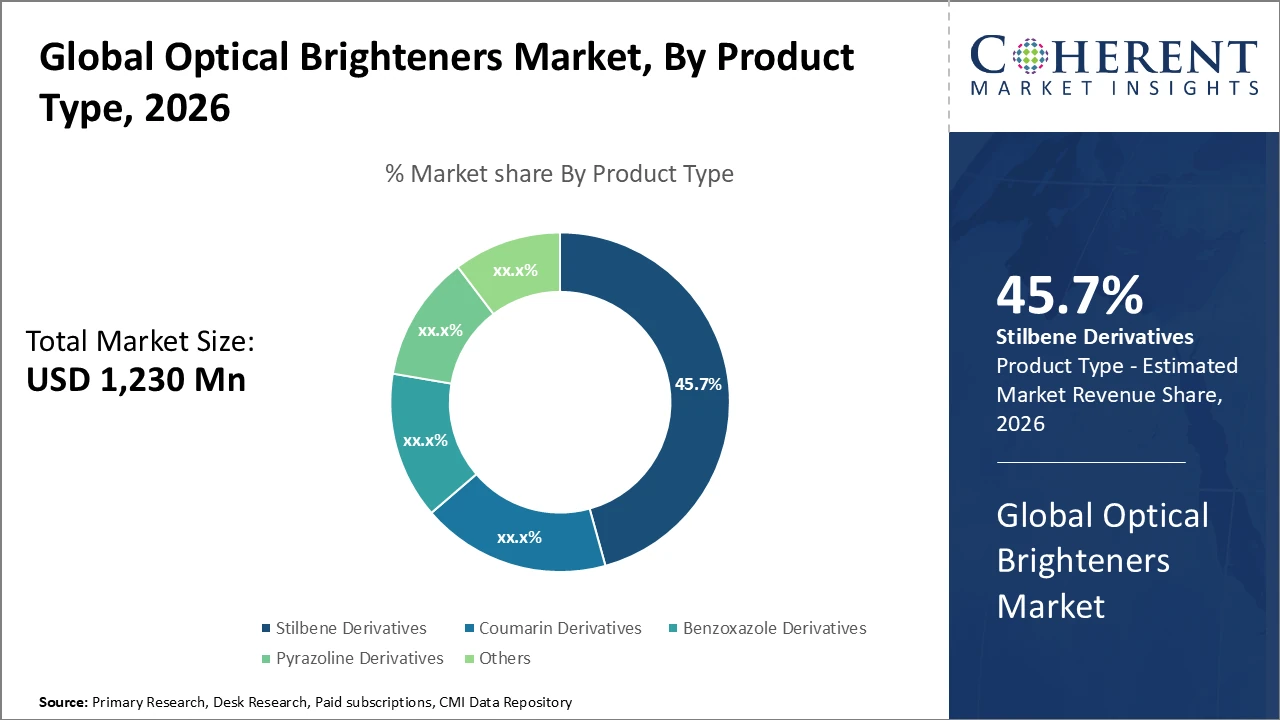
Stilbene derivatives hold a 45.7% market share, driven by their wide application range and cost efficiency, while coumarin derivatives are the fastest-growing segment due to multifunctional performance and increasing focus on sustainability.
The textile segment accounts for 39.5% of total market revenue, supported by rising global textile production and continuous innovation in fabric-enhancing brighteners, while paper and packaging are expanding due to stricter environmental regulations.
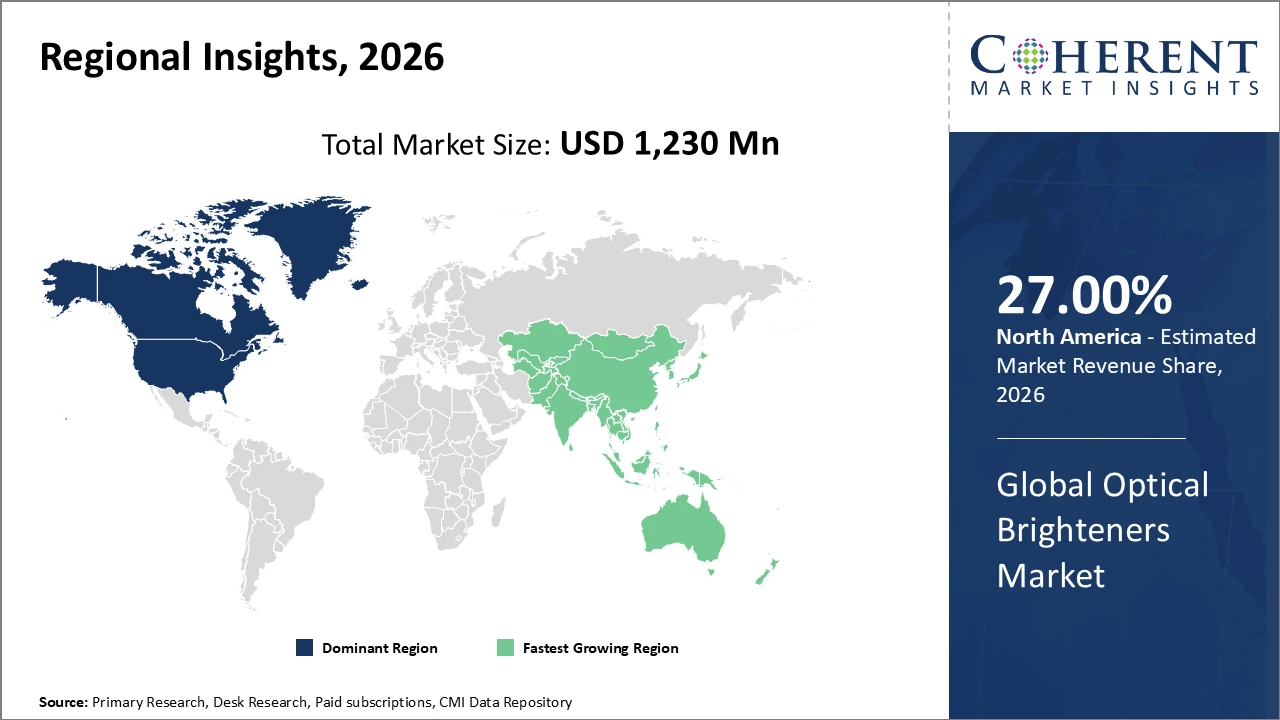
North America represents around 27% of the market, supported by a strong industrial base and regulatory structure, whereas Asia Pacific is the fastest-growing region with a CAGR above 8.4% from 2026 to 2033, driven by rapid industrialization and consumption growth.
Europe maintains steady demand through strict environmental policies and innovation led by countries such as Germany and France, while Latin America is emerging as a key growth region due to expanding industrial activities and consumer markets.
Optical Brighteners Market Segmentation Analysis
Optical Brighteners Market Insights, By Product Type
Stilbene derivatives dominate the optical brighteners market with a 45.7% share, primarily due to their cost-effectiveness, strong performance in brightness enhancement, and widespread use in textiles and detergents. Their chemical stability and ease of large-scale synthesis make them highly preferred across industries. Coumarin derivatives are the fastest-growing segment, driven by their dual functionality of providing optical brightening and UV protection, aligning with evolving environmental standards and specialized applications. Meanwhile, benzoxazole derivatives, pyrazoline derivatives, and other types account for smaller shares, mainly serving niche applications requiring specific optical characteristics or specialized chemical properties.
Optical Brighteners Market Insights, By Application
The textile segment dominates the optical brighteners market with a 39.5% share, driven by large-scale global textile production and strict quality standards for fabric appearance. Continuous innovation in brightener formulations enhances visual appeal and supports growth alongside the expanding fashion industry. The detergent segment is the fastest growing, fueled by rising demand for effective whitening agents in eco-friendly household products. Paper and packaging applications are also expanding due to increasing regulatory focus on sustainable bleaching and brightness. Meanwhile, plastics and other industrial applications remain smaller segments but are gradually gaining traction as formulation technologies continue to improve.
Optical Brighteners Market Insights, By End Use Industry
Textile manufacturing holds the largest share at 42.3%, driven by its continuous expansion and strict quality requirements that demand effective optical brightening solutions for enhanced fabric appearance. The segment remains the primary consumer due to large-scale global production. Paper production is a stable application, supported by rising demand for visually appealing and recyclable packaging materials. Consumer goods and automotive industries represent important growth niches, with automotive emerging as the fastest-growing segment due to increasing quality, durability, and coating standards. The electronics sector is still developing, where optical brighteners are used in display technologies and protective coating applications.
Optical Brighteners Market Trends
Sustainability is a major driver in the optical brighteners market, leading to increased innovation in biodegradable and low-environmental-impact formulations aimed at reducing ecological footprints.
In 2026, several manufacturers introduced next-generation optical brighteners derived from bio-based feedstocks, improving compliance with international environmental and safety standards.
A key emerging trend is the digitalization of supply chains, enabling faster production planning and distribution responsiveness to market demand fluctuations.
In Asia Pacific, adoption of advanced supply chain technologies in 2025 helped reduce lead times by approximately 18%, improving operational efficiency and delivery performance.
Optical Brighteners Market Insights, By Geography
North America Optical Brighteners Market Analysis and Trends
North America’s Optical Brighteners market is characterized by steady demand driven by a well-established industrial base and strong regulatory framework. The region accounts for around 27% of global market share, supported by consistent consumption in textiles, detergents, paper, and packaging industries. Increasing focus on sustainable and high-performance chemical formulations is a key trend, pushing manufacturers toward eco-friendly optical brighteners. Technological advancements and innovation in specialty chemicals further strengthen market growth. The United States leads regional demand due to its large consumer base and advanced manufacturing sector, while Canada contributes steadily through its packaging and industrial applications.
Asia Pacific Optical Brighteners Market Analysis and Trends
Asia Pacific dominates the Optical Brighteners market, driven by rapidly expanding textile and detergent production facilities in China and India, which together account for over 40% of the market share in 2026. The region benefits from a strong manufacturing ecosystem, abundant raw material availability, and supportive government incentives for chemical processing industries. These factors have created a highly favorable environment for large-scale production and export growth. Leading companies such as Jiangsu Huifeng New Material and Venkys BlueStar are leveraging strong domestic demand and global export opportunities, further strengthening the region’s leadership in the optical brighteners industry.
Optical Brighteners Market Outlook for Key Countries
USA Optical Brighteners Market Analysis and Trends
The USA’s Optical Brighteners market is supported by its mature textile and detergent industries, along with strict regulatory standards focused on quality, safety, and sustainability. In 2025, the country accounted for around 20% of North America’s market share, driven by rising investment in research and development of eco-friendly optical brighteners. Major companies such as BASF SE and Clariant AG operate advanced manufacturing facilities in the United States to serve strong domestic demand and export markets. Additionally, government environmental policies are encouraging innovation in bio-based and sustainable formulations, further shaping the market’s long-term growth and technological advancement.
Germany Optical Brighteners Market Analysis and Trends
Germany’s Optical Brighteners market is driven by its strong chemical manufacturing base and leadership in specialty chemicals within Europe. The country benefits from advanced R&D capabilities and a high focus on sustainability, supporting demand for eco-friendly optical brighteners across textiles, paper, and plastics industries. Strict environmental regulations under the EU framework encourage innovation in low-toxicity and biodegradable formulations. German manufacturers emphasize high-performance and precision-engineered chemical solutions, strengthening global competitiveness. Growing demand from packaging and automotive coating applications also supports market expansion. Additionally, collaboration between industry leaders and research institutions continues to accelerate product development and technological advancements in optical brighteners.
Analyst Opinion
Production capacity expansion has been a key supply-side driver, with leading chemical manufacturers increasing capacities by around 12% in 2025 to meet rising demand, particularly in Asia Pacific, supporting a 5.5% rise in global revenue.
Price stabilization during 2024–2026, despite raw material volatility, was achieved through forward contracts, keeping pricing within a 3% range and supporting steady demand growth in detergents at about 8.3% year over year.
Demand-side diversification is evident, with packaging and paper applications growing by 9% annually due to stricter sustainability regulations in Europe and North America, while imports in these segments rose by 10% in 2026.
Emerging micro-trends show rising adoption in automotive and electronics coatings, where appearance and durability are key, contributing about 6.7% to market revenue growth in 2026 due to higher manufacturing quality standards.
- Current Industry Events of 2026
- Market Size Estimation
- Regional Breakdown
- Competitive Landscape
- Customer Intelligence
- Segmental Analysis
- Pricing Analysis
- Key Market Drivers, Challenges & Future Trends
- Customized Insights Section
Market Scope
| Report Coverage | Details | ||
|---|---|---|---|
| Base Year: | 2025 | Market Size in 2026: | USD 1230 million |
| Historical Data for: | 2020 To 2024 | Forecast Period: | 2026 To 2033 |
| Forecast Period 2026 to 2033 CAGR: | 7.1% | 2033 Value Projection: | USD 2040 million |
| Geographies covered: |
| ||
| Segments covered: |
| ||
| Companies covered: | BASF SE, Evonik Industries AG, Clariant AG, Lanxess AG, Dystar Group, Venkys BlueStar, AkzoNobel NV, Illbruck GmbH, Archroma, Huntsman Corporation | ||
| Growth Drivers: |
| ||
Optical Brighteners Market Growth Factors
The optical brighteners industry is driven by strong demand from textiles and detergents, which together account for nearly 70% of total consumption. In 2025, global textile manufacturing output increased by 6.2%, directly boosting brightener usage. Regulatory pressure for eco-friendly solutions has encouraged innovation, with green formulations representing 12% of new product launches in 2026. Technological improvements in wavelength absorption have enhanced efficiency, supporting a 9% rise in paper whitening applications. Additionally, rising urbanization and disposable incomes in emerging economies are increasing demand for visually enhanced consumer goods. Latin America recorded a 7.5% revenue growth from optical brightener applications in 2025.
Optical Brighteners Market Development
In December 2025, the Tambov-based company Pigment raised its production of optical brighteners for the synthetic detergent and pulp and paper sectors by 15%.
Key Players
Leading Companies of the Market
BASF SE
Evonik Industries AG
Clariant AG
Lanxess AG
Archroma
Huntsman Corporation
Dystar Group
AkzoNobel NV
Illbruck GmbH
Venkys BlueStar
Competitive strategies in the optical brighteners market include BASF SE’s 2025 initiative to incorporate bio-based raw materials into its optical brightener portfolio, which resulted in a 15% increase in revenue from its sustainable product lines. This move strengthened its positioning in the growing eco-friendly chemicals segment and aligned with global sustainability trends. Similarly, Huntsman Corporation pursued strategic expansion by acquiring a regional manufacturer in India in 2024, significantly improving its distribution capabilities across Asia Pacific. This acquisition enhanced its regional market presence and contributed to an estimated 7% increase in its overall market share within the region.
Optical Brighteners Market Future Outlook
The Optical Brighteners Market is expected to grow steadily, driven by rising demand from textiles, detergents, paper, and plastics industries. Increasing consumer preference for high-quality, visually appealing products will continue to support market expansion. Sustainability trends are likely to play a major role, encouraging the development of biodegradable and low-toxicity brighteners. Technological advancements in formulation and performance efficiency will further enhance product adoption. Emerging markets in Asia-Pacific are projected to lead growth due to rapid industrialization. Additionally, stricter environmental regulations will push manufacturers toward innovation, shaping a more eco-friendly and competitive market landscape in the coming years.
Optical Brighteners Market Historical Analysis
The Optical Brighteners Market has experienced consistent growth over the past decade, supported by rising demand in textiles, detergents, and paper industries. Increasing consumer preference for brighter and cleaner-looking products significantly boosted adoption, especially in developing regions. Advances in chemical formulations improved product efficiency, stability, and compatibility across various applications, including plastics and coatings. Asia-Pacific emerged as a key growth region due to strong textile manufacturing and exports. Additionally, cost-effective production of stilbene-based brighteners supported market expansion. Over time, growing environmental concerns and regulatory pressures encouraged manufacturers to explore safer and more sustainable optical brightener solutions.
Sources
Primary Research Interviews:
Chemical manufacturers, optical brightener production engineers, and formulation scientists focusing on stilbene, coumarin, and benzoxazole derivative performance, synthesis efficiency, and application optimization in textiles, detergents, and paper industries
Textile industry experts, detergent formulation specialists, and packaging technologists involved in brightness enhancement requirements, whitening efficiency standards, and sustainability compliance in end-use applications
Executives from specialty chemical companies, R&D heads, and process engineers working on fluorescent whitening agents, eco-friendly brightener development, and next-generation optical brightening technologies
Magazines:
Chemical Week – Specialty chemicals industry updates, optical brightener innovations, and company developments
Specialty Chemicals Magazine – Market trends, production technologies, and application innovations
Textile World – Use of optical brighteners in fabric enhancement and textile finishing technologies
Journals:
Dyes and Pigments – Research on fluorescent whitening agents, optical properties, and chemical performance optimization
Journal of Applied Polymer Science – Studies on polymer compatibility and plastic brightening applications
Industrial & Engineering Chemistry Research – Process improvements and synthesis of optical brighteners
Journal of Cleaner Production – Sustainability trends and eco-friendly brightener development
Newspapers:
The Wall Street Journal – Specialty chemical industry investments and market expansion trends
Financial Times – Global chemical trade dynamics and sustainability regulations
Reuters – Industry developments, company expansions, and regulatory updates impacting optical brighteners
Bloomberg – Market pricing trends, corporate strategies, and regional demand analysis
Associations:
European Detergents Association (A.I.S.E.) – Detergent formulation standards and cleaning product industry insights
American Cleaning Institute (ACI) – U.S. detergent industry data, safety standards, and ingredient usage trends
European Chemical Industry Council (Cefic) – Chemical manufacturing regulations and specialty chemical market guidance
Get access to 250+ pages report
Every segment, forecast, competitor profile and data table behind the analysis above — available for instant download.
- ESOMAR Member
- ISO 9001:2015 Certified
- D-U-N-S Registered
- GDPR & CCPA Compliant
Missing comfort of reading report in your local language? Find your preferred language:
Transform your Strategy with Exclusive Trending Reports
Frequently Asked Questions
The market is led by companies such as BASF SE, Evonik Industries AG, and Huntsman Corporation, which collectively hold significant market share due to their diverse product portfolios, strong R&D capabilities, and extensive global manufacturing and distribution networks.
The market size is estimated to reach USD 2,040 million by 2033, expanding at a CAGR of 7.1% from 2026 to 2033, primarily driven by rising demand from textile and detergent applications.
Textile manufacturing holds the largest growth opportunity, accounting for over 42.3% of the end-use industry market share, supported by increasing demand for fabric brightness, quality enhancement, and large-scale global production.
The market will increasingly shift toward sustainable and biodegradable products, expansion of manufacturing bases in Asia Pacific, and growing adoption in specialty applications such as automotive coatings and electronics.
The market is highly competitive, with key challenges including raw material price volatility, strict regulatory compliance, and rising demand for eco-friendly and low-toxicity formulations.
Common strategies include capacity expansion, strategic acquisitions for regional strengthening, diversification of sustainable product portfolios, and continuous investment in R&D for advanced next-generation formulations.