

Thermoplastic Starch (TPS) Market Size and Share Analysis - 2026 To 2033
The global thermoplastic starch (TPS) market is estimated to be valued at USD 292 Mn in 2026 and is projected to grow at a CAGR of 7.8% during the forecast period, reaching nearly USD 494 Mn by 2033. This growth can be attributed to rising demand for biodegradable and compostable packaging materials.
Key Takeaways from the Thermoplastic Starch (TPS) Market Report
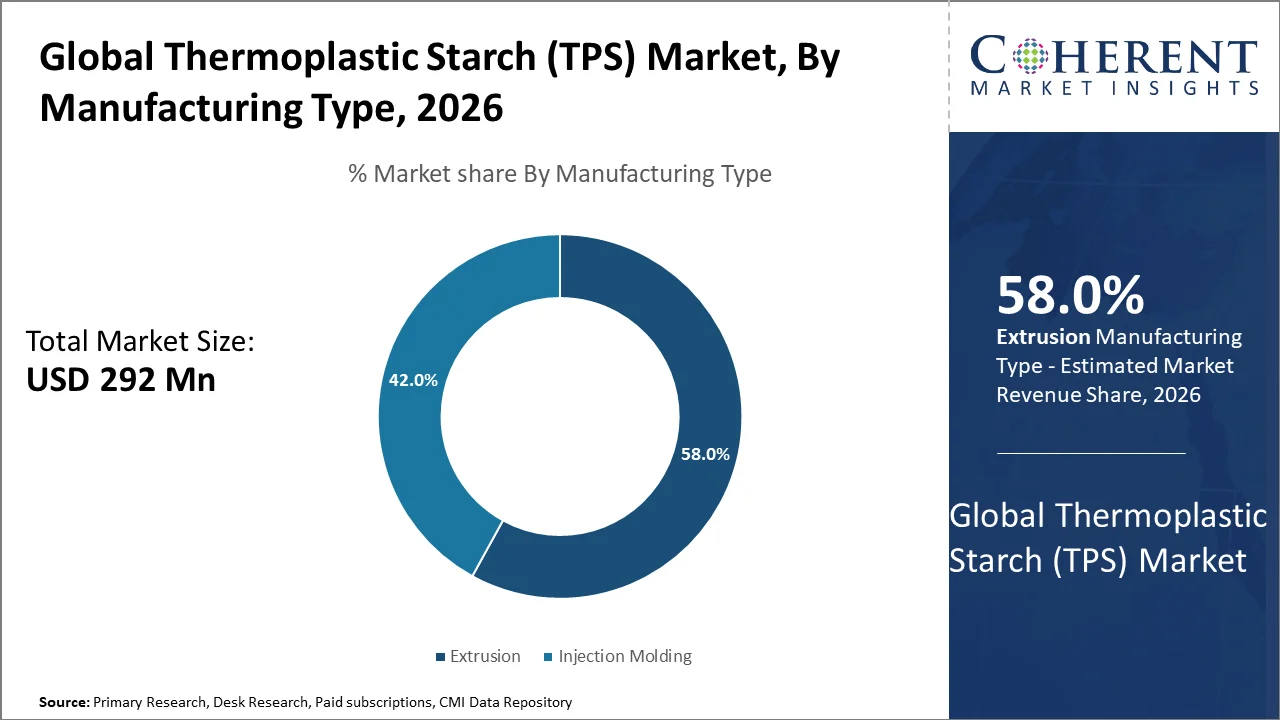
- Extrusion is expected to lead the market with a share of 58.0% in 2026 due to its extensive use in film and bag production. For instance,
- Films segment is projected to account for 47.0% of the global thermoplastic starch market share in 2026 because starch-based films are widely used in compostable food packaging, agricultural films, and flexible packaging applications. For example, Kuraray’s PLANTIC film, a thermoplastic starch-based biodegradable and compostable barrier film, is gaining traction in packaging dry goods such as coffee, animal feed, and tea.
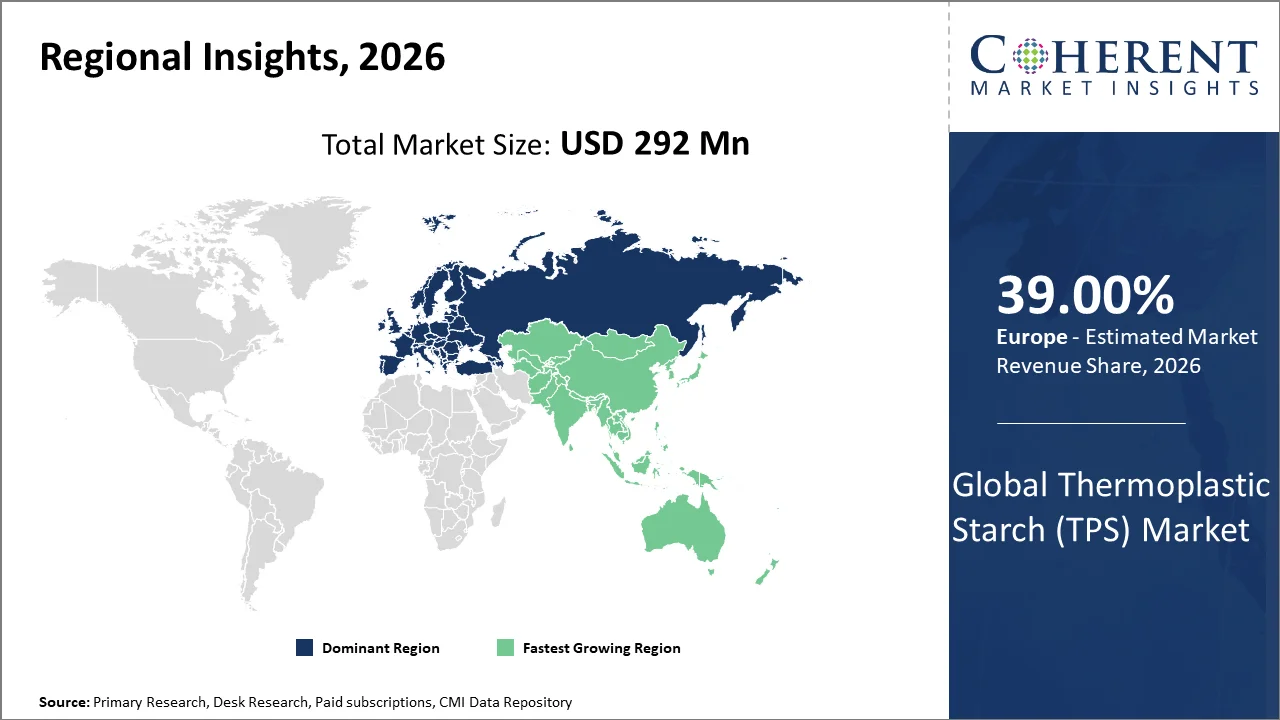
- Regionally, Europe is forecast to dominate the global thermoplastic starch industry with a share of 39.00% in 2026 because of stringent regulations on single-use plastics and rising adoption of biodegradable packaging. This is further evident from the fact that packaging contributes about 40% to the overall plastic use within the EU, thus making the use of environmentally friendly options like thermoplastic starch imperative.
- Asia Pacific is anticipated to emerge as the fastest growing market for thermoplastic starch during the forecast period, registering a CAGR of 9%, thanks to rising government restrictions on single-use plastics, expanding packaging and food service industries, increasing consumer preference for biodegradable materials, and availability of low-cost raw materials.
Thermoplastic Starch (TPS) Market Overview
The global Thermoplastic Starch (TPS) market is expected to register steady growth during the forecast period. This is mostly due to increasing demand for biodegradable and sustainable packaging materials, rising environmental concerns regarding conventional plastic waste, and stringent government regulations promoting the adoption of eco-friendly alternatives. Expanding use of TPS in packaging, agriculture, consumer goods, and disposable products is also boosting market growth.
Thermoplastic starch (TPS) is a biodegradable biopolymer used in various packaging materials. It is derived from starch sources such as cassava, potato, and corn, making it a renewable and relatively inexpensive alternative to conventional plastics. Due to its biodegradability and versatility, TPS is gaining attention for sustainable packaging applications.
Growing consumer preference for eco-friendly products is expected to fuel growth of thermoplastic starch market during the forecast period. Environmentally conscious consumers in the contemporary world are actively seeking products packaged in sustainable materials. This shift is motivating manufacturers and retailers to integrate TPS into packaging and disposable products.
For example, Kuraray is promoting sustainable packaging by developing strong, high-performance materials for recyclable mono-material barrier packaging solutions. These include biocircular EVAL EVOH, KURARAY POVAL, biodegradable PLANTIC (a thermoplastic starch-based, biodegradable and compostable biopolymer), and others.
Growth of compostable packaging solutions is creating growth opportunities in the thermoplastic starch market. Brands and retailers are prioritizing industrially compostable and home-compostable packaging to meet sustainability goals and regulatory requirements. Certified compostable TPS materials are gaining significant traction in food-service and retail packaging.
Segmental Insights
Which Manufacturing Type Dominates the Thermoplastic Starch (TPS) Market?
Extrusion Molding Set to Account for Nearly Three-Fifths of Market Share in 2026
According to Coherent Market Insights’ latest thermoplastic starch (TPS) market analysis, extrusion molding segment is set to lead the market, capturing a share of 58.0% in 2026. This dominance is attributable to its cost-effectiveness, high production efficiency, and ability to process thermoplastic starch into a wide range of biodegradable products, including films, sheets, packaging materials, and disposable items.
Extrusion molding allows continuous production with very little material waste, making it a preferred method for sustainable and scalable manufacturing. Growing demand for eco-friendly packaging in food, consumer goods, and agriculture is expected to increase the use of extrusion molding technologies in the coming years.
Studies conducted at the pilot scale of biodegradable films based on starch indicate that lines for blown-film extrusion can produce films continuously with a consistent bubble generation and consistent draw-down of films. Such continuous operation allows production of TPS films on rolls, providing high capacity and consistency in film production.
- Current Industry Events of 2026
- Market Size Estimation
- Regional Breakdown
- Competitive Landscape
- Customer Intelligence
- Segmental Analysis
- Pricing Analysis
- Key Market Drivers, Challenges & Future Trends
- Customized Insights Section
Which Application Segment Accounts for the Largest Thermoplastic Starch Market Share?
Films Segment Leads the Market Due to Extensive Packaging Applications
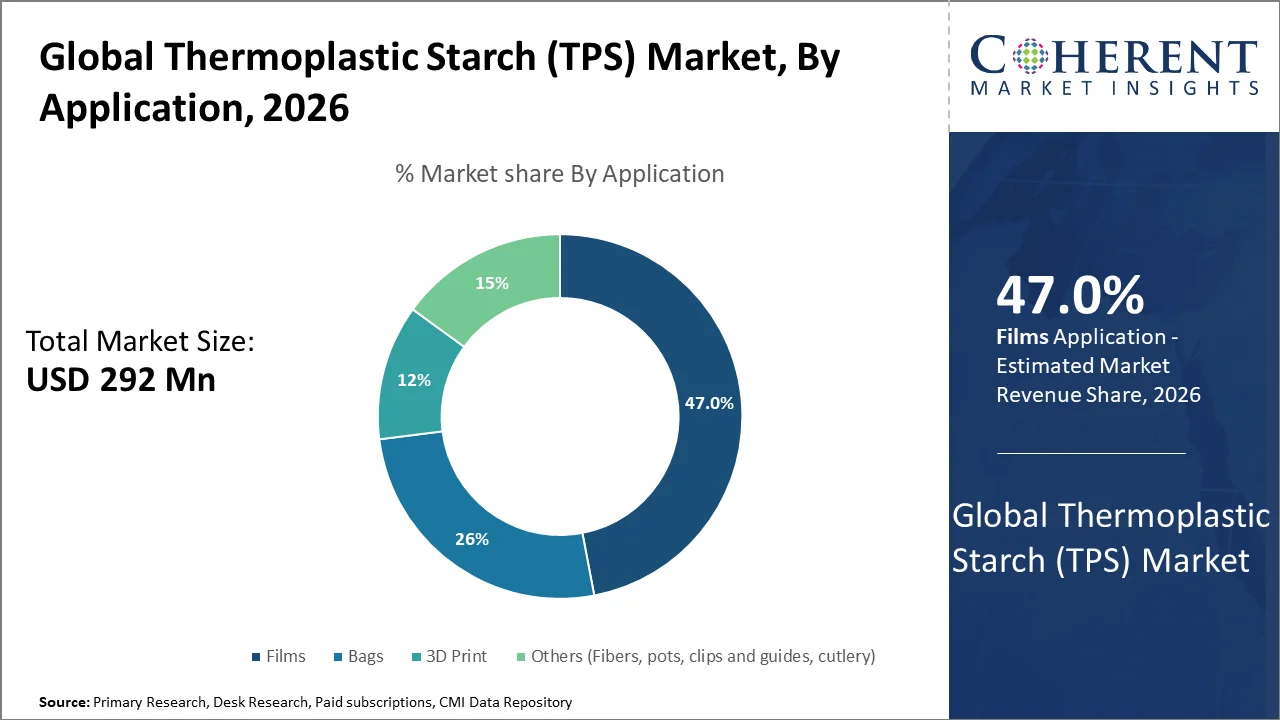
Based on application, films segment is expected to account for a share of 47.0% in the global thermoplastic starch market share in 2026. This is mostly due to growing demand for biodegradable and compostable packaging materials across the food, consumer goods, and retail industries. For example, Kuraray’s PLANTIC film is being gradually used in packaging dry goods like tea, coffee, and animal feed.
Thermoplastic starch-based films are increasingly being adopted as sustainable alternatives to conventional plastic films. This is because they offer excellent biodegradability, flexibility, and cost-effectiveness. Rising environmental concerns, stringent regulations on single-use plastics, and increasing investments in eco-friendly packaging solutions are also expected to drive use of thermoplastic starch films during the forthcoming period.
Thermoplastic Starch (TPS) Market Growth Drivers
Rising Demand for Biodegradable Plastics
Growing preference for biodegradable plastics is providing a strong impetus to the growth of the thermoplastic starch (TPS) market. Industries in the contemporary world are increasingly replacing conventional petroleum-based plastics with biodegradable alternatives such as thermoplastic starch due to rising concerns about plastic pollution and environmental sustainability. TPS is derived from renewable resources, including corn, potato, and cassava starch, making it an attractive eco-friendly material. Thus, escalating demand for biodegradable plastics is expected to drive sales of thermoplastic starch (TPS) during the forecast period.
Thermoplastic Starch (TPS) Market Opportunities
Stringent Government Regulations and Expansion of Sustainable Packaging Industry
Governments across the world are implementing bans, taxes, and restrictions in single-use plastic. This, in turn, is creating a strong demand for thermoplastic starch and other compostable and bio-based materials. Similarly, booming sustainable packing industry is expected to create lucrative growth opportunities for the thermoplastic starch market during the forecast period.
Food, beverage, personal care, and e-commerce companies are increasingly adopting biodegradable packaging to meet sustainability goals as well as comply with regulations and address growing consumer demand for environmentally responsible products. TPS-based films, bags, trays, and containers are becoming popular due to their biodegradability, compostability, and renewable origin, thereby supporting market growth.
Thermoplastic Starch (TPS) Market Trends
Rise of TPS-Polymer Blends
Increasing use of TPS-polymer blends is a key growth-shaping market trend. Manufacturers are increasingly combining TPS with biodegradable polymers such as Polylactic Acid (PLA), Polybutylene Adipate Terephthalate (PBAT), and Polyhydroxyalkanoates (PHA) to enhance mechanical strength, flexibility, moisture resistance, and processing performance. These advanced blends are expanding the use of TPS in packaging films, molded products, agricultural mulch films, and other sustainable applications, thereby supporting broader market growth.
Current Events and Their Impact on the Thermoplastic Starch (TPS) Market
Current Event | Description and its Impact |
EU Packaging and Packaging Waste Regulation (PPWR) Implementation (2025–2026) |
|
WHO/UN Support for Reducing Plastic Pollution Through Global Policy Initiatives |
|
Regional Insights
Europe Dominates the Global Epicenter of Thermoplastic Starch (TPS) Industry
North America is expected to lead the global thermoplastic starch market, accounting for a share of 39.00% in 2026. This is attributable to stringent regulations on single-use plastics, increasing adoption of compostable packaging, and strong circular economy initiatives. Rising use of TPS-based materials in food packaging, shopping bags, and agricultural films is also supporting market expansion.
European Union’s push to reduce packaging waste and plastic pollution is playing a key role in boosting growth of Europe thermoplastic starch market. The new Packaging and Packaging Waste Regulation (PPWR), which entered into force in 2025, promotes recyclable and sustainable packaging solutions across the region.
According to the European Commission, 40% of plastics used in the EU are for packaging, while Eurostat reported that the EU generated 79.7 million tonnes of packaging waste in 2023, including 35.3 kg of plastic packaging waste per person. These figures are encouraging manufacturers to adopt biodegradable materials such as TPS.
Leading manufacturers of thermoplastic starch are expanding their presence across lucrative regions like Europe and Asia to capitalize on emerging opportunities. For instance, in December 2024, AGRANA Starke GmbH signed a joint venture agreement with Ingredion Germany GmbH for the development of starch production in Romania.
Asia Pacific to Emerge as Central Hub for Industry Players
Asia Pacific thermoplastic starch (TPS) market is anticipated to emerge as a highly lucrative market for thermoplastic starch manufacturers, registering a CAGR of 9.0% during the assessment period. This is mostly due to rising concerns about plastic waste, increasing government restrictions on single-use plastics, and growing demand for sustainable packaging from the food and e-commerce sectors.
Countries like China, India, Japan, and South Korea are witnessing increasing adoption of biodegradable packaging materials, including TPS-based products. Implementation of plastic reduction policies across the region is fueling Asia Pacific thermoplastic starch market growth. India, for instance, has strengthened restrictions on single-use plastics and continues to promote eco-friendly alternatives. Growing environmental concerns are also creating revenue streams for TPS manufacturers.
Thermoplastic Starch (TPS) Market Outlook – Country-wise
U.S. Thermoplastic Starch (TPS) Market Trends
The United States is expected to remain a key market for thermoplastic starch (TPS) during the forecast period. This is due to increasing demand for sustainable and biodegradable packaging materials, rising corporate commitments to reduce plastic waste, and supportive environmental regulations. Growing adoption of TPS in food packaging, retail bags, and agricultural applications, along with ongoing investments in bio-based material innovation, is also fostering growth of thermoplastic starch market in the United States.
China Thermoplastic Starch (TPS) Market Forecast
The thermoplastic starch (TPS) market in China is expected to grow rapidly during the assessment period. This can be attributed to increasing government efforts to curb plastic pollution, rising demand for eco-friendly packaging solutions, and expanding use of biodegradable materials across the food, e-commerce, and consumer goods sectors. In addition, growing investments in sustainable manufacturing and development of bio-based plastics are expected to support TPS market growth in the country.
Who are the Major Companies in the Thermoplastic Starch (TPS) Market?
Some of the major players in thermoplastic starch (TPS) market are AGRANA Beteiligungs AG, Biome Bioplastics Limited, BIOTEC, Cardia Bioplastics, Novamont SpA, Kuraray Co. Ltd (Plantic), Rodenburg Biopolymers, and Wittenburg Group.
Key Strategies Adopted by Industry Players
Top thermoplastic starch companies are adopting various organic and inorganic strategies to boost their revenue as well as gain a competitive edge over the industry. These include new product launches, partnerships, mergers, acquisitions, collaborations, and distribution agreements. For instance,
- In April 2026, Kuraray participated in TAPPICon 2026 at the Greater Columbus Convention Center in Columbus, Ohio. The company showcased its sustainable innovations for paper and packaging applications.
- In April 2026, AGRANA completed the acquisition of Mercator-Emba d.o.o in Slovenia. This acquisition will help the company in meeting growing end user demand and boosting growth in Europe.
- In June 2025, AGRANA and Ingredion received regulatory approval for their USD 40 million joint venture in Romania. The project will help them expand starch production in Europe to meet growing industrial demand.
Market Report Scope
Thermoplastic Starch (TPS) Market Report Coverage
| Report Coverage | Details | ||
|---|---|---|---|
| Base Year: | 2025 | Market Size in 2026: | USD 292 Mn |
| Historical Data for: | 2020 To 2024 | Forecast Period: | 2026 To 2033 |
| Forecast Period 2026 to 2033 CAGR: | 7.8% | 2033 Value Projection: | USD 494 Mn |
| Geographies covered: |
| ||
| Segments covered: |
| ||
| Companies covered: |
| ||
| Growth Drivers: |
| ||
| Restraints & Challenges: |
| ||
Analyst Opinion (Expert Opinion)
- The thermoplastic starch (TPS) market is benefiting from the global shift away from conventional plastics. As governments and consumers push for biodegradable alternatives, TPS is gaining traction in packaging, compostable bags, disposable food-service products, and agricultural films, creating steady long-term demand.
- Packaging remains the biggest growth area for TPS because it offers a renewable and biodegradable solution while being compatible with existing plastic-processing equipment. This helps manufacturers adopt sustainable materials without major production changes.
- TPS has a cost advantage over several other bioplastics because it is produced from widely available starch sources such as corn, potato, and cassava. Its relatively low raw-material cost is encouraging broader adoption in price-sensitive applications, thereby fostering thermoplastic starch market growth.
Speak to the analyst
Want personalized insights?
Take the findings above to one of our principal consultants, or have the report rebuilt around the segments, geographies and competitors you actually track.
Market Segmentation
- By Manufacturing Type (Revenue, USD Mn, 2021 - 2033)
- Extrusion
- Injection Molding
- By Application (Revenue, USD Mn, 2021 - 2033)
- Bags
- Films
- 3D Print
- Others (Fibers, pots, clips and guides, cutlery)
- By Region (Revenue, USD Mn, 2021 - 2033)
- North America
- U.S.
- Canada
- Latin America
- Brazil
- Argentina
- Mexico
- Rest of Latin America
- Europe
- Germany
- U.K.
- Spain
- France
- Italy
- Russia
- Rest of Europe
- Asia Pacific
- China
- India
- Japan
- Australia
- South Korea
- ASEAN
- Rest of Asia Pacific
- Middle East
- GCC
- Israel
- Rest of Middle East
- Africa
- South Africa
- Central Africa
- North Africa
- North America
Sources
Primary Research Interviews
- Thermoplastic starch manufacturers
- Raw material suppliers and distributors
- Bioplastics compounders and processors
- Packaging manufacturers
- Industry experts and consultants
- Research scientists and academicians specializing in biodegradable polymers
- Procurement managers and product development executives
Databases
- Eurostat
- UN Comtrade Database
- World Bank Open Data
- OECD Statistics
- FAOSTAT
- International Trade Centre (ITC) Trade Map
- United Nations Industrial Development Organization (UNIDO) Database
- U.S. International Trade Commission (USITC) DataWeb
Magazines
- Bioplastics Magazine
- Packaging Europe
- Sustainable Plastics
- Plastics Recycling Update
- Packaging World
- European Plastics News
- Plastics Technology
Journals
- Carbohydrate Polymers
- Journal of Polymers and the Environment
- Industrial Crops and Products
- Polymer Testing
- Journal of Applied Polymer Science
- International Journal of Biological Macromolecules
- Materials Today Sustainability
- Green Materials
Newspapers
- The Wall Street Journal
- Financial Times
- The Economic Times
- The Business Standard
- Nikkei Asia
- The Guardian (Business Section)
- China Daily (Business Section)
Associations
- European Bioplastics (EUBP)
- Biodegradable Products Institute (BPI)
- Association of Plastic Recyclers (APR)
- Society of Plastics Engineers (SPE)
- Plastics Industry Association (PLASTICS)
- International Association of Packaging Research Institutes (IAPRI)
- European Starch Industry Association (Starch Europe)
Public Domain Sources
- U.S. Department of Agriculture (USDA)
- European Commission
- European Environment Agency (EEA)
- United Nations Environment Programme (UNEP)
- Food and Agriculture Organization (FAO)
- Organisation for Economic Co-operation and Development (OECD)
- World Trade Organization (WTO)
- National Renewable Energy Laboratory (NREL)
- U.S. Environmental Protection Agency (EPA)
Proprietary Elements
- CMI Data Analytics Tool
- Proprietary CMI Existing Repository of Information for Last 8 Years
Get access to 250+ pages report
Every segment, forecast, competitor profile and data table behind the analysis above — available for instant download.
- ESOMAR Member
- ISO 9001:2015 Certified
- D-U-N-S Registered
- GDPR & CCPA Compliant
Missing comfort of reading report in your local language? Find your preferred language:
Transform your Strategy with Exclusive Trending Reports
Frequently Asked Questions
The global Thermoplastic Starch (TPS) Market is estimated to be valued at USD 292 Mn in 2026.
The global Thermoplastic Starch (TPS) Market value is expected to reach USD 494 Mn by 2033.
The global Thermoplastic Starch (TPS) Market is poised to exhibit a CAGR of 7.8% from 2026 to 2033.
Major growth factors include increasing government initiatives to promote the adoption of biodegradable compounds and growing demand from the packaging industry.
Films are set to lead the market with a revenue share of 47% in 2026.
Some major companies in the thermoplastic starch (TPS) market include AGRANA Beteiligungs AG, Biome Bioplastics Limited, BIOTEC, Cardia Bioplastics, Novamont SpA, Kuraray Co. Ltd (Plantic), Rodenburg Biopolymers, and Wittenburg Group.
Europe, with 39% share in 2026, is set to lead the market during the forecast period.