

Orthodontics Market Size and Share Analysis - (2026-2033)
Orthodontics Market is estimated to be valued at USD 6.87 Bn in 2026 and is expected to reach USD 11.13 Bn in 2033, exhibiting a compound annual growth rate (CAGR) of 7.1% from 2026 to 2033.
Key Takeaways
- Based on the Product Type, the Advanced Products segment is expected to lead the market with 73.6% share in 2026, due to aesthetics and digital precision.
- Based on Age Group, the Teenage Group segment is expected to hold the largest share of the market in 2026, as orthodontic treatments are most commonly initiated during adolescence.
- Based on End User, the Specialty Clinics segment is projected to capture the highest share of the market in 2026, driven by expertise and adoption of advanced technologies.
- Based on Region, North America is set to lead the orthodontics market with 39.3% share in 2026. While, Asia Pacific is anticipated to be the fastest growing region.
Market Overview
The global orthodontics market is experiencing strong growth due to the rise in prevalence of malocclusion and increasing awareness among the population about orthodontics. Moreover, rise in demand for orthodontic supplies and rising number of dental aesthetic procedures is expected to boost growth of the market. However, factors such as high cost of treatment and adverse effects associated with orthodontics are expected to hamper growth of the orthodontics market.
Current Events and Its Impacts on the Global Orthodontics Market
Current Event | Description and its Impact |
AI and Digital Orthodontics Revolution |
|
Regulatory and Reimbursement Changes |
|
Orthodontic Practices and Technology in the Global Orthodontics Market
Orthodontics Practices
- There are about 250,000 orthodontists and dental specialists working around the world.
- This is true in both established markets (the U.S. and Europe) and markets that are growing rapidly (China and India).
- The distribution is not even: North America and Europe have more orthodontists per patient, but Asia-Pacific is short on them even though demand is rising.
- Corporate dental chains and teledentistry platforms are becoming more common alongside traditional practices, making dental care more accessible and affordable.
3D Printing in Orthodontics
- By 2025, more than 40% of orthodontic appliances (clear aligners, retainers, brackets) will be made with 3D printing.
- This technology cuts production time from weeks to days, which means treatment can start sooner.
- Customization is better: appliances can be made to fit each patient's body perfectly.
- 3D printing also lowers costs, making orthodontic care easier to get in new markets.
- Major companies like Align Technology, Straumann, and Dentsply Sirona have added 3D workflows to clinics all over the world.
Remote Monitoring
- About 30% of orthodontic patients now use teledentistry apps or AI-powered platforms to keep track of their progress.
- Patients send in pictures or scans, and orthodontists keep an eye on tooth movement from a distance, which means fewer in-person visits.
- This makes things easier, especially for busy adults and people who live in rural areas.
- Remote monitoring also makes patients more likely to follow through with their treatment because orthodontists can step in early if something goes wrong.
- Current Industry Events of 2026
- Market Size Estimation
- Regional Breakdown
- Competitive Landscape
- Customer Intelligence
- Segmental Analysis
- Pricing Analysis
- Key Market Drivers, Challenges & Future Trends
- Customized Insights Section
Segmental Insights
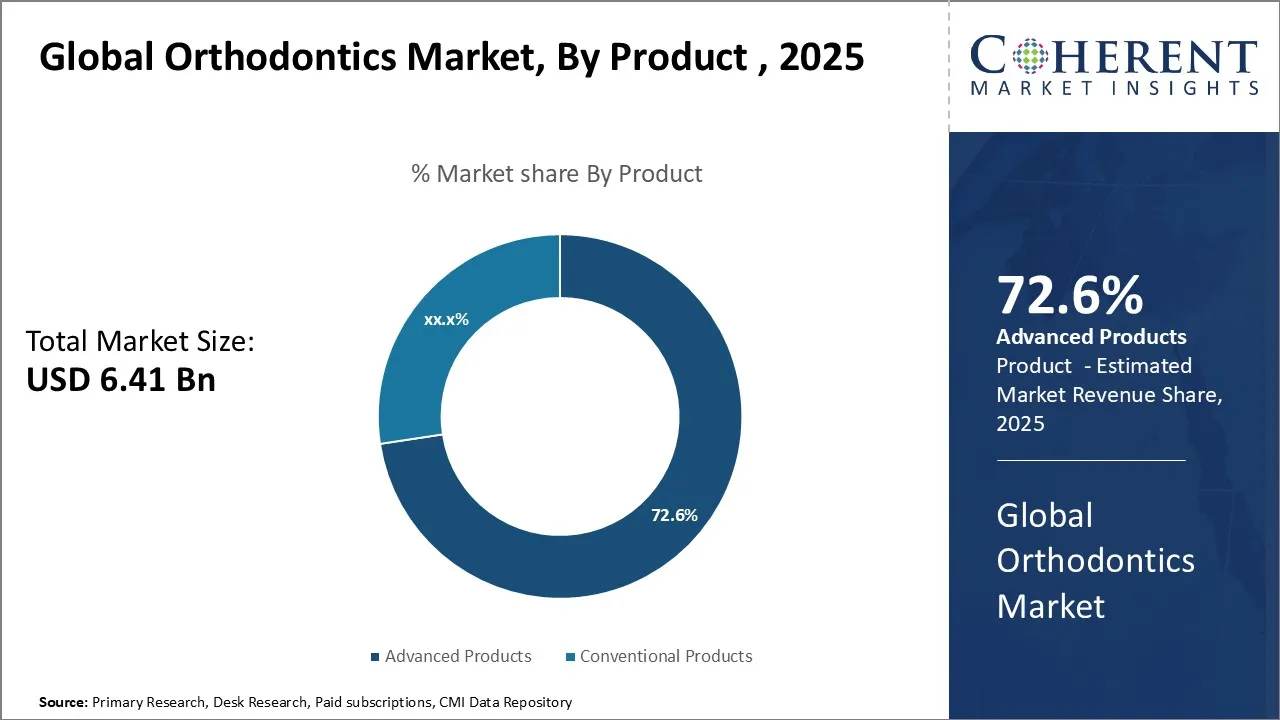
Global Orthodontics Market Insights, By Product Type - Advanced Products, Especially Clear Aligners, Lead the Market Due To Aesthetics and Digital Precision
In terms of product type, the advanced products segment is expected to lead the market with 73.6% share in 2026. Increasing numbers of patients are choosing aligners over traditional brackets and wires because they are less visible, can be taken off, and are more comfortable. Digital orthodontics tools like intraoral scanners, CAD/CAM systems, and 3D printers make this change even stronger. These tools let orthodontists give very personalized treatments with more accuracy. Aligners are also popular with adults who want to improve their appearance without having to wear traditional braces, which is why they are the fastest-growing and highest-grossing product in this category.
For instance, in November 2025, Clove Dental opened its Orthodontic Centre of Excellence in Gurugram, marking an enormous leap forward for advanced orthodontic care. The center will focus on modern treatments like clear aligners, digital scanners, CAD/CAM systems, and 3D printing, which will give patients accurate, attractive, and comfortable options. This project shows how serious Clove Dental is about bringing new ideas and specialized orthodontic care to India.
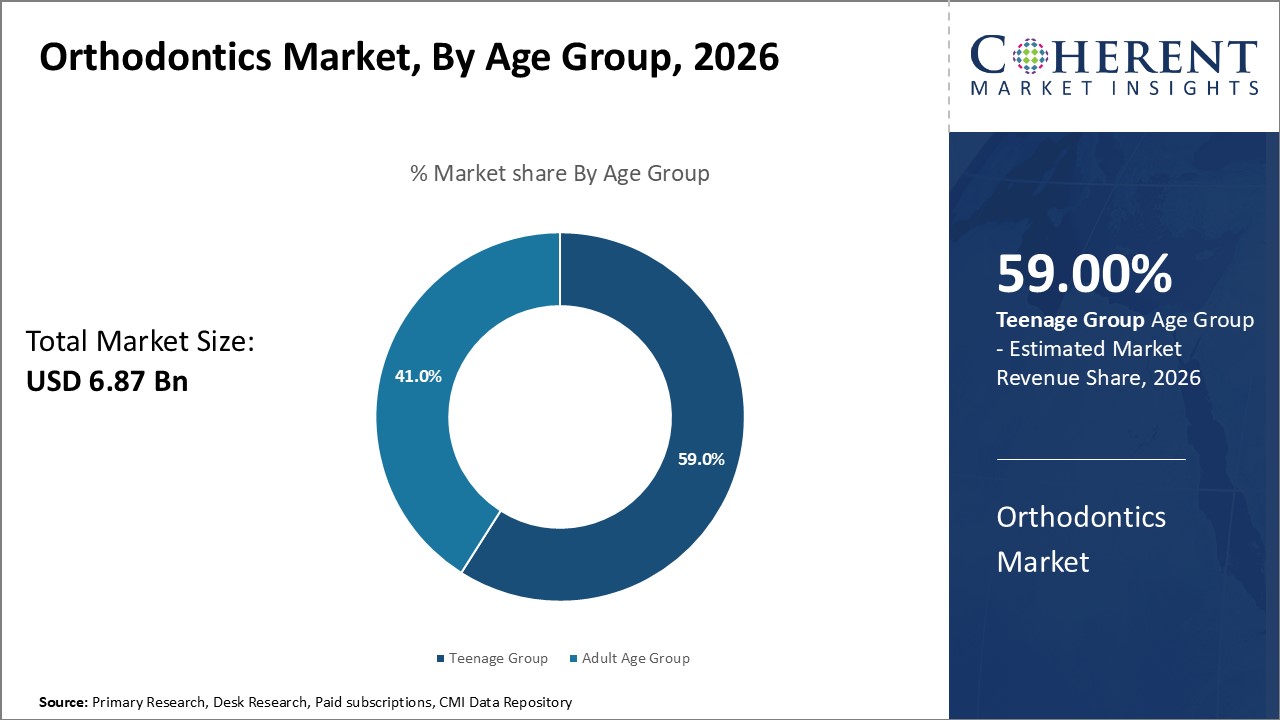
Global Orthodontics Market Insights, By Age Group - Teenagers Dominate as Orthodontic Treatments Are Most Commonly Initiated During Adolescence
In terms of age group, the teenage group segment is expected to hold the largest share of the market in 2026. When teeth and jaws are still growing, orthodontic treatment works best. This is why teenagers are the main target for both traditional braces and more advanced aligners. More and more parents know about the long-term benefits of early orthodontic care, and as disposable incomes rise in emerging markets, more teens are getting braces. Adult demand is growing quickly because of trends in cosmetic dentistry, but teens still make up the majority of patients because orthodontic treatment usually starts when they are teens.
For instance, in May 2025, Laxmi Dental teamed up with Bollywood star Kareena Kapoor to promote Illusion Aligners, which are made for teens who need braces. The campaign focuses on style and confidence, and it offers clear aligners as a modern alternative to braces. The initiative is meant to give teens brighter, more attractive smiles. It also shows how much younger people in India want better orthodontic solutions.
Global Orthodontics Market Insights, By End User - Specialty Clinics Lead Is Driven by Expertise and Adoption of Advanced Technologies
In terms of end user, the specialty clinics segment is projected to account for the highest share of the market in 2026. Orthodontists who specialize in fixing teeth usually run these clinics, so they are reliable places to go for advice and new ideas. Specialty clinics are also among the first to use cutting-edge technologies like CAD/CAM systems and aligners. This makes it easier for them to attract patients who want modern, effective, and attractive solutions. Hospitals help with complicated cases, and small dental offices serve specific groups of people, but specialty clinics are still the best because they are focused, patients trust them, and they have the latest technology.
For instance, in October 2025, Presto Dental opened its first multi-specialty dental office in Bridgeport, Connecticut. This is a big step for Abra Health Group in the state. The new building combines orthodontics with other dental specialties, so patients can get all of their care in one place. This launch shows how important specialty clinics are becoming in providing advanced, patient-centered orthodontic and dental care in the area.
Regional Insights
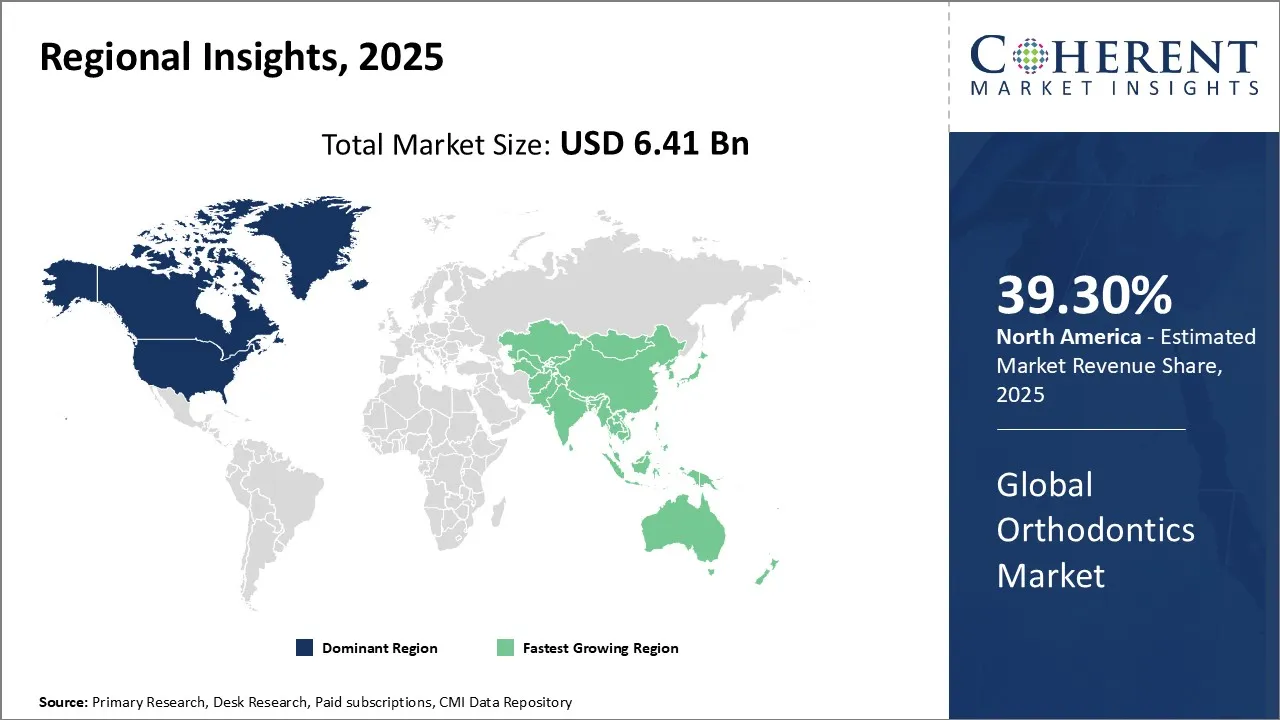
North America Orthodontics Market Analysis & Trends
North America is expected to gain highest share of 39.3% share in the market in 2026, owing to the high prevalence of dental disorders, increasing awareness among people, rising number of dental procedures, and growing population in the region. For instance, as recommended by the American Association of Orthodontists, every child should get a dental check up by the age of seven and regular dental visits should commence at the age of 12 months. Regular dental visits help in the identification of dental problems early on so that treatment can be initiated in time. This in turn is expected to propel the grower of the market.
For instance, in November 2026, Kragor Orthodontics launched a new website that is meant to make it easier for patients to use and enjoy. The platform makes it easier to find information about orthodontic treatments, makes navigation easier, and gives patients digital tools to help them get involved. This project shows that the practice is dedicated to patient-centered care and new ideas. It will help the practice become more well-known in the orthodontics market by using modern digital solutions.
Asia Pacific Orthodontics Market Analysis &Trends
Asia Pacific is projected to be the fastest growing region, as individuals possess increasing disposable income, there is a growing awareness on dental aesthetics, and there is a rising use of advanced solutions like clear aligners. The region is the fastest-growing hub for modern orthodontic care because more and more people are getting braces and other orthodontic treatments, especially teenagers and adults.
For instance, in November 2026, Straumann Group announced that it plans to refocus its orthodontics unit by forming new global partnerships. The company is based in Switzerland and is working with Smartee Denti-Technology in China and Dental Monitoring to improve its clear aligner and digital orthodontic solutions. This strategic move strengthens Straumann's presence in Europe and Asia-Pacific, showing its commitment to innovation in advanced orthodontic care.
Orthodontics Market Outlook Country-Wise
The U.S. Orthodontics Market Trends
The U.S. orthodontics market is expected to be very competitive in 2026 due to countless individuals are going to use new products like clear aligners, CAD/CAM systems, and 3D scanners. Growth is driven by more people caring about how their teeth look, high disposable incomes, and the presence of top companies like Align Technology. More adults getting treatments along with teens getting treatments makes demand for the market even stronger across the country.
For instance, in June 2026, Align Technology launched an integrated consumer and professional platform in North America, which strengthens its position as the leader in advanced orthodontics. The program links patients with Invisalign clear aligners and gives dental professionals digital tools like iTero scanners and CAD/CAM systems to help them do their jobs. This change makes it easier for people to get treatment and strengthens Align's position as a leader in modern orthodontic care.
China Orthodontics Market Trends
In 2026, China's orthodontics market is extremely competitive since greater numbers of individuals can afford it, the middle class is growing, and people are becoming more aware of how their teeth look. Teenagers and young adults are the ones who want clear aligners and more advanced treatments. Align Technology and other global companies are growing in China, which shows that digital orthodontics and other modern, non-invasive solutions are becoming more popular.
For instance, in May 2026, Align Technology received the go-ahead from regulators to sell its Invisalign Palatal Expander System in China. This is a big step forward for the orthodontics market in the Asia-Pacific region. The system is a modern, non-invasive way to help young patients develop their arches. This approval makes Align's presence around the world stronger and shows that China is increasingly interested in advanced orthodontic treatments.
Market Report Scope
Orthodontics Market Report Coverage
| Report Coverage | Details | ||
|---|---|---|---|
| Base Year: | 2025 | Market Size in 2026: | USD 6.87 Bn |
| Historical Data for: | 2020 To 2024 | Forecast Period: | 2026 To 2033 |
| Forecast Period 2026 to 2033 CAGR: | 7.1% | 2033 Value Projection: | USD 11.13 Bn |
| Geographies covered: |
| ||
| Segments covered: |
| ||
| Companies covered: | 3D Systems Corporation, 3M Company, 3Shape A/S, Align Technology, Inc., Bernhard Förster GmbH, Carestream Dental, LLC, and American Orthodontics Corporation, among others. | ||
| Growth Drivers: |
| ||
| Restraints & Challenges: |
| ||
Global Orthodontics Market Drivers
Increasing awareness among people to drive market growth
Another factor which is driving the growth of the orthodontics market is the increasing awareness among the population about orthodontics. For instance, the American Dental Association (ADA) is keen on spreading awareness among people regarding the importance of oral health and hygiene, which is likely to drive the orthodontics market growth. Orthodontic treatment is about more than a beautiful smile, it involves the correction of a bad bite, repositions misaligned jaws and, reduces overcrowding, and straightens crooked teeth, maximizing the overall oral health. This in turn is increasing demand for orthodontics, driving the growth of the market.
High prevalence of dental disorders to propel market growth
One of the key factors expected to augment the growth of the global orthodontics market over the forecast period is the rise in prevalence of dental disorders worldwide. For instance, the prevalence of oral diseases continues to increase worldwide with growing urbanization and changes in living conditions. Thus, with the increase in prevalence of dental disorders, the demand for orthodontics is also increasing rapidly. According to the World Health Organization (WHO), more than 2 billion people worldwide suffer from caries of permanent teeth and 514 million children suffer from caries of primary teeth. This in turn is driving the market growth.
Global Orthodontics Market Opportunities
Rise in demand for orthodontics worldwide is expected to provide significant growth opportunities for players in the global orthodontics market. For instance, with the increase in prevalence of dental disorders and increasing awareness among people, the demand for orthodontics is also increasing with a rapid pace. In August 2022, Orthobrain announced the launch of SimplyClear as the latest addition to its solutions for the growth of orthodontic treatment. SimplyClear is not only advanced, flexible aligner that provides optimal clinical results but it is also part of a wider support package that aims to support and streamline the introduction of orthodontic treatment.
Rising interest for dental aesthetic procedures among people is expected to offer significant growth opportunities for players in the orthodontics market. For instance, the World Health Organization (WHO) considers malocclusion one of the most important oral health problems, after periodontal disease and caries. An estimated prevalence is between 39% and 93% in children and adolescents. Thus, with the rise in burden of malocclusion worldwide, the demand for orthodontics supplies is also increasing.
Global Orthodontics Market Trends
Rise in focus on dental care is a recent trend
Proper oral hygiene is essential for healthy teeth and gums. The goal of oral health education is to improve knowledge, which may lead to adoption of favorable oral health behaviors that contribute to better oral health. The U.S. Centers for Disease Control and Prevention (CDC) support states in their efforts to reduce oral disease and improve oral health by using effective interventions. The CDC also provide state or territorial health departments with funding, guidance, and assistance to monitor oral health and to implement and evaluate oral health interventions. This trend is expected to continue over the forecast period, driving the market growth.
Rising use of 3D printing is another trend
3D printing has provided more advantages over the traditional workflow process by enabling direct printing of scanned computer-aided designing (CAD) files of the patient’s oral configuration. 3D printing is being used by dental companies focused upon advanced orthodontic treatments. Major companies, such as EnvisionTEC, Align Technology, Inc., and Stratasys, Ltd., among others have also invested in 3D printers, as they offer various advantages, such as the unification of workflows and ease of treatment dissemination, compared to the traditional ones. This trend is also expected to continue over the forecast period, driving the market growth.
Analyst Opinion (Expert Opinion)
- The global orthodontics market is growing steadily. This is because more people want cosmetic treatments, dental care is becoming easier to get, and clinical workflows are quickly becoming more digital. Industry reports consistently show that the market will be worth several billion dollars in 2024, with clear aligners being one of the biggest and fastest-growing parts. Top manufacturers say they handle millions of clear-aligner cases each year, which shows that both adults and teens around the world are using them.
- Digital tools are changing how treatments are given. Orthodontic practices have become more accurate, shorter production times, and higher throughput thanks to the increased use of intraoral scanners, AI-based treatment planning, and large-scale 3D printing systems. To stay ahead of the competition, major companies are still putting money into making more products, remote-monitoring platforms, and clinician support systems.
- Consumer preferences are still a big factor in the market. More and more adult patients are choosing treatment options that are private and comfortable. In some areas, the availability of value-oriented aligner solutions is also affecting buying decisions and expanding the number of patients who can be treated.
- North America is still the biggest market because it has established specialist networks and a higher rate of treatment penetration. Asia-Pacific, on the other hand, is growing the fastest, thanks to more people being aware of it, more private dental clinics opening, and more money being spent on cosmetic dental procedures.
Speak to the analyst
Want personalized insights?
Take the findings above to one of our principal consultants, or have the report rebuilt around the segments, geographies and competitors you actually track.
Global Orthodontics Market: Key Developments
- In September 2025, Columbia University College of Dental Medicine helped launch Epic's new orthodontics module, which makes it easier to integrate digital care. The system lets providers keep track of complicated, long-term orthodontic treatments using episode-based documentation, imaging, and tools for getting patients involved.
- In May 2025, OrthoFX made significant advancements in clear aligner therapy, such as the introduction of AirFlex (formerly NiTime) Aligners in India and FDA approval for its NiTime system. These aligners use advanced polymers and AI-powered remote monitoring to make patients more likely to follow the rules and make predictions more accurate. At AAO 2025, the company showed off its newest Rescue™ aligners, which showed that it is still the best in orthodontic technology.
- In April 2025, Ormco released its EtchFree Bonding system, that eliminates the need for traditional acid etching in orthodontic work. This new idea makes patients safer, cuts down on chair time, and makes clinical workflows more efficient. Ormco is a top orthodontics company, and the launch of its new product shows that it is committed to making treatments faster and more comfortable. This is a big step forward in modern orthodontic care.
Market Segmentation
- Global Orthodontics Market, By Product Type (Revenue, USD Bn, 2021 - 2033)
- Conventional Products
- Brackets
- Wires
- Adhesives
- Bands
- Correctors
- Tubes
- Others (Hand Instruments, Elastics, and Retainers)
- Advanced Products
- Aligner
- Scanner
- 3D Printer
- CAD/CAM Systems
- Others (Software and Vibrational Stimuli Devices)
- Conventional Products
- Global Orthodontics Market, By Age Group (Revenue, USD Bn, 2021 - 2033)
- Teenage Group
- Adult Age Group
- Global Orthodontics Market, By End User (Revenue, USD Bn, 2021 - 2033)
- Specialty Clinics
- Hospitals
- Others (Small-scale Dental Practices)
- Global Orthodontics Market, By Region (Revenue, USD Bn, 2021 - 2033)
- North America
- U.S.
- Canada
- Latin America
- Brazil
- Argentina
- Mexico
- Rest of Latin America
- Europe
- Germany
- U.K.
- Spain
- France
- Italy
- Russia
- Rest of Europe
- Asia Pacific
- China
- India
- Japan
- Australia
- South Korea
- ASEAN
- Rest of Asia Pacific
- Middle East & Africa
- GCC Countries
- Israel
- Rest of Middle East & Africa
- North America
- Global Orthodontics Market: Key Companies Insights (Revenue, USD Bn, 2021 - 2033)
- 3D Systems Corporation
- 3M Company
- 3Shape A/S
- Align Technology, Inc.
- Bernhard Förster GmbH
- Carestream Dental, LLC
- American Orthodontics Corporation
Sources
Primary Research Interviews
- Orthodontists (private practice & hospital-based)
- Clear aligner & braces manufacturers (e.g., aligner companies, bracket/wire producers)
- Dental laboratories & orthodontic appliance manufacturers
- Dental service organizations (DSOs) & chain dental clinics
- Dental prosthetics & impression/tray technology providers
- Orthodontic CAD/CAM & 3D scanning solution providers
- Dental distributors & consumables suppliers
- Insurance payers / dental benefit managers
- Clinical researchers & university orthodontic departments
- Others
Databases
- Bloomberg Terminal
- Thomson Reuters Eikon
- IHS Markit
- Euromonitor International
- S&P Global Market Intelligence
- PubMed/Medline (market-related clinical indexing)
- GlobalData Healthcare
- Others
Magazines
- Orthodontic Products Magazine
- Dental Economics
- Dental Tribune
- Dental Products Report
- Implant & Prosthodontic-related trade titles with orthodontic sections
- Others
Journals
- American Journal of Orthodontics and Dentofacial Orthopedics (AJO-DO)
- European Journal of Orthodontics
- Angle Orthodontist
- Journal of Clinical Orthodontics
- Journal of Orofacial Orthopedics / Fortschritte der Kieferorthopädie
- Others
Newspapers
- Financial Times
- The Wall Street Journal
- Reuters
- Bloomberg News
- Local business press covering major dental M&A and clinic rollups
- Others
Associations
- American Association of Orthodontists (AAO)
- World Federation of Orthodontists (WFO)
- British Orthodontic Society (BOS)
- European Orthodontic Society (EOS)
- Asia Pacific Orthodontic Society (APOS)
- Others
Public Domain Sources
- U.S. Centers for Disease Control & Prevention (CDC) — Oral Health Data
- U.S. Food & Drug Administration (FDA) — Dental device approvals/recalls
- World Health Organization (WHO) — Oral health statistics
- National Institutes of Health (NIH) / PubMed Central (PMC) — open research
- World Bank Open Data (healthcare spend, demographics)
- Others
Proprietary Elements
- CMI Data Analytics Tool
- Proprietary CMI Existing Repository of Information for the Last 8 Years
Definition: Orthodontics is the branch of dentistry that focuses on diagnosing and treating bad bites (malocclusion). Common orthodontic treatments include conventional products (brackets, wires, adhesives, bands, correctors, tubes, and others) and advanced products (aligner, scanner, 3D printer, CAD/CAM systems, and others.
Get access to 250+ pages report
Every segment, forecast, competitor profile and data table behind the analysis above — available for instant download.
- ESOMAR Member
- ISO 9001:2015 Certified
- D-U-N-S Registered
- GDPR & CCPA Compliant
Missing comfort of reading report in your local language? Find your preferred language:
Transform your Strategy with Exclusive Trending Reports
Frequently Asked Questions
The Orthodontics Market is estimated to be valued at USD 6.87 Bn in 2026, and is expected to reach USD 11.13 Bn by 2033.
The CAGR of the Orthodontics Market is projected to be 7.1% from 2026 to 2033.
Rise in prevalence of dental disorders and increasing awareness among people about orthodontics is fueling the growth of the market.
The Advanced Products segment is the leading component segment in the market.
High cost of treatment and adverse effects associated with orthodontics are major factors expected to restrain growth of the market.
Major players operating in the global orthodontics market are 3D Systems Corporation, 3M Company, 3Shape A/S, Align Technology, Inc., Bernhard Förster GmbH, Carestream Dental, LLC, and American Orthodontics Corporation, among others.