

Orthokeratology Market Analysis & Forecast: 2026-2033
Global orthokeratology market size is estimated to be valued at USD 467.0 Mn in 2026 and is expected to reach USD 679.4 Mn by 2033, exhibiting a compound annual growth rate (CAGR) of 5.5% from 2026 to 2033.
Key Takeaways
- By Product Type, the Overnight Ortho-K Lenses segment is expected to dominate the Orthokeratology Market with an estimated 60.6% share in 2026, driven by their convenience, effectiveness during sleep, and increasing acceptance as a non-invasive treatment for myopia.
- By Material, the Fluorosilicone Acrylate segment is projected to account for the highest share at 41.71% in 2026, owing to its superior oxygen permeability, durability, and comfort, which enhance patient outcomes and satisfaction.
- By Application, the Myopia treatment segment is anticipated to lead with a 53.5% share in 2026, supported by the rising prevalence of myopia globally, particularly in younger populations experiencing early onset.
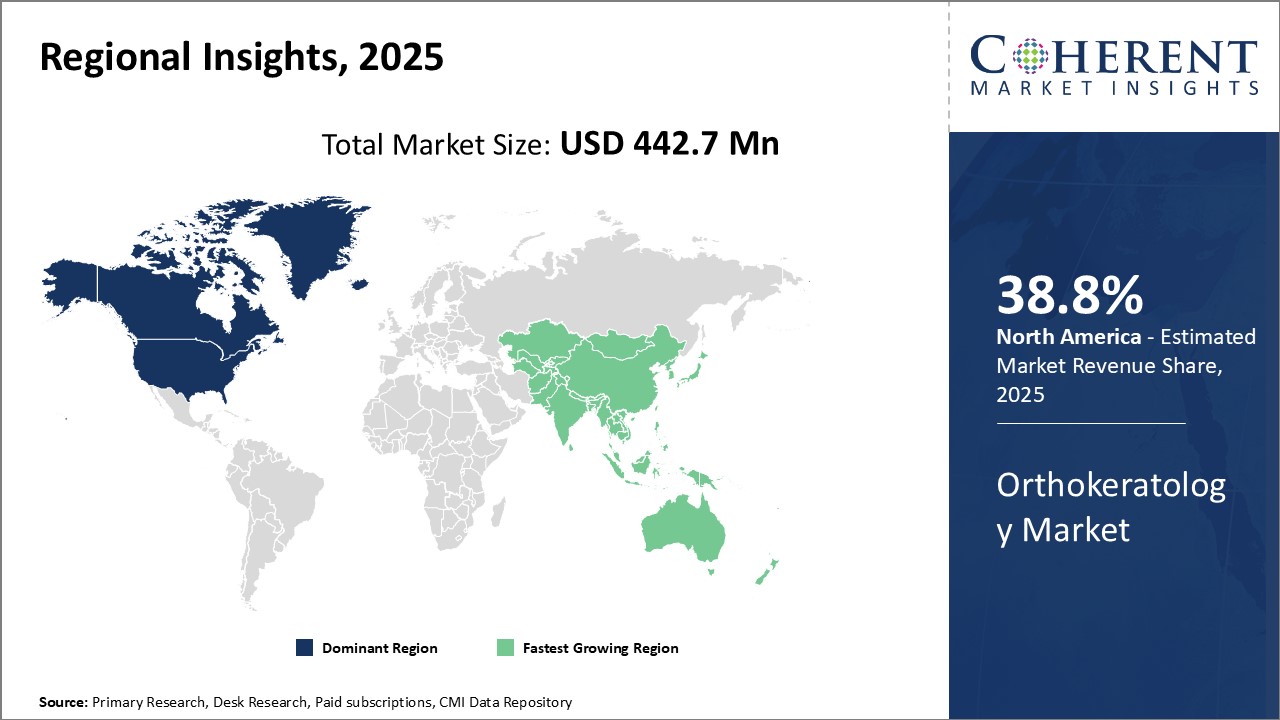
- Regionally, North America is expected to dominate the global Orthokeratology Market outlook in 2026 with a 38.8% market share, attributed to increased awareness, better access to optometric care, and a growing preference for non-surgical vision correction solutions.
Market Overview:
Global Orthokeratology Market growth is driven by increasing awareness about the benefits of orthokeratology such as reversibility and the temporary impact of a procedure. Current improvements in technology related to orthokeratology lenses designed to enhance comfort and prolong wear time can aid market growth as well.
Current Events and Its Impact on the Global Orthokeratology Market
Event | Description and Impact |
Regulatory Approvals & Policy Changes |
|
Technological Innovations
|
|
Geopolitical & Trade Dynamics |
|
Pricing Analysis
- The pricing of orthokeratology lenses differs depending on the level of technology used, the degree of customization, the geographic region, and the clinical services rendered.
- Overall costs: A pair of standard GP (gas permeable) lenses costs between $150 and $400, whereas high oxygen permeable materials increase prices by 30-50%. Advanced wavefront-guided lenses are priced at $500-$800 per pair.
- Professional fees: The initial fitting followed by Topography is charged at $200-$500. Each subsequent visit (3-6 visits during the first year) is billed at $50-$150. Replacing the lenses annually incurs an additional $300-$600.
- Regional differences: The total expenditure for the first year in North America is estimated at $1,500 to $4,000, compared to Europe’s €1,200-€3,200. The Asia Pacific region shows great disparity, as the Chinese market is estimated to be 40% cheaper than US prices.
- Market sections: Covers 20%, primarily in developing economics, growing at a 9% CAGR. The premium segment (> $1,500/year) is reported to hold 45% market share with fully featured, advanced treatment with complete follow-up. The mid-range market ($800-$1,500) represents 35%.
- Additional fees: The myopia management bundle adds a yearly cost of $200-$500. Compliance tools add between $50 and $150, and $20-50 a month respectively.
- Insurance: Offers partial coverage across 28 countries, providing typical reimbursement of 15-30% of lens costs.
- Although technology and other digital tools increase pricing, they also enhance the convenience and quality of treatment received.
- Current Industry Events of 2026
- Market Size Estimation
- Regional Breakdown
- Competitive Landscape
- Customer Intelligence
- Segmental Analysis
- Pricing Analysis
- Key Market Drivers, Challenges & Future Trends
- Customized Insights Section
Reimbursement Scenario
The reimbursement of Orthokeratology (Ortho-K) is affected by policies, global systems, and insurances specifics; however, in the U.S., the system is better documented due to consistency in orthokeratology system state policies.
Regulatory Codes:
As it is the case in America, Ortho-K lenses are FDA approved as class II medical devices. Pertinent billing codes are CPT 92060 (fitting of contact lens prosthesis of the eye for treatment encompassing disease), CPT 92071 (supply of a lens), and ICD-10-CM H44.2A (myopia, degenerative) for fulfilling surgical necessity.
Reimbursement Process:
Insurance eligibility requires a prior approval based on the clinical documents. Claims must be submitted alongside the necessary CPT/ICD-10 codes, and the providers must keep documentation for audits that justify medical need.
Insurance Coverage:
In the United States, medical insurance offers partial reimbursement, ranging from 50% to 70% of the fitting fees, if deemed medically necessary. However, the costs of the lenses are largely out-of-pocket, costing $1,500–$3,000 per year. Vision plans almost always classify Ortho-K as elective and don't reimburse for it. Flexible spending accounts (FSA/HSA) do cover qualifying expenditures, but only on a tax-exempt basis.
Global Overview:
Canada and Australia offer limited public healthcare for pediatric or therapeutic cases, while the UK's NHS reimburses for specific instances such as keratoconus. All other markets classify Ortho-K as elective and reimburse reluctantly, if not at all.
Market and Financial Barriers:
Despite an estimated industry growth rate (CAGR) of 6.2%, 85% of the costs associated with Ortho-K are still borne by the patients. Furthermore, the reimbursement limit set by insurers is $500 a year, and only 15% of American insurers offer partial coverage. The cost of maintaining high-performance lens materials and multiple follow-up appointments increase the expenses further.
Challenges and Trends:
The absence of standardized ICD-10 codes for claim submission makes it more difficult. Advocacy groups are pushing to expand the coverage, spending packages which range from $2,000 - $4,000, help improve cost transparency.
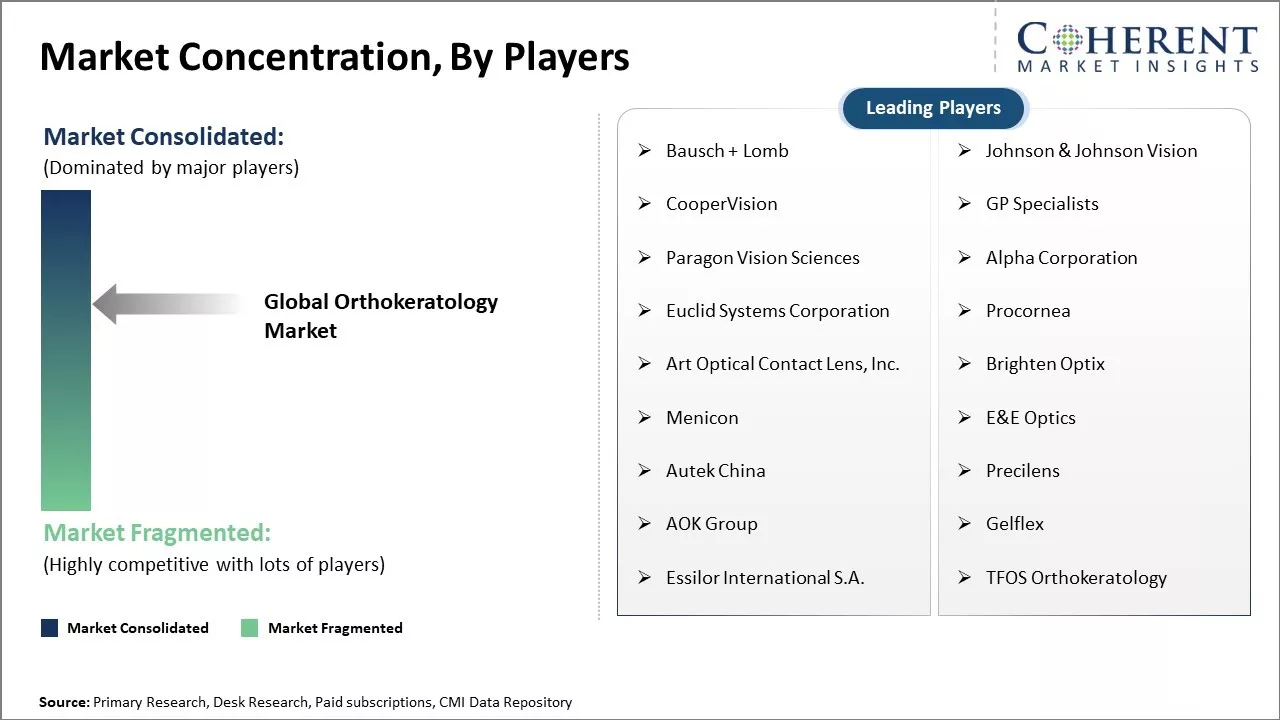
Market Concentration and Competitive Landscape
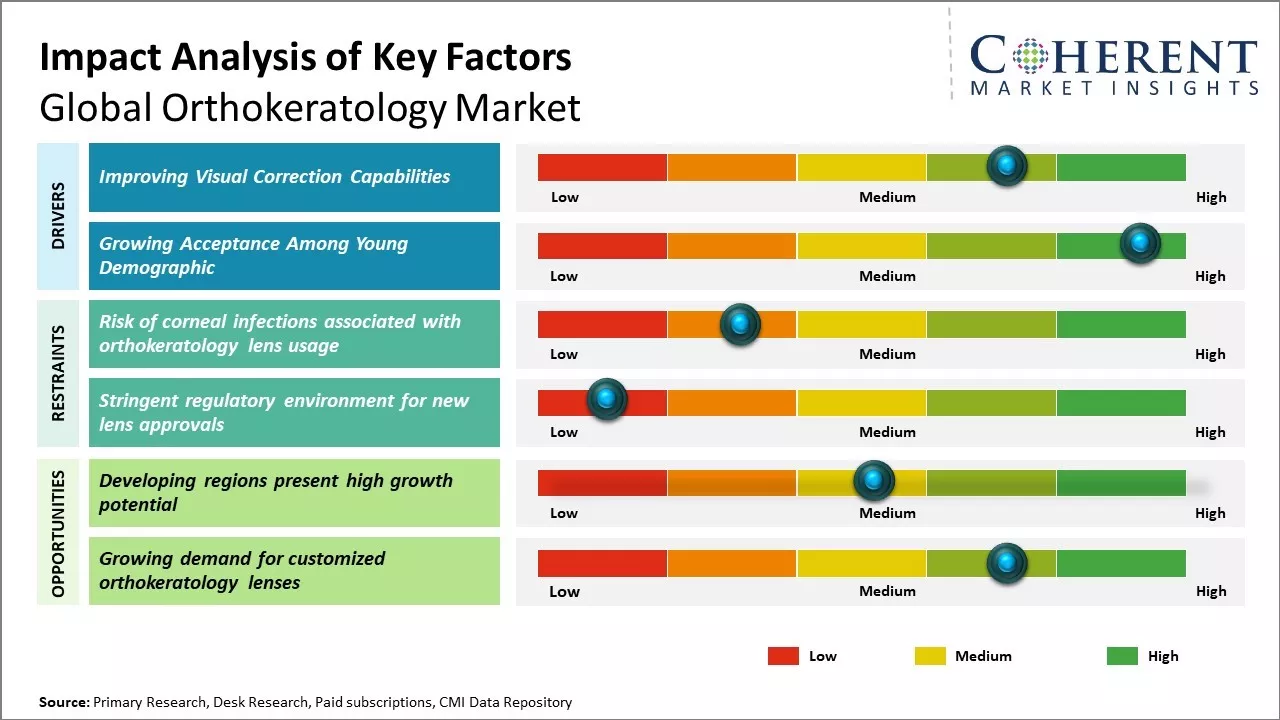
Improving visual correction capabilities
Wearing orthokeratology lenses overnight improves one's eyesight by temporarily flattening the cornea. This non-invasive method allows corrective vision without dependence on glasses or contact lenses during waking hours. With continuous technological advancements, orthokeratology has proven to be a highly effective option for moderate to high degrees of myopia. Newer lens designs have significantly enhanced the refractive error range that can be treated.
Precision UV technology tailors the lenses to the individual’s needs by correcting the corneal curvature to match the prescription. This achieves the best possible vision outcomes with the least amount of variation. Compared to the past, the precision and efficiency of orthokeratology correction has greatly advanced. Advanced methods of lens characterization facilitate corneal mapping with ultra-high resolution. This, along with advanced techniques for lens profiling, allows the creation of unique lenses designed to fit the specialized eye parameters of every patient.
Clinically validated results indicate that orthokeratology can at least accurately and dependably address myopia up to a severity of −6.00 diopters and astigmatism up to −1.50 diopters. Some advanced lens designs even expand the treatment spectrum to low hyperopia. The development of new technological tools has made orthokeratology more widely accepted as an effective non-invasive surgery alternative for moderate to high ametropia.
Growing acceptance among young demographic
Growing popularity of orthokeratology among the Young people can drive the market growth. Teenagers and young adults form a major end user segment for vision correction products. For this digitally active generation constantly engaged with screens, dependence on glasses can be quite problematic.
Contact lenses provide an alternative but require daily maintenance and handling. Orthokeratology lenses have gained popularity within this group due to their convenience of overnight wear with clear vision during the day. Orthokeratology avoids risks of visual side effects that may arise from extended contact lens usage at a young age. Orthokeratology improves self-esteem and quality of life for teenagers with moderate to high myopia. The confidence boost from not having to wear glasses plays an important psychological role during formative years.
Many orthokeratology adopters use it mainly for the convenience aspect, until these stabilize refractive error progression and consider more permanent vision correction options later in life. Favorable opinions shared on social media platforms have further boosted the acceptance of orthokeratology among young consumers globally. Lens manufacturers recognize this important demographic pillar and tailor appropriate marketing strategies accordingly.
Market Opportunities: Developing regions present high growth potential
Developing regions present significant growth potential for the global orthokeratology market due to their rapid economic development, increasing disposable incomes, and improved access to healthcare services. Rising living standards increases awareness about vision correction options, thus, boosting popularity of orthokeratology. High-potential areas include Asia Pacific, Latin America, the Middle East, and Africa.
Asia Pacific, with its high myopia rates, and Africa, projected to see a population surge, both offer large untapped markets. Supportive government initiatives, like India's 'Vision Fast Track Initiative,' can also offer growth opportunities. With targeted marketing and affordable products, orthokeratology companies can capture substantial market share in these developing regions.
Segmentation Analysis
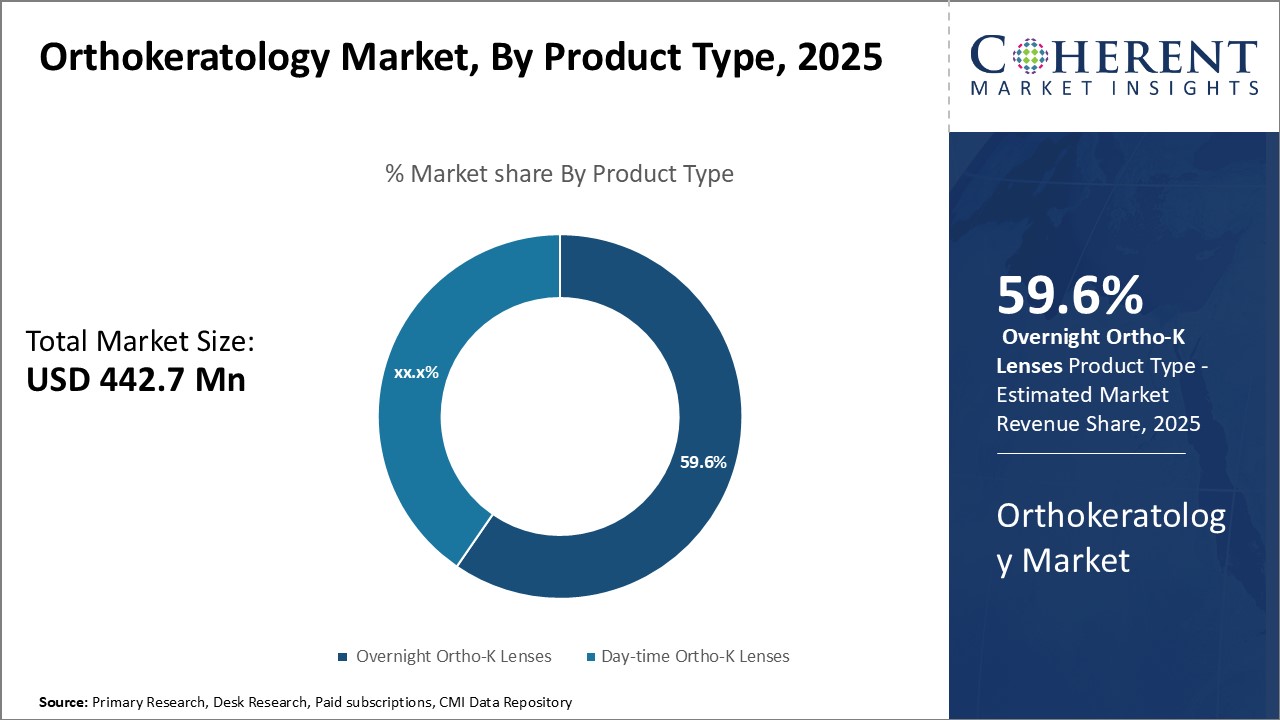
Global Orthokeratology Market, By Product Type
In terms of product type, overnight ortho-K lenses segment is estimated to contribute the highest Orthokeratology market share of 60.6% in 2026, owing to their convenience and effectiveness. Overnight lenses offer patients the flexibility to simply wear their lenses overnight and remove them in the morning. This allows patients to avoid the hassle of wearing lenses during waking hours, and giving their eyes extended periods of rest.
The results with overnight wear is similar to that of using the device during the day when it comes to correcting low and moderate levels of myopia. Orthokeratology operates by controlled reshaping of the cornea while a person sleeps. Overnight corneal molds are capable of achieving the desired shape changes through a constant light force which is applied overnight. This effectiveness for treatment has made overnight lenses a preferred choice.
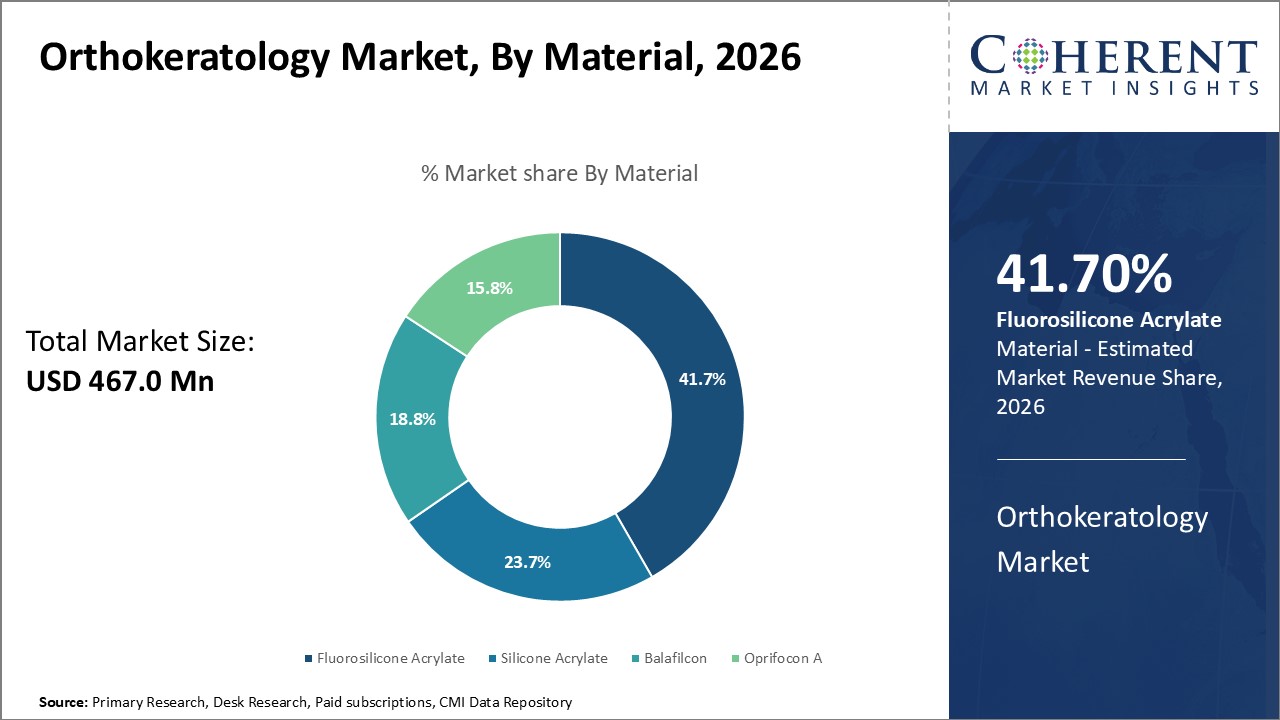
Global Orthokeratology Market, By Material
In terms of material, fluorosilicone acrylate segment is estimated to contribute the highest Orthokeratology market demand share of 40.71% in 2026, due to its advanced material properties. Fluorosilicone acrylate lenses are highly breathable and flexible. This allows them to move smoothly with blinking and reduce irritation. The material is designed to maximally oxygenate the cornea even during long periods of wear. This provides patients increased comfort levels.
The enhanced elastic properties of fluorosilicone acrylate allows it to gently reshape the cornea with minimal force, reducing risk of complications. The biocompatibility of this material has also been shown to support corneal health. These superior properties have increased patient satisfaction with fluorosilicone acrylate lenses.
Global Orthokeratology Market Insights, By Application
In terms of application, myopia segment is estimated to contribute the highest market share of 53.5% in Orthokeratology market forecast 2026, due to high and growing prevalence of myopia globally. Myopia is one of the most common vision conditions affecting people of all ages. In particular, its early onset and continued rise in pediatric populations have elevated demand for myopia control treatments such as orthokeratology.
The prevalence of myopia in children has doubled over the past few decades. With growing use of digital devices and reduced outdoor time implicated as risks for faster myopia progression in young years, early intervention has become a priority. Orthokeratology enables non-invasive treatment of low to moderate myopia through overnight wear of corrective lenses and slowing further increases in nearsightedness.
Regional Insights
North America Orthokeratology Market Analysis and Trends
North America is projected to dominate the global orthokeratology market with an estimated share of 38.8% in 2026. This regional leadership is backed by the strong presence of major industry players such as Johnson & Johnson Vision and Bausch & Lomb, both headquartered in the U.S. These companies benefit from well-established manufacturing and R&D facilities, enabling efficient local supply and innovation.
The U.S. and Canada continue to see high adoption of orthokeratology, supported by favorable reimbursement policies and a growing preference for non-invasive vision correction technologies. In 2024, leading players expanded their product portfolios to cater to increasing consumer interest in overnight vision correction lenses.
Asia Pacific Orthokeratology Market Analysis and Trends
Asia Pacific is emerging as the fastest-growing region in the global orthokeratology market trend, driven by rising demand from China and India. In 2026, this surge is fueled by rising disposable income, a large myopic population, and increased awareness of non-surgical vision correction.
China continues to play a pivotal role, with high adoption rates among students and strong government focus on eye health. Local manufacturers are also gaining traction by offering cost-effective solutions, boosting both affordability and market penetration. In 2024, medical tourism and school-based screening initiatives further accelerated demand in countries such as South Korea and Southeast Asian nations.
Orthokeratology Market Dominating Countries
U.S. Orthokeratology Market Analysis and Trends
The U.S. strengthens its position as the key driver of North America’s orthokeratology market through a combination of technological innovation, consumer willingness to adopt advanced eye care solutions, and supportive reimbursement frameworks. In 2024, U.S.-based companies expanded their outreach through digital health platforms and targeted campaigns aimed at promoting orthokeratology as a safe and effective option for myopia control among children and teens.
China Orthokeratology Market Analysis and Trends
China holds a commanding position in the Asia Pacific orthokeratology landscape, attributed to its vast population, rising awareness of eye health, and escalating rates of childhood myopia. In 2026, the country’s market is supported by government-led myopia prevention strategies, as well as increasing access to affordable and branded orthokeratology lenses. In 2024, collaborations between local and global manufacturers led to new product introductions tailored for pediatric use, further propelling market momentum.
Market Report Scope
Orthokeratology Market Report Coverage
| Report Coverage | Details | ||
|---|---|---|---|
| Base Year: | 2025 | Market Size in 2026: | USD 467.0 Mn |
| Historical Data for: | 2020 To 2024 | Forecast Period: | 2026 To 2033 |
| Forecast Period 2026 to 2033 CAGR: | 5.5% | 2033 Value Projection: | USD 679.4 Mn |
| Geographies covered: |
| ||
| Segments covered: |
| ||
| Companies covered: | Bausch + Lomb, Johnson & Johnson Vision, CooperVision, GP Specialists, Paragon Vision Sciences, Alpha Corporation, Euclid Systems Corporation, Procornea, Art Optical Contact Lens, Inc., Brighten Optix, Menicon, E&E Optics, Autek China, Precilens, AOK Group, Gelflex, Essilor International S.A., TFOS Orthokeratology | ||
| Growth Drivers: |
| ||
| Restraints & Challenges: |
| ||
Analyst Viewpoints
- Global orthokeratology market growth is driven by rising prevalence of myopia worldwide. Countries in Asia Pacific have witnessed rising cases of near-sightedness, an dthis can drive the market growth.
- Growing awareness about orthokeratology treatment and its advantages over conventional methods for temporary control of myopia progression can also boost adoption.
- Orthokeratology lenses are considered safer and more comfortable options as compared to spectacles and contact lenses. Advancements in material science have improved the biocompatibility of lenses, thus, boosting its sales.
- Lack of medical reimbursement coverage for orthokeratology treatment can hamper the market growth. High procedural costs can pose challenge for wider consumer acceptance in price-sensitive developing regions.
- Furthermore, prolonged overnight wear of lenses poses risks of infection and discomfort. Ongoing clinical trials evaluating the efficacy and safety of newer lens designs and materials can boost orthokeratology adoption over the forecast period. Favorable government policies promoting non-invasive options for myopia control can offer opportunities for market players.
Orthokeratology Market Key Developments
- In March 2025, Menicon Co., introduced a next-generation range of overnight ortho-k lenses featuring advanced oxygen-permeable materials to improve comfort and corneal reshaping effectiveness for pediatric myopia control.
- In January 2025, CooperVision Specialty EyeCare expanded its global footprint by opening new ortho-k training centers across Asia and Europe, aiming to boost practitioner adoption and improve lens fitting outcomes.
- In November 2024, Euclid Systems launched an AI-driven software platform for personalized ortho-k lens design, enhancing customization and treatment accuracy through data-based corneal mapping and predictive modeling.
Market Segmentation
- Product Type Insights (Revenue, USD Mn, 2021 - 2033)
- Day-time Ortho-K Lenses
- Overnight Ortho-K Lenses
- Material Insights (Revenue, USD Mn, 2021 - 2033)
- Fluorosilicone Acrylate
- Silicone Acrylate
- Balafilcon
- Oprifocon A
- Application Insights (Revenue, USD Mn, 2021 - 2033)
- Myopia
- Hyperopia
- Presbyopia
- Astigmatism
- End Users Insights (Revenue, USD Mn, 2021 - 2033)
- Hospitals
- Optometry Clinics
- Ophthalmology Clinics
- Others
- Regional Insights (Revenue, USD Mn, 2021 - 2033)
- North America
- U.S.
- Canada
- Latin America
- Brazil
- Argentina
- Mexico
- Rest of Latin America
- Europe
- Germany
- U.K.
- Spain
- France
- Italy
- Russia
- Rest of Europe
- Asia Pacific
- China
- India
- Japan
- Australia
- South Korea
- ASEAN
- Rest of Asia Pacific
- Middle East
- GCC Countries
- Israel
- Rest of Middle East
- Africa
- South Africa
- North Africa
- Central Africa
- Key Players Insights
- Bausch + Lomb
- Johnson & Johnson Vision
- CooperVision
- GP Specialists
- Paragon Vision Sciences
- Alpha Corporation
- Euclid Systems Corporation
- Procornea
- Art Optical Contact Lens, Inc.
- Brighten Optix
- Menicon
- E&E Optics
- Autek China
- Precilens
- AOK Group
- Gelflex
- Essilor International S.A.
- TFOS Orthokeratology
Sources
Primary Research Interviews
- Bausch + Lomb
- Johnson & Johnson Vision
- CooperVision
- Paragon Vision Sciences
- Others
Databases
- Others
Magazines
- Review of Optometry
- Ophthalmology Times
- Contact Lens Spectrum
- Eyewire Today
- Others
Journals
- Eye & Contact Lens: Science and Clinical Practice
- Optometry and Vision Science
- Cornea: The Journal of Corneal and External Disease
- Others
Newspapers
- The Wall Street Journal (Healthcare Sector)
- Financial Times (Pharmaceuticals & Medical Devices)
- The Economic Times (India) Healthcare Edition
- Others
Associations
- American Academy of Ophthalmology (AAO)
- American Optometric Association (AOA)
- Asia Cornea Society
- European Society of Ophthalmology
- Others
Public Domain Sources
- National Institutes of Health (NIH) Myopia Research
- World Health Organization (WHO) Vision Care Reports
- U.S. Food and Drug Administration (FDA) Medical Device Registries
- Others
Proprietary Elements
- CMI Data Analytics Tool
- Proprietary CMI Existing Repository of Information (Last 8 Years)
*Definition: Global Orthokeratology Market involves the design, development, and manufacturing of contact lenses used for overnight orthokeratology, a non-surgical alternative to correct refractive errors like myopia and hyperopia. The orthokeratology contact lenses are specially designed to gently reshape the cornea while worn overnight to temporarily improve vision without glasses or contact lenses during waking hours. Global leaders in this market supply orthokeratology lenses and related products globally to optometrists and consumers looking for non-invasive vision correction solutions.
Get access to 250+ pages report
Every segment, forecast, competitor profile and data table behind the analysis above — available for instant download.
- ESOMAR Member
- ISO 9001:2015 Certified
- D-U-N-S Registered
- GDPR & CCPA Compliant
Missing comfort of reading report in your local language? Find your preferred language:
Transform your Strategy with Exclusive Trending Reports
Frequently Asked Questions
The Orthokeratology Market is estimated to be valued at USD 467.0 Mn in 2026, and is expected to reach USD 679.4 Mn by 2033.
The CAGR of the Orthokeratology Market is projected to be 5.5% from 2026 to 2033.
Improving visual correction capabilities and growing acceptance among young demographic are the major factors driving the growth of global orthokeratology market.
Risk of corneal infections associated with orthokeratology lens usage and stringent regulatory environment for new lens approvals are the major factors hampering the growth of global orthokeratology market.
In terms of product type, overnight ortho-K lenses segment is estimated to dominate the market in 2026.
Bausch + Lomb, Johnson & Johnson Vision, CooperVision, GP Specialists, Paragon Vision Sciences, Alpha Corporation, Euclid Systems Corporation, Procornea, Art Optical Contact Lens, Inc., Brighten Optix, Menicon, E&E Optics, Autek China, Precilens, AOK Group, Gelflex, Essilor International S.A., TFOS Orthokeratology are the major players.
North America is expected to lead the global orthokeratology market.