

P2x7 Receptor Antagonists Market Size and Trends: 2026-2033
P2x7 Receptor Antagonists Market is estimated to be valued at USD 135.2 Mn in 2026 and is expected to reach USD 438 Mn by 2033, exhibiting a compound annual growth rate (CAGR) of 18.3% from 2026 to 2033.
Key Takeaways
- By Drugs, JNJ-55308942 is expected to lead the global P2X7 Receptor Antagonists Market with 29% share in 2026, driven by its advanced clinical development stage and strong pipeline positioning in inflammatory and neurological indications.
- By Application, Central Nervous System (CNS) Disorders are expected to dominate the market, accounting for 47% share in 2026.
- Regionally, North America is set to lead the P2X7 Receptor Antagonists Market with 45% share in 2026. While, Asia Pacific is anticipated to be the fastest growing region.
Market Overview
Growing focus on targeted therapies for the treatment of inflammatory and neurodegenerative diseases drives the growth of the global P2X7 Receptor Antagonists Market. P2X7 receptors are implicated in neuroinflammation and modulation of immune responses and, hence, are promising drug targets for neurological disorders such as Alzheimer's disease, major depression, chronic pain, and various autoimmune diseases. Increasing incidence of central nervous system and immunological disorders and growing investment in neuroscience and immunology research supplement the market growth.
Current Events and Its Impacts on the P2x7 Receptor Antagonists Market
Current Events | and its impact |
Regulatory Landscape Evolution and Drug Approval Processes |
|
Global Supply Chain Disruptions and Manufacturing Challenges |
|
How is Product Innovation driving the growth in the P2X7 Receptor Antagonists Market?
- Next Generation Small Molecules: Research and development related to highly selective antagonists for the P2X7 receptor, together with enhanced blood-brain barrier permeability, will definitely enhance the chances that these small molecules could emerge as effective therapies.
- Expanded Indication Targeting: Extensive studies have extended the applications from inflammation alone to other areas such as depression, Alzheimer’s disease, epilepsy, and chronic pain, thus creating tremendous commercial value in the pipeline drugs.
- Improved Safety and Tolerability Profiles: The developments made to improve safety and tolerability have also further contributed to the overall success rate.
- Strategic Collaborations and Licensing: Collaboration between bio-tech companies, academic bodies, and large pharmaceutical companies can speed up bio-tech innovation, validation, and global bio-tech products development.
- Current Industry Events of 2026
- Market Size Estimation
- Regional Breakdown
- Competitive Landscape
- Customer Intelligence
- Segmental Analysis
- Pricing Analysis
- Key Market Drivers, Challenges & Future Trends
- Customized Insights Section
Segmental Insights
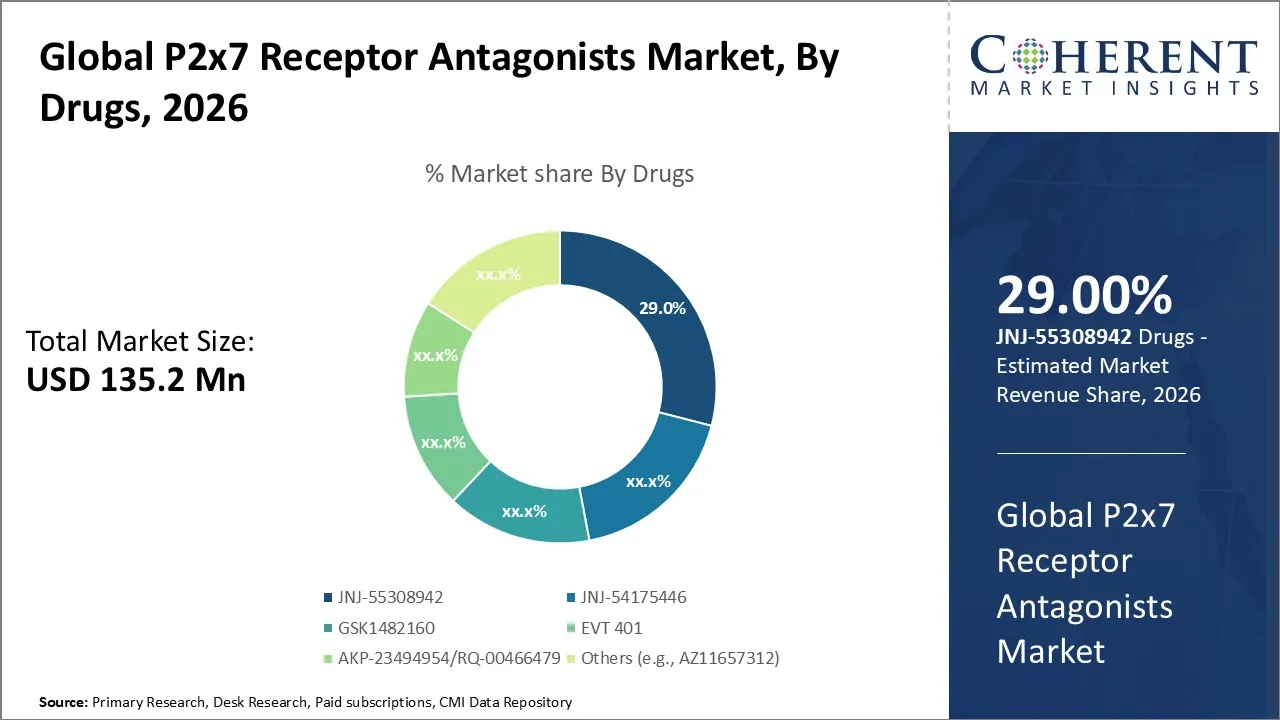
P2X7 Receptor Antagonists Market Insights, By Drugs– JNJ-55308942 leads due to advanced clinical progress
By drug type, JNJ-55308942 is estimated to contribute the highest market share of 29% in 2026 in the global P2X7 Receptor Antagonists Market. This segment dominance is attributed to its advanced stage of clinical development and strong therapeutic potential across inflammatory and neurological indications. JNJ-55308942 has demonstrated favorable pharmacological properties and target selectivity, positioning it as one of the leading candidates within the competitive P2X7 antagonist pipeline.
P2X7 Receptor Antagonists Market Insights, By Application – CNS disorders dominate driven by unmet medical needs
By application, Central Nervous System (CNS) disorders are expected to represent the largest market share of 47% by 2026, driven by an improved understanding of the role P2X7 receptors play in neuroinflammation, neurodegeneration, and synaptic dysfunction. The increasing prevalence of pathologies such as Alzheimer's disease, depression, epilepsy, and chronic pain has accelerated research efforts toward novel CNS-targeted therapies.
For instance, in September 2025, researchers at Oregon Health & Science University published breakthrough findings on the structural mechanism of P2X7 receptors, revealing distinct binding sites and conformational changes, which could enable design of more selective antagonists for neurological and neuroinflammatory conditions.
Regional Insights
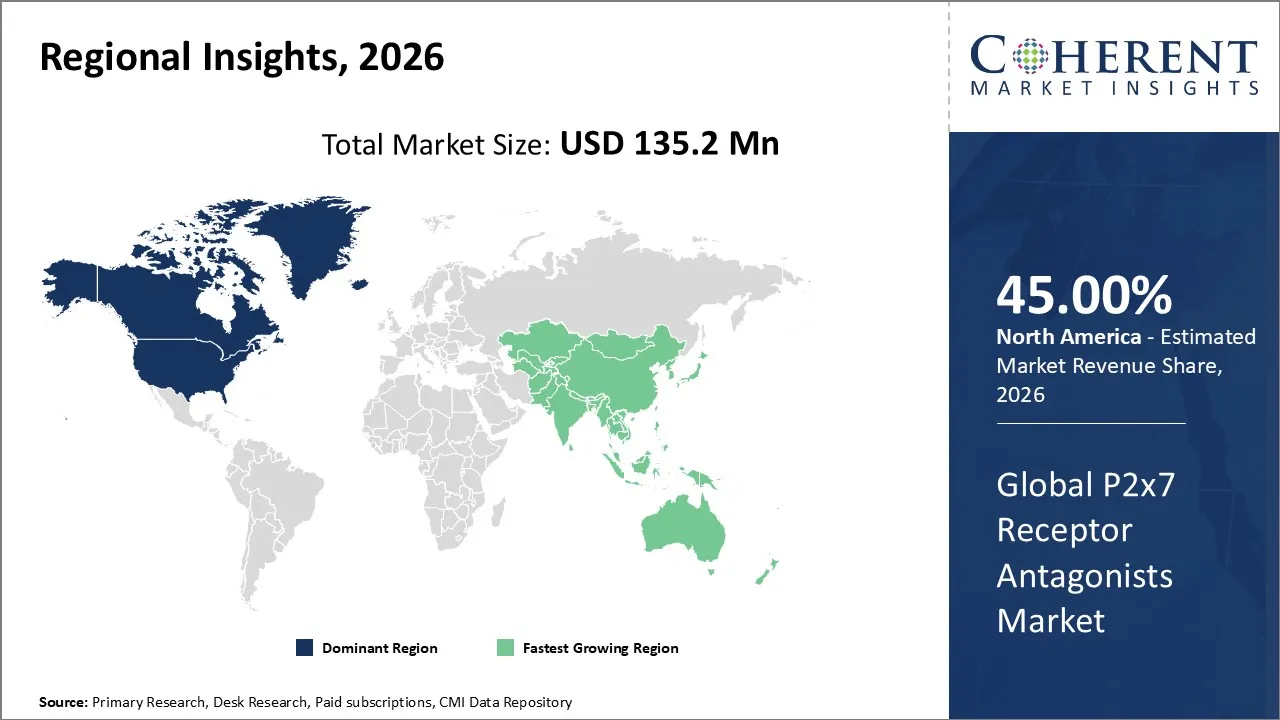
North America P2X7 Receptor Antagonists Market Analysis & Trends
North America is expected to lead the global P2X7 Receptor Antagonists Market in the year 2026, while holding an estimated market share of 45%. The key reasons behind the dominance of the North American region can be accounted for by the developed health infrastructure of the region, high investment in neuroscience and immunology research, presence of key players, and the presence of clinical trials.
Asia Pacific P2X7 Receptor Antagonists Market Analysis & Trends
The Asia Pacific region is anticipated to be the fastest-growing market for P2X7 receptor antagonists due to increasing cases of neurological and immunological diseases, growing healthcare expenditure, increased collaboration among pharmaceutical companies, and favorable government support for the development of drugs, such as those for China, Japan, and India.
For instance, in October 2025, RaQualia Pharma Inc. announced an update regarding the P2X7 receptor antagonist, noting that while Eli Lilly removed this compound from its Phase II pain development pipeline, the existing license agreement remains active and future development pathways are under discussion.
Is the U.S. P2X7 Receptor Antagonists Market growing due to advanced R&D and pharmaceutical presence?
The U.S. P2X7 Receptor Antagonists Market is expanding, driven by robust clinical research, strong pharmaceutical company presence, and high prevalence of CNS and immunological disorders. North America accounts for the largest regional share of the market in 2026 (45%).
Is China’s focus on healthcare innovation driving market growth?
China’s growing emphasis on healthcare innovation, biotechnology development, and clinical trial infrastructure is accelerating adoption and research for P2X7 receptor antagonists. Neurodegenerative and inflammatory disease-related research investment is particularly strong, based on the government commitment to improved public health outcomes.
For instance, in July 2025, Chinese researchers at Chengdu University’s preclinical research program continued development of a novel small‑molecule P2X7 receptor antagonist (compound code: 13a) targeting conditions such as chronic kidney disease, with ongoing evaluation in preclinical models indicating promising therapeutic potential.
Market Report Scope
P2X7 Receptor Antagonists Market Report Coverage
| Report Coverage | Details | ||
|---|---|---|---|
| Base Year: | 2025 | Market Size in 2026: | USD 135.2 Mn |
| Historical Data for: | 2020 To 2024 | Forecast Period: | 2026 To 2033 |
| Forecast Period 2026 to 2033 CAGR: | 18.3% | 2033 Value Projection: | USD 438 Mn |
| Geographies covered: |
| ||
| Segments covered: |
| ||
| Companies covered: | GlaxoSmithKline Plc, Johnson & Johnson, AstraZeneca Plc, RaQualia Pharma, Evotec AG, and Asahi Kasei Corporation. | ||
| Growth Drivers: |
| ||
| Restraints & Challenges: |
| ||
P2X7 Receptor Antagonists Market Driver
Rising prevalence of CNS and immunological disorders
The increasing prevalence of neurological and immunological disorders, such as Alzheimer's disease, multiple sclerosis, chronic pain, and inflammatory conditions, serves as a driving force in the demand for P2X7 receptor antagonists. These disorders have often been associated with neuroinflammation and immune dysregulation, hence presenting P2X7 as a very auspicious therapeutic target. Pharmaceutical companies continue to invest in the development of novel antagonists with ongoing research and clinical trials that show potential efficacy to address these unmet medical needs.
P2X7 Receptor Antagonists Market Opportunity
Expansion of pipeline and novel drug delivery approaches
The market has growth opportunities through the development of next-generation P2X7 receptor antagonists with improved efficacy, safety, and bioavailability. Innovations such as oral, injectable, and targeted delivery systems can enhance patient compliance and therapeutic outcomes. Additionally, expanding clinical trials to new indications, including rare neuroinflammatory and autoimmune disorders, offers opportunities for market penetration. Collaborations between global pharmaceutical companies and regional biotech firms in North America and Asia Pacific can further accelerate development and commercialization.
Analyst Opinion (Expert Opinion)
- The P2X7 Receptor Antagonists market is also gaining traction with the rise in scientific rationale supporting the role of the receptor in the pathogenesis of CNS and immunological disorders. According to a study in Nature Reviews Drug Discovery, the activation of the P2X7 receptor has a direct role in the secretion of pro-inflammatory cytokines following the onset of Alzheimer’s disease, multiple sclerosis, along with chronic pain. Pre-clinicals lend a hand towards the prospective role of antagonists, which can amount to a 60-70% reduction in secretion rates of IL-1β.
- Most of the leading candidates, such as JNJ-55308942 and GSK1482160, have well-established CNS pipelines with high priority and focus in clinical research activities. Preclinical as well as early clinical research activities have confirmed efficacy as well as tolerability, thereby enhancing the attraction for investors as well as research activities with these promising active compounds in the market. Additionally, priority in CNS diseases is evident with nearly half of the targets for CNS diseases due to high unmet need for neuroinflammatory as well as neurodegenerative diseases.
- North America remains the primary hub for P2X7 receptor antagonist development, driven by advanced clinical trial infrastructure, strong R&D funding, and active pharmaceutical collaborations. At the same time, Asia Pacific, particularly China and Japan, is emerging as a critical center for early-stage preclinical research and licensing partnerships, reflecting a global and competitive development landscape.
Speak to the analyst
Want personalized insights?
Take the findings above to one of our principal consultants, or have the report rebuilt around the segments, geographies and competitors you actually track.
P2X7 Receptor Antagonists Industry News
- In June 2025, Evotec AG announced the initiation of a Phase I clinical trial for its proprietary small‑molecule P2X7 receptor antagonist. The study is a double‑blind, placebo‑controlled single ascending dose trial in healthy volunteers to assess safety, tolerability, pharmacokinetics, and pharmacodynamic effects following oral administration.
- In October 2025, RaQualia Pharma announced an update on the P2X7 receptor antagonist compound AK1780/RQ‑00466479/LY3857210 licensed to Eli Lilly via Asahi Kasei Pharma.
Market Segmentation
- Drugs Insights (Revenue, USD Mn, 2026 - 2033)
- AKP-23494954/RQ-00466479
- EVT 401
- GSK1482160
- JNJ-55308942
- JNJ-54175446
- Others (e.g.- AZ11657312)
- Application Insights (Revenue, USD Mn, 2026 - 2033)
- Central Nervous System Disorders
- Immunological Disorders
- Others
- Regional Insights (Revenue, USD Mn, 2026 - 2033)
- North America
- U.S.
- Canada
- Latin America
- Brazil
- Argentina
- Mexico
- Rest of Latin America
- Europe
- Germany
- U.K.
- Spain
- France
- Italy
- Russia
- Rest of Europe
- Asia Pacific
- China
- India
- Japan
- Australia
- South Korea
- ASEAN
- Rest of Asia Pacific
- Middle East
- GCC Countries
- Israel
- Rest of Middle East
- Africa
- South Africa
- North Africa
- Central Africa
- North America
- Key Players Insights
- GlaxoSmithKline Plc
- Johnson & Johnson
- AstraZeneca Plc
- RaQualia Pharma
- Evotec AG
- Asahi Kasei Corporation
Sources
Primary Research Interviews
- Pharmaceutical & Biotech R&D Heads
- Drug Development & Clinical Trial Managers
- Pharmacologists & Medicinal Chemists
- Hospital & Clinical Trial Site Directors
- Regulatory Affairs & Compliance Experts
- Healthcare Consultants & Advisors
- KOLs (Key Opinion Leaders) in CNS & Immunology
- Others
Databases
- ClinicalTrials.gov
- PubMed
- FDA & EMA Databases
- NIH Research Databases
- PatentScope (WIPO)
- Scopus
- Others
Magazines
- Pharmaceutical Executive
- PharmaTimes
- BioPharm International
- Drug Discovery & Development Magazine
- Genetic Engineering & Biotechnology News (GEN)
- Others
Journals
- Nature Reviews Drug Discovery
- Journal of Neuroinflammation
- Frontiers in Pharmacology
- Trends in Pharmacological Sciences
- British Journal of Pharmacology
- Others
Newspapers
- The New York Times – Health Section
- The Wall Street Journal – Life Sciences Section
- Reuters Health & Pharma News
- Bloomberg Health & Pharma Section
- Financial Times – Healthcare & Pharma Section
- Others
Associations
- International Society for Neurochemistry (ISN)
- Society for Neuroscience (SfN)
- European Federation of Pharmaceutical Industries and Associations (EFPIA)
- American Pharmacists Association (APhA)
- Others
Public Domain Sources
- U.S. FDA Publications & Reports
- European Medicines Agency (EMA) Reports
- NIH & NCBI Publications
- WHO – Health & Pharmaceutical Reports
- Clinical Study Reports from Public Registries
- Others
Proprietary Elements
- CMI Data Analytics Tool
- Proprietary CMI Existing Repository of Information for the Last 8 Years
Get access to 250+ pages report
Every segment, forecast, competitor profile and data table behind the analysis above — available for instant download.
- ESOMAR Member
- ISO 9001:2015 Certified
- D-U-N-S Registered
- GDPR & CCPA Compliant
Missing comfort of reading report in your local language? Find your preferred language:
Transform your Strategy with Exclusive Trending Reports
Frequently Asked Questions
The global P2X7 Receptor Antagonists Market is estimated to be valued at USD 135.2 Mn in 2026, and is expected to reach USD 438 Mn by 2033.
The CAGR of the P2X7 Receptor Antagonists Market is projected to be 18.3% from 2026 to 2033.
Rising prevalence of CNS and immunological disorders, increasing R&D investment in novel antagonists, and growing pipeline of advanced P2X7-targeting therapies are the major factors driving market growth.
Challenges such as high development costs, regulatory hurdles, and competition from alternative anti-inflammatory and immunomodulatory therapies are the major factors hampering market growth.
In terms of drug type, JNJ 55308942 is estimated to dominate the market in 2026 due to its advanced clinical development and strong positioning in CNS and inflammatory indications.
GlaxoSmithKline Plc, Johnson & Johnson, AstraZeneca Plc, RaQualia Pharma, Evotec AG, and Asahi Kasei Corporation are the major players operating in this market.
North America is expected to lead the P2X7 Receptor Antagonists Market in 2026, driven by strong clinical trial infrastructure, R&D investments, and high prevalence of targeted disorders.