

Partial Knee Arthroplasty Market Size and Trends - 2025 to 2033
The Partial Knee Arthroplasty Market is estimated to be valued at USD 3,350 Mn in 2026 and is expected to reach USD 5,205 Mn by 2033, growing at a compound annual growth rate (CAGR) of 6.5% from 2026 to 2033.
Key Takeaways
- Based on Implant Type, the Fixed Bearing segment is expected to lead the market with 57.60% share in 2026, due to its wide use and simpler surgical technique.
- Based on End User, the Hospitals segment is expected to hold 48.20% share of the market in 2026, driven by increasing surgical procedures.
- Based on Region, North America is set to lead the market with 36.60% share in 2026. While, Asia Pacific is anticipated to be the fastest growing region.
Market Overview
The Partial Knee Arthroplasty Market provides specialized orthopedic implants and surgical systems for patients suffering from localized osteoarthritis. The market includes noncompartmental knee implants, fixed-bearing and mobile-bearing designs, associated robotic-assisted surgical platforms, and precision instrumentation.
The prevalence of degenerative joint diseases is increasing each year, thus creating a greater demand for bone-preserving surgical options among aging and active populations. Orthopedic surgeons and healthcare providers recognize the importance of minimally invasive procedures for improving patient recovery times and long-term kinematics. Medical regulatory bodies now emphasize clinical outcomes and cost efficiency, making partial knee replacements a preferred alternative to total knee surgery in eligible candidates.
Current Events and Its Impacts on the Partial Knee Arthroplasty Market
Current Event | Description and the Impacts |
Technological Advancements in Partial Knee Arthroplasty |
|
Demographic and Epidemiological Trends
|
|
Competitive Landscape and Strategic Collaborations |
|
Role Of Artificial Intelligence (AI) In Partial Knee Arthroplasty Market
The use of Artificial intelligence (AI) in partial knee arthroplasty (PKA) or unicompartmental knee arthroplasty (UKA) mainly offers more accurate surgeries and personalized treatment. Based on the data of the patient, machine algorithms assist in making the right decision regarding the patient and also provide accurate 3D simulations of the surgeries in order to suit the patient’s need. AI-assisted robotic technologies as well as augmented reality (AR) navigation assist in accurate bone cuts during the process with absolute minimal chances of human error or soft tissue damage.
For instance, in March 2025, Vent Creativity, a medical software firm, announced the FDA clearance of its new AI driven software program, Hermes Knee. The software uses deep learning (DL) to create surgical plans using mechanical, kinematic, and anatomical alignment techniques for total and partial knee arthroplasty procedures.
- Current Industry Events of 2026
- Market Size Estimation
- Regional Breakdown
- Competitive Landscape
- Customer Intelligence
- Segmental Analysis
- Pricing Analysis
- Key Market Drivers, Challenges & Future Trends
- Customized Insights Section
Segmental Insights
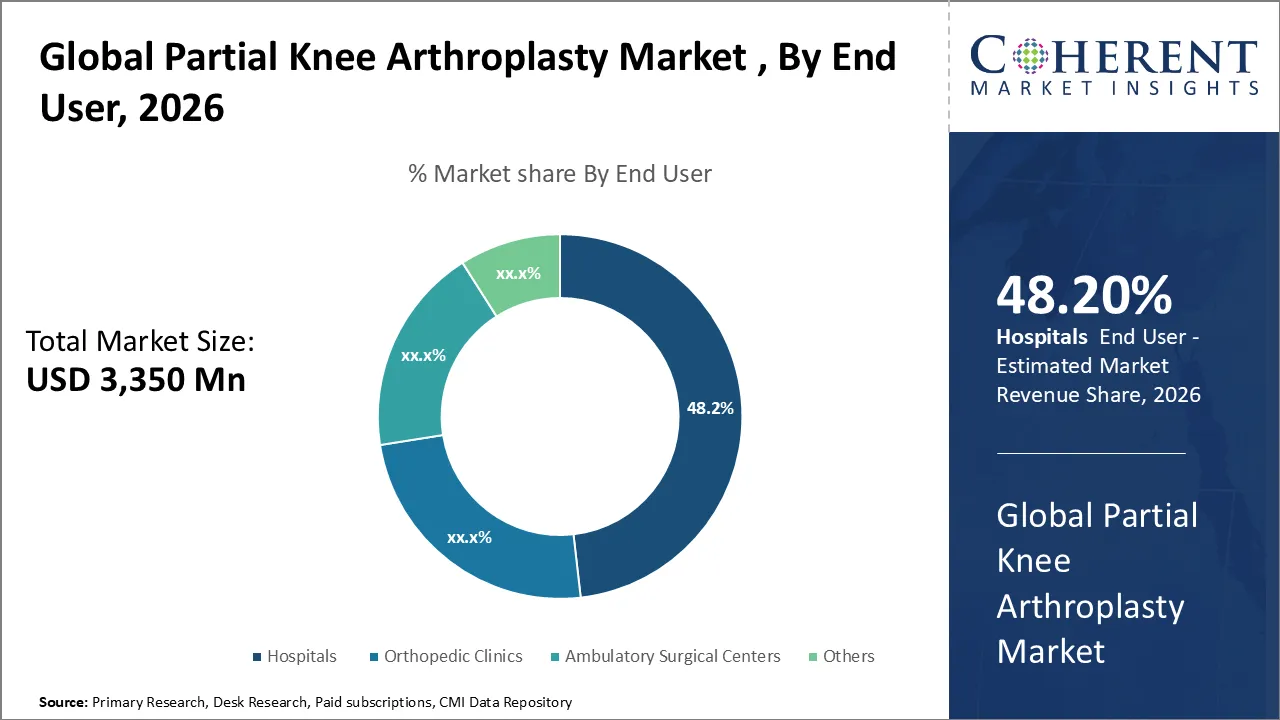
Partial Knee Arthroplasty Market Insights By, End User- Hospitals Leads with High Surgical Volumes and Availability of Orthopedic Specialists
In terms of end user, the hospitals segment contributes the highest share of 48.20% in 2026 of the market. Hospitals have full-service facilities, state-of-the-art operating rooms, orthopedic departments, and access to emergency care immediately if complications arise during or after surgery. Experienced orthopedic surgeons treat a large number of partial knee arthroplasty cases in these settings, developing their own expertise over time, which helps to foster relationships with primary care physicians and specialists who recommend patients to them. The environment maintains an integrated care pathway, from preoperative assessment to postoperative rehabilitation, and therefore offers coordinated care for all the patients.
These centers also function as training sites for young surgeons to acquaint them with state-of-the-art procedures and approaches for partial knee replacements, making them pioneers at their respective sites for adopting novel and innovative approaches and technologies for this treatment modality. The availability of multidisciplinary teams, including anesthesiologists, nurses, physiotherapists, and pain management specialists, creates a complete care ecosystem for patients.
Partial Knee Arthroplasty Market Insights By, Implant Type - Wider Adoption, Simpler Surgical Technique, and Long-Term Survivorship Drives Preference for Fixed Bearing
In terms of implant type, the fixed bearing segment contributes the highest share of 57.60% in 2026 of the market due their unparalleled clinical reliability and cost-effectiveness. Surgeons often prefer these implants because they are technically less demanding to install, thus reducing the risk of perioperative errors. Unlike mobile bearing alternatives, fixed bearing designs eliminate the threat of bearing dislocation, a crucial factor in maintaining long-term patient safety.
Moreover, the progress in cross-linked polyethylene have mitigated historic wear concerns, making these tried-and-true devices the gold standard for a wide patient demographic. Their lower price point and high success rates make them highly attractive to procurement departments looking to optimize value-based care outcomes.
For instance, in October 2023, Ortho Development Corporation unveiled the latest addition to its line of Balanced Knee® implant systems, the BKS® Uni. BKS Uni is a partial knee replacement system that makes use of the clinical legacy of the Balanced Knee System while preserving bone and streamlining surgical technique. In order to precisely and effectively treat unicompartmental knee arthritis, the BKS Uni Knee System provides surgeons with a medial fixed-bearing system of implants and instruments that are designed for intraoperative adjustments.
Regional Insights
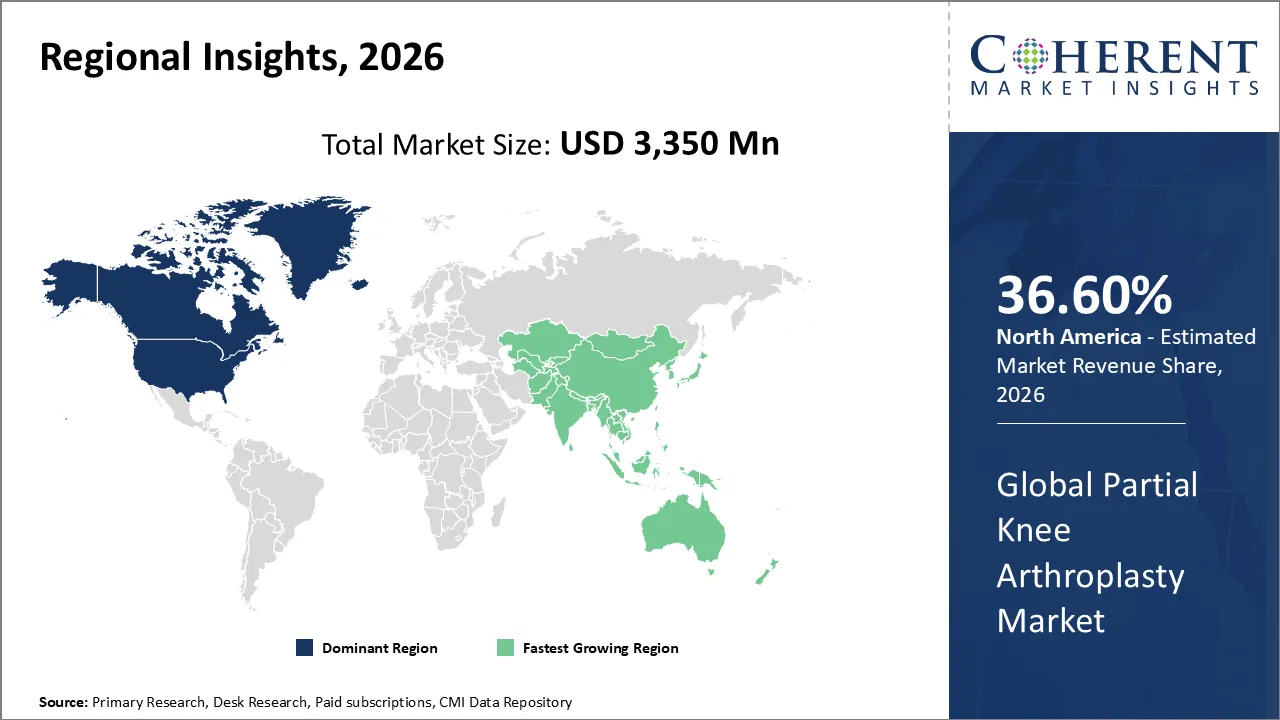
North America Partial Knee Arthroplasty Market Analysis & Trends
North America has remained the dominant region with 36.60% in 2026 of the global Partial Knee Arthroplasty Market over the past decade. The US is the center of this expansion, with surgeons increasingly prioritizing bone preservation and ligament retention. The adoption is fueled by the rollout of the 3D printed implants and patient-specific information, which solve traditional issues with component fit and alignment. These specialized tools have transformed the procedure from a niche option into a reliable, high-performance solution for localized joint damage.
A major catalyst for this growth is the shift of surgeries to ambulatory surgical centers. They align with the cost-saving requirements and efficiency objectives of outpatient facilities as partial replacements allow for same day discharge. High precision robotics have also reduced the technical difficulty, making the surgery more predictable for a broader range of practitioners. This shift is meeting the demands of active patients in their 40s and 50s who require faster recovery times to maintain athletic lifestyles while postponing total knee surgery.
For instance, in November 2024, Zimmer Biomet Holdings, Inc., a med tech firm, received U.S. FDA Premarket Approval Application (PMA) Supplement for the Oxford® Cementless Partial Knee. This innovation enables surgeons to conduct PKR with superior fixation, higher long-term implant survival rates, and greater operating room efficiency compared to the cemented version of the Oxford Partial Knee.
Asia Pacific Partial Knee Arthroplasty Market Analysis & Trends
The Asia Pacific market has become the fastest-growing region. Countries like India, Japan, and China are the leading contributors to this market. The region’s growth is owing to a massive number of patients with unicompartmental osteoarthritis and a growing middle class that can afford elective surgeries to stay active. The market is being reshaped by the introduction of Asian-specific patella designs which better accommodate the thinner patellas and unique bone morphology found in Asian populations compared to traditional Western models.
The region is becoming a hub for medical tourism, as high-precision robotic systems like Stryker's Mako are deployed in private hospital chains at a fraction of the cost found in North America. These factors, combined with a cultural preference for bone-preserving surgeries that allow for deeper flexion (essential for floor-based lifestyles), are cementing PKA as a primary choice for younger active patients across the region.
For instance, in January 2025, A J Hospital and Research Centre introduced a major advancement of using robots for joint replacement from Smith+Nephew US. The robotic system provides superior accuracy in joint replacement operations and results in better patient results and quicker healing times. IT incorporates sophisticated 3D imaging and live navigation features, enabling surgeons to develop customized surgical plans and position implants with exceptional precision. Notably, it’s the sole robot equipped to handle full knee, partial knee, and hip replacement surgeries.
Partial Knee Arthroplasty Market Outlook Country-Wise
The U.S. Partial Knee Arthroplasty Market Trends
The U.S. leads the world in performing partial knee replacement procedures, primarily because of its widespread access to cutting-edge medical technology and innovative surgical tools. Currently, demand for minimally invasive surgical procedures, those that enable patients to immediately return to their active lifestyles with minimal recovery time, is increasing dramatically among Americans seeking faster rehabilitation options. The baby boomer population, with its vast numbers and aging demographics, serves as a massive and reliable source of patients for the healthcare sector, which is actively seeking out procedures designed specifically to help them maintain their independence and quality of life. Robot-assisted technology has dramatically enhanced the precision of partial knee replacements, leading to superior outcomes and fewer complications. Major players in the orthopedic industry engage in stiff and intense competition with one another to develop and produce the best possible impact designs, advanced materials, and state-of-the-art technologies.
For instance, in January 2022, Smith+Nephew, a prominent international medical technology firm, revealed its purchase of Engage Surgical, which holds the right to the only commercially available cementless unicompartmental partial knee system in the US market. The Engage Surgical Partial Knee System represents an innovative, contemporary cementless option tailored for a growing field, offering advantages like enhanced long-term stability via biological bonding, reduced surgery duration, and compatibility with Ambulatory Surgery Centers (ASCs).
India Partial Knee Arthroplasty Market Trends
India’s market is exhibiting fast growth with increasing awareness of the partial knee arthroplasty treatment option among patients. The healthcare infrastructure in major cities has improved significantly, thus making cutting-edge orthopedic procedures accessible to the middle-class segment. Patients prefer partial knee arthroplasty because it is less invasive than total knee arthroplasty and allows for quicker recovery. The rising disposable incomes have resulted in more Indians affording these procedures without any financial strain. Insurance companies are expanding their coverage to include such surgeries, which helps in propelling the market adoption. Medical tourism has become an important revenue source as international patients travel to India for quality treatment at lower costs.
For instance, in January 2023, the world's first robotic-arm-assisted surgical system, Stryker Mako, was clinically introduced at Kokilaben Dhirubhai Ambani Hospital in Navi Mumbai. This cutting-edge ortho-robotic technology is designed for joint replacement surgery. The new robotic system was successfully utilized in its first two cases. The Mako robotic system, which has received approval from the US FDA, is applicable for total hip replacements, total knee replacements, and partial knee replacements.
Market Report Scope
Partial Knee Arthroplasty Market Report Coverage
| Report Coverage | Details | ||
|---|---|---|---|
| Base Year: | 2025 | Market Size in 2026: | USD 3,350 Mn |
| Historical Data for: | 2020 To 2024 | Forecast Period: | 2026 To 2033 |
| Forecast Period 2026 to 2033 CAGR: | 6.5% | 2033 Value Projection: | USD 5,205 Mn |
| Geographies covered: |
| ||
| Segments covered: |
| ||
| Companies covered: | Corin Group, Depuy Synthes (J&J), Exactech Inc., Lepu Medical Technology (Beijing) Co., Ltd., Medacta International, Stryker Corporation, Smith & Nephew Plc, Zimmer Biomet Holdings, B. Braun Medical (India) Pvt. Ltd., Gruppo Bioimpianti, Bodycad, Exactech, Inc., and Arthrex Inc. | ||
| Growth Drivers: |
| ||
| Restraints & Challenges: |
| ||
Partial Knee Arthroplasty Market Drivers
Rising prevalence of degenerative joint diseases
The global expansion of the market is fueled by the increasing incidence of degenerative joint diseases, including unicompartmental knee osteoarthritis and others. As the global population ages, the natural wear and tear on knee cartilage becomes more widespread, which leads to a surge in patients suffering from localized joint degradation. This demographic shift is compounded by rising obesity rates, which place excessive mechanical stress on the knee and often damage a single section of the joint while leaving other compartments healthy.
Unlike total knee replacement, partial knee arthroplasty offers a bone-preserving alternative that appeals to sedentary elderly patients and younger active individuals seeking quicker recovery plus more natural joint kinematics. This growing patient pool, along with a preference for minimally invasive surgical interventions, remains a primary driver for the growth of the market.
Osteoarthritis cases are expected to rise by 74.9% for knee, 78.6% for hip, and 95.1% for other types of osteoarthritis by 2050 compared to 2020, according to data from the National Library of Medicine.
Osteoarthritis cases are expected to rise significantly by 2050 compared to 2020, with an increase of 74.9% for knee osteoarthritis, 78.6% for hip osteoarthritis, and 95.1% for other types, according to data from the National Library of Medicine.
Partial Knee Arthroplasty Market Trends
Emergence of cementless implants
The emergence of cementless implants represents a significant advancement in the market for partial knee arthroplasty devices, as orthopedic specialists are increasingly focusing on biologic fixation as an alternative to mechanical fixation. The modern implants exhibit a highly porous surface designed to replicate the structure of natural bones. As a result, orthopedic specialists favor biologic fixation as a means to enhance the implant interface, enabling it to withstand the stresses associated with an active lifestyle. For younger patients specifically, conserving native bones is an important factor because it may lower the risk of aseptic loosening caused by degraded cement. Cementless implants simplify surgery since there is no need to prepare cement or wait for it to cure. Additionally, traditional cement fixation carries the risk of thermal tissue damage.
For instance, in June 2022, global medtech leader Smith+Nephew revealed that Dr. Cyna Khalily, an orthopedic expert in hip and knee reconstructive surgery based in Louisville, KY, completed the inaugural robotic-assisted surgery using the LEGION CONCELOC Cementless Total Knee System.
Analyst Opinion (Expert Opinion)
The partial knee arthroplasty (PKA) market is supported by clear epidemiological demand and improving clinical outcomes in appropriately selected patients. Knee osteoarthritis remains a major cause of mobility impairment worldwide, with evidence suggesting that 10–15% of adults above 60 years experience symptomatic disease requiring surgical consideration. Among these patients, approximately 15–30% present with unicompartmental knee osteoarthritis, making them clinically suitable candidates for partial knee replacement rather than total knee arthroplasty.
Registry-based evidence from developed healthcare systems indicates a steady rise in unicompartmental knee procedures, with PKA accounting for up to one-quarter of primary knee arthroplasties in high-adoption centers. Clinical outcome studies consistently report shorter hospital stays, faster functional recovery, and improved range of motion compared with total knee replacement, contributing to higher patient satisfaction rates. Advances in implant geometry, fixation techniques, and bearing surfaces have improved survivorship, while robotic-assisted surgery and patient-specific instrumentation have enhanced alignment accuracy and reduced early revision risk.
Demographic trends further support market expansion, particularly among the 55–75 year age group, where demand for quicker rehabilitation and preservation of natural joint kinematics is high. However, adoption remains uneven due to surgeon training requirements and variability in reimbursement policies. Overall, strong procedural data, favorable functional outcomes, and technological integration position the partial knee arthroplasty market for sustained, evidence-driven growth.
Speak to the analyst
Want personalized insights?
Take the findings above to one of our principal consultants, or have the report rebuilt around the segments, geographies and competitors you actually track.
Partial Knee Arthroplasty Industry News
- In January 2026, Palm Beach Gardens Medical Center stands out as the only hospital in South Florida to have obtained two 4th Generation Mako SmartRobotics systems. The hospital uses these systems for total knee, partial knee, total hip, and hip revision procedures. Mako SmartRobotics™ enables surgeons to gain more insights and perform with less invasive techniques, thereby revolutionizing the approach to joint replacements.
- In March 2025, During the American Academy of Orthopaedic Surgeons’ (AAOS) 2025 Annual Meeting in San Diego, Stryker highlighted the newest advancements in its Mako SmartRobotics™ platform for hip, knee, spine, and shoulder surgeries. The system has now supported more than 1.5 million procedures worldwide across 45 countries, establishing it as a frontrunner in orthopaedics.
- In June 2024, Johnson & Johnson MedTech made an announcement that DePuy Synthes, its Orthopaedics division, secured clearance from the FDA for using the VELYS™ Robotic-Assisted Solution in Unicompartmental Knee Arthroplasty (UKA) procedures.
- In May 2024, OrthAlign, Inc., a pioneer in surgical innovations, rolled out its premier of Lantern Handheld Technology for Total, Partial, and Revision Knee Arthroplasty in Japan. The rollout is spearheaded by its long-term distributor, a partner since 2013 that has facilitated more than 68,000 OrthAlign procedures. This move highlights a key achievement in their ongoing collaboration and worldwide growth strategy.
Market Segmentation
- Implant Type Insights (Revenue, USD Mn, 2026 - 2033)
- Fixed Bearing
- Mobile Bearing
- Medical Pivot
- Posterior Cruciate Ligament Retaining (Non-constrained)
- Posterior Cruciate Ligament Substituting (Constrained)
- Gender Specific
- End Use r Insights (Revenue, USD Mn, 2026 - 2033)
- Hospitals
- Orthopedic Clinics
- Ambulatory Surgical Centers
- Others
- Regional Insights (Revenue, USD Mn, 2026 - 2033)
- North America
- U.S.
- Canada
- Latin America
- Brazil
- Argentina
- Mexico
- Rest of Latin America
- Europe
- Germany
- U.K.
- France
- Italy
- Russia
- Rest of Europe
- Asia Pacific
- China
- India
- Japan
- Australia
- South Korea
- ASEAN
- Rest of Asia Pacific
- Middle East
- GCC
- Israel
- Rest of Middle East
- Africa
- North Africa
- Central Africa
- South Africa
- Key Players Insights
- Corin Group
- Depuy Synthes (J&J)
- Exactech Inc.
- Lepu Medical Technology (Beijing) Co., Ltd.
- Medacta International
- Stryker Corporation
- Smith & Nephew Plc
- Zimmer Biomet Holdings
- B. Braun Medical (India) Pvt. Ltd.
- Gruppo Bioimpianti
- Bodycad
- Exactech, Inc.
- Arthrex Inc.
Sources
Primary Research Interviews
- Orthopedic Surgeons (Knee & Joint Replacement Specialists)
- Arthroplasty Device Manufacturers
- Implant Design & Biomaterials Engineers
- Hospital Orthopedic Department Heads
- Ambulatory Surgery Center Administrators
- Rehabilitation & Sports Medicine Specialists
- Others
Databases
- PubMed / MEDLINE
- Embase
- GlobalData Healthcare
- S&P Global Market Intelligence
- Bloomberg Terminal
- Thomson Reuters Eikon
- Others
Magazines
- Orthopedics Today
- AAOS Now
- Medical Device Network Magazine
- Becker’s Orthopedic Review
- Hospital & Healthcare Management
- Others
Journals
- Journal of Arthroplasty
- Knee Surgery, Sports Traumatology, Arthroscopy (KSSTA)
- Clinical Orthopaedics and Related Research
- The Bone & Joint Journal
- Journal of Orthopaedic Research
- Others
Newspapers
- Financial Times – Healthcare & Medical Devices
- The Wall Street Journal – Health
- Reuters Health
- Bloomberg News – Healthcare
- The Economic Times – Healthcare
- Others
Associations
- American Academy of Orthopaedic Surgeons (AAOS)
- International Society of Arthroscopy, Knee Surgery and Orthopaedic Sports Medicine (ISAKOS)
- European Federation of National Associations of Orthopaedics and Traumatology (EFORT)
- Knee Society
- Orthopaedic Research Society (ORS)
- Others
Public Domain Sources
- World Health Organization (WHO)
- U.S. Food and Drug Administration (FDA) – Medical Devices
- National Institutes of Health (NIH)
- Centers for Medicare & Medicaid Services (CMS)
- European Commission – Medical Device Regulation (MDR)
- Others
Proprietary Elements
- CMI Data Analytics Tool
- Proprietary CMI Existing Repository of Information for the Last 8 Years
Definition: The Partial Knee Arthroplasty Market encompasses unicompartmental knee osteoarthritis systems such as specialized implants, robot-assisted instrumentation, and resurfacing components for the medial, lateral, and patellofemoral compartments affected by isolated osteoarthritis. These minimally invasive solutions are widely used by orthopedic surgeons for patients with isolated osteoarthritis, thus preserving healthy bone and ligaments unlike total knee replacements. Partial knee replacements reduce recovery time, pain, and complications while improving joint function and mobility. Demand primarily comes from aging populations, orthopedic clinics, hospitals, and ambulatory surgery centers facing rising osteoarthritis cases and preferences for joint-preserving surgeries.
Get access to 250+ pages report
Every segment, forecast, competitor profile and data table behind the analysis above — available for instant download.
- ESOMAR Member
- ISO 9001:2015 Certified
- D-U-N-S Registered
- GDPR & CCPA Compliant
Missing comfort of reading report in your local language? Find your preferred language:
Transform your Strategy with Exclusive Trending Reports
Frequently Asked Questions
The Partial Knee Arthroplasty Market is estimated to be valued at USD 3,350 Mn in 2026, and is expected to reach USD 5,205 Mn by 2033.
The CAGR of the Partial Knee Arthroplasty Market is projected to be 6.5% from 2026 to 2033.
The increasing launches and approvals of knee systems are the major factors driving the growth of the Partial Knee Arthroplasty Market.
The high cost of implants and procedures and limited availability of skilled surgeons are the major factors hampering the growth of the Partial Knee Arthroplasty Market.
In terms of implant type, the Fixed Bearing segment is estimated to dominate the market revenue share in 2026.
Corin Group, Depuy Synthes (J&J), Exactech Inc., Lepu Medical Technology (Beijing) Co., Ltd., Medacta International, Stryker Corporation, Smith & Nephew Plc, Zimmer Biomet Holdings, B. Braun Medical (India) Pvt. Ltd., Gruppo Bioimpianti, Bodycad, Exactech, Inc., and Arthrex Inc. are the major players.
North America is expected to lead the Partial Knee Arthroplasty Market in 2026.