

Polymer Coated Fabrics Market Size and Share Analysis - 2026 To 2033
The Polymer Coated Fabrics Market size is anticipated to grow at a CAGR of 5.2%, with USD 25.12 Bn in 2026 and is expected to reach approximately USD 35.82 Bn in 2033. The primary drivers are largely defined by the increasing use of polymer-coated fabrics in automotive interiors and transportation applications, rising demand for durable and weather-resistant materials, growing utilization of protective clothing, and expanding construction and infrastructure activities. According to the European Automobile Manufacturers’ Association (ACEA) estimates that in 2024 there were some 256 million passenger cars, 31.1 million vans and 6.2 million trucks on EU roads, a large installed transportation base that requires durable interior, seating, cover and protective materials.
Key Takeaways
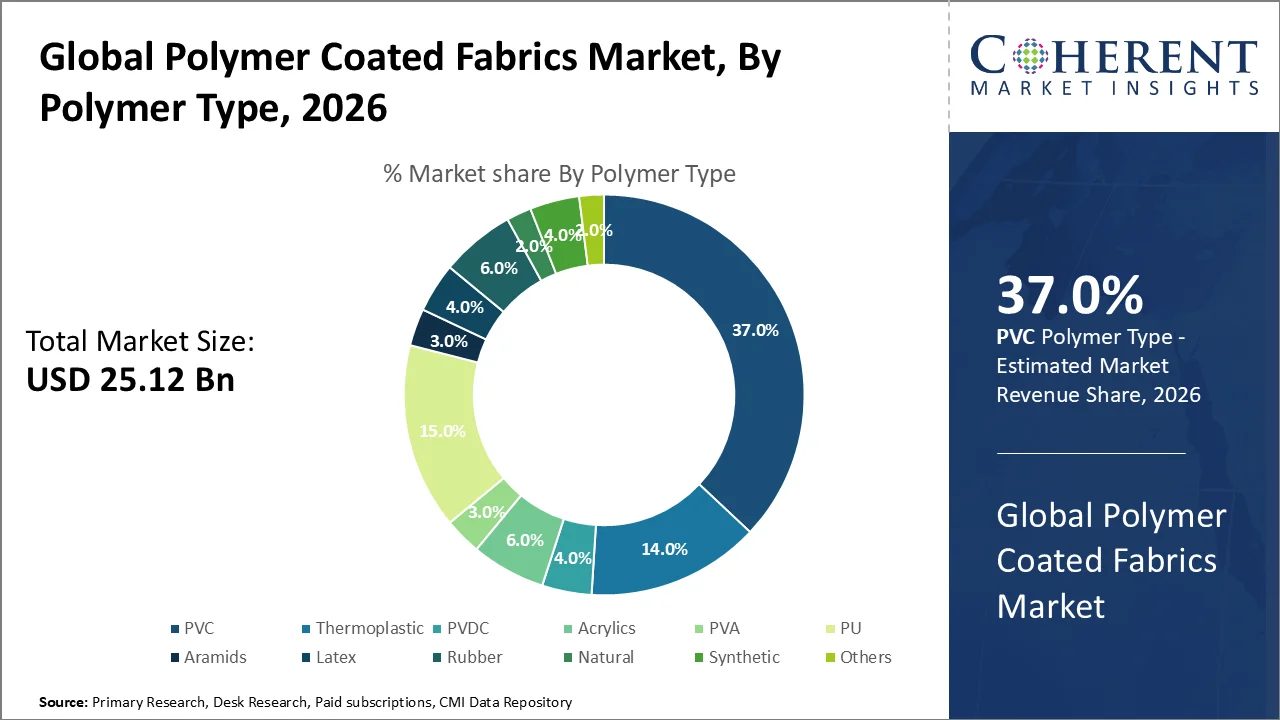
- The PVC segment is likely to dominate the polymer type category with approximately 37.0% in 2026. The segment’s growth is owing to its cost-effectiveness, high abrasion and water resistance, easy weldability, flexibility, and extensive use in transportation covers, architectural membranes, industrial fabrics, and protective applications. Around 765,972 tonnes of PVC waste were recycled in Europe in 2025, representing an increase of 5.7% compared with 2024, while converters registered 508,109 tonnes of recycled PVC uptake during the year.
- The woven segment is expected to lead the material type category with approximately 54.5% in 2026. The segment’s growth is owing to the superior tensile and tear strength of woven substrates, dimensional stability, ability to withstand repeated mechanical stress, and suitability for polymer coating in tarpaulins, transportation fabrics, architectural structures, and industrial applications. According to Textile Exchange, global fiber production reached approximately 132 million tonnes in 2024, increasing from 125 million tonnes in 2023, while polyester represented 59% of total global fiber production, equivalent to approximately 78 million tonnes.
- The transportation segment is set to dominate the application category with approximately 33.0% in 2026. The segment’s growth is owing to increasing use of coated fabrics in vehicle interiors, railway seating, aircraft interiors, marine upholstery, truck covers, and other applications requiring lightweight, weather-resistant, abrasion-resistant, and easy-to-clean surfaces. According to the International Air Transport Association (IATA), global passenger demand increased 5.3% in 2025, while airline capacity expanded 5.2%, and the global passenger load factor reached a record 83.6%.
- The automobile segment is anticipated to lead the end-use industry category with approximately 40.5% in 2026. The segment’s growth is owing to widespread utilization of coated fabrics in airbags, seat upholstery, door trims, headliners, tonneau covers, convertible roofs, and other interior and protective applications. According to the International Organization of Motor Vehicle Manufacturers (OICA), global motor vehicle production increased 3.9% from 92.7 million units in 2024 to 96.4 million units in 2025, while worldwide vehicle sales increased 4.7% to 99.8 million units.
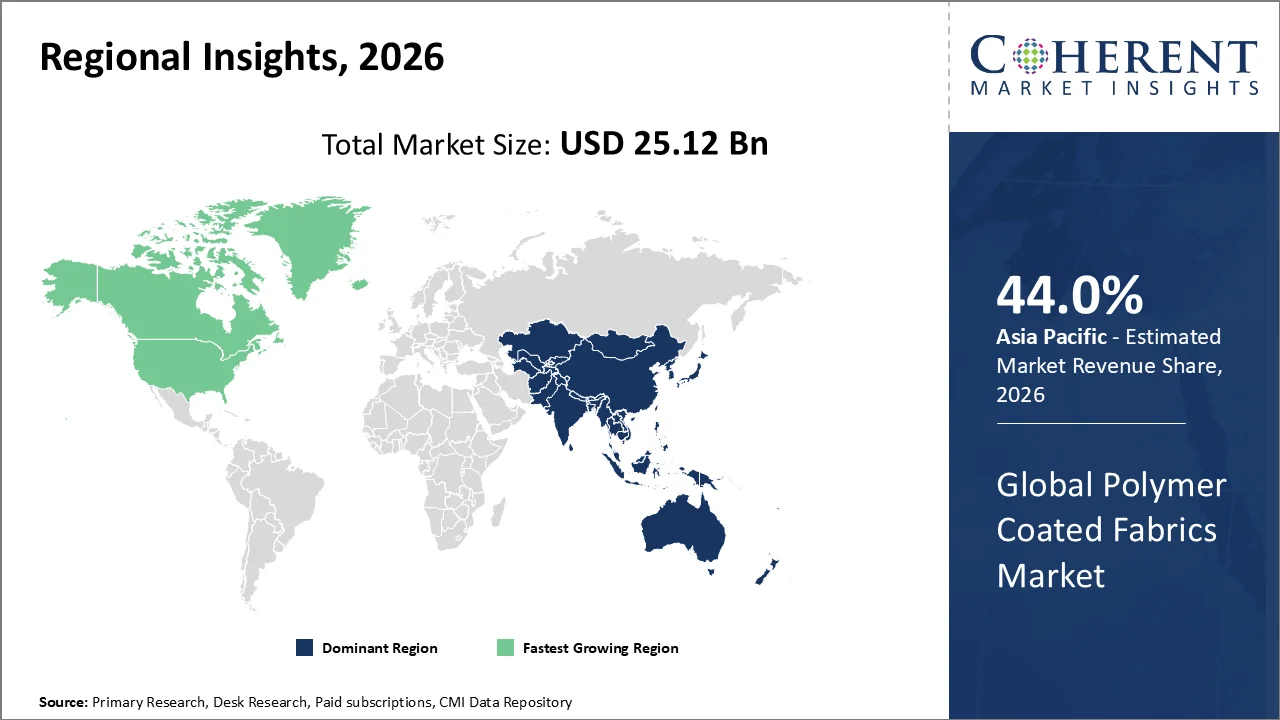
- Asia Pacific is expected to acquire the prominent regional share of approximately 44.0% in 2026. The region’s growth is owing to its large textile and polymer-processing base, expanding automobile manufacturing, rapid industrialization, infrastructure development, and high concentration of manufacturing activity across China, India, Japan, South Korea, and Southeast Asia. According to UNIDO, Asia and Oceania accounted for approximately 57.2% of global manufacturing value added and 47.2% of global manufactured exports.
Market Drivers
Expansion in Transportation and Aircraft Production is Accelerating Demand for High-Performance Coated Fabrics
The Polymer Coated Fabrics Market is gaining significant momentum from the expansion and modernization of the global transportation fleet. Polymer coated fabrics combine abrasion resistance, flexibility, light weight, moisture resistance, flame retardant properties and easy to clean surfaces, making them suitable for aircraft seating and interior surfaces, automotive upholstery, railroad interiors, truck covers, marine applications and other transportation components.
The commercial aerospace sector is especially strong in terms of production activity. Airbus delivered 418 commercial aircraft to 82 customers in the first seven months of 2026, it said in July. Airbus also recorded 886 gross orders for commercial aircraft in the first half of 2026 alone, compared with 494 aircraft in H1 2025, indicating a still expanding aircraft production pipeline.
Rising Defense Expenditure is Strengthening Demand for Durable and Protective Coated Fabrics
Another major driver for the Polymer Coated Fabrics Market is the increasing defense procurement and modernization programs. Military applications require materials that can function in extreme weather, abrasion, moisture, UV exposure, chemical contact, and repeated mechanical stress. Hence, fabrics with a polymer coating are widely used in military shelters, tents, vehicle covers, inflatable structures, protective clothing, covers for equipment, storage systems and field infrastructure.
According to the Stockholm International Peace Research Institute (SIPRI) said global military expenditure reached a record USD 2.887 trillion in 2025, an increase of 2.9% in real terms and the 11th consecutive year of growth in worldwide defense spending. Europe saw a particularly strong 14% rise to USD 864 billion. Military spending across Asia and Oceania rose 8.1% to USD 681 billion.
Current Events and Their Impact on the Polymer Coated Fabrics Market
Current Event | Description and its Impact |
California Implements PFAS Restrictions for Textile Articles (2025) |
|
EU Advances Broad PFAS Restriction under REACH (2026) |
|
- Current Industry Events of 2026
- Market Size Estimation
- Regional Breakdown
- Competitive Landscape
- Customer Intelligence
- Segmental Analysis
- Pricing Analysis
- Key Market Drivers, Challenges & Future Trends
- Customized Insights Section
Segmental Insights
Why is PVC Acquiring the Largest Share?
On the basis of polymer type, the PVC segment is projected to account for the largest Polymer Coated Fabrics Market share of approximately 37.0% in 2026. The segment’s dominance is owing to PVC’s cost-effectiveness, flexibility, abrasion resistance, waterproofing capability, chemical resistance, and ease of welding and fabrication. These properties support extensive use in tarpaulins, truck covers, awnings, architectural membranes, protective covers, upholstery, and other industrial coated fabrics.
According to the European Council of Vinyl Manufacturers (ECVM) says total world consumption of PVC resin is now over 40 million tons a year and more than 4.5 million tons are consumed each year in the EU-27, U.K., Norway and Switzerland. PVC represents around 10% of total plastics use in Europe which is a significant downstream processing base.
Why does Woven Fabric Hold the Largest Material Type Share?
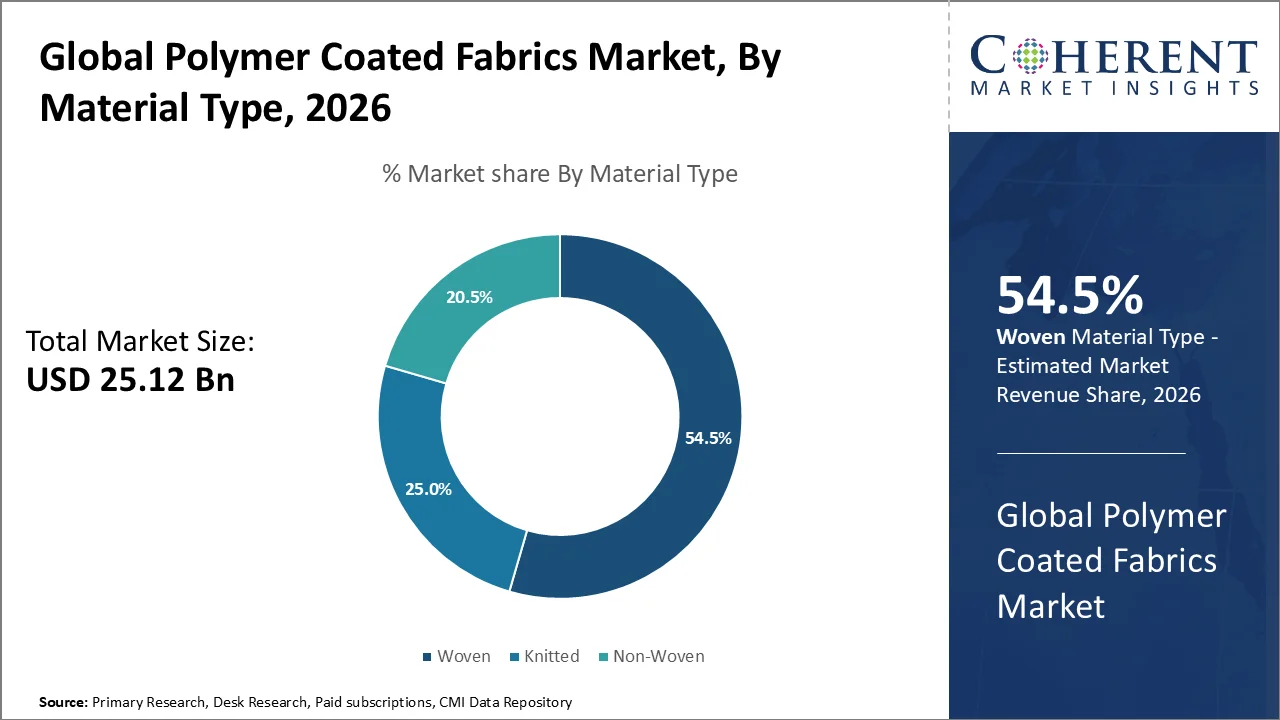
On the basis of material, the woven segment is projected to lead the polymer coated fabrics market with the largest share of 54.5% in 2026. Woven substrates, with their interlaced warp-and-weft construction, provide high tensile strength, tear resistance, dimensional stability and load bearing capability. These properties make them particularly suitable for transportation covers, architectural membranes, industrial curtains, protective structures, inflatable products and heavy-duty technical fabrics.
According to the International Textile Manufacturers Federation (ITMF), around 164,000 shuttle-less looms were shipped worldwide in 2025, with Asia & Oceania accounting for 95% of global deliveries. China received about 95,000 units and India around 52,000 units, demonstrating the considerable manufacturing infrastructure supporting woven-fabric production.
ITMF also reported that deliveries of rapier and projectile looms to India increased 21% in 2025. Such looms are commonly suited to a broad range of woven constructions, including heavier and technical fabrics, supporting the availability of strong woven substrates required for subsequent polymer coating and finishing.
Why is Transportation Acquiring the Largest Application Share?
On the basis of application, the transportation segment is projected to hold the largest Polymer Coated Fabrics Market share of approximately 33.0% in 2026. The segment’s dominance is owing to widespread use of coated fabrics in automotive upholstery, aircraft interiors, railway seating, marine applications, truck covers, cargo protection, and other transportation components requiring lightweight, flexible, abrasion-resistant, flame-resistant, and easy-to-clean materials.
In 2026 Commercial Market Outlook, Boeing projects that the global commercial aircraft fleet will expand by nearly 80% to more than 50,000 airplanes by 2045, requiring almost 44,000 new aircraft deliveries during 2026–2045. Approximately half of these deliveries are expected to
Why does the Automobile Segment Hold the Largest End-use Industry Share?
On the basis of end-use industry, the automobile segment is anticipated to lead the Polymer Coated Fabrics Market with approximately 40.5% in 2026. The segment’s growth is owing to extensive use of coated technical fabrics in seat upholstery, airbags, door panels, dashboard coverings, headliners, convertible roofs, tonneau covers, and vehicle-protection components. Polymer coatings provide the abrasion resistance, flexibility, appearance retention, moisture protection, and cleanability required in automotive environments.
According to the China Association of Automobile Manufacturers (CAAM), China produced 34.531 million vehicles in 2025, an increase of 10.4% year-on-year, while vehicle sales reached 34.4 million units, rising 9.4%. China remained the world’s largest automobile producer and seller for the 17th consecutive year.
Polymer Coated Fabrics Market Trends
- The growing shift toward PFAS-free polymer coatings is accelerating reformulation across upholstery, outdoor fabrics, protective textiles, and other coated-fabric applications. In June 2026 the EU-funded ZeroF project announced the successful development and pilot-scale demonstration of PFAS-free textile coatings based on silane-based organic-inorganic hybrids that provide high water repellency and abrasion resistance and progress toward improved oil repellency.
- The increasing use of bio-based polyurethane, silicone and other low carbon coating chemistries is influencing product development in technical textiles. The EU-funded BLUECOAT project, launched in 2026, is developing 12 bio-based and low-carbon coating formulations for textile, marine and construction applications, such as bio-based PU, bio-based silicone, PLA and natural-fibre systems. The project targets greenhouse-gas emissions of around 45% lower from the developed coating solutions.
- Increasing attention to multi-functional coated fabrics is leading manufacturers to combine water repellency with abrasion resistance, antimicrobial protection, self-cleaning properties and improved durability. The EU-funded BIO-SUSHY project reported in 2025 that its PFAS-free hybrid textile coatings containing approximately 5–46% bio-based content achieved hydrophobic and oleophobic functionality while matching conventional PFAS technologies in key repellency and durability characteristics.
Regional Insights
 Asia Pacific Dominates Owing to the Large Technical Textile Manufacturing Base and Expanding Industrial Applications
Asia Pacific is expected to account for the prominent 44.0% share of the Polymer Coated Fabrics Market in 2026. The region’s dominance is owing to its extensive textile-processing capacity, large automotive and industrial manufacturing base, rapid infrastructure development, and increasing production of technical textiles used in transportation, protective clothing, construction, industrial covers, and other coated-fabric applications.
India provides a strong indication of this regional technical-textile capacity.
In February 2026, the Government of India approved 16 additional research projects under the National Technical Textiles Mission focusing on high-performance fibers, functional textiles, protective gear, composite systems, and industrial applications.
North America is Expected to be the Fastest-Growing Region Owing to Advanced Technical Textile Manufacturing and Transportation Investment
North America is expected to witness the fastest growth in the Polymer Coated Fabrics Market over the forecast period. Regional growth is supported by the strong U.S. technical-textile manufacturing base, high demand for performance materials in automotive, defense, transportation, industrial, and infrastructure applications, and increasing investment in advanced domestic manufacturing.
Canada is also strengthening the region’s transportation manufacturing base. On February 2026, the Government of Canada announced that it will invest up to CAD 3 billion from the Strategic Response Fund and up to CAD 100 million from the Regional Tariff Response Initiative to support automotive assembly, parts manufacturing, electrification, automation and connected-vehicle technologies.
Strong Technical Textile Manufacturing and Shift Toward PFAS-Free Coatings are Accelerating the Polymer Coated Fabrics Market in the United States
The U.S. Polymer Coated Fabrics Market is steadily growing owing to the established technical-textile and polymer-processing infrastructure in the country, high demand for durable fabrics across transportation, defense, industrial equipment, architectural applications and protective products, and increasing development of safer coating chemistries.
The recent U.S. manufacturing activity continues to offer a sizable downstream base. U.S. manufacturing production rose 0.2% in July 2026, and output from textile and product mills also increased in the month, according to the Federal Reserve. Overall manufacturing capacity utilization reached 76.0% in July 2026.
Large Textile and Polymer Production Capacity is Strengthening the Polymer Coated Fabrics Market in China
China is expected to remain one of the most important national markets for polymer-coated fabrics owing to its large textile-manufacturing ecosystem, substantial chemical-fiber capacity, expanding polymer-processing industry, and strong demand from automotive, transportation, construction, industrial, and technical-textile applications.
Government policy is further pushing the textile industry toward higher-performance and sustainable materials. In March 2026, China's Ministry of Industry and Information Technology, Ministry of Ecology and Environment, and State Administration for Market Regulation introduced the Textile Industry Optimization and Upgrading Action Plan (2026–2028).
Who are the Major Companies in Polymer Coated Fabrics Industry
Some of the major key players in Polymer Coated Fabrics Market are Continental AG, Saint Gobain SA, Sioen Industries, Spradling International Inc., Takata Corporation, Colmant Coated Fabrics, Serge Ferrari Group, Trelleborg AB, SRF Limited, Seaman Corporation.
Key News
- In May 2026, Trelleborg AB opened a new advanced extrusion-coating manufacturing facility in Forest City, North Carolina. The facility supports engineered coated fabrics for aerospace, healthcare, safety, protection, and industrial applications and includes both pilot-scale R&D and full-scale production capabilities.
- In April 2026, Sioen Industries expanded its Sioline coated-fabric portfolio for transport, tensile architecture, tents, military, and other technical textile applications. The expanded offering strengthens the company’s position in high-performance polymer-coated fabrics across industrial and outdoor end uses.
Market Report Scope
Polymer Coated Fabrics Market Report Coverage
| Report Coverage | Details | ||
|---|---|---|---|
| Base Year: | 2025 | Market Size in 2026: | USD 25.12 Bn |
| Historical Data for: | 2020 To 2024 | Forecast Period: | 2026 To 2033 |
| Forecast Period 2026 to 2033 CAGR: | 5.2% | 2033 Value Projection: | USD 35.82 Bn |
| Geographies covered: |
| ||
| Segments covered: |
| ||
| Companies covered: | Continental AG, Saint Gobain SA, Sioen Industries, Spradling International Inc., Takata Corporation, Colmant Coated Fabrics, Serge Ferrari Group, Trelleborg AB, SRF Limited, Seaman Corporation. | ||
| Growth Drivers: |
| ||
| Restraints & Challenges: |
| ||
Analyst Opinion
- The Polymer Coated Fabrics Market is expected to increasingly shift from conventional commodity coatings toward high-performance, safer, and more sustainable formulations. In March 2026, the European Commission revised its Safe and Sustainable by Design framework, encouraging manufacturers to substitute or minimize substances of concern across the complete lifecycle of chemicals and advanced materials. Moreover, Horizon Europe’s 2026 program allocated an indicative EUR 38 million for developing safe and sustainable alternatives to substances of concern, explicitly covering technical textiles among the targeted application areas.
- Circularity is expected to become an increasingly important competitive differentiator, particularly for coated fabrics where bonded polymer-textile structures can complicate recycling. The European Environment Agency reported that EU Member States generated approximately 6.94 million tonnes of textile waste, while around 85% of household textile waste was not separately collected and instead entered mixed waste streams.
- Publicly funded textile innovation is also expected to improve the commercialization pathway for next-generation polymer-coated fabrics. Under the Horizon Europe 2026–2027 Work Programme, the European Commission has earmarked an indicative EUR 16 million for textile circularity through advanced processing and manufacturing technologies, with expected EU contributions of approximately EUR 4–6 million per project.
Speak to the analyst
Want personalized insights?
Take the findings above to one of our principal consultants, or have the report rebuilt around the segments, geographies and competitors you actually track.
Market Segmentation
- By Polymer Type (Revenue, USD Bn, 2021-2033)
- Thermoplastic
- PVC
- PVDC
- Acrylics
- PVA
- PU
- Aramids
- Latex
- Rubber
- Natural
- Synthetic
- Others
- By Material Type (Revenue, USD Bn, 2021-2033)
- Knitted
- Woven
- Non-Woven
- By Application (Revenue, USD Bn, 2021-2033)
- Protective Clothing
- Transportation
- Industrial
- Furniture & Seating
- Others
- By End Use Industry (Revenue, USD Bn, 2021-2033)
- Automobile
- Aerospace
- Marine
- Chemical Processing
- Military
- Others
- By Region (Revenue, USD Bn, 2021-2033)
- North America
- U.S.
- Canada
- Latin America
- Brazil
- Mexico
- Argentina
- Rest of Latin America
- Europe
- Germany
- U.K.
- France
- Italy
- Spain
- Russia
- Rest of Europe
- Asia Pacific
- China
- India
- Japan
- Australia
- South Korea
- ASEAN
- Rest of Asia Pacific
- Middle East
- GCC
- Israel
- Rest of Middle East
- Africa
- South Africa
- Central Africa
- North Africa
- North America
Sources
Primary Research Interviews
- Polymer coated fabric manufacturers
- PVC, PU, acrylic, and specialty polymer suppliers
- Technical textile and woven fabric manufacturers
- Coating, laminating, and textile finishing companies
- Automotive and transportation component suppliers
- Aerospace, marine, defense, and industrial procurement managers
- Distributors and converters of coated technical fabrics
- Technical textile and polymer coating industry experts
Databases
- World Bank
- Organisation for Economic Co-operation and Development (OECD)
- UN Comtrade Database
- Eurostat
- U.S. Census Bureau
- United Nations Industrial Development Organization (UNIDO)
- International Trade Centre (ITC) Trade Map
Magazines
- Textile World
- Innovation in Textiles
- Technical Textiles International
- Specialty Fabrics Review
- Textile Technology
- CompositesWorld
Journals
- Journal of Industrial Textiles
- Textile Research Journal
- Progress in Organic Coatings
- Journal of Coatings Technology and Research
- Polymer Testing
- Polymers
- Journal of Applied Polymer Science
Newspapers
- Financial Times
- The Wall Street Journal
- Reuters
- The Economic Times
- The Guardian
Associations
- Advanced Textiles Association (ATA)
- International Textile Manufacturers Federation (ITMF)
- European Apparel and Textile Confederation (EURATEX)
- National Council of Textile Organizations (NCTO)
- European Council of Vinyl Manufacturers (ECVM)
- VinylPlus
- Textile Exchange
- PlasticsEurope
Public Domain Sources
- Company Annual Reports and Investor Presentations
- Government Textile, Polymer, and Manufacturing Statistics
- Customs, Import–Export, and Trade Publications
- Environmental and Chemical Regulatory Publications from EPA and ECHA
- Patent Databases such as WIPO, USPTO, and Google Patents
- Technical Textile Research and University Publications
- Product Launches, Capacity Expansion Announcements, and Company Press Releases
- Standards and Certification Publications related to coated fabrics, chemical safety, flame resistance, and textile performance
Proprietary Elements
- CMI Data Analytics Tool
- Proprietary CMI Existing Repository of Information for the Last 10 Years
Get access to 250+ pages report
Every segment, forecast, competitor profile and data table behind the analysis above — available for instant download.
- ESOMAR Member
- ISO 9001:2015 Certified
- D-U-N-S Registered
- GDPR & CCPA Compliant
Missing comfort of reading report in your local language? Find your preferred language:
Transform your Strategy with Exclusive Trending Reports
Frequently Asked Questions
The Polymer Coated Fabrics Market is expected to reach approximately USD 35.82 Bn in 2033, increasing from USD 25.12 Bn in 2026.
Major players operating in the global Polymer Coated Fabrics Market include Continental AG, Saint Gobain SA, Sioen Industries, Spradling International Inc., Takata Corporation, Colmant Coated Fabrics, Serge Ferrari Group, Trelleborg AB, SRF Limited, and Seaman Corporation.
The stringent environmental regulations governing coating chemicals, volatility in polymer and textile raw-material prices, recycling complexity of multilayer coated fabrics, and increasing reformulation requirements are key factors hampering market growth.
The increasing adoption of polymer-coated fabrics in automotive and transportation applications, together with rising demand for durable, abrasion-resistant, weather-resistant, and protective technical fabrics, is boosting market growth.
The Polymer Coated Fabrics Market is anticipated to grow at a CAGR of 5.2% between 2026 and 2033.
Asia Pacific is expected to dominate the global Polymer Coated Fabrics Market with approximately 44.0% share in 2026. The region benefits from extensive textile-processing capacity, large automotive and industrial manufacturing bases, infrastructure development, and strong technical-textile production across China, India, Japan, South Korea, and Southeast Asia.
Polymer coated fabrics are woven, knitted, or non-woven textile substrates coated or laminated with polymers to improve properties such as water resistance, abrasion resistance, chemical resistance, flexibility, durability, flame performance, and weatherability. They are widely used where conventional fabrics require additional surface protection and functional performance.