

Skin Fibrosis Treatment Market Size and Share Analysis: 2026 - 2033
The global skin fibrosis treatment market size is estimated to reach USD 796 Mn in 2026 and is projected to grow at a compound annual growth rate (CAGR) of 6.9% during the forecast period (2026-2033), surpassing USD 1,267 Mn by 2033. This is attributable to rising prevalence of skin disorders and fibrosis-related complications, along with growing demand for anti-fibrotic therapies for skin.
Key Takeaways from the Skin Fibrosis Treatment Market Report
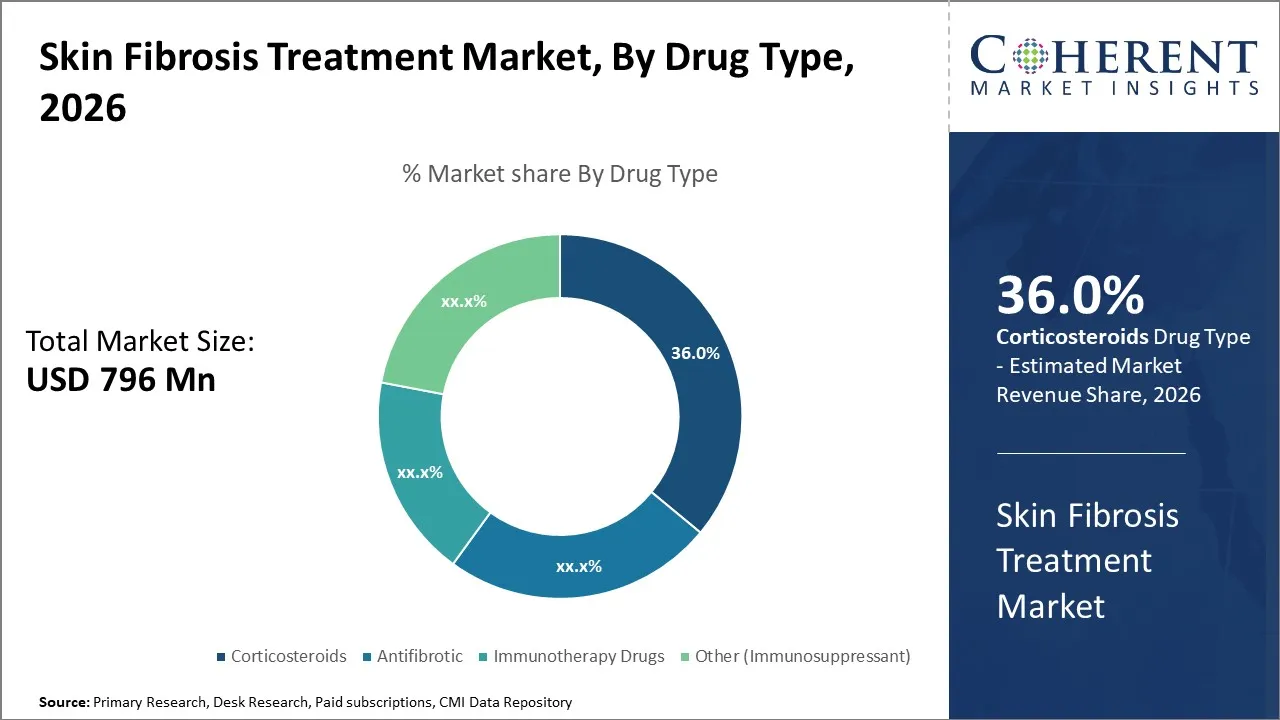
- Based on drug type, corticosteroids segment is expected to dominate the market with a revenue share of more than 36% in 2026, thanks to their common clinical use in reducing inflammation and slowing the progression of skin fibrosis.
- By route of administration, oral segment is slated to account for a market share of 60% in 2026, owing to patient preference for convenient oral formulations of immunosuppressants and antifibrotic agents.
- Hospital Pharmacies segment is likely to dominate the skin fibrosis treatment market with a share of 40% in 2026 as a result of complex diagnostics and specialty prescriptions.
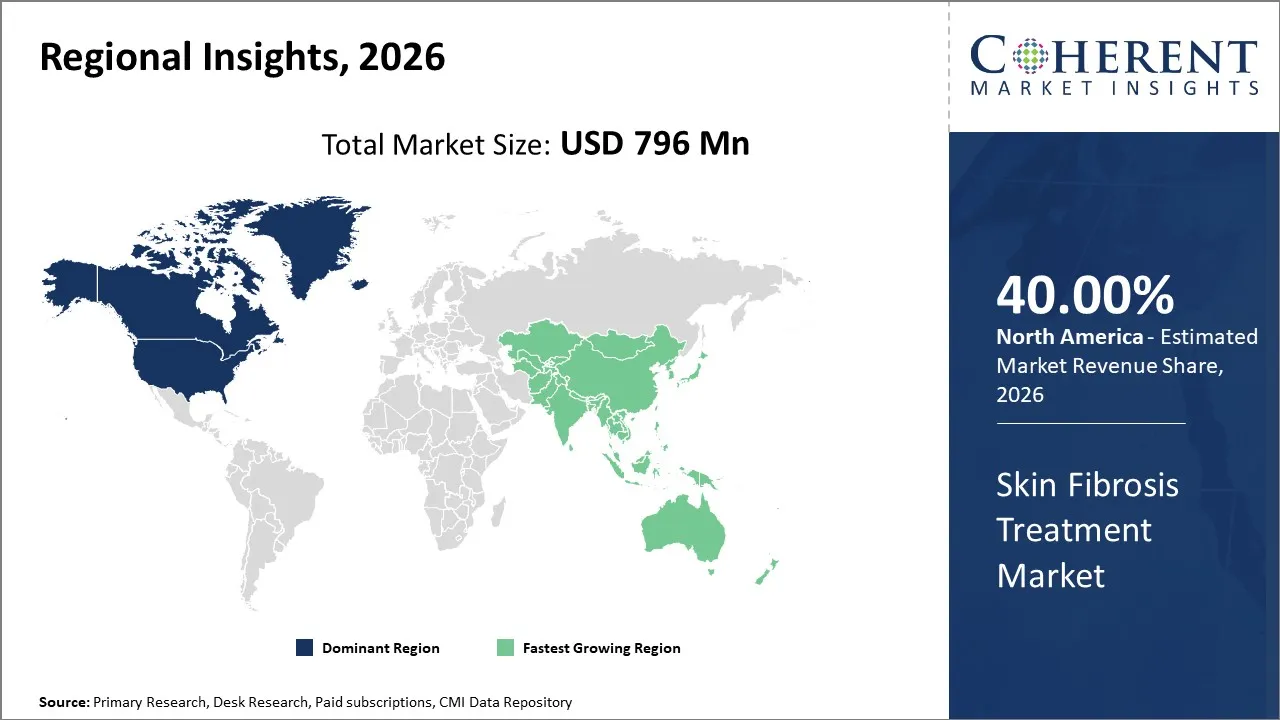
- North America is expected to lead the global skin fibrosis treatment industry, capturing a share of 40% in 2026, mostly due to high prevalence of chronic skin conditions, increasing awareness and early diagnosis of skin fibrosis, and adoption of advanced drug therapies like corticosteroids and antifibrotic agents.
- Asia Pacific, with a share of 22% in 2026, is anticipated to emerge as the fastest growth market for skin fibrosis treatments during the forecast period, owing to improving healthcare access, expanding patient pool, and increasing awareness about innovative therapies for skin fibrosis.
Skin Fibrosis Treatment Market Overview
The global skin fibrosis treatment market is projected to grow steadily during the forecast period. This is mostly due to increasing prevalence of skin fibrosis disorders, rising awareness about early diagnosis and treatment, and growing adoption of advanced therapeutic options. In addition, the expansion of healthcare infrastructure, shift towards non-invasive skin fibrosis therapies, and rising geriatric population are supporting market expansion.
Skin fibrosis is a critical clinical condition that can lead to serious disability and increased morbidity. It occurs in both skin-restricted and systemic disorders, including localized scleroderma, systemic sclerosis (SSc), and chronic graft-versus-host disease. Fibrosis often develops following epidermal or dermal damage caused by trauma, chemical exposure, or immune-mediated processes. It is frequently associated with chronic inflammation and is characterized by an increase in fibrous connective tissue in the dermis or subcutis.
Increasing awareness of rare conditions such as localized scleroderma, eosinophilic fasciitis, scleromyxedema, and scleredema is driving demand for skin fibrosis treatments. For example, systemic sclerosis, a major form of skin fibrosis, has a global prevalence of approximately 18.9 per 100,000 persons and an incidence of about 8.6 per 100,000 person-years, highlighting its clinical significance. These disorders are typically managed with corticosteroids, antifibrotic agents, immunotherapy drugs, and other immunosuppressants.
Current Events and Their Impact on the Skin Fibrosis Treatment Market
Current Event | Description and its Impact |
Advances in Gene Therapy and CRISPR Technology |
|
Artificial Intelligence Integration in Drug Discovery |
|
Segmental Insights
- Current Industry Events of 2026
- Market Size Estimation
- Regional Breakdown
- Competitive Landscape
- Customer Intelligence
- Segmental Analysis
- Pricing Analysis
- Key Market Drivers, Challenges & Future Trends
- Customized Insights Section
Which Is the Most Commonly Used Drug Type for Skin Fibrosis Treatment?
Corticosteroids Remain the Most Sought-After Drug Type in the Market
As per CMI’s latest skin fibrosis market outlook, the corticosteroids segment is set to account for a revenue share of 36% in 2026. Corticosteroids remain the most commonly used drug type for the treatment of skin fibrosis because of their strong anti-inflammatory properties and ability to reduce fibroblast activation. They are particularly effective in controlling disease progression and minimizing skin thickening in both localized and systemic forms of fibrosis.
Topical or intralesional corticosteroids, such as prednisone or triamcinolone, are often considered first-line therapy for localized fibrotic conditions like hypertrophic scars, keloids, morphea, and lichen sclerosus. The use of corticosteroids depends on how severe and widespread the condition is. Topical or intralesional treatments are preferred for localized lesions, while systemic use is reserved for more severe or widespread disease.
Which Distribution Channel Rules the Skin Fibrosis Treatment Industry?
Hospital Pharmacies Lead with the Skin Fibrosis Treatment Market
Based on distribution channel, hospital pharmacies are expected to dominate the global skin fibrosis treatment market, accounting for a share of 40% in 2026. This is mostly due to their direct access to patients with severe or chronic conditions, higher prescription rates from dermatologists and rheumatologists, and the ability to dispense specialized or costly antifibrotic medications that are often not available through retail or online pharmacies.
In addition, hospitals provide integrated care and monitoring for patients undergoing complex treatment regimens, further reinforcing their leading role in the distribution of skin fibrosis therapies. On the other hand, online pharmacies segment is anticipated to grow at a higher CAGR during the assessment period, owing to increasing adoption of e-pharmacy platforms, convenience of home delivery, and growing patient preference for discreet and accessible medication procurement.
Regional Insights
North America Remains at the Epicenter of Skin Fibrosis Treatment Market Growth
North America is projected to lead the global skin fibrosis treatment market, accounting for approximately 40% of the market share in 2026. This is mostly due to high patient awareness, widespread adoption of advanced treatment options, robust healthcare infrastructure, and strong presence of leading pharmaceutical companies.
Rising prevalence of systemic sclerosis, chronic graft-versus-host disease, and other fibrotic skin conditions is driving demand for effective therapies. The region also gains from strong investment in research and development, which has led to new treatments like antifibrotic drugs, targeted biologics, and combination therapies that improve patient outcomes and make treatments more accessible.
Growing interest in regenerative medicine is also increasing the skin fibrosis treatment market value in North America. Therapies such as stem cell treatments, platelet‑rich plasma (PRP), and other biologic approaches for tissue repair and remodeling are attracting attention as alternatives or additions to conventional therapies.
Rising Disease Awareness Fueling Growth in Asia Pacific
Asia Pacific is set to become a highly profitable market for manufacturers of skin fibrosis drugs during the forecast period. This is mainly because of increasing disease awareness, expanding healthcare infrastructure, and improving access to specialist care. The rising prevalence of skin-restricted and systemic fibrotic disorders in countries like Japan, China, and India is encouraging both public and private sectors to invest in early detection and management programs.
In addition, collaborations between local hospitals and global pharmaceutical companies are facilitating clinical trials, training programs, and introduction of advanced antifibrotic therapies. As a result, Asia Pacific, led by China and India, is anticipated to hold 22% of the global skin fibrosis industry share in 2026.
Skin Fibrosis Treatment Market Outlook – Country-wise
U.S. Skin Fibrosis Treatment Market Trends
The United States skin fibrosis treatment industry is expected to grow steadily due to increasing patient awareness, robust healthcare spending, and the rapid adoption of advanced therapeutics. A major driver in this market is the high focus on research and development of novel antifibrotic drugs and biologics.
Continuous R&D investment has led to the approval of innovative therapies that target the underlying mechanisms of fibrosis, improving efficacy and safety, and thereby driving widespread clinical adoption and market expansion. Emerging trends include precision medicine approaches that utilize biomarkers and genetic profiles for patient stratification and tailored therapeutic regimens.
China Skin Fibrosis Treatment Market Forecast
The skin fibrosis treatment industry is poised to exhibit strong growth during the assessment period. This is mostly due to increasing recognition of systemic sclerosis, growing patient awareness, and expansion of healthcare infrastructure. Among these, the most significant driver is the rising investment in specialized dermatology and rheumatology centers, which improves early diagnosis and access to advanced therapies. These centers facilitate timely intervention with antifibrotic medications and biologics, enhancing treatment outcomes and supporting wider adoption of innovative therapies across the country.
Skin Fibrosis Treatment Industry News
- In March 2026, Roche launched an AI factory powered by NVIDIA to accelerate the development of new therapeutics and diagnostics solutions. The AI factory uses advanced computing and machine learning to help scientists discover new drugs faster.
- In March 2026, Sanofi launched a new innovation center in the Chinese city of Chengdu. The new facility will support Sanofi’s R&D efforts, clinical operations, and manufacturing and supply chain services.
- In December 2025, Boehringer Ingelheim’s drug JASCAYD® was approved by the FDA for progressive pulmonary fibrosis. This gives the company a new treatment in the fibrosis market.
- In February 2024, Bristol Myers Squibb announced the official opening of a new facility in Hyderabad, India. The new facility will support research, drug development, and digital operations for the company.
Market Report Scope
Skin Fibrosis Treatment Market Report Coverage
| Report Coverage | Details | ||
|---|---|---|---|
| Base Year: | 2025 | Market Size in 2026: | USD 796 Mn |
| Historical Data for: | 2020 To 2024 | Forecast Period: | 2026 To 2033 |
| Forecast Period 2026 to 2033 CAGR: | 6.9% | 2033 Value Projection: | USD 1,267 Mn |
| Geographies covered: |
| ||
| Segments covered: |
| ||
| Companies covered: | Pharmaxis, Jubilant Cadista, Horizon Pharma USA, Pfizer, Sanofi, F. Hoffmann-La Roche, Boehringer Ingelheim, Bristol-Myers Squibb Company | ||
| Growth Drivers: |
| ||
| Restraints & Challenges: |
| ||
Skin Fibrosis Treatment Market Drivers
Rising Prevalence of Fibrotic Skin Conditions: Conditions associated with skin fibrosis, such as keloids, scleroderma, graft-versus-host disease (GVHD), and radiation-induced fibrosis, are increasing globally due to genetic factors, autoimmune disorders, and environmental exposures. For instance, systemic sclerosis (scleroderma) affects nearly 1.47 million individuals worldwide. This growing patient population is providing a strong impetus for the growth of the skin fibrosis treatment market.
Increasing Healthcare Expenditure and Awareness: Global healthcare spending is growing, especially in developed markets, because of aging populations and the need to manage chronic diseases. Simultaneously, greater awareness among physicians and patients regarding early diagnosis and effective management of fibrotic skin conditions is improving access to advanced treatments, thereby supporting growth in the skin fibrosis treatment market.
Skin Fibrosis Treatment Market Trends
Shift Towards Advanced Therapeutics: Rising adoption of advanced therapeutics is a key trend in the skin fibrosis treatment market. There is a rising shift from non-specific anti-inflammatory treatments toward targeted anti fibrotic and biologic therapies. These advanced therapeutics offer improved outcomes by addressing underlying fibrosis mechanisms.
Growing Demand for Minimally and Non-Invasive Treatments: There is a rising preference for minimally invasive and non‑invasive treatments in managing skin fibrosis. Patients and healthcare providers in the contemporary world increasingly choose options that offer shorter recovery times and improved cosmetic results. This includes advancements in topical antifibrotic agents, laser therapies, photodynamic therapy (PDT), and other non‑invasive modalities. These trends are expected to boost skin fibrosis market growth during the forthcoming period.
Skin Fibrosis Treatment Market Opportunities
Rising Popularity of Combination Treatments: Emerging multimodal strategies that combine anti-fibrotic agents with immunomodulators or advanced drug delivery systems have shown promise in improving patient outcomes. Ongoing research in these combination approaches is expected to drive innovation and create lucrative growth opportunities for the skin fibrosis market during the assessment period.
Advancements in R&D and Clinical Trials: Increasing research into novel fibrosis pathways, regenerative therapies, and immunomodulators is expanding the therapeutic pipeline. Although many therapies are in preclinical or early clinical stages, these developments are expected to fuel market growth in the coming years.
Analyst Opinion (Expert Opinion)
- The impact of systemic sclerosis (SSc) and localized scleroderma is creating strong demand for new treatments. Research shows that up to 80% of SSc patients develop worsening skin thickening, and 25–30% face serious movement problems. This highlights patient need as well as presents a clear opportunity for therapies that can slow skin fibrosis and help improve mobility. Companies ignoring targeted anti-fibrotic innovation risk losing relevance in a segment where measurable outcomes dictate prescribing behavior.
- Current treatments mostly focus on boosting or regulating the immune system, but side effects can be a major problem. For example, studies of nintedanib and pirfenidone show that about 15–20% of patients experience stomach or digestive issues, which can make them stop taking the drugs. Companies that are developing newer methods—like targeted delivery systems or drug combinations that limit overall exposure—are getting doctors’ attention, showing that treatment success is now judged not just by effectiveness, but also by safety and tolerability.
- Real-world evidence underscores the value of early intervention: retrospective cohort studies indicate that initiating therapy within 12 months of diagnosis can reduce Modified Rodnan Skin Score (mRSS) progression by 30–40%. This creates a differentiated advantage for companies with rapid diagnostic integration and patient support programs — not just for market share, but for establishing clinical standard-of-care leadership.
- Biologic and small-molecule drugs targeting TGF-β, CTGF, and other fibrosis-related pathways are attracting more investor attention. Early clinical trials show that selective inhibition can reduce skin thickness by 20–25% over six months compared to placebo—results rarely achieved with standard immunosuppressants.
Speak to the analyst
Want personalized insights?
Take the findings above to one of our principal consultants, or have the report rebuilt around the segments, geographies and competitors you actually track.
Skin Fibrosis Treatment Market Segmentation
- By Drug Type Insights ( Revenue, USD Mn, 2020 - 2033)
- Corticosteroids
- Antifibrotic Drugs
- Immunotherapy Drugs
- Other (Immunosuppressant)
- By Route of Administration Insights ( Revenue, USD Mn, 2020 - 2033)
- Oral
- Parenteral
- Other (Topical)
- By Application Insights ( Revenue, USD Mn, 2020 - 2033)
- Localized forms of scleroderma
- Eosinophilic fasciitis
- Scleromyxedema (papular mucinosis)
- Scleredema
- By Distribution Channel Insights ( Revenue, USD Mn, 2020 - 2033)
- Hospital Pharmacies
- Retail Pharmacies
- Online Pharmacies
- By Region Insights ( Revenue, USD Mn, 2020 - 2033)
- North America
- U.S.
- Canada
- Latin America
- Brazil
- Argentina
- Mexico
- Rest of Latin America
- Europe
- Germany
- U.K.
- Spain
- France
- Italy
- Russia
- Rest of Europe
- Asia Pacific
- China
- India
- Japan
- Australia
- South Korea
- ASEAN
- Rest of Asia Pacific
- Middle East & Africa
- GCC Countries
- Israel
- Rest of Middle East & Africa
- North America
- Key Players in the Skin Fibrosis Treatment Market
- Pharmaxis
- Jubilant Cadista
- Horizon Pharma USA
- Pfizer, Sanofi
- Hoffmann-La Roche
- Boehringer Ingelheim
- Bristol-Myers Squibb Company
Sources
Primary Research interviews
- Dermatologists, rheumatologists, and immunologists specializing in skin fibrosis
- Clinical researchers from leading hospitals and medical institutes
- Pharmaceutical and biotech company representatives involved in fibrosis treatment
Databases
- PubMed
- ClinicalTrials.gov
- EMBASE
- Scopus
Magazines
- Pharmaceutical Technology Europe
- BioPharm International
Journals
- Journal of Dermatological Science
- Fibrogenesis & Tissue Repair
- The Journal of Investigative Dermatology
- Nature Reviews Rheumatology
Newspapers
- The New York Times – Health Section
- The Guardian – Health
Associations
- American Academy of Dermatology (AAD)
- Scleroderma Foundation
- European Dermatology Forum (EDF)
Public Domain sources
- World Health Organization (WHO) Reports
- U.S. National Institutes of Health (NIH) Publications
- Centers for Disease Control and Prevention (CDC) Reports
Proprietary Elements
- CMI Data Analytics Tool
- Proprietary CMI Existing Repository of information for last 8 years
Get access to 250+ pages report
Every segment, forecast, competitor profile and data table behind the analysis above — available for instant download.
- ESOMAR Member
- ISO 9001:2015 Certified
- D-U-N-S Registered
- GDPR & CCPA Compliant
Missing comfort of reading report in your local language? Find your preferred language:
Transform your Strategy with Exclusive Trending Reports
Frequently Asked Questions
The global market is estimated to be valued at USD 796 Mn in 2026.
The global Skin Fibrosis Treatment Market value is expected to reach USD 1,267 Mn by 2033.
The global market is poised to exhibit a CAGR of 6.9% from 2026 to 2033.
Major growth factors include rising prevalence of fibrotic skin disorders and growing demand for advanced skin fibrosis drugs.
High cost of skin fibrosis drugs is slowing down market growth.
Some major companies in the Skin Fibrosis Treatment Market include Pharmaxis, Jubilant Cadista, Horizon Pharma USA, Pfizer, Sanofi, F. Hoffmann-La Roche, Boehringer Ingelheim, Bristol-Myers Squibb Company.
North America, with 40% share in 2026, is expected to lead the market during the forecast period.