

Suboxone Market Size and Forecast: 2026-2033
The Suboxone Market is estimated to be valued at USD 7.4 Bn in 2026 and is expected to reach USD 9.6 Bn by 2033, exhibiting a compound annual growth rate (CAGR) of 4.1% from 2026 to 2033.
Key Takeaways:
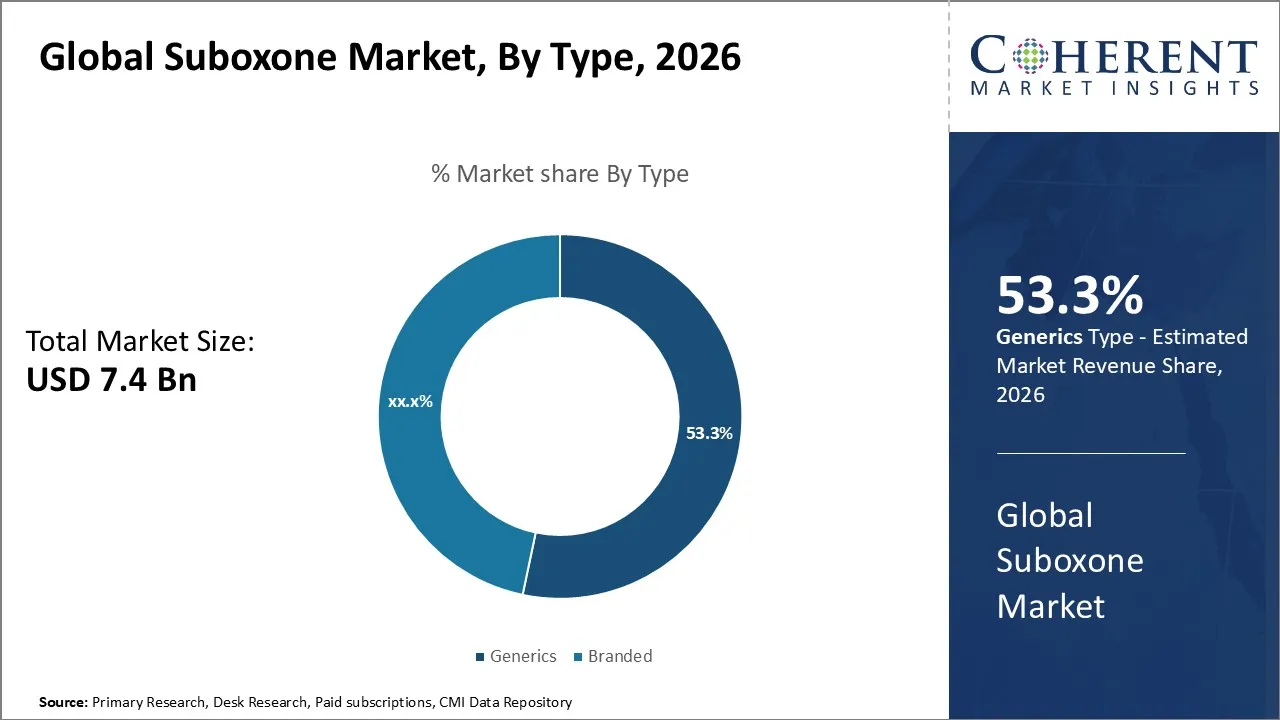
- By Type, Generics hold the largest market share of 53.3% in 2026 owing to its patent expiry of brand-name suboxone.
- By Formulation, Tablets expected to hold largest market share of 52.2% in 2026 owing to the lower cost compared to film formulations.
- By Distribution channel, Hospital Pharmacies acquired the prominent market share of 36.7% in 2026 owing to the increasing hospital-based treatment for opioid use disorder.
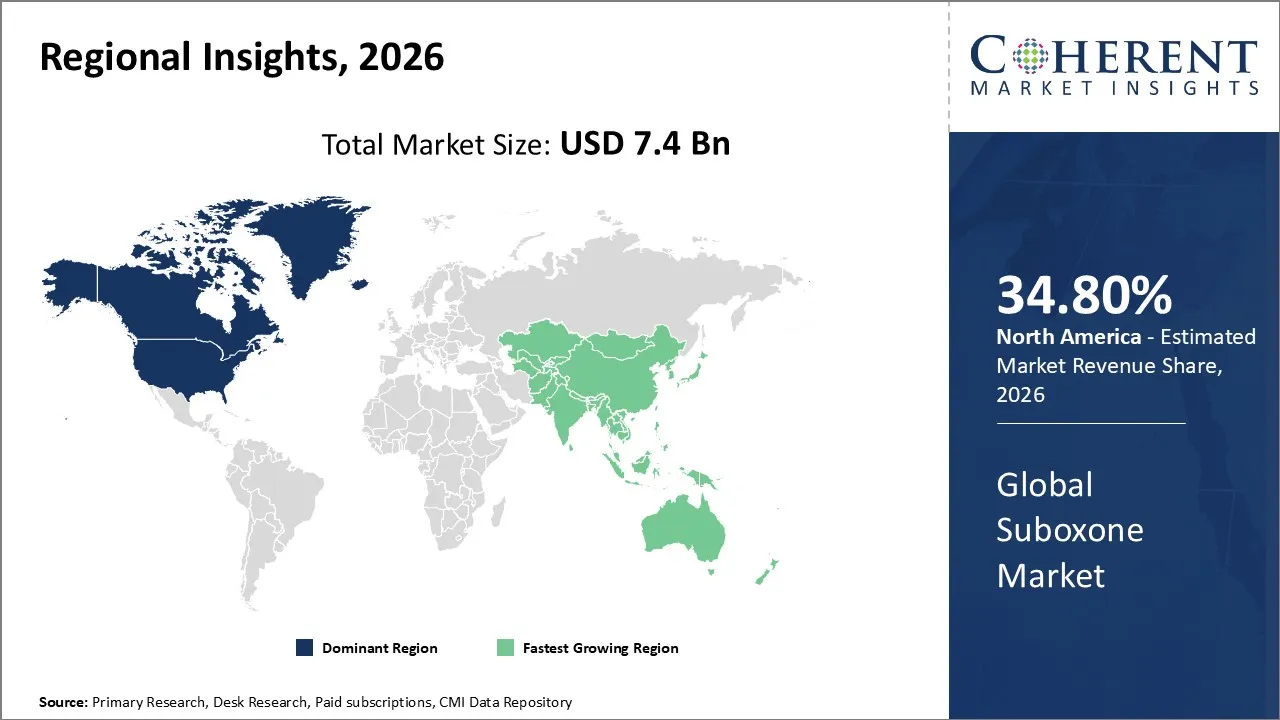
- By Region, North America dominates the overall market with an estimated share of 34.8% in 2026 owing to the high prevalence of opioid use disorder (OUD).
Market Overview
Healthcare systems are driving the Suboxone market by increasing the adoption of medication-assisted therapy and addressing the rising need for effective treatments for opioid use disorder. Suboxone, which combines buprenorphine and naloxone, reduces withdrawal symptoms and helps prevent opioid misuse, leading addiction treatment programs to use it widely. Governments and healthcare organizations are raising awareness of substance use disorders and expanding access to treatment centers, which strengthens market demand. Furthermore, pharmaceutical companies are introducing generic formulations and expanding distribution through hospital and retail pharmacies, supporting the global growth of the market.
Current Events and their Impact on the Suboxone Market
Current Events | Description and its impact |
Regulatory and Policy Changes in Key Markets |
|
Opioid Epidemic Trends and Public Health Initiatives |
|
Technological Innovations in Treatment and Monitoring |
|
Segmental Insights
- Current Industry Events of 2026
- Market Size Estimation
- Regional Breakdown
- Competitive Landscape
- Customer Intelligence
- Segmental Analysis
- Pricing Analysis
- Key Market Drivers, Challenges & Future Trends
- Customized Insights Section
Suboxone Market Insights, By Type - Generics contribute the highest share of the market owing to its favorable insurance coverage and reimbursement
Generics hold the largest market share of 53.3% in 2026. Patent expirations in the Suboxone market have allowed multiple manufacturers to enter, driving down treatment costs and fueling the growth of generics. Healthcare providers and payers increasingly choose generics for their affordability and accessibility. The rising prevalence of opioid use disorder and the expansion of medication-assisted treatment programs increase demand, while government initiatives and insurance coverage actively promote generic adoption. Moreover, manufacturers leverage established production capabilities and broad distribution networks to make generic Suboxone widely available, enhancing its use in hospitals, clinics, and retail pharmacies.
Suboxone Market Insights, By Formulation - Tablets contribute the highest share of the market owing to its established clinical use and physician familiarity
Tablets expected to hold largest market share of 52.2% in 2026. Healthcare providers and treatment centers drive the demand for Suboxone tablets due to their cost-effectiveness, wide availability, and simpler administration compared to film formulations. Multiple generic tablet options increase accessibility and affordability, encouraging hospitals and outpatient clinics to adopt them. As medication-assisted treatment programs expand and awareness of opioid use disorder grows, clinicians actively utilize tablets, making them a practical and reliable option for managing opioid dependence over the long term. For instance, India-based Dr. Reddy’s has launched generic omeprazole delayed-release tablets for heartburn and resumed its generic Suboxone (buprenorphine/naloxone) in the U.S. after the injunction was lifted.
Suboxone Market Insights, By Distribution Channel - Hospital Pharmacies contribute the highest share of the market owing to its improved care continuity between hospitals and outpatient clinics.
Hospital Pharmacies acquired the prominent market share of 36.7% in 2026. Hospital pharmacies drive the Suboxone market by providing timely access to buprenorphine/naloxone for inpatient and emergency care. Hospitals actively initiate medication-assisted treatment for patients with opioid use disorder, increasing demand through their pharmacies. By integrating addiction services into hospital care and leveraging supportive government policies and opioid crisis funding, they strengthen their role in treatment. Additionally, hospital pharmacies supply initial doses and coordinate with outpatient programs, ensuring continuity of care and positioning themselves at the center of Suboxone distribution and patient management.
Regional Insights
North America Suboxone Market Trends
North America dominates the overall market with an estimated share of 34.8% in 2026. Healthcare providers are driving growth in the North America Suboxone market by increasingly adopting medication-assisted treatment for opioid use disorder, supported by rising awareness and government initiatives. Hospitals, clinics, and outpatient programs actively integrate buprenorphine/naloxone therapy, while telemedicine expands patient access. Manufacturers and pharmacies enhance affordability and reach by offering generic formulations. Furthermore, policymakers and funding programs addressing the opioid crisis influence prescribing practices, actively boosting demand for Suboxone throughout the region.
Asia Pacific Suboxone Market Trends
Healthcare systems across the Asia Pacific region are driving the Suboxone market by strengthening addiction treatment services and increasing awareness of opioid use disorder. Hospitals, clinics, and rehabilitation centers actively adopt buprenorphine/naloxone therapy, while government initiatives and public health programs expand access. Manufacturers and pharmacies promote adoption by supplying affordable generic formulations to both urban and rural areas. Additionally, investments in healthcare infrastructure, training of addiction specialists, and integration of medication-assisted treatment into outpatient and community programs are actively boosting Suboxone use throughout the region.
United States Suboxone Market Trends
Healthcare providers are driving the United States Suboxone market by increasing awareness of opioid use disorder and integrating medication-assisted treatment into hospitals, clinics, and outpatient programs. They actively prescribe buprenorphine/naloxone to manage withdrawal symptoms and prevent relapse, while telemedicine expands patient access in remote areas. Manufacturers and pharmacies enhance adoption by offering affordable generic formulations. Furthermore, federal and state initiatives, along with opioid crisis funding, shape treatment protocols and actively reinforce Suboxone’s role in addressing opioid dependence nationwide. For instance, Mylan N.V. announced the U.S. launch of its Buprenorphine and Naloxone Sublingual Film in 8/2 mg and 12/3 mg strengths, a generic version of Indivior's Suboxone Sublingual Film.
China Suboxone Market Trends
Healthcare authorities in China are driving the Suboxone market by expanding efforts to address opioid dependence and strengthen addiction treatment services. Hospitals, clinics, and rehabilitation centers actively adopt buprenorphine/naloxone therapy, supported by government initiatives and pilot programs targeting substance use disorders. Manufacturers and pharmacies improve accessibility by supplying affordable generic formulations, overcoming historical barriers of limited awareness and high costs. Additionally, investments in training addiction specialists, establishing outpatient programs, and integrating medication-assisted treatment into community healthcare are actively boosting Suboxone use nationwide.
End-user Feedback and Unmet Needs in the Suboxone Market
- Treatment Accessibility: Patients report difficulty accessing consistent Suboxone therapy, especially in rural or underserved areas. Limited prescriber availability and geographic disparities in healthcare infrastructure restrict timely treatment. Users emphasize the need for expanded telemedicine services, more certified providers, and increased distribution through community clinics to ensure uninterrupted access to medication-assisted treatment.
- Affordability and Insurance Coverage: High costs remain a barrier for many patients, particularly where insurance coverage is limited. End-users seek broader inclusion of Suboxone in reimbursement plans and lower out-of-pocket expenses. Availability of generics helps, but affordability concerns persist, highlighting the need for financial support programs and policy interventions to reduce treatment-related economic burdens.
- Diversion and Safety Concerns: Some patients and providers express concerns about misuse, diversion, or accidental ingestion. Feedback indicates a need for safer formulations, education on proper administration, and monitoring programs. Users prefer packaging, dosing, or film options that reduce misuse potential while maintaining effective withdrawal management and treatment adherence.
Suboxone Market Trend
Rising Adoption of Medication-Assisted Treatment (MAT)
Healthcare providers increasingly integrate Suboxone into treatment protocols for opioid use disorder. Hospitals, outpatient clinics, and rehabilitation centers are actively initiating MAT programs to manage withdrawal symptoms and prevent relapse. Telemedicine is expanding access, allowing remote prescribing and follow-up care. Patient awareness campaigns and educational initiatives by healthcare authorities encourage acceptance of MAT, driving broader utilization. These efforts position Suboxone as a cornerstone therapy in both acute care and long-term addiction management.
Growth of Generic Formulations
The entry of multiple generic buprenorphine/naloxone products is reshaping the Suboxone market. Generics improve affordability and accessibility for patients, especially in public health programs and community clinics. Pharmacies and hospitals increasingly stock generics, creating price competition and widening patient reach. The availability of lower-cost alternatives enables healthcare systems to expand treatment programs and reduce barriers to care, strengthening Suboxone adoption across urban and rural regions.
Suboxone Market Opportunity
Rising Generic Penetration
The increasing availability of generic buprenorphine/naloxone creates an opportunity to make treatment more affordable and accessible. Healthcare providers, hospitals, and pharmacies can adopt generics to reduce costs, improve patient adherence, and expand coverage in public health programs. Manufacturers can leverage competitive pricing, distribution networks, and partnerships with government-funded addiction programs to strengthen market penetration, particularly in regions with cost-sensitive patient populations.
Market Report Scope
Suboxone Market Report Coverage
| Report Coverage | Details | ||
|---|---|---|---|
| Base Year: | 2025 | Market Size in 2026: | USD 7.4 Bn |
| Historical Data for: | 2020 To 2024 | Forecast Period: | 2026 To 2033 |
| Forecast Period 2026 to 2033 CAGR: | 4.1% | 2033 Value Projection: | USD 9.6 Bn |
| Geographies covered: |
| ||
| Segments covered: |
| ||
| Companies covered: | Indivior PLC, Dr. Reddy’s Laboratories Ltd., Amneal Pharmaceuticals LLC., Mylan N.V., Novartis AG, Teva Pharmaceutical Industries Ltd., Mallinckrodt, Lannett Co Inc., Rhodes Pharmaceuticals L.P., Alvogen, Sun Pharmaceutical Industries Ltd., Alkem Labs, and Hikma Pharmaceuticals PLC | ||
| Growth Drivers: |
| ||
| Restraints & Challenges: |
| ||
Suboxone Market News
- In May 2025, Kevin M. Passer, a Johns Hopkins-trained, triple board-certified psychiatrist, launched Addiction TeleMD, a concierge-style practice providing personalized Suboxone treatment for opioid use disorder through telemedicine and in-office visits in Mississippi and California.
Analyst Opinion (Expert Opinion)
- The Suboxone market is at a critical inflection point where traditional revenue engines are being decisively disrupted by generics and evolving treatment modalities. What stood for nearly two decades as a high‑margin branded therapy has now ceded real economic control to lower‑cost competitors — recent filings show that Indivior’s market share for SUBOXONE Film slid from over 50% in 2018 to about 14.2% in 2025, underscoring how aggressive generic entry has eroded brand dominance. This is not a transient trend; it reflects structural shifts in pricing and competition across mature healthcare systems.
- Pricing dynamics further validate this shift: post‑patent expiry, generic buprenorphine/naloxone formulations are ~25–30% cheaper than branded equivalents and increasingly favoured on formularies. Medicare Part D coverage illustrates this transition — coverage of generics rose to 82% by 2020, while brand coverage contracted significantly — a clear signal that payers are prioritizing cost containment over brand loyalty.
- Market narratives around diversion and misuse further complicate commercial forecasts. Clinical stakeholders increasingly cite diversion risk as a genuine operational challenge, amplified by telehealth prescribing frameworks that, while expanding reach, also dilute traditional safeguards. The divergence between clinical imperatives to broaden access and regulatory imperatives to mitigate misuse is sharpening, and market strategies that ignore this tension risk reputational and financial setbacks.
- Apart from this, while buprenorphine‑naloxone therapies remain foundational to medication‑assisted treatment protocols, competitive pressures from long‑acting formulations and alternative OUD medications are intensifying. The rise of depot injections and extended‑release options suggests Suboxone’s entrenched formulation portfolio may face relevance challenges unless innovation and strategic positioning are aggressively pursued. The market’s evolution will increasingly favour diversified treatment offerings over reliance on legacy sublingual formats.
Speak to the analyst
Want personalized insights?
Take the findings above to one of our principal consultants, or have the report rebuilt around the segments, geographies and competitors you actually track.
Market Segmentation
- By Type
- Branded
- Generics
- By Formulation
- Tablets
- Films
- By Distribution Channel
- Hospital Pharmacies
- Retail Pharmacies
- Online Pharmacies
- By Regional Insights
- North America
- U.S.
- Canada
- Latin America
- Brazil
- Argentina
- Mexico
- Rest of Latin America
- Europe
- Germany
- U.K.
- Spain
- France
- Italy
- Russia
- Rest of Europe
- Asia Pacific
- China
- India
- Japan
- Australia
- South Korea
- ASEAN
- Rest of Asia Pacific
- Middle East
- GCC Countries
- Israel
- Rest of Middle East
- Africa
- South Africa
- North Africa
- Central Africa
- North America
- Key Players Insights
- Indivior PLC
- Reddy’s Laboratories Ltd.
- Amneal Pharmaceuticals LLC.
- Mylan N.V.
- Novartis AG
- Teva Pharmaceutical Industries Ltd.
- Mallinckrodt
- Lannett Co Inc.
- Rhodes Pharmaceuticals L.P.
- Alvogen
- Sun Pharmaceutical Industries Ltd.
- Alkem Labs
- Hikma Pharmaceuticals PLC
Sources
Primary Research interviews
- Addiction specialists and psychiatrists in U.S. and Europe
- Healthcare providers operating opioid treatment programs (OTPs)
- Pharmacists dispensing buprenorphine/naloxone
- Hospital and clinic administrators overseeing MAT programs
- Policy makers in substance use disorder treatment
Databases
- U.S. Food and Drug Administration (FDA) Drug Database
- ClinicalTrials.gov
- Drug Enforcement Administration (DEA) Controlled Substance Data
- National Institutes of Health (NIH) PubMed database
- Centers for Medicare & Medicaid Services (CMS) coverage data
Magazines
- Addiction Professional
- Substance Abuse Advisor
- Pharmacy Times
- Behavioral Health Executive
- MedPage Today – Psychiatry section
Journals
- Journal of Substance Abuse Treatment
- American Journal of Psychiatry
- Journal of Addiction Medicine
- Drug and Alcohol Dependence
- Clinical Therapeutics
Newspapers
- The New York Times – Health Section
- The Washington Post – Health and Science
- The Guardian – Public Health
- USA Today – Health
- Wall Street Journal – Healthcare
Associations
- American Society of Addiction Medicine (ASAM)
- National Institute on Drug Abuse (NIDA)
- Substance Abuse and Mental Health Services Administration (SAMHSA)
- American Psychiatric Association (APA)
- International Society of Addiction Medicine (ISAM)
Public Domain sources
- FDA Drug Approvals and Labeling Data
- DEA Automation of Reports and Consolidated Orders System (ARCOS)
- CMS Public Data Sets
- CDC Opioid Prescribing Data
- WHO Global Health Observatory – Substance Use
Proprietary Elements
- CMI Data Analytics Tool
- Proprietary CMI Existing Repository of information for last 8 years
Get access to 250+ pages report
Every segment, forecast, competitor profile and data table behind the analysis above — available for instant download.
- ESOMAR Member
- ISO 9001:2015 Certified
- D-U-N-S Registered
- GDPR & CCPA Compliant
Missing comfort of reading report in your local language? Find your preferred language:
Transform your Strategy with Exclusive Trending Reports
Frequently Asked Questions
The Suboxone Market is estimated to be valued at USD 7.4 Bn in 2026 and is expected to reach USD 9.6 Bn by 2033.
Factors such as increasing use of opioids, rising prevalence of chronic and acute pain, and increasing approvals and launches for generic versions of suboxone are expected to drive the growth of the market during the forecast period.
Generics segment is the leading type segment in the market
The major factors hampering growth of the market include product recalls and side effects associated with the use of suboxone.
Major players operating in the market include Indivior PLC, Dr. Reddy’s Laboratories Ltd., Amneal Pharmaceuticals LLC., Mylan N.V., Novartis AG, Teva Pharmaceutical Industries Ltd., Mallinckrodt, Lannett Co Inc., Rhodes Pharmaceuticals L.P., Alvogen, Sun Pharmaceutical Industries Ltd., Alkem Labs, and Hikma Pharmaceuticals PLC