

T-cell Lymphoma Market Size and Forecast – 2026 to 2033
The T-cell Lymphoma Market is anticipated to grow at a CAGR of 7.1% with USD 2.8 Bn share in 2026 and is expected to reach USD 4.3 Bn in 2033. Rising incidence of rare T-cell lymphomas drives the market, while improved diagnostic techniques enhance detection. Growing clinician awareness supports earlier identification. According to the SEER Program, T-cell lymphomas represent approximately 7% of all non-Hodgkin lymphoma (NHL) cases in the United States.
Key Takeaways
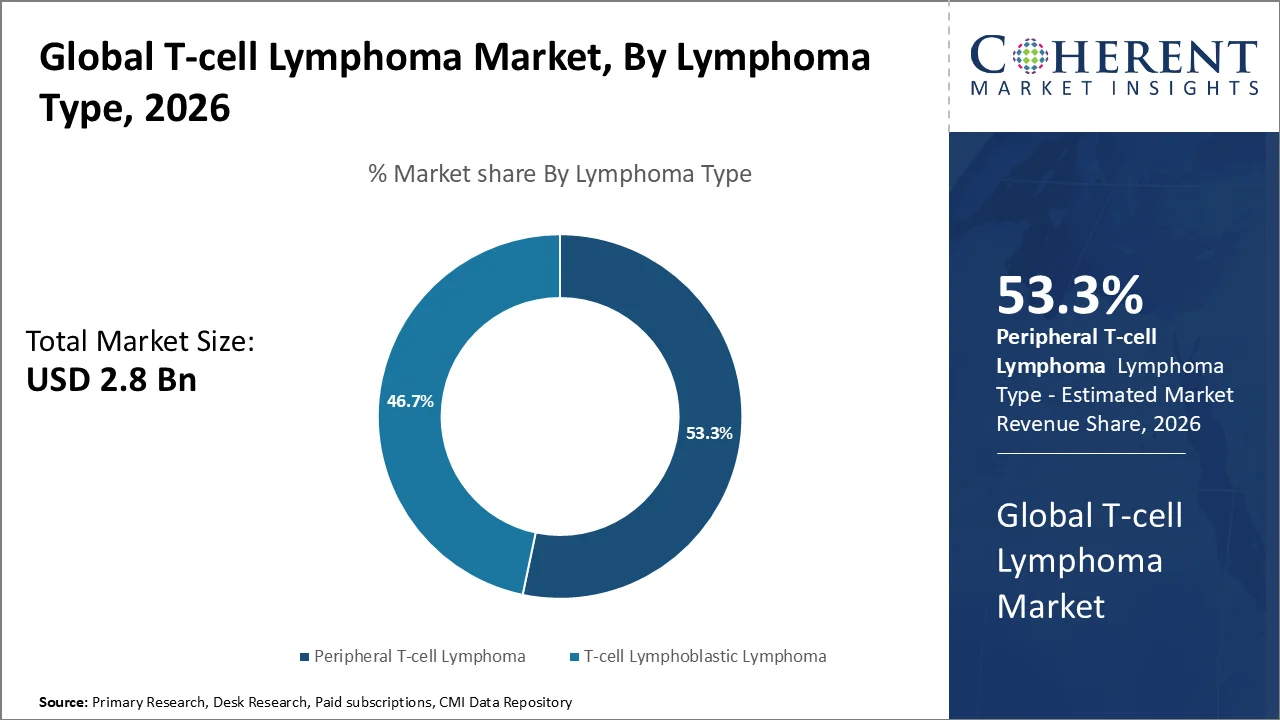
- Peripheral T-cell Lymphoma hold the largest market share of 53.3% in 2026 owing to the rising incidence of t-cell malignancies. An estimated 5–10 million people worldwide are infected with HTLV-1, with about 2–5% of carriers developing adult T-cell leukemia/lymphoma (ATLL), a rare and highly aggressive cancer that is difficult to diagnose.
- Chemotherapy expected to hold largest market share of 39.2% in 2026 owing to its established first-line treatment backbone.
- North America is expected to acquire the dominant share of 42.8% in 2026 owing to its high adoption of advanced oncology therapies. In February 2026, the Mark Foundation for Cancer Research announced a coalition with AACR, Lustgarten Foundation, Break Through Cancer, and Tina’s Wish to improve early cancer detection. The group will invest USD 12 million across six collaborative research projects targeting pancreatic, ovarian, and esophageal cancers, along with cancer predisposition syndromes.
Current Events and Their Impact on the T-cell Lymphoma Market
Current Event | Description and its Impact |
Technological and Scientific Advancements in T-cell Lymphoma Therapy |
|
EU Health Technology Assessment (HTA) Regulation Implementation |
|
Segmental Insights
- Current Industry Events of 2026
- Market Size Estimation
- Regional Breakdown
- Competitive Landscape
- Customer Intelligence
- Segmental Analysis
- Pricing Analysis
- Key Market Drivers, Challenges & Future Trends
- Customized Insights Section
Why is Peripheral T-cell Lymphoma Acquiring the Largest Market Share?
Peripheral T-cell Lymphoma hold the largest market share of 53.3% in 2026. Rising diagnosis of aggressive T-cell malignancies drives the market for Peripheral T-cell Lymphoma within T-cell Lymphoma, along with a high unmet clinical need and poor outcomes from standard chemotherapy. Physicians increasingly adopt targeted therapies, immunotherapies, and epigenetic drugs, which expands available treatment options. Improved molecular diagnostics and greater disease awareness enable earlier and more accurate detection. Active clinical trials and orphan drug incentives support ongoing drug development, while healthcare infrastructure improvements and broader access to oncology care sustain global market demand. For instance, in December 2025, Citius Oncology, Inc. announced the commercial launch of LYMPHIR, a novel IL-2 receptor–targeted fusion protein. The U.S. FDA approves it for adult patients with relapsed or refractory Stage I–III cutaneous T-cell lymphoma after at least one prior systemic therapy, marking its entry as a new treatment option in this setting.
Chemotherapy expected to hold largest market share
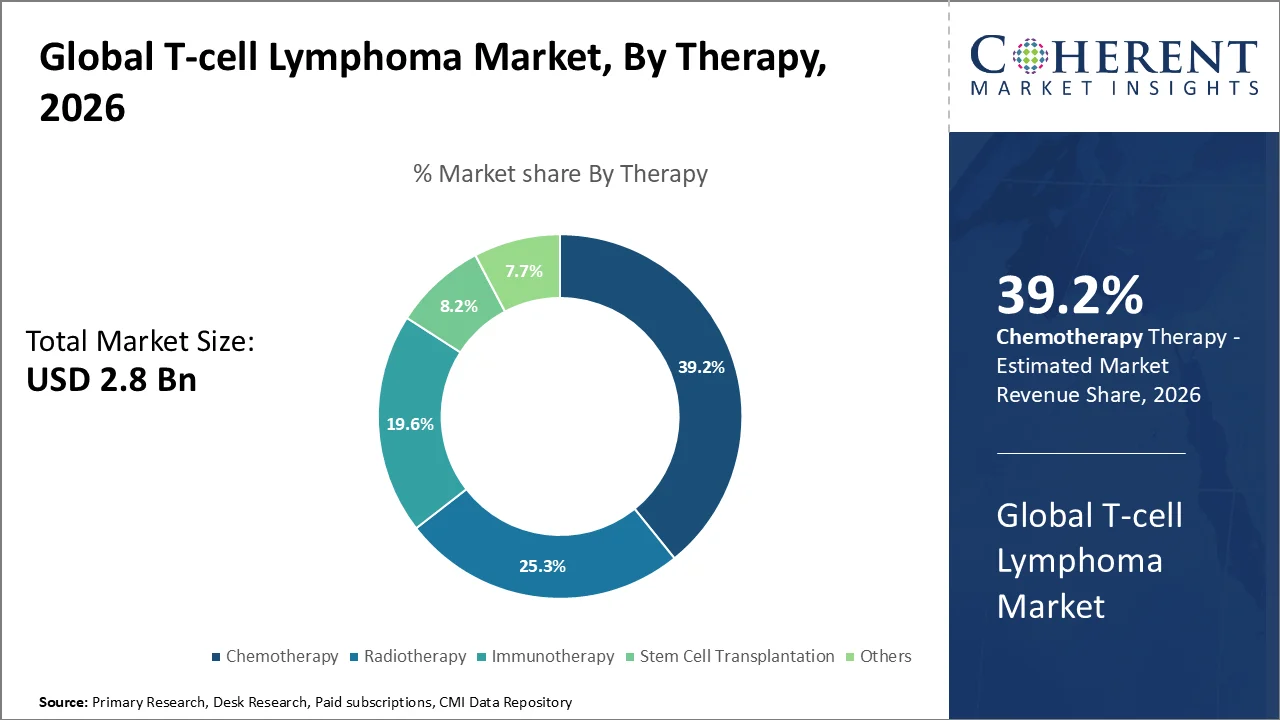
Chemotherapy expected to hold largest market share of 39.2% in 2026 owing to its Combination regimens with newer therapies. Physicians continue to drive the chemotherapy segment in the T-cell Lymphoma market by using it as a first-line treatment, particularly through established regimens like CHOP. They depend on chemotherapy for rapid tumor reduction in aggressive cases and effective initial disease control. Limited access to advanced therapies in many regions also increases its use. Healthcare systems widely provide it due to its cost-effectiveness and existing hospital infrastructure. Clinicians further use chemotherapy in combination and salvage settings, maintaining its importance in routine clinical practice. For instance, in May 2026, Labcorp expanded its DPYD genotyping test to identify cancer patients at higher risk of severe or life-threatening side effects from fluoropyrimidine chemotherapy, enhancing treatment safety and personalized care.
T-cell Lymphoma Market Trends
- Rising incidence of aggressive T-cell malignancies, including Peripheral T-cell Lymphoma (PTCL), continues to drive demand for effective therapies. PTCL accounts for approximately 10–15% of all non-Hodgkin lymphoma cases in Western populations, with higher prevalence in parts of Asia.
- Growing adoption of immunotherapies, targeted therapies, and epigenetic agents (e.g., HDAC inhibitors such as romidepsin and belinostat) is gradually replacing chemotherapy-only regimens, especially in relapsed/refractory disease settings where response rates remain limited with conventional therapy.
- Improved healthcare infrastructure and reimbursement support in developed regions is increasing patient access to advanced therapies, particularly CAR-T and monoclonal antibodies, which can cost over USD 300,000–500,000 per treatment course, reinforcing the importance of payer coverage expansion for market growth.
Regional Insights
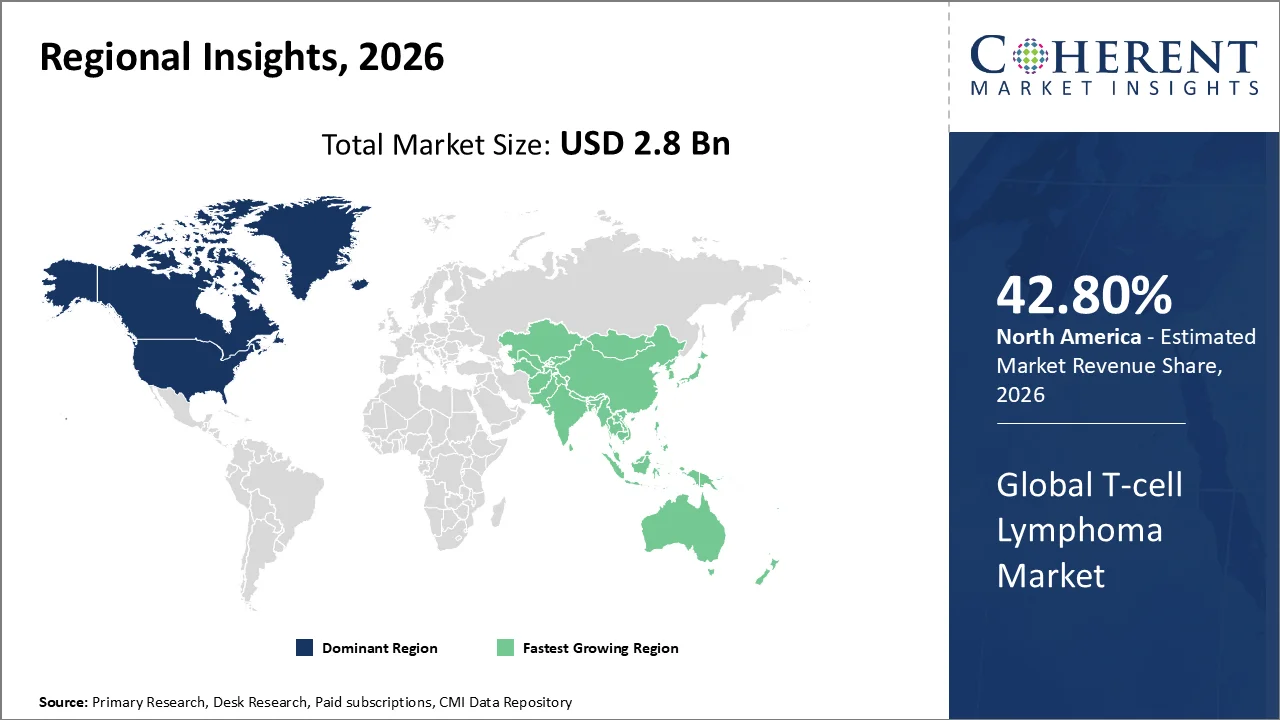
North America dominates owing to high disease awareness among clinicians
North America is expected to acquire the dominant share of 42.80% in 2026. Healthcare providers in North America drive the T-cell Lymphoma market by adopting advanced therapies such as immunotherapies, targeted agents, and emerging cellular treatments. Clinicians improve disease detection and treatment initiation through widespread use of molecular testing and next-generation sequencing. Research institutions and pharmaceutical companies actively conduct clinical trials and accelerate drug development and commercialization. Payers and insurance systems expand patient access to high-cost therapies. Regulatory bodies offer incentives for rare cancers, while strong disease awareness among clinicians further supports market growth in the region. For instance, in February 2026, Lyell Immunopharma, Inc. doses the first patient in its PiNACLE–H2H Phase 3 trial, evaluating rondecabtagene autoleucel (LYL314) against lisocabtagene maraleucel or axicabtagene ciloleucel for second-line relapsed or refractory large B-cell lymphoma.
Asia Pacific T-cell Lymphoma Market Trends
Healthcare providers and stakeholders actively drive the Asia Pacific T-cell lymphoma market by detecting more T-cell malignancies and improving diagnostic capabilities. Healthcare professionals and patients boost market growth by raising disease awareness. Governments support expansion through cancer care initiatives, while healthcare systems improve access to advanced oncology treatments. Researchers and companies increase investment in clinical trials and innovation. A large patient pool and aging population drive demand, and broader availability of targeted therapies and immunotherapies speeds up treatment adoption across the region. For instance, India launched its first global CAR T-cell therapy for adult B-cell Non-Hodgkin lymphoma, providing a new treatment option and hope for patients with aggressive blood cancers affecting the lymphatic system.
United States T-cell Lymphoma Market Trends
Rising cases of rare T-cell malignancies and greater awareness among clinicians drive the United States T-cell lymphoma market by enabling earlier diagnosis and treatment. Advancements in immunotherapy, targeted therapies, and CAR T-cell research expand treatment options and improve patient outcomes. Strong clinical trial activity supports innovation, while the FDA provides regulatory approvals that accelerate access to new therapies. Growing healthcare infrastructure, increasing biotech investments, and widespread adoption of precision medicine strengthen market growth across specialized cancer treatment centers in the country. For instance, AbbVie announced that the U.S. FDA approves EPKINLY (epcoritamab-bysp) as the first subcutaneous T-cell engaging bispecific antibody for adults with relapsed or refractory follicular lymphoma after two or more prior therapies.
China T-cell Lymphoma Market Trends
Increasing awareness of rare hematologic cancers and improved diagnostic capabilities across major hospitals drive the growth of the T-cell lymphoma market in China. Rising healthcare spending and the expansion of advanced oncology infrastructure support earlier detection and treatment. A World Bank–China joint report projected that, without policy reforms, China’s total health expenditure would rise from about USD 543.5 billion (2014) to approximately USD 2.5 trillion by 2035. Government initiatives in cancer care and faster regulatory approvals promote the availability of novel therapies. Expanding clinical research activity and the involvement of domestic and global pharmaceutical companies improve access to targeted treatments and enhance overall disease management outcomes nationwide.
Who are the Major Companies in T-cell Lymphoma Industry
Some of the major key players in T-cell Lymphoma are F. Hoffmann-La Roche Ltd, Biocryst Pharmaceuticals Inc., Bristol-Myers Squibb Company, Kyowa Kirin Co., Ltd., Genmab A/S, Seagen Inc., GlaxoSmithKline plc., Johnson and Johnson Private Limited, Elorac, Acrotech Biopharma, Merck and Co. Inc., Novartis AG, SHIONOGI & Co., Ltd., Spectrum Pharmaceuticals Inc., and Bausch Health Companies Inc.
Key News
- In February 2026, Lyell Immunopharma, Inc. launched its first head-to-head CAR T-cell lymphoma trial and presents updated rondecabtagene autoleucel (LYL314) data at ASH 2025, showing strong efficacy in third-line-plus large B-cell lymphoma with a 93% overall response rate and 76% complete responses, along with promising outcomes in the second-line cohort.
Market Report Scope
T-cell Lymphoma Market Report Coverage
| Report Coverage | Details | ||
|---|---|---|---|
| Base Year: | 2025 | Market Size in 2026: | USD 2.8 Bn |
| Historical Data for: | 2020 To 2024 | Forecast Period: | 2026 To 2033 |
| Forecast Period 2026 to 2033 CAGR: | 7.1% | 2033 Value Projection: | USD 4.3 Bn |
| Geographies covered: |
| ||
| Segments covered: |
| ||
| Companies covered: | F. Hoffmann-La Roche Ltd, Biocryst Pharmaceuticals Inc., Bristol-Myers Squibb Company, Kyowa Kirin Co., Ltd., Genmab A/S, Seagen Inc., GlaxoSmithKline plc., Johnson and Johnson Private Limited, Elorac, Acrotech Biopharma, Merck and Co. Inc., Novartis AG, SHIONOGI & Co., Ltd., Spectrum Pharmaceuticals Inc., and Bausch Health Companies Inc. | ||
Analyst Opinion
- T-cell lymphoma management is increasingly driven by unmet clinical need rather than incremental demand shifts. Peripheral T-cell lymphomas account for roughly 10–15% of all non-Hodgkin lymphoma cases, yet outcomes remain poor, with 5-year survival often reported below 30% in aggressive subtypes such as angioimmunoblastic T-cell lymphoma, underscoring a significant therapeutic gap that continues to pressure innovation in targeted and immune-based therapies.
- Treatment intensity reflects disease severity and relapse patterns, with real-world oncology datasets indicating that more than half of patients require second-line or later therapy due to early relapse or refractory disease, highlighting persistent limitations of conventional chemotherapy regimens and reinforcing dependence on novel agents such as histone deacetylase inhibitors and monoclonal antibodies.
- Clinical innovation is accelerating adoption of advanced therapies, with drugs like brentuximab vedotin demonstrating meaningful response rates in CD30-positive T-cell lymphomas, where objective response rates in relapsed/refractory settings have been reported above 50% in pivotal studies, strengthening physician confidence and expanding use of targeted biologics across treatment lines.
Speak to the analyst
Want personalized insights?
Take the findings above to one of our principal consultants, or have the report rebuilt around the segments, geographies and competitors you actually track.
Market Segmentation
- By Lymphoma Type (Revenue, USD Bn, 2021-2033)
- Peripheral T-cell Lymphoma
- Cutaneous T-cell Lymphoma
- Anaplastic Large Cell Lymphoma
- Angio-immuno-blastic T-cell Lymphoma
- Others (Intestinal T-cell Lymphoma, Follicular T-cell lymphoma, etc.)
- T-cell Lymphoblastic Lymphoma
- Peripheral T-cell Lymphoma
- By Therapy (Revenue, USD Bn, 2021-2033)
- Radiotherapy
- Chemotherapy
- Immunotherapy
- Stem Cell Transplantation
- Others (Antiviral Therapy, etc.)
- By Region (Revenue, USD Bn, 2021-2033)
- North America
- U.S.
- Canada
- Latin America
- Brazil
- Mexico
- Argentina
- Rest of Latin America
- Europe
- Germany
- U.K.
- France
- Italy
- Spain
- Russia
- Rest of Europe
- Asia Pacific
- China
- India
- Japan
- Australia
- South Korea
- ASEAN
- Rest of Asia Pacific
- Middle East
- GCC
- Israel
- Rest of Middle East
- Africa
- South Africa
- Central Africa
- North Africa
- North America
Sources
Primary Research interviews
- Oncologists and hematologists specializing in peripheral T-cell lymphoma treatment across tertiary care hospitals
- Hospital pharmacy directors and oncology department clinicians involved in chemotherapy and immunotherapy protocols
- Clinical researchers participating in lymphoma-focused trials and real-world evidence studies
Databases
- National Cancer Institute (NCI) SEER database
- World Health Organization (WHO) Global Cancer Observatory (GLOBOCAN)
- PubMed Central clinical study repository
- ClinicalTrials.gov oncology trial registry
Magazines
- Hematology & Oncology publications featuring advances in lymphoma treatment
- Cancer therapy-focused medical magazines covering immunotherapy and targeted therapy developments
Journals
- Journal of Clinical Oncology
- Blood (American Society of Hematology journal)
- Lancet Oncology
- Haematologica
Newspapers
- The New York Times (health and science section)
- The Guardian (global health coverage)
- Reuters Health
Associations
- American Society of Hematology (ASH)
- European Hematology Association (EHA)
- Lymphoma Research Foundation
- International Agency for Research on Cancer (IARC)
Public Domain sources
- World Health Organization (WHO) reports and fact sheets
- National cancer control program publications from multiple countries
- Government health ministry oncology statistics and registries
- Peer-reviewed open-access oncology research articles
Proprietary Elements
- CMI Data Analytics Tool
- Proprietary CMI Existing Repository of information for last 10 years
Get access to 250+ pages report
Every segment, forecast, competitor profile and data table behind the analysis above — available for instant download.
- ESOMAR Member
- ISO 9001:2015 Certified
- D-U-N-S Registered
- GDPR & CCPA Compliant
Missing comfort of reading report in your local language? Find your preferred language:
Transform your Strategy with Exclusive Trending Reports
Frequently Asked Questions
The T-cell Lymphoma Market is anticipated to grow at a CAGR of 7.1% with USD 2.8 Bn share in 2026 and is expected to reach USD 4.3 Bn in 2033.
Increasing research and development activities for the development of novel therapeutics and increasing product launches and regulatory approvals for the treatment of T-cell lymphoma are expected to drive the market growth over the forecast period.
Chemotherapy segment is expected to hold the major market share, owing to increasing product approvals and launches during the forecast period.
North America holds the largest market share in the market.
Major factors hampering growth of the market include the side effects of chemotherapy drugs used in the treatment of T-cell lymphoma.
Major players operating in the market include F. Hoffmann-La Roche Ltd, Biocryst Pharmaceuticals Inc., Bristol-Myers Squibb Company, Kyowa Kirin Co., Ltd., Genmab A/S, Seagen Inc., GlaxoSmithKline plc., Johnson and Johnson Private Limited, Elorac, Acrotech Biopharma, Merck and Co. Inc., Novartis AG, SHIONOGI & Co., Ltd., Spectrum Pharmaceuticals Inc., and Bausch Health Companies Inc.