

Web Real-Time Communication Market Size and Forecast — 2026-2033
The Global Web Real-Time Communication Market size is estimated to be valued at USD 6.14 billion in 2026 and is expected to reach USD 15.08 billion by 2033, exhibiting a compound annual growth rate (CAGR) of 13.7% from 2026 to 2033.
Overview
The Web Real-Time Communication Market is witnessing transformative growth driven by digital transformation across enterprises and increasing demand for low-latency, real-time communication across industries ranging from telecommunications to healthcare. The evolution of 5G infrastructure, coupled with the uptake of video conferencing, telemedicine, and IoT applications, has catalyzed new possibilities for seamless peer-to-peer interactions. WebRTC technology enables browser-to-browser communication without the need for additional plugins or downloads, pushing industry players to innovate rapidly.
Key Takeaways
The software component, especially cloud deployments, leads with over 59% market share, driven by scalability and integration ease.
Video conferencing remains the dominant application subsegment, reflecting a 43% share, fueled by remote work trends globally.
Asia Pacific is the fastest-growing region, with its rising digital infrastructure projects and increasing mobile penetration fueling demand for WebRTC, while North America maintains dominance with a commanding 38% market share supported by robust enterprise ecosystems and early technology adoption.
Web Real-Time Communication Market Segmentation Analysis
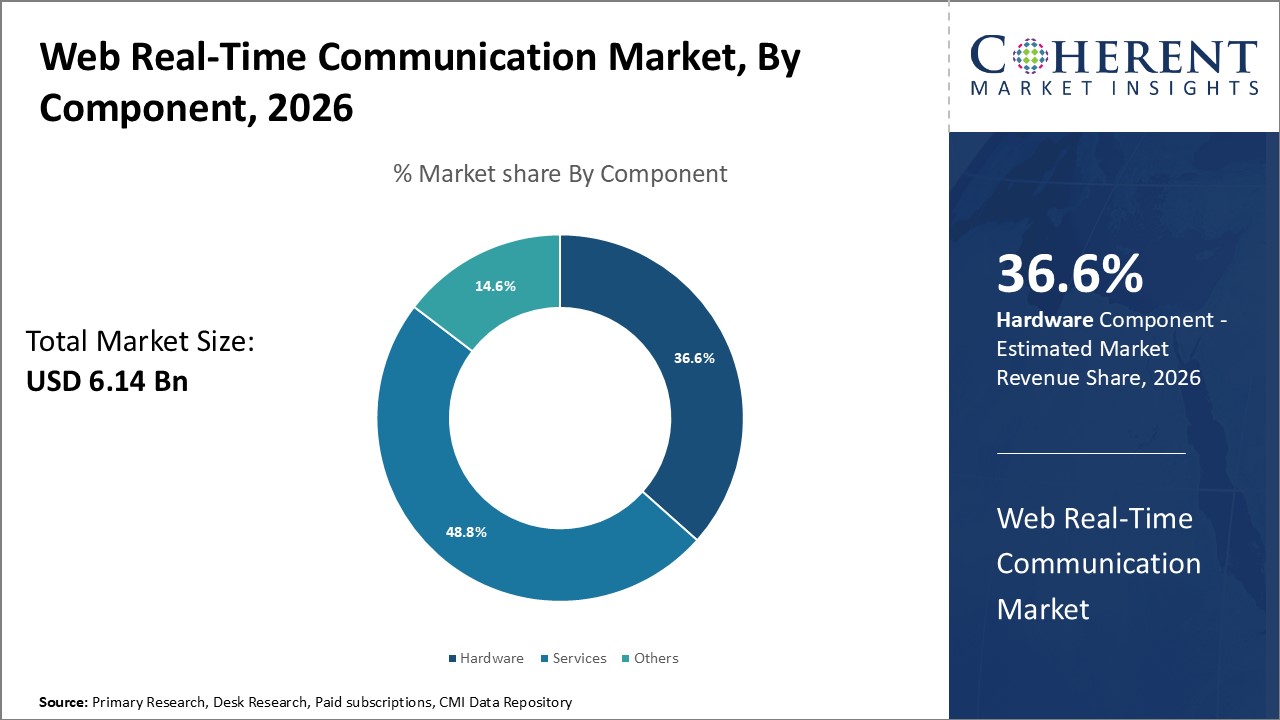
Web Real-Time Communication Market Insights, By Component
In terms of component, Software segment dominates the market share (58%). Software's dominance is credited to the rising adoption of cloud-based WebRTC platforms, which offer scalability, seamless integration, and ease of deployment. Cloud software provides flexible real-time communication APIs and SDKs, fostering business growth for enterprises seeking quick and cost-effective communication solutions. Services subsegment is growing rapidly due to increased demand for customized deployment, support, and integration services associated with complex enterprise infrastructures.
Web Real-Time Communication Market Insights, By Application
In the application segment, the Video Conferencing leads the segment with a 42% market share, propelled by ongoing hybrid work trends and increasing global communication demands. It remains the primary use case driving WebRTC adoption across enterprises and SMBs. Telemedicine, the fastest-growing subsegment, gained traction with the rise in remote healthcare delivery and regulatory approvals for virtual care, particularly evident from the 35% increase in WebRTC-enabled health consultations recorded in 2025.
Web Real-Time Communication Market Insights, By Deployment
Cloud deployment dominates the market with a commanding share of 65%, driven by its flexibility, cost-effectiveness, and rapid scalability to meet surging demand. Adoption of managed WebRTC platforms hosted on AWS, Azure, and Google Cloud during 2025 has accelerated this trend, facilitating faster time-to-market for enterprises. Hybrid deployments, combining cloud scalability and on-premises control, are capturing mindshare as organizations address security and compliance requirements while harnessing cloud benefits.
Web Real-Time Communication Market Trends
The Web Real-Time Communication market continues to evolve with technology trends shaping its trajectory.
Cloud-native migration is a dominant force, reducing operational costs and enabling scalable deployment for enterprises seeking flexibility.
In 2025, AWS and Microsoft Azure documented a surge in WebRTC workload migration exceeding 41%, accentuating this shift.
The integration of AI with WebRTC platforms is propelling intelligent real-time communication, enabling predictive analytics, automated moderation, and enhanced accessibility, and key providers reported over 26% increase in AI-enabled communication services adoption in early 2026.
Web Real-Time Communication Market Insights, By Geography
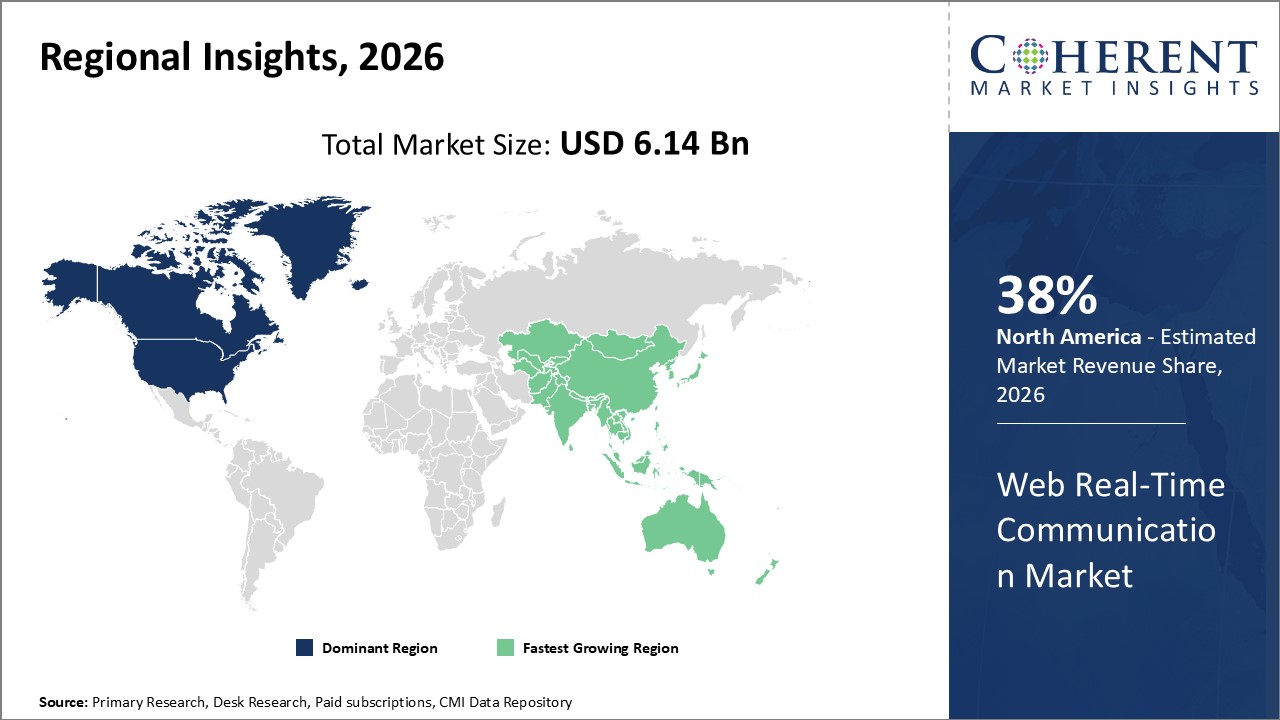
North America Web Real-Time Communication Market Analysis and Trends
In North America, the dominance in the Web Real-Time Communication market remains undisputed, with approximately 38% market share driven by aggressive cloud infrastructure investments and early technology adoption across sectors such as fintech and healthcare. The presence of headquarters and R&D centers of major market players such as Cisco, Microsoft, and Twilio strengthens the innovation ecosystem and accelerates product offerings tailored to regional enterprise demands. Regulatory frameworks also support secure data communication, facilitating market penetration.
Asia Pacific Web Real-Time Communication Market Analysis and Trends
The Asia Pacific region exhibits the fastest growth due to widespread mobile device adoption, burgeoning digital infrastructure investments, and government initiatives promoting smart city and IoT deployments. Countries like India and China lead, benefiting from increased internet penetration rates, while local players and global market companies collaborate to customize solutions addressing local language and network challenges.
Web Real-Time Communication Market Outlook for Key Countries
USA Web Real-Time Communication Market Analysis and Trends
The USA’s market leads the North American region with strong contributions from enterprise digital transformation initiatives and the expanding remote work culture. Major players like Microsoft and Cisco have launched cutting-edge WebRTC solutions tailored to U.S. enterprises, contributing to over 40% of regional market revenue in 2025. Federal and private sector investments in 5G infrastructure and cybersecurity are propelling demand for secure, scalable real-time communication platforms. In addition, the healthcare sector’s adoption of telemedicine applications has surged by 38% from 2023 to 2026, underpinning business growth.
India Web Real-Time Communication Market Analysis and Trends
India’s WebRTC market is one of the fastest-growing globally, propelled by increasing smartphone penetration and government-driven digitalization initiatives such as Digital India. Domestic companies and international market players are collaborating to address network heterogeneity and local content delivery challenges, enhancing real-time communication reliability. The country reported a 32% annual increase in WebRTC app deployments within education and e-commerce sectors in 2025.
Analyst Opinion
Supply capacity and increasing infrastructure investments are key drivers of the web real-time communication market share growth. In 2025, global server deployment dedicated to WebRTC platforms increased by 23%, indicating robust supply side support, while cloud service providers expanded their offerings specific to real-time video and audio streaming. This supply-side development directly supports market revenue acceleration.
Demand for cross-industry use cases has enhanced WebRTC adoption significantly. Telehealth platforms, for example, reported a 36% increase in WebRTC-enabled consultations in Q1 2026 compared to the same period in 2025, indicating strong demand-side indicators driven by evolving healthcare delivery models.
Pricing optimization and integration with existing enterprise communication suites are impacting market dynamics. Major enterprises improved customer engagement by reducing latency by 31% through WebRTC leveraging in their CRM applications, directly fueling business growth and revenues in 2026.
Micro-level indicators such as API adoption rates and developer engagement signal a thriving ecosystem. The number of active WebRTC developers increased by 19% globally in 2025, supported by enhanced SDKs and open-source initiatives, which is instrumental in expanding market scope and creating new use cases.
- Current Industry Events of 2026
- Market Size Estimation
- Regional Breakdown
- Competitive Landscape
- Customer Intelligence
- Segmental Analysis
- Pricing Analysis
- Key Market Drivers, Challenges & Future Trends
- Customized Insights Section
Market Scope
| Report Coverage | Details | ||
|---|---|---|---|
| Base Year: | 2025 | Market Size in 2026: | USD 6.14 billion |
| Historical Data for: | 2020 To 2024 | Forecast Period: | 2026 To 2033 |
| Forecast Period 2026 to 2033 CAGR: | 13.7% | 2033 Value Projection: | USD 15.08 billion |
| Geographies covered: |
| ||
| Segments covered: |
| ||
| Companies covered: | Cisco Systems; Google LLC; Microsoft Corporation; Twilio Inc.; Amazon Web Services, Inc.; Zoom Video Communications; Huawei Technologies Co., Ltd.; Ericsson; Dialogic Corporation; Adobe Inc.; 8x8, Inc.; Vonage Holdings Corp.; BroadSoft (now part of Cisco); Genesys Telecommunications Laboratories. | ||
| Growth Drivers: |
| ||
Web Real-Time Communication Market Growth Factors
According to data from 2025, over 70% of enterprises globally have integrated WebRTC technology into their communication stack.
The rapid deployment of 5G networks has boosted real-time communication quality, with latency reductions of up to 50% in pilot deployments across North America and Europe.
Increased web and mobile application penetration in emerging regions has expanded market scope, with Asia Pacific witnessing a surge of 28% in WebRTC-powered applications in 2026 alone. Regulatory clarity on data privacy and security, for example, with GDPR implementation in the EU, has reduced market restraints and fostered customer confidence in WebRTC solutions, driving higher adoption.
Web Real-Time Communication Market Development
Vidyo released updates to VidyoConnect for WebRTC in 2026, including versions 25.1.0 (August 2026), 24.1.1 (April 2026), and 24.1.0 (January 2026). The release notes indicate incremental enhancements in stability, browser compatibility, and new features in the WebRTC integration.
In February 2026, Vonage released version 2.29 of its native Video Client SDKs (for iOS, Android, Windows, macOS, and Linux), which now leverage the WebRTC M121 framework. This update improves performance, stability, and security, including better audio/video codecs, improved network adaptation, and enhanced browser compatibility.
In February 2026, Hugging Face, an AI startup valued at more than $4 billion, launched FastRTC, an open-source Python library designed to eliminate a significant challenge for developers creating real-time audio and video AI applications.
Key Players
Cisco Systems
Google LLC
Microsoft Corporation
Twilio Inc.
Amazon Web Services, Inc.
Zoom Video Communications
Huawei Technologies Co., Ltd.
Ericsson
Dialogic Corporation
Adobe Inc.
8x8, Inc.
Vonage Holdings Corp.
BroadSoft (now part of Cisco)
Genesys Telecommunications Laboratories
Competitive strategies are centered around strategic partnerships and acquisitions. For instance, Microsoft’s acquisition of real-time communication platform vendors significantly improved its Teams offering, resulting in a 25% increase in user engagement in 2025. Similarly, Twilio’s extensive API toolkit release strengthened its market position through enhanced developer adoption and integration with emerging use cases, causing a 40% growth in market revenue from developers in 2026.
Web Real-Time Communication Market Future Outlook
The future outlook points to deeper integration of WebRTC into enterprise ecosystems, customer service platforms, and emerging IoT applications. Improvements in 5G connectivity, AI-powered analytics, and edge computing will enhance real-time performance and reduce latency. Healthcare, education, e-commerce, and financial services are expected to remain key growth verticals, while emerging markets will accelerate adoption as digital infrastructure expands. Enhanced security, scalability, and interoperability with unified communication systems will shape the next phase of growth.
Web Real-Time Communication Market Historical Analysis
The web real-time communication (WebRTC) originated in the early 2010s when open standards enabled browsers to transmit audio, video, and data directly without plugins. Initially, adoption was limited to tech innovators and startups building peer-to-peer communication applications. Over time, enterprises recognized its potential for cost-effective, browser-based collaboration, video conferencing, and customer service. The rise of cloud platforms and APIs facilitated wider integration, WebRTC adoption surged as remote working, telemedicine, and digital-first business models became mainstream.
Sources
· Databases:
o World Wide Web Consortium (W3C) Database
o Internet Engineering Task Force (IETF) Reports
· Magazines:
o TechCrunch
o Communications Today
o Network World
o Telecoms.com
· Journals:
o IEEE Communications Magazine
o Journal of Web Engineering
o Computer Communications (Elsevier)
o International Journal of Web Information Systems
· Newspapers:
o The Wall Street Journal (Technology Section)
o The Washington Post (Technology)
o The Economic Times (Telecom & IT)
· Associations:
o Internet Engineering Task Force (IETF)
o World Wide Web Consortium (W3C)
o GSMA Association
o Internet Society (ISOC)
Get access to 250+ pages report
Every segment, forecast, competitor profile and data table behind the analysis above — available for instant download.
- ESOMAR Member
- ISO 9001:2015 Certified
- D-U-N-S Registered
- GDPR & CCPA Compliant
Missing comfort of reading report in your local language? Find your preferred language:
Transform your Strategy with Exclusive Trending Reports
Frequently Asked Questions
Leading market players include Cisco Systems; Google LLC; Microsoft Corporation; Twilio Inc.; Amazon Web Services, Inc.; Zoom Video Communications; Huawei Technologies Co., Ltd.; Ericsson; Dialogic Corporation; Adobe Inc.; 8x8, Inc.; Vonage Holdings Corp.; BroadSoft (now part of Cisco); Genesys Telecommunications Laboratories, with a combined influence on product innovation, partnerships, and market growth strategies.
The market size is projected to grow significantly, expected to reach USD 15.08 billion by 2033 from USD 6.14 billion in 2026, at a CAGR of 13.7%.
Video conferencing dominate the application segment, with telemedicine showing rapid growth due to increased healthcare digitization and remote care demands.
Trends such as cloud-native WebRTC deployments, integration with AI and edge computing will drive market dynamics, improving scalability and latency, enabling new use cases.
Competition is intense with companies focusing on innovation, partnerships, and acquisitions. Challenges include ensuring robust data privacy compliance and addressing latency in underdeveloped network areas.
Key strategies revolve around API ecosystem expansion, strategic alliances with telecom and cloud providers, and embedded solutions in enterprise communication platforms.