

White Noise Sleep Aid Market Size and Trends-(2026-2033)
The White Noise Sleep Aid Market is estimated to be valued at USD 1.64 Bn in 2026 and is expected to reach USD 2.82 Bn by 2033, growing at a compound annual growth rate (CAGR) of 8.2% from 2026 to 2033.
Key Takeaways
- Based on Power Source, the Battery segment is expected to lead the market with 62% share in 2026, due to greater portability and on the go usage demand.
- Based on Indication Type, the Insomnia segment is expected to hold 48.4 % share of the market in 2026, owing to the larger user base looking for sleep improvement solutions.
- Based on Age Group, the Adults segment is projected to account for 65.8 % share in 2026, owing to widespread use for sleep health.
- Based on End User, the Home Care Settings segment is projected to capture the largest share of 58% in the market in 2026, as they are most common for sleep routines.
- Based on Region, North America is set to lead the White Noise Sleep Aid Market with 41.7 % share in 2026. While, Asia Pacific is anticipated to be the fastest growing region.
Market Overview
Growth projections for the worldwide white noise sleep aid sector are linked to higher reported cases of tinnitus and sleep disorders among adult consumers. Market momentum is also building from increased consumer uptake of these devices combined with ongoing technological refinements in the product category throughout the analysis timeframe.
Strategic corporate activities including consolidations, collaborative agreements, and company acquisitions, alongside broader consumer acceptance, continued product innovation, and steady new product introductions represent additional growth catalysts for this market segment. The psychological effects of the pandemic like stress and worry have made many people's sleep problems worse. Because of this, more and more people are using dedicated sleep machines or smartphone based alternatives that make constant ambient sound to help them sleep better at night.
Current Events and Its Impacts on the White Noise Sleep Aid Market
Current Event | Description and the Impact |
Global Technological Advancements in Sleep Tech
|
|
Increasing Global Awareness of Sleep Health and Mental Wellness
|
|
Role of Artificial Intelligence (AI) in White Noise Sleep Aid Market
AI is shifting the white noise sleep aid market through personalization and adaptive technology. AI-powered applications analyze user sleep patterns, ambient noise levels, and preferences to automatically adjust white noise frequencies, volume, and sound mixing in real time. Machine learning algorithms identify optimal sound profiles for individual users, creating customized audio environments that improve sleep quality. Smart devices use AI to detect sleep stages and adjust output accordingly. Predictive analytics helps in anticipating disruptions based on environmental factors. This technology speeds up the use of these machines among consumers and institutional buyers like hotels and hospitals. This also helps in reducing development costs and improving time to market for manufacturers seeking competitive advantages in the growing sleep wellness industry.
For instance, in January 2025, at CES 2025, South Korea’s VIV Health unveiled its VIV Ring. It is a smart wearable that features generative audio for sleep comfort alongside biometric tracking. It also performs continuous health data gathering and utilizes artificial intelligence (AI) for health predictions
- Current Industry Events of 2026
- Market Size Estimation
- Regional Breakdown
- Competitive Landscape
- Customer Intelligence
- Segmental Analysis
- Pricing Analysis
- Key Market Drivers, Challenges & Future Trends
- Customized Insights Section
Segmental Insights
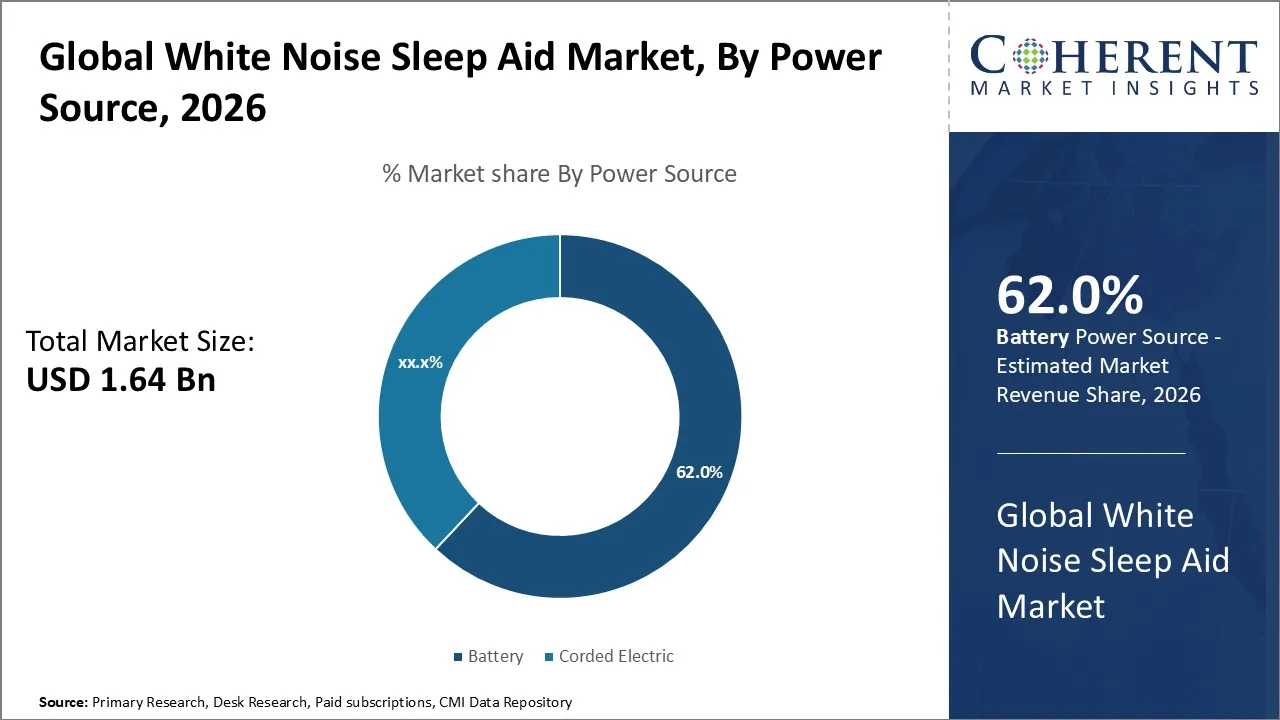
White Noise Sleep Aid Market Insights, By Power Source - Greater Portability Drives Preference for Battery Power Source
In terms of power source, the battery segment contributes the highest share of 62.0% in 2026 of the market owing to the portability and convenience that battery-powered devices provide for travel and movement between rooms. They allow users to place sleep aid devices anywhere without needing nearby electrical outlets, which improves flexibility and ease of use. The growing demand for portable sleep solutions among frequent travelers and parents with young children is increasing the adoption of battery-powered models. Recent market research reveals that 73% of consumers consider portability a "very important" factor when purchasing white noise devices.
White Noise Sleep Aid Market Insights, By Indication Type- Insomnia Leads Due To Larger User Base Seeking Sleep Improvement Solutions
In terms of indication type, the insomnia segment contributes the highest share of 48.4% in 2026 of the market owing to owing to the rising prevalence of sleep disorders and growing awareness about non-pharmaceutical sleep solutions globally. They allow individuals to mask disruptive environmental noises and create consistent sound environments, which improves sleep quality and reduces nighttime awakenings. The growing stress levels from modern lifestyles and increased diagnoses of chronic insomnia are increasing the demand for white noise sleep aids. Studies indicate that 30-35% of adults experience short-term insomnia symptoms. These devices provide a safe and drug-free approach to managing sleep difficulties, making insomnia the primary indication for white noise device usage worldwide.
White Noise Sleep Aid Market Insights, By Age Group - Adults Lead Owing to Widespread Adoption for Sleep Hygiene
In terms of age group, the adults contribute the highest share of 65.8% in 2026 of the market owing to the rising work-related stress and growing prevalence of sleep disorders among working-age populations globally. They allow adults to block out environmental disturbances and create calming sleep environments, which improves sleep quality and daily productivity. The growing awareness about sleep health and increased use of wellness products among adults is also increasing the demand for white noise devices. They provide a practical solution for managing stress-induced insomnia and urban noise pollution, making adults the primary user group.
White Noise Sleep Aid Market Insights, By End User - Home Care Settings Leads as it is Most Common for Sleep Routines
In terms of end user, the home care settings segment is expected to lead the market with largest share of 58% in 2026. This is because more people are looking for sleep solutions and putting more effort into making their homes better places to sleep. People can use white noise machines in their own bedrooms every night, helping them sleep better and more comfortable in the long run. The rising awareness about sleep health and increased consumer spending on home wellness products is increasing the product use in homecare settings. They provide privacy and personal control over conditions, making them the main setting for white noise device usage compared to clinical settings.
As per a recent market research survey, the home healthcare settings account for an estimated 35-40% of white noise device purchases, compared to 15% in institutional settings.
Regional Insights
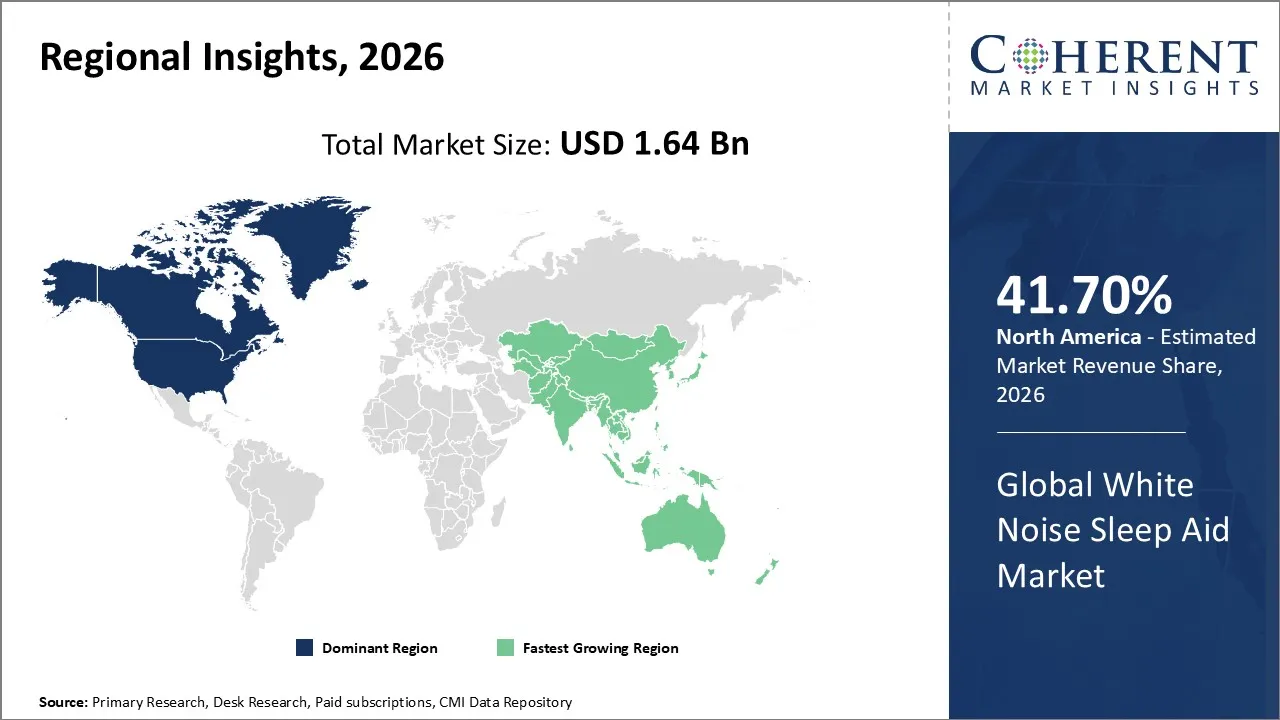
North America White Noise Sleep Aid Market Analysis & Trends
North America has remained the dominant region with 41.70% in 2026 of the global White Noise Sleep Aid Market over the past decade. The high stress levels from demanding work cultures and fast-paced urban lifestyles are driving consumers toward effective sleep solutions. The strong purchasing power, which makes premium sleep devices accessible to middle-class and affluent households, is also helping the market grow. There is a widespread awareness about sleep health, fueled by healthcare professionals and wellness influencers who actively promote better sleep hygiene practices.
The tech-savvy population is quickly adopting smart sleep devices that provide smartphone connectivity and personalized features. The growing prevalence of sleep disorders, including insomnia, that affects millions of Americans and Canadians is creating continued demand for these devices. Parents are also purchasing white noise machines for their babies, which is helping to grow the customer base in the region.
For instance, in November 2025, the Cot and Cradle Company introduced its new product named Shushiie. This baby sleep device is the first ever tool that merges white noise, lullabies, and womb-inspired shushing for a unified audio blend to help infants fall asleep quicker and longer.
Asia Pacific White Noise Sleep Aid Market Analysis & Trends
The Asia Pacific region has emerged as the fastest-growing market globally in recent years. The rising stress levels and demanding work cultures in urban centers like Tokyo, Seoul, and Singapore are increasing sleep disorders and insomnia cases. The growing awareness about sleep hygiene and mental wellness is encouraging consumers to seek non-pharmaceutical sleep solutions. The growing middle-class population have greater disposable incomes, which helps them buy wellness products and improve their sleep. Rapid urbanization brings increased noise pollution, making white noise devices essential for peaceful sleep environments.
For instance, in October 2025, Dreamegg, a leader in sleep wellness, launched its Sunrise 1+. This new version of the sunrise alarm clock and sound machine is meant to make mornings and nights more relaxing for everyone. There is also a bigger sound library with 34 options instead of 29. It has sound effects like white noise, lullabies and nature sounds.
White Noise Sleep Aid Market Outlook Country-Wise
The U.S. White Noise Sleep Aid Market Trends
In 2026, the market in the U.S. is expected to be strong due to widespread awareness about sleep disorders and their serious health impacts among the population. Adults are seeking effective sleep solutions due to their busy and stressful lives. Many parents are using white noise machines for infant sleep training and are considering them essential nursery items for newborns. The market is also growing due to the constant release of new, smart, and portable products. In the US, there is a growing interest in mental health and self-care, leading more people to purchase items that can naturally improve their sleep quality.
For instance, in August 2025, Yogasleep, the company that made the first sound machine and has been working on sleep innovations for more than 60 years, announced that it had won a national award. Good Housekeeping awarded the Yogasleep Duet White Noise Machine as a winner in its 2025 Parenting Awards. The Yogasleep Duet is carefully made to help every family member sleep better by blocking out noises that would otherwise wake them up.
China White Noise Sleep Aid Market Trends
The market in China is booming owing to increasing urbanization and noise pollution in major cities that disrupt sleep patterns. The rising stress levels from competitive work environments are increasing the demand for sleep solutions among busy professionals who seek better rest. As the middle class's income continues to rise, consumers are more able to purchase health and wellness products designed to improve their sleep and overall well-being. E-commerce sites like Tmall and JD.com make it easy for people all over the country to get these products regardless of their location.
For instance, the Langham Hospitality Group (LHG) started a new full sleep wellness program. The program is now available at all LHG properties worldwide. It includes a variety of experiences and rituals that are meant to help guests sleep better. Guests can also order items that will help them sleep better from the Sleep Matters Menu. These include yoga mats and fitness balls for stretching before bed, weighted blankets, white-noise machines, and a choice of pillows.
Market Report Scope
White Noise Sleep Aid Market Report Coverage
| Report Coverage | Details | ||
|---|---|---|---|
| Base Year: | 2025 | Market Size in 2026: | USD 1.64 Bn |
| Historical Data for: | 2020 To 2024 | Forecast Period: | 2025 To 2032 |
| Forecast Period 2026 to 2033 CAGR: | 8.2% | 2033 Value Projection: | USD 2.82 Bn |
| Geographies covered: |
| ||
| Segments covered: |
| ||
| Companies covered: | Sandland, Snooz, LLC, YogaHome, LLC, Homedics Inc., Hatch, Inc., Mintal Inc., Adaptive Sound Technologies, Inc. (ASTI), and BrookStone Company. | ||
| Growth Drivers: |
| ||
| Restraints & Challenges: |
| ||
White Noise Sleep Aid Market Drivers
Rising Stress and Sleep Disorders along with Greater Awareness of Sleep Hygiene
The white noise sleep aid market is experiencing robust growth driven by several interconnected factors. The rising stress levels across global populations, amplified by demanding work environments and fast-paced lifestyles, have significantly contributed to sleep problems. There has been a significant increase in sleep disorders, such as insomnia and restless sleep problems. At the same time, there is a greater public awareness about sleep hygiene and how it helps overall health, productivity, and mental well-being.
The healthcare professionals are recommending non-drug treatments to improve sleep quality. As a result, white noise machines have become a viable alternative to medication. Also, urbanization contributes to increased air pollution, prompting individuals to seek effective sound masking solutions. Scientific research increasingly validates the effectiveness of white noise in promoting deeper, better sleep patterns, which in turn boosts consumer confidence in these products.
White Noise Sleep Aid Market Opportunities
Technological Integration for Personalized Devices
The white noise sleep aid has major opportunities for growth owing to advancements in technology and digital integration. The incorporation of IoT capabilities enables smart devices that automatically adjust sound frequencies based on environmental conditions or user sleep patterns, which makes them superior. The mobile applications provide unmatched personalization, allowing users to customize soundscapes and set timers easily. Users can track sleep quality through easy analytics that help them understand patterns.
Artificial intelligence and machine learning open up opportunities for adaptive systems that learn individual preferences. These systems optimize sound profiles accordingly, which makes them superior to traditional devices. The convergence with smart home ecosystems creates better user experiences that consumers appreciate. Subscription-based content libraries generate recurring revenue streams for manufacturers and bring continuous value.
Analyst Opinion (Expert Opinion)
- The White Noise Sleep Aid Market is experiencing steady expansion, supported by rising awareness of sleep health, increasing incidence of sleep disturbances, and broader acceptance of non-pharmacological sleep support solutions. Data from sleep health surveys indicate that nearly one-third of adults globally report difficulty initiating or maintaining sleep at least several times per week, creating sustained demand for accessible sleep-enhancing technologies such as white noise devices and applications.
- Consumer electronics sales data shows consistent growth in sleep-focused audio devices, with online channels accounting for a significant share of purchases. Industry surveys suggest that more than 60% of buyers prefer white noise products offering additional features such as adjustable sound profiles, timers, and smartphone connectivity. App analytics further indicate millions of monthly active users for sleep sound applications, reflecting strong engagement beyond standalone hardware devices.
- Clinical and behavioral sleep studies demonstrate that continuous, low-frequency sound patterns can reduce sleep onset latency and improve perceived sleep quality by masking environmental noise. Research findings show statistically significant improvements in sleep efficiency scores among users of sound-based sleep aids compared to control groups without auditory intervention.
- Demographic data highlights higher adoption among urban populations and working-age adults, with usage rates exceeding 40% among younger consumers who actively track sleep and wellness metrics. Regionally, North America and Western Europe show high product penetration and replacement demand, while Asia Pacific and Latin America are witnessing accelerated adoption driven by digital wellness trends and increased affordability. Overall, the market reflects strong alignment between consumer behavior, clinical evidence, and technology-driven product innovation.
Speak to the analyst
Want personalized insights?
Take the findings above to one of our principal consultants, or have the report rebuilt around the segments, geographies and competitors you actually track.
White Noise Sleep Aid Industry News
- In September 2025, Ambient revealed its Dreamie, a screen-free bedside companion that replaces evening phone habits for a dedicated sleep routine. This device has lights, audio tracks, guided sessions, nature sounds, and podcasts that help people unplug and get better sleep, which makes them wake up more regularly.
- In August 2025, Momcozy, a brand focused on superior comfort for mothers, introduced its DreamSyn Sound Machine. It is a versatile smart aid for family sleep challenges. It adapts to changing needs with features like customizable lights and white noise.
- In October 2023, health and wellness brand Adrien Gagnon teamed up with the Kowloon Motor Bus Company to create a white noise experience that helps people sleep. White noise helps users fall asleep naturally and keeps them from waking up, which improves the quality of their sleep.
- In October 2022, Dreamegg, a company that makes high-quality baby sleep products, has added a new sound machine to its line of products. These machines help babies sleep better in any setting, but especially when they are traveling. The D11 Max Portable Sleep Aid, which makes white noise to help babies fall asleep, is now available in a smaller size for travel.
Market Segmentation
- Power Source Insights (Revenue, USD Bn, 2020 - 2033)
- Battery
- Corded Electric
- Indication Type Insights (Revenue, USD Bn, 2020 - 2033)
- InsoBnia
- Tinnitus
- Age Group Insights (Revenue, USD Bn, 2020 - 2033)
- Pediatrics
- Adults
- End User Insights (Revenue, USD Bn, 2020 - 2033)
- Hospitals
- Specialty Clinics
- Home Care Settings
- Others
- Regional Insights (Revenue, USD Bn, 2020 - 2033)
- North America
- U.S.
- Canada
- Latin America
- Brazil
- Argentina
- Mexico
- Rest of Latin America
- Europe
- Germany
- U.K.
- France
- Italy
- Russia
- Rest of Europe
- Asia Pacific
- China
- India
- Japan
- Australia
- South Korea
- ASEAN
- Rest of Asia Pacific
- Middle East & Africa
- GCC Countries
- South Africa
- Rest of Middle East & Africa
- North America
- Key Players Insights
- Sandland
- Snooz, LLC
- YogaHome, LLC
- Homedics Inc.
- Hatch, Inc.
- Mintal Inc
- Adaptive Sound Technologies, Inc. (ASTI).
- BrookStone Company
Sources
Primary Research Interviews
- White Noise Device Manufacturers
- Smart Sleep Aid & Wellness Device Companies
- Consumer Electronics Product Managers
- Sleep Medicine Specialists & Clinical Psychologists
- Pediatricians & Neonatal Care Experts
- Audiology & Acoustic Engineering Consultants
- E-commerce Channel Partners & Retail Buyers
- Others
Databases
- Bloomberg Terminal
- Thomson Reuters Eikon
- Euromonitor International
- Others
Magazines
- Wired
- Consumer Electronics Monthly
- Sleep Review Magazine
- Digital Health Today
- Audio Engineering Society (AES) Magazine
- Others
Journals
- Journal of Clinical Sleep Medicine
- Sleep Health (Elsevier)
- Journal of Sleep Research
- Applied Acoustics
- Frontiers in Psychiatry (Sleep Disorders Section)
- Others
Newspapers
- Financial Times
- The Wall Street Journal
- Reuters
- Bloomberg News
- The Guardian – Health & Lifestyle
- Others
Associations
- American Academy of Sleep Medicine (AASM)
- Sleep Research Society (SRS)
- World Sleep Society
- Consumer Technology Association (CTA)
- Audio Engineering Society (AES)
- Others
Public Domain Sources
- U.S. National Institutes of Health (NIH) – Sleep & Circadian Research
- U.S. Centers for Disease Control and Prevention (CDC) – Sleep Health
- National Sleep Foundation
- World Health Organization (WHO) – Sleep & Mental Health
- OECD Health Statistics
- Others
Proprietary Elements
- CMI Data Analytics Tool
- Proprietary CMI Existing Repository of Information for the Last 8 Years
Get access to 250+ pages report
Every segment, forecast, competitor profile and data table behind the analysis above — available for instant download.
- ESOMAR Member
- ISO 9001:2015 Certified
- D-U-N-S Registered
- GDPR & CCPA Compliant
Missing comfort of reading report in your local language? Find your preferred language:
Transform your Strategy with Exclusive Trending Reports
Frequently Asked Questions
The White Noise Sleep Aid Market is estimated to be valued at USD 1.64 Bn in 2026, and is expected to reach USD 2.82 Bn by 2033.
The CAGR of the White Noise Sleep Aid Market is projected to be 8.2% from 2026 to 2033.
The rising stress and sleep disorders and greater awareness of sleep hygiene are the major factors driving the growth of the White Noise Sleep Aid Market.
Limited consumer awareness about the benefits of white noise for sleep and increasing competition from alternative sleep aid solutions are the major factors hampering the growth of the White Noise Sleep Aid Market.
In terms of Power Source, battery is estimated to dominate the market revenue share in 2026.
Sandland, Snooz, LLC, YogaHome, LLC, Homedics Inc., Hatch, Inc., Mintal Inc., Adaptive Sound Technologies, Inc. (ASTI), and BrookStone Company are the major players.
North America is expected to lead the White Noise Sleep Aid Market in 2026.