64-bit Computing Market Analysis & Forecast: 2026-2033

64-bit Computing Market Size and Forecast – 2026 – 2033
The Global 64-bit Computing Market size is estimated to be valued at USD 32.5 billion in 2026 and is expected to reach USD 68.9 billion by 2033, exhibiting a compound annual growth rate (CAGR) of 11.2% from 2026 to 2033.
Global 64-bit Computing Market Overview
The 64-bit computing market comprises processors, memory modules, and software optimized to leverage 64-bit architecture for enhanced performance and scalability. Processors dominate the hardware segment, offering higher data throughput, larger addressable memory, and improved multitasking capabilities essential for servers, desktops, and high-performance computing applications. Memory solutions, including DDR4 and DDR5 RAM modules, support the full potential of 64-bit processors, enabling faster data access and larger workload handling. Software products, including operating systems and applications, are increasingly optimized for 64-bit processing to improve efficiency, security, and compatibility. The growing adoption across cloud computing, data centers, AI, and enterprise IT drives robust market demand.
Key Takeaways
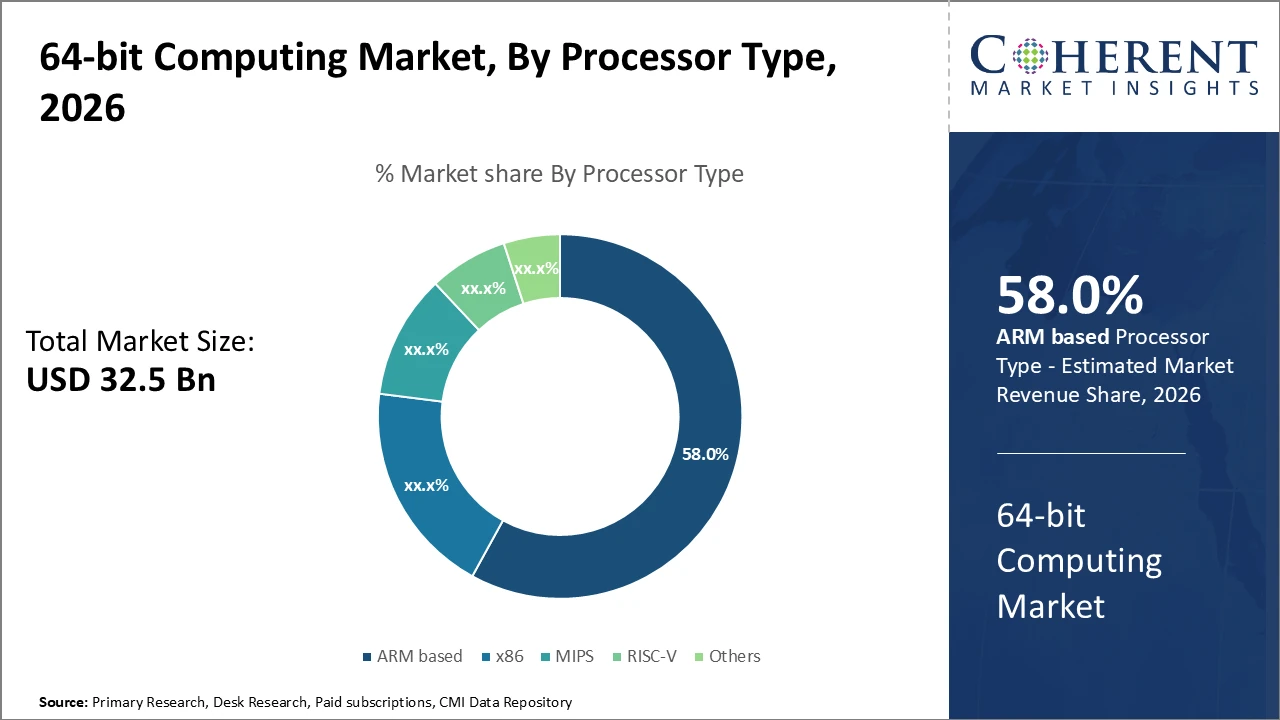
64-bit processor types, particularly ARM-based architectures, dominate the market with over 58% share due to low power consumption and scalability advantages.
Consumer electronics and data center applications lead in market adoption, while embedded systems are the fastest-growing segment, driven by IoT expansion.
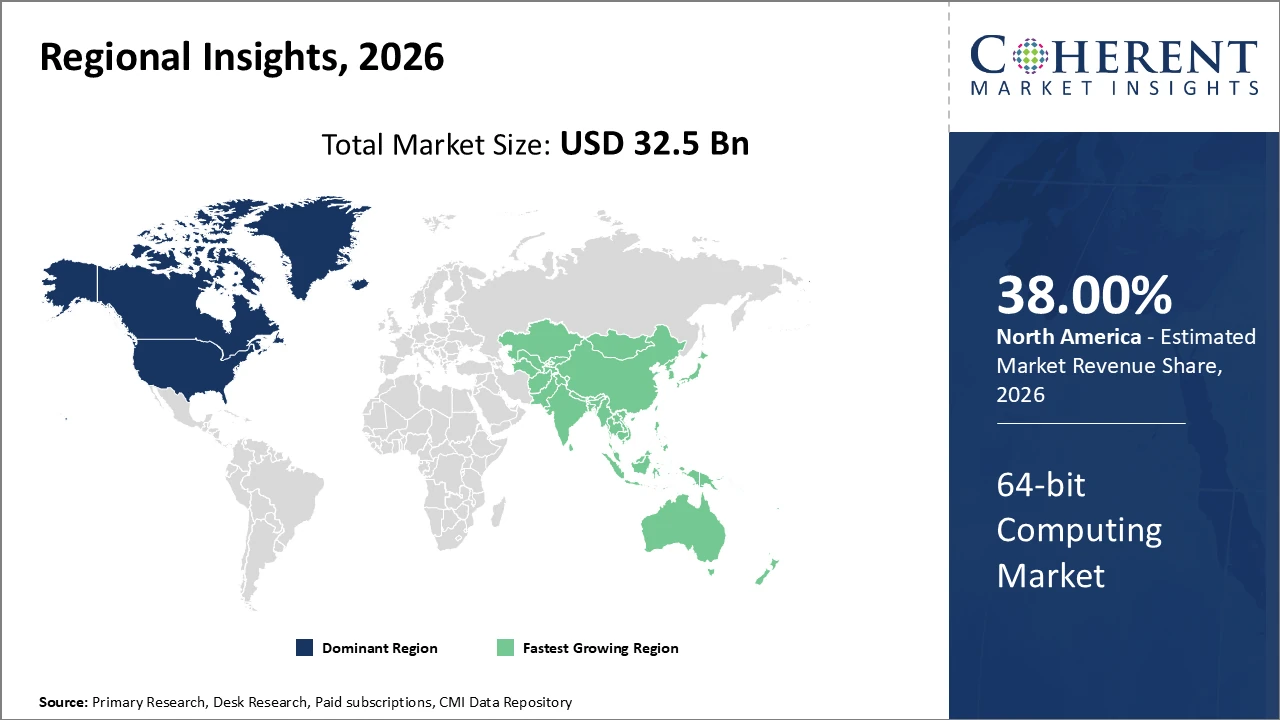
North America holds a significant market share, supported by the U.S. technological ecosystem, extensive cloud infrastructure, and AI research investments.
Asia Pacific is the fastest-growing region with a CAGR above 13%, fueled by government subsidies in semiconductor manufacturing and rapid digital adoption.
64-bit Computing Market Segmentation Analysis
To learn more about this report, Request Free Sample
64-bit Computing Market Insights, By Processor TypeARM-based processors dominate the 64-bit computing market due to their exceptional power efficiency and scalability across mobile, embedded, and edge computing platforms. Their low energy consumption makes them ideal for battery-powered devices and IoT applications, driving widespread adoption. The fastest-growing subsegment is the RISC-V architecture, favored for its open-source flexibility, customization potential, and cost-effectiveness, making it increasingly popular in specialized industrial, automotive, and AI chips. Meanwhile, x86 processors remain relevant in legacy systems and high-performance computing environments, and MIPS along with other architectures continue to serve niche applications, supporting diverse computing needs across sectors.
64-bit Computing Market Insights, By End User Industry
The IT & Telecom segment holds the largest share in the 64-bit computing market, driven by rapid advancements in cloud infrastructure, networking equipment, and mobile communications that leverage 64-bit processors for enhanced performance, efficiency, and security. The Automotive sector is the fastest-growing end-user segment, fueled by the integration of 64-bit processors in electric vehicles, autonomous driving systems, and advanced infotainment platforms. Healthcare is also expanding quickly, adopting 64-bit architectures for medical imaging, diagnostics, and patient monitoring requiring high-speed data processing. Industrial automation and other sectors contribute steadily, embedding 64-bit processors in robotics, control systems, and specialized computing applications.
64-bit Computing Market Insights, By Application
Consumer electronics dominate the 64-bit computing market, driven by the widespread adoption of smartphones, tablets, and smart devices that demand high-performance processing. Data centers represent the fastest-growing application segment, fueled by expanding cloud services, AI workloads, and big data analytics requiring advanced 64-bit server processors. Automotive systems are rapidly gaining traction as 64-bit processors become essential for vehicle control units, infotainment, and autonomous driving platforms. Embedded systems maintain steady growth by supporting industrial automation, medical devices, and IoT applications.
64-bit Computing Market Trends
The 64-bit computing market is increasingly shifting toward edge computing applications, enabling faster and localized data processing.
AI integration within 64-bit processor architectures is a key trend, with AI-specific instructions incorporated in processors by 2025 for intelligent computing tasks.
Automotive embedded systems adoption is rising, reflecting a trend toward smarter, safer, and connected vehicles.
Electrification of vehicles and autonomous driving technologies drive demand for high-performance 64-bit processors in automotive platforms.
Specialized 64-bit chipsets are emerging to support AI workloads, real-time analytics, and advanced computing needs across multiple industries.
64-bit Computing Market Insights, By Geography
To learn more about this report, Request Free Sample
North America 64-bit Computing Market Analysis and TrendsNorth America dominates the 64-bit computing market, driven by the U.S.’s leadership in semiconductor innovation, cloud infrastructure, and AI research investments. Major companies such as Intel and AMD, headquartered in the region, contribute significantly to market revenue, with North America accounting for approximately 38% of the global share. Robust government support for semiconductor fabrication, research grants, and digital transformation initiatives strengthens the region’s technological edge. Additionally, widespread adoption of 64-bit architectures across IT, telecom, and automotive sectors ensures sustained demand. The mature industrial ecosystem, combined with high R&D capabilities, reinforces North America’s continued leadership in the global 64-bit computing market.
Asia Pacific 64-bit Computing Market Analysis and Trends
The Asia Pacific region is witnessing the fastest growth in the 64-bit computing market, with a CAGR exceeding 13% from 2026 to 2033. Rapid digital adoption, government-backed incentives for semiconductor production, and the presence of large-scale consumer electronics manufacturers fuel this expansion. China’s strategic semiconductor policies and Taiwan’s advanced foundry ecosystem have significantly enhanced regional manufacturing capabilities for 64-bit computing hardware. Key companies such as Samsung and MediaTek actively contribute to market development through R&D investments and localized production. Rising demand from consumer electronics, automotive, and industrial sectors further accelerates regional market growth, solidifying Asia Pacific as a critical global player.
64-bit Computing Market Outlook for Key Countries
USA 64-bit Computing Market Analysis and Trends
The U.S. 64-bit computing market thrives on a strong innovation ecosystem, with leading companies like Intel and NVIDIA developing advanced processors optimized for AI, cloud computing, and high-performance applications. In 2025, deployment of 64-bit processors in American data centers grew by approximately 27%, driven by enterprises pursuing digital transformation and cloud expansion. Government initiatives, notably the CHIPS Act, have provided substantial funding to enhance domestic semiconductor manufacturing and R&D, bolstering technological leadership. Combined with robust startup activity and collaborations with global technology partners, these factors continue to propel the U.S. market, ensuring sustained growth and global competitiveness.
Germany 64-bit Computing Market Analysis and Trends
Germany’s 64-bit computing market is driven by its strong industrial and automotive sectors, which demand high-performance processors for automation, autonomous vehicles, and smart manufacturing applications. The country benefits from a mature semiconductor ecosystem, robust R&D infrastructure, and government initiatives supporting Industry 4.0 and digital transformation. In 2025, German enterprises increased deployment of 64-bit processors in industrial automation and data center applications by over 20%, reflecting rising adoption. Additionally, collaborations between local tech firms and global semiconductor companies, such as Intel and AMD, have accelerated innovation in energy-efficient and AI-enabled 64-bit architectures, reinforcing Germany’s position as a key European market.
Analyst Opinion
Increasing production capacity of advanced 64-bit processors is a key supply-side driver, with leading semiconductor manufacturers reporting a 14% year-on-year rise in wafer fabrication capacity in 2025 to meet growing demand from cloud computing and IoT devices.
On the demand side, industries such as automotive saw a 22% global increase in 64-bit chip procurement in 2024, driven by requirements for enhanced in-vehicle infotainment and autonomous driving systems.
Pricing strategies reflect a 5%-7% annual decline in average selling prices for 64-bit processors, improving affordability and adoption, particularly in emerging markets.
Integration of 64-bit architectures into mobile and edge devices is accelerating, with shipments of 64-bit-enabled smartphones and related devices rising 30% in 2026.
Market Scope
| Report Coverage | Details | ||
|---|---|---|---|
| Base Year: | 2025 | Market Size in 2026: | USD 32.5 billion |
| Historical Data for: | 2020 To 2024 | Forecast Period: | 2026 To 2033 |
| Forecast Period 2026 to 2033 CAGR: | 11.2% | 2033 Value Projection: | USD 68.9 billion |
| Geographies covered: |
|
||
| Segments covered: |
|
||
| Companies covered: | Intel Corporation, NVIDIA Corporation, Apple Inc., MediaTek Inc., Samsung Electronics, ARM Holdings, IBM Corporation, Texas Instruments, Advanced Micro Devices, Broadcom Inc. | ||
| Growth Drivers: |
|
||
Uncover macros and micros vetted on 75+ parameters: Get instant access to report
64-bit Computing Market Growth Factors
The expansion of cloud computing infrastructure has significantly driven the 64-bit computing market, with global data center capacities increasing by 31% in 2025. Rising AI and machine learning adoption, which requires higher processing power, has further fueled demand for 64-bit processors across industries such as automotive, healthcare, and finance. Government initiatives supporting semiconductor manufacturing and digital transformation, particularly in Asia Pacific, have boosted production capabilities. Moreover, the growing integration of 64-bit architectures in mobile devices, IoT applications, and edge computing has expanded the market, driven by consumer demand for enhanced performance, security, and energy-efficient computing solutions.
64-bit Computing Market Development
In December 2025, India launched DHRUV64, its first 1.0 GHz, 64-bit dual-core microprocessor, designed by Centre for Development of Advanced Computing under the Microprocessor Development Programme.
Key Players
Leading Companies of the Market
Intel Corporation
NVIDIA Corporation
ARM Holdings
Advanced Micro Devices
Samsung Electronics
Texas Instruments
IBM Corporation
Broadcom Inc.
MediaTek Inc.
Several leading companies have strategically invested in R&D to advance energy-efficient 64-bit processors for diverse applications. For instance, Intel’s 2025 launch of its latest 64-bit Xeon scalable processors delivered a 20% performance improvement, securing major contracts with cloud infrastructure providers and reinforcing its enterprise market presence. Similarly, Qualcomm accelerated its penetration in the smartphone segment by introducing 64-bit processors with integrated AI accelerators, enhancing device performance and enabling advanced features. These strategic launches not only expanded revenue streams but also strengthened competitive positioning, highlighting the industry’s focus on high-performance, energy-efficient computing solutions across cloud and mobile ecosystems.
64-bit Computing Market Future Outlook
The 64-bit computing market is poised for robust growth driven by the accelerating adoption of cloud infrastructure, AI, and edge computing applications. Future trends indicate increasing integration of AI accelerators, enhanced security features, and energy-efficient architectures to meet enterprise and consumer demands. Emerging markets in Asia Pacific are expected to lead adoption, supported by government incentives and expanding semiconductor manufacturing capabilities. The automotive and healthcare sectors will further drive demand through advanced in-vehicle computing and medical devices. Overall, the market is projected to witness sustained revenue growth, technological innovation, and expanded deployment across diverse industrial, consumer, and mobile applications.
64-bit Computing Market Historical Analysis
The 64-bit computing market has experienced significant evolution over the past decade, transitioning from niche high-performance computing to widespread adoption across consumer electronics, data centers, and embedded systems. Early growth was driven by the proliferation of 64-bit processors in desktops and servers, offering enhanced memory addressing and processing power. Between 2018 and 2023, market expansion accelerated with the rise of cloud computing, AI workloads, and IoT integration, prompting semiconductor manufacturers to scale production and innovate energy-efficient architectures. Legacy x86 and ARM-based processors maintained relevance, while emerging architectures like RISC-V gained traction for specialized industrial and automotive applications, shaping historical market dynamics.
Sources
Primary Research Interviews:
Semiconductor industry executives and 64-bit processor manufacturers
Data center operators and cloud service providers
Consumer electronics and mobile device manufacturers
Market analysts and technology trend consultants
Magazines:
Semiconductor Engineering – Processor Technology and Market Updates
Electronics Weekly – Embedded Systems and Computing Trends
EE Times – Semiconductor Innovations and AI Hardware Developments
VentureBeat – AI and Edge Computing Market Insights
Journals:
IEEE Transactions on Computers – Processor Architecture and Performance Studies
ACM Computing Surveys – Embedded and Mobile 64-bit Systems
Microelectronics Journal – Semiconductor Technology and Chip Design
Newspapers:
The Wall Street Journal – Semiconductor Industry and Technology Market News
Financial Times – Global Technology and Semiconductor Insights
Reuters – Processor Market and Cloud Hardware Developments
Bloomberg – Semiconductor and Computing Market Trends
Associations:
Semiconductor Industry Association
Global Semiconductor Alliance
International Microelectronics and Computer Society
IEEE Computer Society
Share
Share
Monica Shevgan has 9+ years of experience in market research and business consulting driving client-centric product delivery of the Information and Communication Technology (ICT) team, enhancing client experiences, and shaping business strategy for optimal outcomes. Passionate about client success.

Credibility and Certifications

860519526


9001:2015
27001:2022


Need a Custom Report?
We can customize every report - free of charge - including purchasing stand-alone sections or country-level reports
Customize NowJoining thousands of companies around the world committed to making the Excellent Business Solutions.
View All Our Clients