Astaxanthin Market Analysis & Forecast: 2026-2033
Astaxanthin Market Size and Forecast – 2026 – 2033
The Global Astaxanthin Market size is estimated to be valued at USD 510 million in 2026 and is expected to reach USD 915 million by 2033, exhibiting a compound annual growth rate (CAGR) of 8.3% from 2026 to 2033.
Global Astaxanthin Market Overview
Astaxanthin is a naturally occurring red-orange carotenoid pigment found mainly in marine organisms such as microalgae, salmon, trout, shrimp, and krill. It is produced primarily by the microalga Haematococcus pluvialis and is responsible for the pink or red color of seafood like Salmo salar. Astaxanthin is known for its powerful antioxidant properties, which help protect cells from oxidative stress and inflammation. Unlike some other antioxidants, it can cross the blood-brain and blood-retina barriers, supporting eye, skin, and brain health. It is commonly used as a dietary supplement for improving skin elasticity, endurance, and overall immune support.
Key Takeaways
The Nutraceutical segment leads the Astaxanthin market by application, driven by strong consumer preference for antioxidant-rich dietary supplements.
By source, Synthetic astaxanthin holds the largest market share due to its cost-efficiency and consistent quality control, although the natural segment is witnessing faster growth, especially in cosmetic applications.
In terms of form, Powder remains the dominant converter form, widely preferred in industrial formulations because of its stability, ease of handling, and versatility.
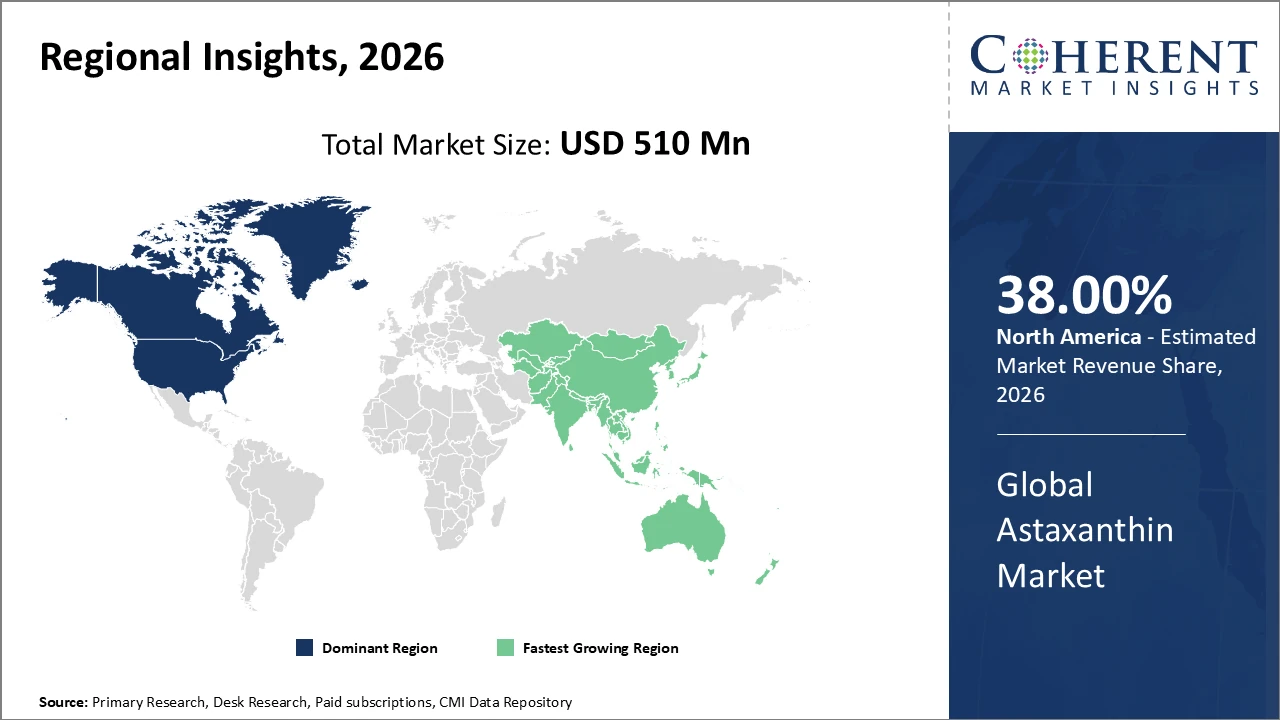
Regionally, North America accounts for approximately 38% of total market revenue in 2026, supported by high demand for health supplements and cosmetics along with favorable regulatory support for natural ingredients.
Asia Pacific is the fastest-growing regional market, registering a CAGR above 9%, driven by expanding aquaculture production and increasing health awareness among consumers, particularly in China and Japan.
Astaxanthin Market Segmentation Analysis
To learn more about this report, Request Free Sample
Astaxanthin Market Insights, By Application
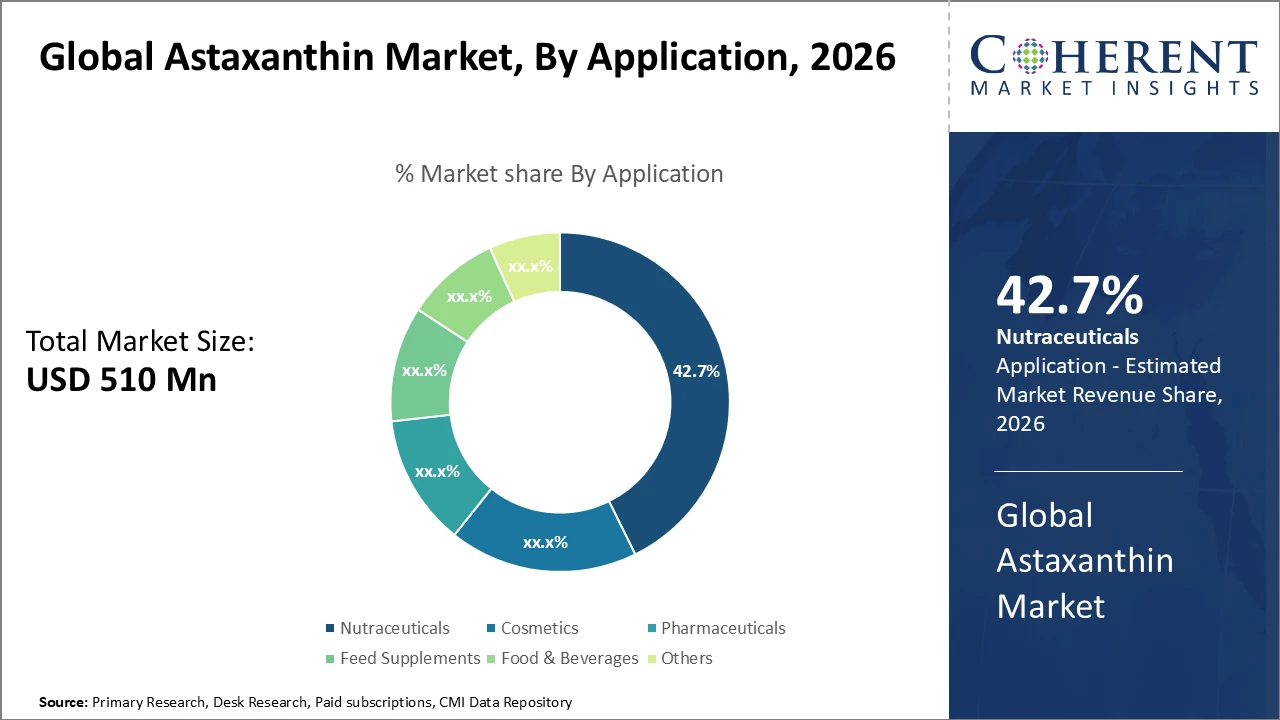
Nutraceuticals account for the largest market share of 42.7%, driven by widespread adoption of astaxanthin as a functional ingredient that supports immune health and reduces oxidative stress. Growth is reinforced by expanding scientific validation and a rising number of supplement product launches containing astaxanthin antioxidants. Cosmetics represent the fastest-growing subsegment, supported by increasing demand for natural, high-performance anti-aging ingredients and a 20% annual rise in new product introductions between 2024 and 2026. Pharmaceuticals and feed supplements demonstrate steady expansion due to clinical research advancements and strong aquaculture demand. The food and beverage segment remains smaller but is gaining traction through fortified beverages and health-focused food products.
Astaxanthin Market Insights, By Source
Synthetic astaxanthin holds the largest market share due to its cost-effectiveness, consistent quality, and suitability for large-scale production across high-volume applications. Its scalability and stable supply chain contribute significantly to overall market revenue and operational efficiency. Meanwhile, the natural segment is the fastest growing, driven by rising demand for clean-label, sustainable, and plant-based ingredients, especially in premium nutraceutical and cosmetic products. Bacterial and other alternative sources represent smaller, niche segments catering to specialized applications. Advancements in biotechnology, including improved extraction and fermentation techniques, are strengthening natural production capabilities and reshaping competitive dynamics within the astaxanthin market.
Astaxanthin Market Insights, By Form
Powder holds the largest market share due to its high stability, easy blending properties, and versatility across multiple formulations, making it highly suitable for large-scale industrial applications. Capsules represent the fastest-growing subsegment, supported by consumer demand for convenient supplement formats that provide accurate dosing and improved bioavailability. Oil-based formulations are increasingly adopted in cosmetic and pharmaceutical applications because of their enhanced absorption and skin penetration benefits. Tablets and other forms maintain smaller, specialized roles in targeted pharmaceutical and dietary supplement uses. Overall, form-based segmentation reflects shifting consumer preferences and advancements in innovative delivery systems within the astaxanthin market.
Astaxanthin Market Trends
The Astaxanthin market reflects a growing strategic shift toward sustainable and biologically derived sources, with companies prioritizing environmentally responsible production methods.
In 2025, industry participants increased investments in advanced microalgae cultivation technologies to reduce carbon footprints and enhance yield efficiency.
The integration of astaxanthin into multi-ingredient formulations has gained momentum, particularly in customized nutraceutical products designed for targeted health benefits.
In 2026, the rise of personalized nutrition significantly boosted the inclusion of astaxanthin in tailored dietary supplement solutions.
Demand for natural colorants in aquaculture and feed supplements has accelerated, supporting ecosystem-focused development that emphasizes animal welfare, product quality, and sustainable supply chains.
Astaxanthin Market Insights, By Geography
To learn more about this report, Request Free Sample
North America Astaxanthin Market Analysis and Trends
In North America, the Astaxanthin market maintains its leading position, acquiring a share of 38%, due to strong demand for nutraceutical products, supportive regulatory frameworks promoting natural antioxidants, and a well-established cosmetics industry utilizing astaxanthin for anti-aging and skin health applications. High consumer awareness regarding preventive healthcare and dietary supplementation further strengthens regional growth. The region accounts for approximately 38% of the global market share, supported by continuous product innovation and research activities. The United States serves as a major innovation hub, driving consistent revenue expansion through advanced formulation technologies, strategic partnerships, and increasing incorporation of astaxanthin into premium health and wellness products.
Asia Pacific Astaxanthin Market Analysis and Trends
Asia Pacific represents the fastest-growing region in the Astaxanthin market, registering a CAGR exceeding 9% during the forecast period. Growth is primarily driven by rapid expansion of the aquaculture industry, where astaxanthin is widely used to enhance pigmentation and improve feed efficiency. Rising consumer awareness regarding preventive healthcare and antioxidant supplementation further strengthens regional demand. Favorable government initiatives encouraging the use of natural and sustainable ingredients also contribute to market expansion. China and Japan serve as key growth engines, supported by increasing investments in production infrastructure, technological advancements, and a growing consumer base adopting health-focused and nutraceutical products.
Astaxanthin Market Outlook for Key Countries
USA Astaxanthin Market Analysis and Trends
The United States stands as a cornerstone of the Astaxanthin market, supported by strong consumer health awareness and continuous product innovation. In 2025, more than 30% of newly launched nutraceutical products incorporated natural antioxidants, including astaxanthin, reflecting growing preventive healthcare trends. Leading companies such as BASF SE and AstaReal AB have advanced the market through focused research on enhanced bioavailability and novel delivery systems. Supportive government health guidelines encouraging antioxidant intake further strengthen demand. Additionally, the expanding cosmetics industry increasingly integrates astaxanthin into premium skincare formulations, accelerating growth in specialized anti-aging segments.
Germany Astaxanthin Market Analysis and Trends
Germany’s Astaxanthin market is characterized by strong adoption in nutraceuticals and cosmetics, driven by high consumer health awareness and preference for natural, sustainable ingredients. The market benefits from robust regulatory support for food supplements and functional foods, encouraging innovation in antioxidant-rich formulations. Synthetic astaxanthin remains widely used due to cost-efficiency, while natural sources from microalgae gain traction in premium products. Powder and capsule forms dominate, with oil-based formulations rising in skincare applications. Key trends include personalized nutraceuticals, multi-ingredient functional products, and increasing incorporation of astaxanthin in anti-aging cosmetics. Ongoing R&D and sustainability initiatives shape market growth and competitive dynamics.
Analyst Opinion
Demand-side trends indicate that the rise in functional food and beverage innovation is a key market driver. In 2025, over 28% of newly launched nutraceutical products globally incorporated antioxidants such as astaxanthin, significantly boosting market revenue.
On the supply side, improvements in production capacity through bioengineering and fermentation methods increased output by 15% in 2024 compared to 2023, reducing raw material costs and stabilizing pricing for large-scale producers.
Market analysis shows expanding use in cosmetic formulations as a major growth factor, with sunscreen and anti-aging product launches featuring astaxanthin rising 22% globally in 2026.
Pricing trends indicate increasing affordability due to competitive raw algae sources and synthetic alternatives.
Astaxanthin exports from top Asia Pacific producers grew 18% in 2025, supported by government incentives promoting business growth through export facilitation.
Market Scope
| Report Coverage | Details | ||
|---|---|---|---|
| Base Year: | 2025 | Market Size in 2026: | USD 510 million |
| Historical Data for: | 2020 To 2024 | Forecast Period: | 2026 To 2033 |
| Forecast Period 2026 to 2033 CAGR: | 8.3% | 2033 Value Projection: | USD 915 million |
| Geographies covered: |
|
||
| Segments covered: |
|
||
| Companies covered: | BASF SE, BGG Group, Lonza Group AG, Earthrise Nutritionals, AstaReal AB, Cyanotech Corporation, Algatechnologies Ltd., Valensa International, DSM Nutritional Products AG, Pharmalys Laboratories | ||
| Growth Drivers: |
|
||
Uncover macros and micros vetted on 75+ parameters: Get instant access to report
Astaxanthin Market Growth Factors
The astaxanthin market is experiencing strong growth driven by rising demand for natural antioxidants across nutraceutical, pharmaceutical, cosmetics, and aquaculture industries. Increasing consumer awareness about preventive healthcare and immunity support has significantly boosted the adoption of astaxanthin supplements, particularly for cardiovascular health, skin protection, eye health, and anti-inflammatory benefits. The growing aging population and preference for clean-label, plant-based ingredients further support demand, especially for naturally sourced astaxanthin derived from microalgae such as Haematococcus pluvialis. In the cosmetics sector, expanding interest in anti-aging and UV-protection formulations is accelerating product incorporation.
Astaxanthin Market Development
In September 2024, Suyu expanded its product portfolio by launching an astaxanthin-infused skincare range. The brand states that the collection features nature-derived ingredients, highlighting astaxanthin as the primary component, complemented by superfoods such as reishi, shiitake, and chaga.
Key Players
Leading Companies of the Market
BASF SE
BGG Group
AstaReal AB
Lonza Group AG
DSM Nutritional Products AG
Cyanotech Corporation
Algatechnologies Ltd
Valensa International
EarthRise Nutritionals
Pharmalys Laboratories
Several market players have pursued strategic collaborations to enhance production scalability and market reach. In 2025, a leading company partnered with local algae producers in the Asia Pacific region to increase cost-effective natural astaxanthin extraction, achieving a 20% growth in regional market share. Innovation-driven product launches have also played a critical role in market expansion; for example, in 2026, a key player introduced nano-emulsified astaxanthin formulations, improving bioavailability and broadening applications in both cosmetics and nutraceuticals. These strategies contributed to higher market revenue and strengthened competitive positioning across global astaxanthin markets.
Astaxanthin Market Future Outlook
The future outlook for the Astaxanthin market is highly positive, driven by increasing consumer focus on preventive healthcare, functional nutrition, and natural cosmetic solutions. Demand for natural and sustainable sources is expected to rise, encouraging innovations in microalgae cultivation, fermentation technologies, and high-bioavailability formulations. Expanding applications in personalized nutraceuticals, anti-aging skincare, and fortified foods will further support market growth. Regionally, Asia Pacific is projected to grow rapidly due to aquaculture expansion and rising health awareness, while North America and Europe will continue to lead in premium product adoption. Overall, technological advancements and sustainability trends are set to shape long-term market dynamics.
Astaxanthin Market Historical Analysis
The Astaxanthin market has experienced steady growth over the past decade, primarily driven by rising awareness of its antioxidant and health-promoting properties. Early demand was concentrated in aquaculture and feed applications to enhance pigmentation in salmon, trout, and shrimp. Gradually, nutraceutical and cosmetic sectors emerged as significant contributors, fueled by research validating astaxanthin’s benefits for immune support, skin health, and oxidative stress reduction. Synthetic astaxanthin initially dominated due to cost efficiency and scalability, while natural sources gained traction with increasing consumer preference for clean-label and sustainable ingredients. Technological advancements in extraction and formulation further expanded market reach and product diversity.
Sources
Primary Research Interviews:
Astaxanthin producers and manufacturers
Nutraceutical, cosmetic, and pharmaceutical companies
Aquaculture and animal feed companies
Food and beverage product developers
Magazines:
Nutraceuticals World
Natural Products Insider
Cosmetics & Toiletries
Food & Beverage Industry News
Journals:
Journal of Functional Foods
Journal of Agricultural and Food Chemistry
Food Chemistry
Aquaculture Nutrition
Newspapers:
Financial Times – Health & Nutrition
The Wall Street Journal – Food & Supplements
Reuters – Natural Ingredients & Market Trends
Bloomberg – Consumer Health & Wellness
Associations:
International Astaxanthin Association (IAA)
European Nutraceutical Association (ENA)
Global Organization for EPA & DHA Omega-3s (GOED)
Natural Products Association (NPA)
Share
Share
Shivam Bhutani has 6 years of experience in market research and strategy consulting. He is a Market Research Consultant with strong analytical background. He is currently an MBA candidate specializing in Business Analytics from BITS Pilani.
He is adept at navigating diverse roles from sales and marketing to research and strategy consulting. He excels in market estimation, competitive intelligence, pricing strategy, and primary research. He is skilled at analysing large datasets to provide precise insights, helping clients in achieving strategic transformation across various industries. He is skilled in leveraging data visualization techniques to drive innovation and enhance business processes.

Credibility and Certifications

860519526


9001:2015

27001:2022


Need a Custom Report?
We can customize every report - free of charge - including purchasing stand-alone sections or country-level reports
Customize NowJoining thousands of companies around the world committed to making the Excellent Business Solutions.
View All Our Clients