Automotive Energy Harvesting And Regeneration Market Analysis & Forecast: 2026-2033

Automotive Energy Harvesting and Regeneration Market Size and Forecast – 2026 – 2033
The Global Automotive Energy Harvesting and Regeneration Market size is estimated to be valued at USD 8.2 billion in 2026 and is expected to reach USD 19.7 billion by 2033, exhibiting a compound annual growth rate (CAGR) of 13.8% from 2026 to 2033.
Global Automotive Energy Harvesting And Regeneration Market Overview
The Automotive Energy Harvesting and Regeneration market includes products such as regenerative braking systems, kinetic energy recovery systems (KERS), thermoelectric generators, piezoelectric vibration harvesters, and solar energy integration modules. These technologies capture waste energy from braking, heat, vibration, and sunlight and convert it into usable electrical power. The recovered energy is stored in batteries or capacitors to improve vehicle efficiency and extend driving range. They are widely used in electric vehicles, hybrid electric vehicles, and plug-in hybrids. Key goals include reducing fuel consumption, lowering emissions, and enhancing overall energy efficiency in modern automotive systems.
Key Takeaways
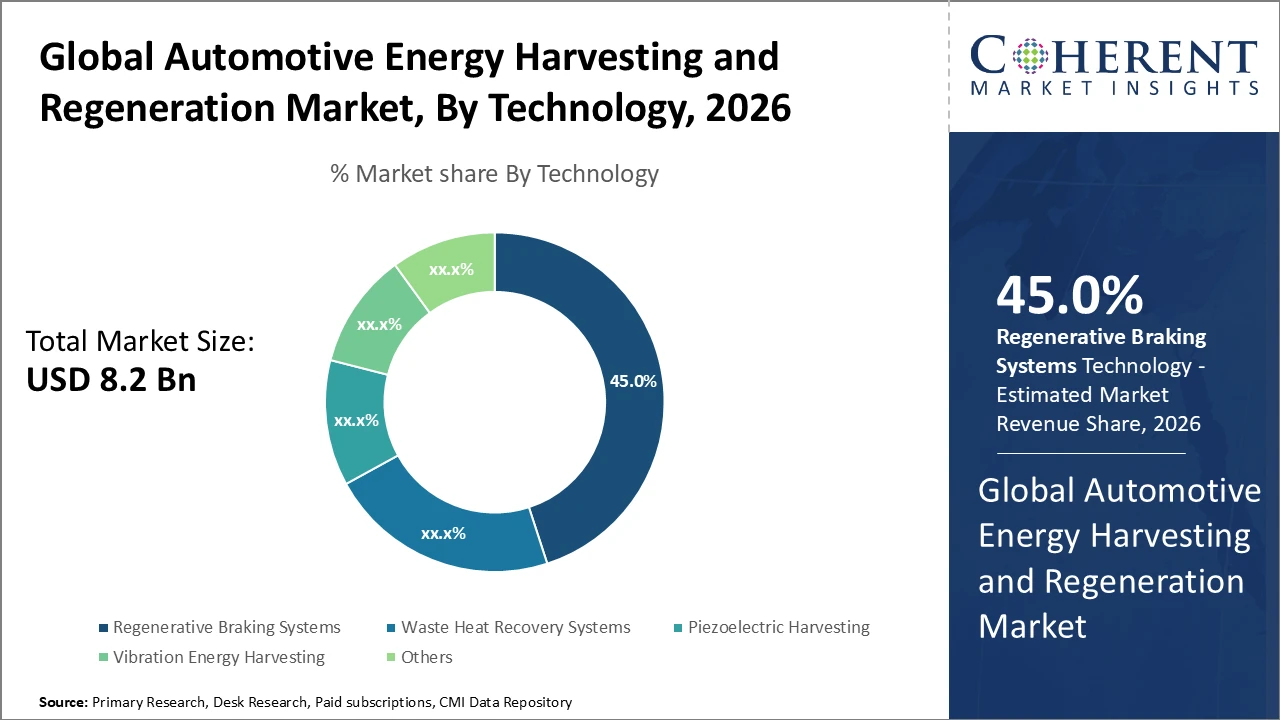
The regenerative braking systems segment, holding 45% market share, remains pivotal due to its mature technology and wide use in commercial vehicles, reflecting robust industry trends with steady demand growth.
Commercial vehicles dominate with a 52% industry share, driven by stricter fuel efficiency regulations and fleet electrification efforts, particularly in North America and Europe where fleet sustainability targets are aggressive.
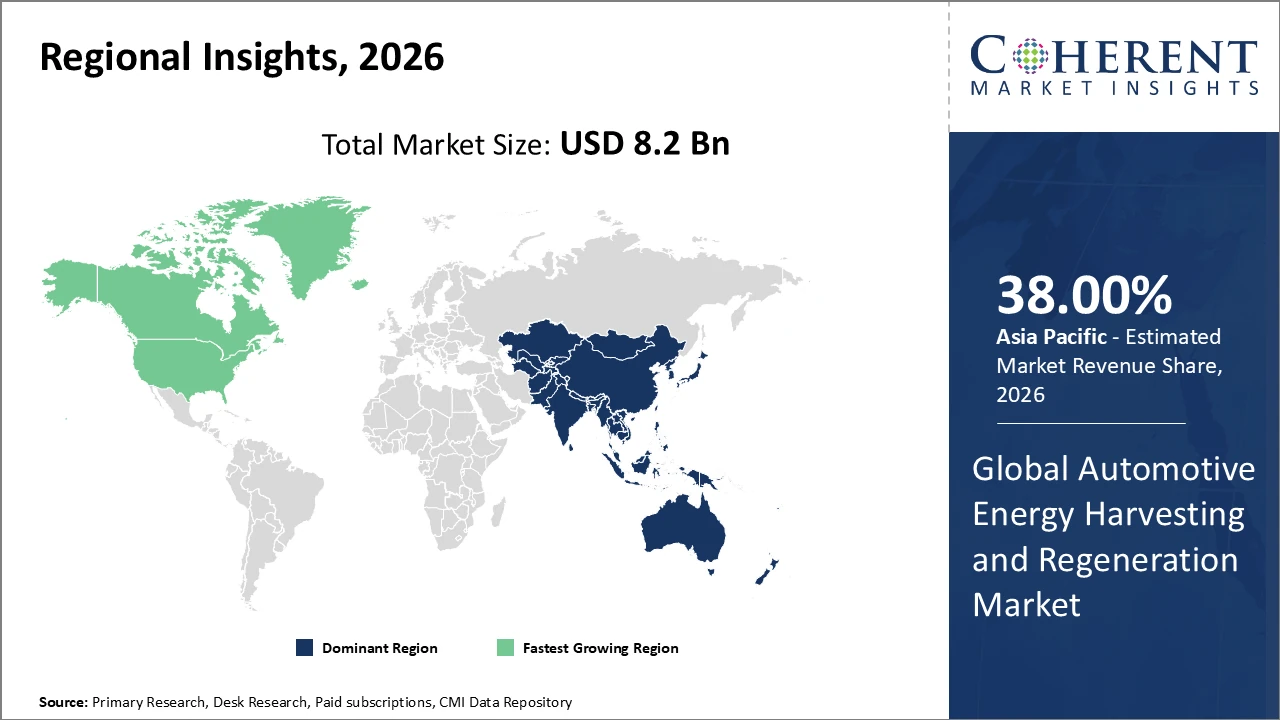
Regionally, Asia Pacific leads market growth momentum, accounting for over 38% of the market share due to escalating EV production and government subsidies in China and India. Meanwhile, North America exhibits a CAGR exceeding 14%, fueled by high consumer adoption rates and advanced automotive technology infrastructure.
Automotive Energy Harvesting and Regeneration Market Segmentation Analysis
To learn more about this report, Request Free Sample
Automotive Energy Harvesting and Regeneration Market Insights, By Technology
Regenerative braking systems dominate the market share, accounting for around 45% due to their high efficiency in recovering kinetic energy during vehicle deceleration and widespread adoption in electric and hybrid vehicles. Waste heat recovery systems represent the fastest-growing subsegment, supported by advancements in thermoelectric materials that improve heat-to-electricity conversion, increasing usage in commercial and heavy-duty vehicles. Piezoelectric and vibration energy harvesting technologies serve niche applications, particularly for powering low-energy autonomous sensors, but hold smaller shares due to technical limitations.
Automotive Energy Harvesting and Regeneration Market Insights, By Vehicle Type
Commercial vehicles dominate the Automotive Energy Harvesting and Regeneration market with a 52% share, driven by high energy demand, longer operational hours, and strong benefits from regenerative technologies. Increasing regulatory pressure on fuel efficiency and emissions is pushing manufacturers to integrate advanced energy recovery systems as standard features in this segment. Electric vehicles represent the fastest-growing subsegment, supported by rapid adoption of integrated energy harvesting modules that enhance battery life and extend driving range. Passenger cars show steady growth due to rising demand for fuel-efficient and low-emission models. Two-wheelers and other vehicle types contribute modestly, mainly in emerging economies with gradual electrification trends.
Automotive Energy Harvesting and Regeneration Market Insights, By Component
Energy storage devices dominate the market due to their critical role in capturing and storing regenerated energy, supported by rapid advancements in battery and capacitor technologies that improve efficiency and capacity. Power electronics represent the fastest-growing segment, driven by increasing demand for efficient energy conversion, voltage regulation, and seamless system integration in electric and hybrid vehicles. Sensors and actuators enable real-time monitoring and precise energy management, enhancing overall system responsiveness. Control units manage and coordinate energy flows to ensure optimal performance and safety. The others segment includes cooling systems and mounting hardware, which support stability, durability, and long-term operational reliability.
Automotive Energy Harvesting and Regeneration Market Trends
The market trend is characterized by the increasing adoption of hybrid energy harvesting solutions combining regenerative braking, waste heat recovery, and piezoelectric technologies, enabling more efficient overall energy utilization in vehicles.
This integrated approach is exemplified by Continental AG’s 2025 launch of a combined system that improved energy regeneration efficiency by over 18%, highlighting advancements in system-level optimization.
Another key trend is the growing use of AI for energy management, with Johnson Controls deploying smart control units in 2026 that optimize harvesting operations and reduce energy losses.
There is also a shift toward modular and scalable solutions, allowing manufacturers to serve different vehicle segments more effectively and expand overall market applications and growth potential.
Automotive Energy Harvesting and Regeneration Market Insights, By Geography
To learn more about this report, Request Free Sample
North America Automotive Energy Harvesting and Regeneration Market Analysis and Trends
North America exhibits the fastest growth in the Automotive Energy Harvesting and Regeneration market, with a CAGR exceeding 14%, driven by strong consumer demand for energy-efficient electric vehicles and strict corporate fleet emission standards. The region’s expansion is further supported by proactive regulatory frameworks, including policies similar to the Clean Modern Vehicle Act, which encourage investment in advanced energy harvesting technologies. The U.S. leads regional adoption due to its strong EV ecosystem and innovation-driven automotive sector. Major players such as Bosch and Eaton are increasing R&D and product development efforts in North America to leverage rising opportunities and strengthen their market presence.
Asia Pacific Automotive Energy Harvesting and Regeneration Market Analysis and Trends
In Asia Pacific, dominance in the Automotive Energy Harvesting and Regeneration market is driven by large-scale automotive manufacturing hubs in China, Japan, and India. The region accounted for approximately 38% of the market share in 2026, supported by strong government incentives promoting electric and hybrid vehicle production. Rapid industrialization, rising urbanization, and ongoing infrastructure modernization further accelerate the adoption of advanced energy harvesting technologies. A well-established and cost-efficient automotive supply chain ecosystem enhances production scalability and technology deployment. Additionally, increasing investments in EV innovation and sustainability initiatives continue to strengthen Asia Pacific’s leadership position and long-term market growth outlook.
Automotive Energy Harvesting and Regeneration Market Outlook for Key Countries
USA Automotive Energy Harvesting and Regeneration Market Analysis and Trends
The U.S. market plays a critical role in the North American Automotive Energy Harvesting and Regeneration industry, contributing significantly to regional revenue due to the presence of major automotive manufacturers adopting advanced energy harvesting solutions. In 2026, commercial fleet operators reported up to 12% fuel efficiency improvement through regenerative systems, reinforcing strong market potential and adoption benefits. The government’s stringent Corporate Average Fuel Economy (CAFE) standards continue to drive widespread implementation of energy-efficient technologies across vehicle categories. Additionally, active research and development collaborations between public institutions and private companies are accelerating innovation, improving system performance, and strengthening long-term market growth prospects.
Germany Automotive Energy Harvesting and Regeneration Market Analysis and Trends
Germany’s Automotive Energy Harvesting and Regeneration market is strongly driven by strict EU emission regulations and rapid EV adoption. Key trends include widespread integration of regenerative braking systems in electric and hybrid vehicles, along with growing use of thermoelectric and vibration-based energy harvesting technologies. German OEMs such as Bosch and Continental focus on improving energy efficiency and extending vehicle range through advanced recovery systems. Brake-by-wire and lightweight component innovations are also accelerating adoption. However, high system integration costs remain a challenge. Overall, Germany is a leading European hub for R&D and deployment of sustainable automotive energy recovery solutions.
Analyst Opinion
The surge in hybrid and electric vehicle production is a major demand-side driver, with over 12 million EVs sold globally in 2025, reflecting around 40% growth compared to the previous year. This shift is significantly boosting adoption of energy regeneration systems that enhance battery life and overall vehicle efficiency.
Increased investments in research and development have improved production capacity for thermoelectric generators used in waste heat recovery systems. In 2024, Asia Pacific recorded a 25% rise in manufacturing output of these components, indicating strengthened supply-side capabilities.
Pricing trends show a decline of approximately 10% in energy harvesting system costs in 2025, driven by economies of scale and improved material sourcing, which is expanding adoption across mid-range vehicle platforms and increasing market penetration.
Import volumes of advanced regenerative components into major automotive hubs such as Germany and the United States rose by nearly 18% in 2026, highlighting growing demand across passenger cars, commercial vehicles, and heavy-duty trucks.
Market Scope
| Report Coverage | Details | ||
|---|---|---|---|
| Base Year: | 2025 | Market Size in 2026: | USD 8.2 billion |
| Historical Data for: | 2020 To 2024 | Forecast Period: | 2026 To 2033 |
| Forecast Period 2026 to 2033 CAGR: | 13.8% | 2033 Value Projection: | USD 19.7 billion |
| Geographies covered: |
|
||
| Segments covered: |
|
||
| Companies covered: | Bosch, Denso Corporation, Valeo, Continental AG, Johnson Controls, Mitsubishi Electric, Hyundai Mobis, Delphi Technologies, Mahle GmbH, AVL List GmbH | ||
| Growth Drivers: |
|
||
Uncover macros and micros vetted on 75+ parameters: Get instant access to report
Automotive Energy Harvesting and Regeneration Market Growth Factors
The proliferation of electric and hybrid vehicles continues to be a major market growth driver, supported by government incentives such as the U.S. Inflation Reduction Act (2024) and Europe’s strict emission reduction targets. This has resulted in a 28% increase in automotive energy harvesting installations between 2024 and 2026. Advances in material science have improved thermoelectric conversion efficiencies to over 15%, boosting waste heat recovery applications, which grew by 22% in commercial vehicles in 2025. The expanding aftermarket for retrofit energy regeneration systems offers strong growth potential in emerging economies. Integration of smart sensors and AI-driven controls has further optimized performance, delivering up to 10% fuel savings in North American pilot fleets in 2026.
Automotive Energy Harvesting and Regeneration Market Development
In April 2026, a UK-based cleantech startup introduced a novel approach to improving electric vehicle efficiency: tyres that generate power from potholes. The company, RoadHarvest Technologies, claims its “Kinetic Recovery Tyres” (KRT) can convert the impact of uneven road surfaces into usable electricity..
Key Players
Leading Companies of the Market
Bosch
Denso Corporation
Valeo
Continental AG
Johnson Controls
Delphi Technologies
Mahle GmbH
Mitsubishi Electric
Hyundai Mobis
AVL List GmbH
Competitive strategies in the Automotive Energy Harvesting and Regeneration market include strong partnerships, acquisitions, and product innovation. Bosch has collaborated with electric vehicle manufacturers to develop customized regenerative braking modules, resulting in a 15% improvement in energy recuperation efficiency in 2025. Continental AG strengthened its technological capabilities through the strategic acquisition of a key thermoelectric generator supplier in 2026, which enhanced its product portfolio and contributed to a 12% increase in market revenue across Europe. Meanwhile, Denso Corporation focused on innovation by developing lightweight piezoelectric energy harvesting systems, improving cost efficiency and adaptability, thereby expanding its market presence across the Asia Pacific region.
Automotive Energy Harvesting and Regeneration Market Future Outlook
The Automotive Energy Harvesting and Regeneration market is expected to witness strong growth driven by rising EV adoption, stricter emission regulations, and advancements in energy-efficient technologies. Future systems will increasingly integrate regenerative braking, waste heat recovery, and vibration-based harvesting into unified platforms. AI and smart control units will optimize energy flow, improving overall vehicle efficiency and reducing losses. Continuous innovation in thermoelectric materials and lightweight components will further enhance performance and cost-effectiveness. Growing demand for extended vehicle range and fuel savings will accelerate adoption across passenger and commercial vehicles. Emerging economies and aftermarket retrofit solutions will also contribute significantly to long-term market expansion.
Automotive Energy Harvesting and Regeneration Market Historical Analysis
The Automotive Energy Harvesting and Regeneration market has evolved steadily over the past decade, driven by increasing focus on vehicle electrification and fuel efficiency. Initially, regenerative braking systems dominated early adoption in hybrid vehicles, primarily in premium and commercial segments. Over time, advancements in battery technology and power electronics enabled broader integration across passenger cars. Between 2018 and 2024, rising EV production and stricter emission norms significantly accelerated market growth. Technological progress in waste heat recovery and lightweight materials further diversified applications. Increased R&D investments and government incentives supported commercialization, making energy harvesting systems a standard feature in modern electric and hybrid vehicles globally.
Sources
Primary Research Interviews:
Automotive OEM executives, vehicle electrification engineers, and powertrain specialists focusing on regenerative braking systems, energy recovery efficiency, and hybrid/EV integration
Energy storage experts, battery management system (BMS) engineers, and ultracapacitor developers involved in capturing and storing harvested energy
Industry consultants, mobility strategists, and sustainability experts analyzing fuel efficiency regulations, electrification trends, and carbon reduction initiatives
Databases:
International Energy Agency – EV adoption trends, energy efficiency data, and transport decarbonization insights
International Organization of Motor Vehicle Manufacturers – Global vehicle production and sales statistics
Magazines:
Automotive News – Updates on OEM strategies, supplier developments, and vehicle technology trends
Green Car Congress – Innovations in energy recovery systems and sustainable mobility technologies
SAE International publications – Technical developments in regenerative braking and energy harvesting
Journals:
Applied Energy – Studies on vehicle energy efficiency and recovery systems
Energy Conversion and Management – Research on thermoelectric and kinetic energy harvesting technologies
IEEE Transactions on Vehicular Technology – Advances in automotive electronics and regenerative systems
Journal of Power Sources – Battery and ultracapacitor developments for energy storage
Newspapers:
The Wall Street Journal – Automotive investments, electrification trends, and supplier strategies
Financial Times – Global automotive transition and clean energy policies
Reuters – Updates on EV technology, regulations, and partnerships
Bloomberg – Market analysis, EV adoption, and automotive innovation trends
Associations:
Society of Automotive Engineers – Standards and research on automotive energy systems and regenerative technologies
International Council on Clean Transportation – Policy research on vehicle efficiency and emissions reduction
European Automobile Manufacturers Association – EU automotive regulations and electrification trends
Share
Share
Gautam Mahajan is a Research Consultant with 5+ years of experience in market research and consulting. He excels in analyzing market engineering, market trends, competitive landscapes, and technological developments. He specializes in both primary and secondary research, as well as strategic consulting across diverse sectors.

Credibility and Certifications

860519526


9001:2015

27001:2022


Need a Custom Report?
We can customize every report - free of charge - including purchasing stand-alone sections or country-level reports
Customize NowJoining thousands of companies around the world committed to making the Excellent Business Solutions.
View All Our Clients