Bullet Proof Jacket Market Analysis & Forecast: 2026-2033

Bullet Proof Jacket Market Size and Forecast – 2026 – 2033
The Global Bullet Proof Jacket Market size is estimated to be valued at USD 2.69 billion in 2026 and is expected to reach USD 4.2 billion by 2033, exhibiting a compound annual growth rate (CAGR) of 7.4% from 2026 to 2033.
Global Bullet Proof Jacket Market Overview
Bulletproof jackets, or ballistic vests, are protective garments designed to absorb and disperse the impact of bullets, shrapnel, and other ballistic threats. These jackets are primarily made from high-strength materials such as Kevlar, ultra-high-molecular-weight polyethylene (UHMWPE), aramid fibers, and ceramic plates for higher protection levels. They are classified into soft armor vests for handgun protection and hard armor plates for rifle-level threats. Features such as modular attachments, trauma pads, enhanced mobility designs, and lightweight composites have significantly improved comfort and protection performance. Bullet proof jackets are widely used by military forces, police personnel, private security, and civilians in high-risk environments.
Key Takeaways
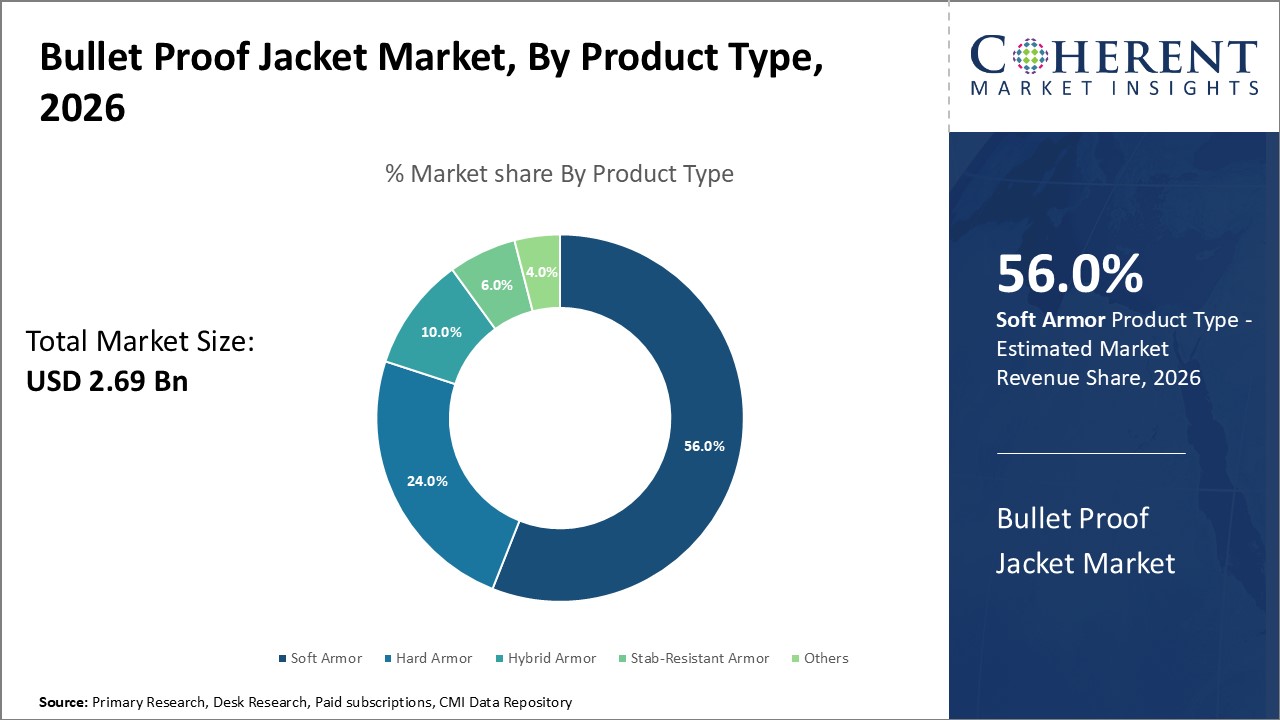
The Soft Armor segment dominates the product type category with a 56% market share, driven primarily by demand in law enforcement due to its lightweight nature and effective ballistic protection. Military applications favor Hard Armor for high-threat scenarios, reflecting segment specialization.
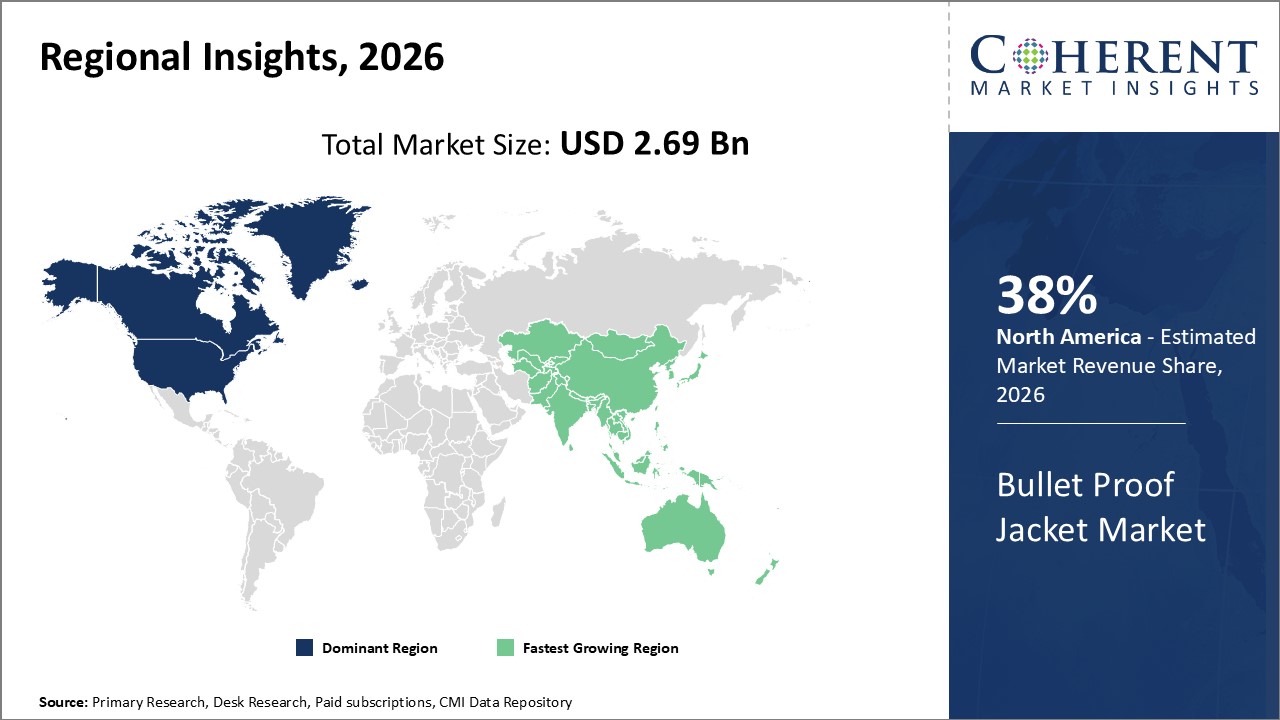
Geographic focus on North America remains significant, with the region commanding approximately 38% industry share, supported by sustained defense spending and rigorous occupational safety regulations.
Asia Pacific stands out as the fastest-growing region, exhibiting a CAGR of 8.4%, propelled by government initiatives to strengthen border security and boost local production capabilities.
Material innovation, especially in UHMWPE & ceramic composites, is a crucial market driver influencing segmental and regional growth dynamics, enabling manufacturers to meet evolving protection standards.
Bullet Proof Jacket Market Segmentation Analysis
To learn more about this report, Download Free Sample
Bullet Proof Jacket Market Insights, By Product Type
Soft Armor dominates the market share with 56%. Soft Armor’s dominance owes to its lightweight and flexible design, making it ideal for law enforcement and frequent mobility operations; it effectively balances protection and comfort for all-day wear. The fastest growing subsegment is Hybrid Armor, integrating soft and hard elements to provide multi-threat protection suitable for military and tactical units facing diverse attack vectors. Hard Armor remains crucial for high-risk combat scenarios due to superior ballistic resistance. Stab-Resistant Armor caters to niche markets, primarily corrections and specialized law enforcement applications.
Bulletproof Jacket Market Insights, By Material Type
Aramid Fiber is the dominating subsegment, given its widespread use in soft armor and a significant market share. Its high strength-to-weight ratio facilitates effective ballistic protection and user comfort. The fastest growing subsegment is UHMWPE, reflecting superior ballistic resistance and lighter weight compared to traditional materials, making it increasingly preferred in modern body armor products. Ceramic Plates continue to maintain crucial applications in hard armor due to their excellent impact resistance, but are limited by fragility and cost. Steel Plates, although heavy, are valued for cost-effectiveness in specific contexts.
Bulletproof Jacket Market Insights, By End-User
Law Enforcement dominates the market share due to widespread procurement for police and paramilitary personnel requiring reliable yet ergonomic protection. Military & Defense represents the fastest-growing subsegment, spurred by increasing deployment of advanced armor systems in combat operations and training exercises. Private Security is expanding as corporate and personal security demands heighten amid rising global threats. Civilian Use, although a smaller portion, is gaining traction amidst concerns over personal safety in high-risk areas.
Bullet Proof Jacket Market Trends
Recent bullet proof jacket market trends reveal substantial progress in integrating smart wearable tech, such as body vitals sensors and GPS communication modules, enhancing operational command capabilities.
For example, several law enforcement units in Europe and North America piloted smart jacket programs in 2025, reporting improved incident response efficacy.
Another trend is the adoption of modular armor systems allowing adaptability for various threat levels, which has increased market traction, particularly in Asia Pacific defense sectors.
Environmental concerns have also driven manufacturers to explore sustainable material alternatives, responding to evolving regulatory pressures.
Bullet Proof Jacket Market Insights, By Geography
To learn more about this report, Download Free Sample
North America Bullet Proof Jacket Market Analysis and Trends
In North America, the bullet proof jacket market retains dominance with a commanding 38% share, attributable to ongoing defense budget increases, stringent safety standards, and widespread law enforcement modernization programs. The U.S. is a pivotal contributor due to its consolidated defense ecosystem and large-scale procurement initiatives, which stabilize demand and innovation investment.
Asia Pacific Bullet Proof Jacket Market Analysis and Trends
Meanwhile, the Asia Pacific exhibits the fastest growth, accelerating at an 8.4% CAGR. This surge is driven by increasing security concerns, expansion of local protective gear manufacturing hubs in China, South Korea, and India, and supportive government policies promoting import substitution and defense collaborations. Regional trade dynamics and geopolitical tensions further stimulate market uptake.
Bullet Proof Jacket Market Outlook for Key Countries
USA Bullet Proof Jacket Market Analysis and Trends
The USA commands a substantial share of the bullet proof jacket market, supported by robust investments in law enforcement and military personnel protective equipment. Recent federal funding augmented body armor acquisition by law enforcement agencies by 20% in 2025, alongside evolving NIJ (National Institute of Justice) ballistic standards enhancing product safety requirements. Numerous key players headquartered in the U.S. continue to lead innovation, integrating advanced composite materials and smart technologies in their offerings, which bolsters the country’s dominant industry size and market share.
India Bullet Proof Jacket Market Analysis and Trends
India’s bullet proof jacket market is experiencing rapid growth driven by expanding defense modernization programs and internal security enhancements in response to geopolitical tensions. The government's initiative to boost indigenization under ‘Make in India’ has catalyzed manufacturing investments, leading to significant output increases by local market companies in 2025. Growth in private security services further complements demand, positioning India as a critical emerging market with robust business growth potential.
Analyst Opinion
The demand-side dynamics reflect escalating procurement volumes by law enforcement and military entities globally. In 2025 alone, police departments across the U.S. increased bullet proof jacket acquisitions by over 16% in response to rising violent crime rates and enhanced officer safety protocols, underlining a growing market share in public safety applications.
Examining production capacity, manufacturers scaled up output by approximately 12% across Asia Pacific in late 2023 to meet growing orders from emerging markets, indicating a robust supply side foundation that sustains market revenue growth and competitive pricing strategies.
Technological innovation in lightweight and multi-threat resistant materials, such as ultra-high-molecular-weight polyethylene (UHMWPE) composites, enhanced the ballistic performance of jackets without adding weight. For example, a 2026 launch of next-gen ballistic panels by a prominent manufacturer reduced jacket weight by 26%, fostering demand among tactical units requiring mobility.
Export trends show a notable increase in bullet proof jacket shipments from manufacturing hubs like China and South Korea to the Middle East and Africa regions, where procurement surged by an estimated 18% in 2025 due to heightened regional conflicts and security investments. This export growth is a critical contributor to the expanding global market scope.
Market Scope
| Report Coverage | Details | ||
|---|---|---|---|
| Base Year: | 2025 | Market Size in 2026: |
USD 2.69 billion |
| Historical Data for: | 2020 To 2024 | Forecast Period: | 2026 To 2033 |
| Forecast Period 2026 to 2033 CAGR: | 7.4% | 2033 Value Projection: |
USD 4.2 billion |
| Geographies covered: |
|
||
| Segments covered: |
|
||
| Companies covered: | BAE Systems, Heckler & Koch GmbH, Crye Precision, Armorsource America, Aramid Technologies, Honeywell International Inc., Safeguard Armor, Tencate Protective Fabrics, Mehler Vario System GmbH, MikroPul Equipment | ||
| Growth Drivers: |
|
||
Uncover macros and micros vetted on 75+ parameters: Get instant access to report
Bullet Proof Jacket Market Growth Factors
The rise in global security threats has intensified investments in protective gear, directly escalating market revenue. Increasing urban violence and terrorism-related incidents boosted demand for bullet proof jackets by law enforcement agencies, especially in North America and Europe. Technological advancements delivering lightweight yet robust materials are critical growth drivers, enhancing user comfort without compromising ballistic protection, which fuels adoption in military and civilian segments. Further, stringent government mandates on personnel safety, coupled with increasing private security needs in developing economies, act as strong catalysts for sustained market growth. For instance, new regulations in the U.S. requiring standard ballistic protection levels for body armor usage accelerated market uptake in 2025.
Bullet Proof Jacket Market Development
In 2026, DRDO and IIT Delhi introduced a new generation of lightweight high-protection ballistic jackets engineered to withstand AK-47 and sniper-grade rounds. The innovation features advanced composite layering for superior mobility and impact resistance, with technology transfer initiated to Indian defense manufacturers to support large-scale indigenous production.
In 2025, DuPont and Point Blank Enterprises launched a next-generation armor line integrating DuPont’s Kevlar® EXO™ technology for North American law enforcement agencies. The solution delivers enhanced ballistic performance, reduced weight, and improved ergonomic flexibility, representing a significant upgrade over legacy aramid-based protective systems.
Key Players
Leading Companies of the Market
BAE Systems
Heckler & Koch GmbH
Crye Precision
Armorsource America
Aramid Technologies
Honeywell International Inc.
Safeguard Armor
Tencate Protective Fabrics
Mehler Vario System GmbH
MikroPul Equipment
Competitive strategies in the market include product innovation and portfolio expansion, demonstrated by a leading global company that introduced ultra-lightweight bullet proof jackets in 2026, gaining a 11% increase in market share within six months. Another key player executed strategic partnerships with defense ministries in the Asia Pacific to co-develop region-specific protective gear, resulting in expanded market penetration and a 16% surge in regional revenue
Bullet Proof Jacket Market Future Outlook
Going forward, innovation will center on ultra-lightweight composite materials, multi-hit resistant plates, and ergonomic soft armor for enhanced mobility. Integration of smart sensors for real-time ballistic impact detection and biometric monitoring may become a new standard. The shift toward modular tactical gear will increase product customization across military and law enforcement. Additionally, geopolitical tensions, urban security concerns, and expanded budgets for soldier protection programs will continue to reinforce growth.
Bullet Proof Jacket Market Historical Analysis
The Bullet Proof Jacket market has been historically influenced by defense modernization initiatives, changes in global security threats, and law enforcement mobility requirements. Early bulletproof vests relied on heavy steel plates, but the introduction of aramid fibers (like Kevlar) and high-performance polyethylene transformed the industry, enabling lightweight, more comfortable designs. Over the past decade, rising military expenditures in Asia-Pacific, modernization across NATO nations, and an increased focus on counterterrorism strengthened demand. Civilian adoption also increased due to heightened safety concerns in private security and essential frontline services.
Sources
Primary Research Interviews:
Defense Procurement Officers
Ballistics Engineers
Law Enforcement Agencies
Armor Manufacturers
Military Consultants
Databases:
SIPRI Defense Data
DoD Procurement Database
UN Comtrade
Magazines:
Defence Review
Military Times
Tactical Gear Magazine
Soldier Systems
Force Magazine
Journals:
Journal of Defense Technology
Materials Science & Engineering
Journal of Protective Materials
Composite Structures
Military Engineering Journal
Newspapers:
The Times (Defense)
The Washington Post (Security)
Reuters (Defense)
The Hindu (Defence)
Financial Express (Security)
Associations:
NIJ
NATO Standardization Office
Indian Ordnance Board
AFCEA
National Tactical Officers Association (NTOA)
Share
Share
Sakshi Suryawanshi is a Research Consultant with 6 years of extensive experience in market research and consulting. She is proficient in market estimation, competitive analysis, and patent analysis. Sakshi excels in identifying market trends and evaluating competitive landscapes to provide actionable insights that drive strategic decision-making. Her expertise helps businesses navigate complex market dynamics and achieve their objectives effectively.

Credibility and Certifications

860519526


9001:2015
27001:2022


Need a Custom Report?
We can customize every report - free of charge - including purchasing stand-alone sections or country-level reports
Customize NowJoining thousands of companies around the world committed to making the Excellent Business Solutions.
View All Our Clients