Enterprise Performance Monitoring Market Analysis & Forecast: 2026-2033

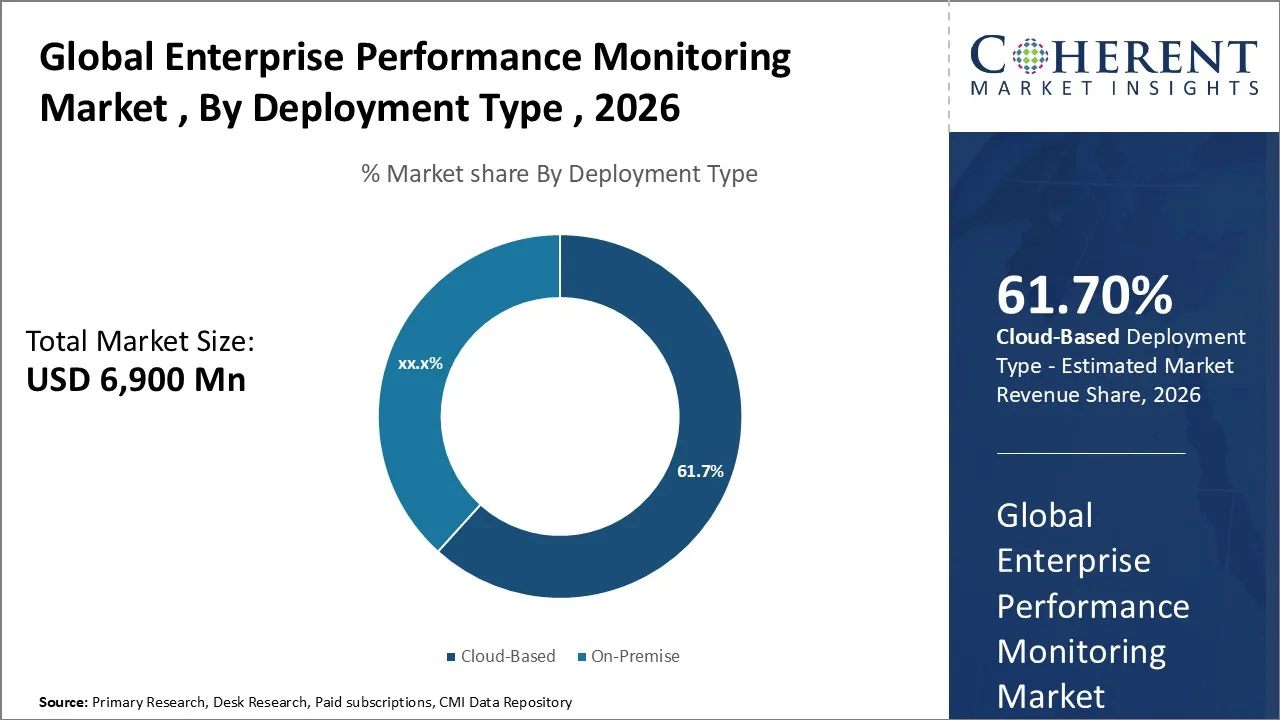
The Enterprise Performance Monitoring Market is estimated to be valued at USD 6,900 Mn in 2026 and is expected to reach USD 13,580 Mn by 2033, growing at a compound annual growth rate (CAGR) of 10.2% from 2026 to 2033.
The enterprise performance management solutions assist organizations in conducting financial planning, budget allocation, forecasting activities, and fiscal oversight. They also provide analytical capabilities, data visualization, and predictive modeling tools that allow enterprises to evaluate, interpret, and prepare for business operations. Companies can enhance their fiscal and operational effectiveness as well as optimize organizational efficiency with the help of performance management platforms. The increasing need for clear business operations, a focus on better organizational performance, more attention to key business activities, and the rising use of data-driven decision-making in companies are propelling the market growth.
|
Current Event |
Description and the Impact |
|
Regulatory and Compliance Changes
|
|
|
Technological Advancements and Innovations |
|
|
Industry-Specific Digital Transformation Drives |
|
Uncover macros and micros vetted on 75+ parameters: Get instant access to report
Artificial intelligence (AI) is changing the way companies are adopting performance monitoring of their business through intelligent analysis and prediction. AI technology continually monitors complex IT infrastructure and business application performance in distributed networks and detects problems that cannot be manually monitored by human resources. This technology helps in lowering mean time to resolution (MTTR) and improves system and service availability. Capacity and potential bottlenecks or points of failure are analyzed through machine learning models to predict them before they become issues for the business.
For instance, in April 2025, Oracle NetSuite announced that organizations in Singapore can now access NetSuite Enterprise Performance Management (EPM), which includes NetSuite Planning and Budgeting and NetSuite Account Reconciliation. By integrating planning, budgeting, forecasting, account reconciliation, financial close, and reporting procedures from throughout the entire organization, NetSuite EPM enables Singaporean organizations to improve visibility, make better decisions with AI-powered insights, and spur growth.
In terms of deployment type, the cloud-based segment contributes the highest share of 61.70% in 2026 of the market. Cloud EPM gives real-time insights through easy-to-use visual dashboards and strong reporting tools. This helps finance leaders to make decisions and fuel market growth. Cloud EPM applies predictive analytics for more accurate and flexible planning. This allows finance leaders to quickly adjust to market shifts and update business plans with financial targets. It provides a single platform that cuts direct and indirect costs, leading to lower total ownership costs.
For instance, in October 2025, Datadog rolled out fresh integrations for its platform via Oracle Cloud Marketplace and enabled seamless deployment on Oracle Cloud Infrastructure (OCI). These additions aim at improving reliability, boosting cost efficiency, and strengthening security for workloads (including AI and machine learning applications). GPU Monitoring, Cloud Cost Management, and Cloud SIEM serve as key features that expand the platform’s existing monitoring capabilities.
In terms of business function type, the finance segment contributes the highest share of 42.50% in 2026 of the market. The finance function guides decisions across the organization, needing deeper and clearer understanding of operations, customers, markets, and the outside environment. EPM covers various activities and practices that provide the key points needed to deliver insights from internal, external, financial, non-financial, structured, and unstructured data information. This helps in driving the segment growth.
For instance, in October 2025, Oracle announced that it will be assisting finance professionals in transforming fundamental finance activities with the use of new AI agents within Oracle Fusion Cloud Applications. The new AI agents, created with Oracle AI Agent Studio for Fusion Applications, are built into finance processes to help finance professionals work more efficiently and boost business performance by automating complete workflows and offering helpful predictions.
In terms of vertical type, the Banking, Financial Services and Insurance (BFSI) segment contribute the highest share of 35.20% in 2026 of the market. EPM uses transactional data, including debt capital market deals, letters of credit, deposits, loans, trading desks, and the EPM framework, to help clients assess and report on execution while tracking budgets, investments, and the effects of change programs the banks approve across business areas. This makes EPM software valuable as it helps banks reduce risk, achieve better financial results, and ensure profitability.
For instance, in March 2024, EY India created a "Customised Fine-Tuned LLM" especially for the Banking, Financial Services, and Insurance (BFSI) industry, which promises to transform operational efficiency and customer service. EY India's customized LLM offers cutting-edge AI-driven capabilities as the industry shifts to vertical LLMs. It provides clients with more accurate and reliable AI results by improving answer accuracy, intent detection, contextual comprehension, and BFSI-specific language depth.
To learn more about this report, Request Free Sample
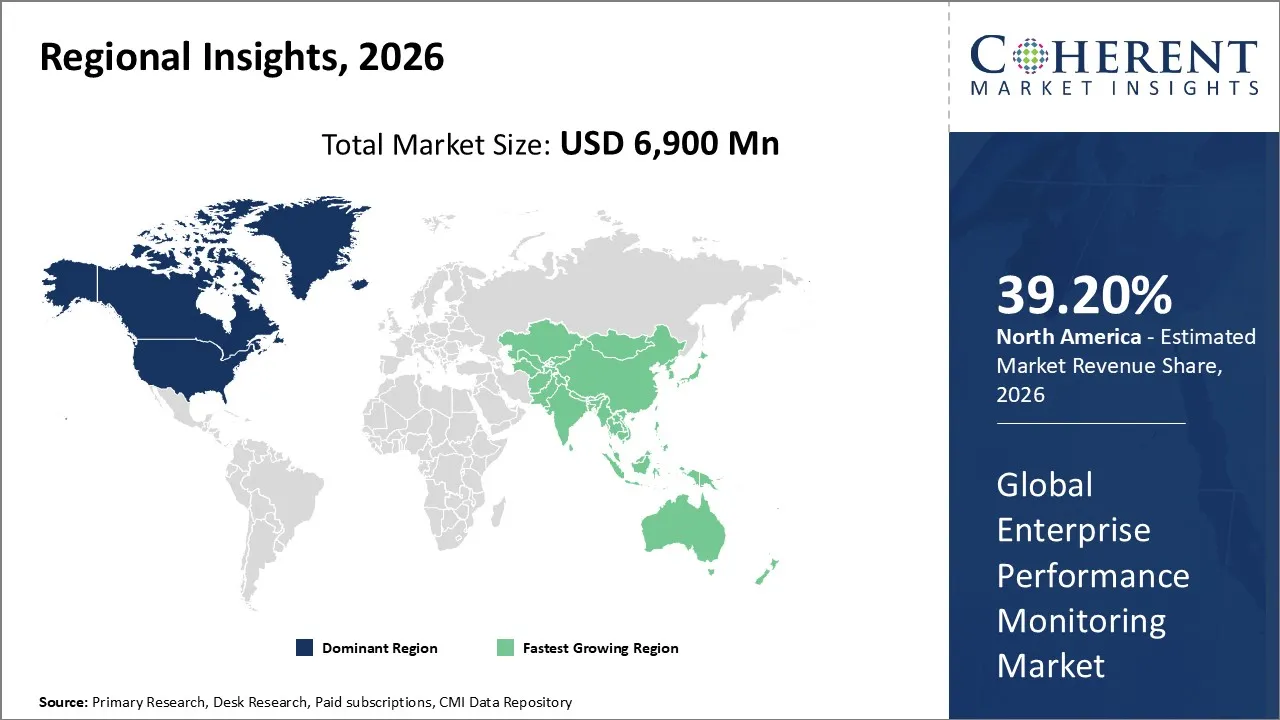
North America has remained the dominant region, with 39.20% in 2026 of the global Enterprise Performance Monitoring Market over the past decade. Companies are looking for better ways and tools to handle financial planning, budgeting, and reporting. Therefore, the firms are shifting from their traditional, conservative methods of planning and reporting to a more modern approach of cloud-based solutions offering real-time insights across departments and teams. The US leads the way in the market, and Canada has been expressing keen interest in implementing the same.
For instance, in September 2025, Lumel, a top worldwide supplier of planning and analytics software, has announced that Enterprise Performance Management (EPM) in Microsoft Fabric is now generally available. Through a no-code, self-service interface, Lumel EPM eliminates data silos and replication by enabling business users to create and manage complex planning workflows directly in Microsoft Fabric, including budgeting, forecasting, scenario modeling, and driver-based planning.
The Asia Pacific region has become the fastest-growing market. Monitoring solutions are being increasingly adopted due to digital transformation initiatives across industries, which helps companies scale their monitoring capabilities more easily while reducing infrastructure costs significantly. The growing middle class in the region is pushing businesses to improve customer experience by using monitoring systems that can find and fix problems before they affect service quality. SMEs are also investing more in these solutions, and this has enabled them to compete favorably in the market by keeping their systems running smoothly. The growth of digital economies via government initiatives in countries like China, India, and Singapore is driving the need to seek better performance monitoring systems.
E-commerce businesses need advanced monitoring platforms to keep their systems reliable during high transaction volumes. Mobile-first consumers are driving companies to adopt monitoring strategies that track performance across all digital channels. The need to optimize labor costs further encourages organizations to adopt an automatic monitoring process, helping them identify problems and work in a more efficient manner.
The U.S. market for enterprise performance monitoring leads global innovation with substantial growth that is driven by multiple factors. Advanced technological infrastructure makes it easier for companies to adopt sophisticated monitoring solutions that deliver superior visibility across operations. The competitive business environment pushes organizations to implement solutions that enable better operational efficiency and productivity. Cloud adoption rates are exceptionally high in the country, which helps enterprises monitor their operations faster than traditional methods.
For instance, in March 2024, KPMG LLP introduced a cutting-edge financial platform called KPMG Digital Finance. This managed finance and management reporting solution leverages the most recent data and AI technologies, powered by Aptitude's accounting hub, subledger technology, and KPMG Modern Data Platform assets built on Microsoft Azure. The KPMG Digital financial solution is a fully integrated financial solution that gives finance teams access to a cutting-edge and effective technology stack so they can concentrate on managing their businesses.
China's market is growing owing to the government-backed digitalization initiative across all sectors. The Made in China 2025 strategy drives manufacturing enterprises to adopt monitoring platforms that make operations smarter and production processes more efficient. E-commerce giants invest heavily in infrastructure, which allows smaller businesses to use superior performance monitoring technologies more easily. The massive consumer base pushes companies to implement systems that make application performance tracking simpler and effective daily.
| Report Coverage | Details | ||
|---|---|---|---|
| Base Year: | 2025 | Market Size in 2026: | USD 6,900 Mn |
| Historical Data for: | 2020 To 2024 | Forecast Period: | 2026 To 2033 |
| Forecast Period 2026 to 2033 CAGR: | 10.2% | 2033 Value Projection: | USD 13,580 Mn |
| Geographies covered: |
|
||
| Segments covered: |
|
||
| Companies covered: |
Oracle, IBM, Infor, SAP, Anapian, Workday, Epicor Software, Unicom Systems, Planful, OneStream, Workiva, BearingPoint, Broadcom, Board International, and Lucanet. |
||
| Growth Drivers: |
|
||
| Restraints & Challenges: |
|
||
Uncover macros and micros vetted on 75+ parameters: Get instant access to report
Cloud-based EPM systems deliver notable advantages in scalability, cutting down IT maintenance expenses while enabling seamless access from multiple devices through web browsers. It's vital to review service level agreements, security, and per-user costs to ensure top efficiency. Cloud EPM solutions deliver multiple features and business advantages that help companies reduce risks and improve performance. Cloud EPM tools are set to offer greater business automation, with providers adding advanced tech like artificial intelligence (AI) for new automation and analysis tools, enabling automated data collection, budgeting, and more. Businesses select cloud EPM as it avoids infrastructure investments and lowers total ownership costs. Cloud EPM eases compliance by weaving governance and risk management into financial processes, cutting time and costs for regulations. Thus, the growing adoption of cloud EPM solutions is fueling enterprise performance management market growth.
Therefore, the growing adoption of cloud EPM solutions is fueling enterprise performance management market growth.
EPM providers are incorporating machine learning (ML) and artificial intelligence (AI) methods to launch pilot programs and proof of concepts (POC). These initiatives aim to identify precise ways to apply augmented intelligence in use case development. The POCs target key areas such as sales forecasting, revenue projections, supply chain planning, workforce efficiency, and demand detection.
The AI and ML tools tackle three major challenges faced by business teams namely issues with data volume, complexity, and accessibility that slow down processes. As data volumes grow, they become increasingly intricate. Traditional EPM systems demand expensive, lengthy updates to pull in data from multiple sources. AI/ML addresses this by enabling systems to adapt automatically. The rise of Internet of Things (IoT) and Big Data has exploded enterprise data volumes. Automation proves essential here, as it delivers timely, cost-efficient insights from vast datasets. AI/ML technologies streamlines repetitive tasks. On accessibility, these technologies simplify data discovery and usage within systems while broadening employee access across the organization.
Share
Share
Suraj Bhanudas Jagtap is a seasoned Senior Management Consultant with over 7 years of experience. He has served Fortune 500 companies and startups, helping clients with cross broader expansion and market entry access strategies. He has played significant role in offering strategic viewpoints and actionable insights for various client’s projects including demand analysis, and competitive analysis, identifying right channel partner among others.
Joining thousands of companies around the world committed to making the Excellent Business Solutions.
View All Our Clients