Facial Recognition System Market Analysis & Forecast: 2026-2033

Facial Recognition System Market Size and Forecast – 2026 – 2033
The Global Facial Recognition System Market size is estimated to be valued at USD 9.93 billion in 2026 and is expected to reach USD 19.3 billion by 2033, exhibiting a compound annual growth rate (CAGR) of 11.6% from 2026 to 2033.
Global Facial Recognition System Market Overview
Facial recognition systems are biometric solutions that identify or verify individuals based on facial features captured through cameras and processed with AI algorithms. These systems include hardware such as sensors, 2D/3D cameras, and software capable of image detection, feature extraction, and pattern matching. They are used for surveillance, access control, identity verification, smartphones, payment authentication, and law enforcement, offering fast, contactless, and automated recognition.
Key Takeaways
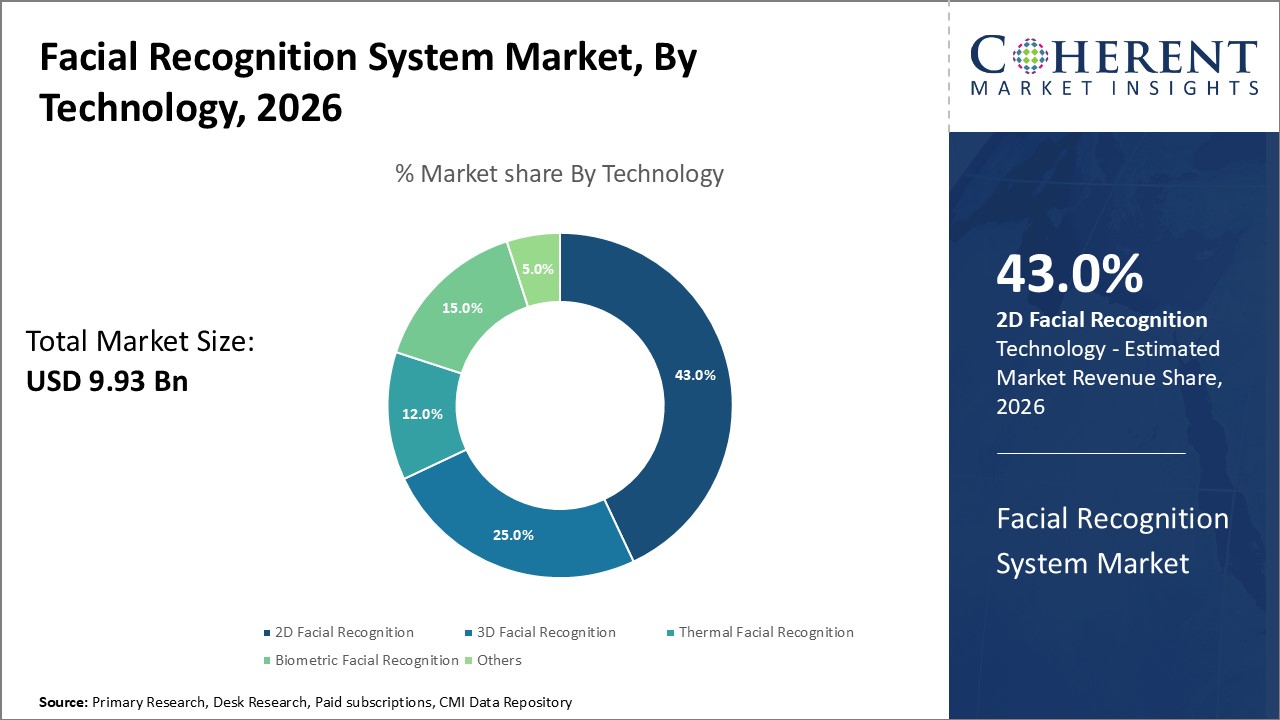
The 2D Facial Recognition segment controls the largest share within technology-driven developments, accounting for 43% of the market size, driven by widespread compatibility and cost efficiency.
Surveillance & Security applications remain the leading segment, benefiting from intensified government funding in the public safety-enhancing market revenue.
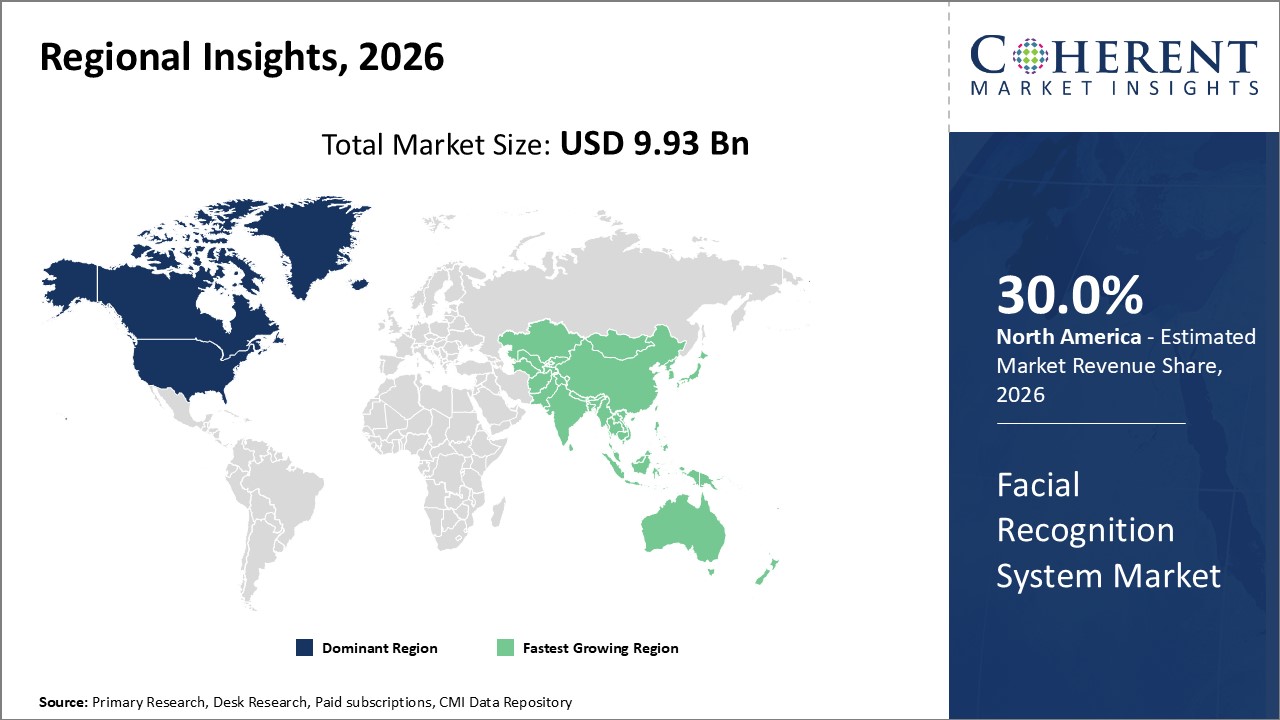
Regionally, North America holds dominance with over 30% market share, credited to proactive regulations and high enterprise adoption rates.
Asia Pacific emerges as the fastest-growing region with a double-digit CAGR, fueled by governmental digitization initiatives and expanding smart city projects, enhancing business growth prospects.
Facial Recognition System Market Segmentation Analysis
To learn more about this report, Request Free Sample
Facial Recognition System Market Insights, By Technology
2D Facial Recognition dominates the market share at 43%. 2D Facial Recognition remains the market leader due to its cost-effectiveness and compatibility with existing camera infrastructure, which has been instrumental, especially in video surveillanceapplications across public safety projects. The fastest-growing subsegment, 3D Facial Recognition, leverages depth information to significantly improve accuracy and reduce spoofing attempts. This technology is increasingly favored in high-security environments such as airports and banking by virtue of its ability to deliver enhanced precision.
Facial Recognition System Market Insights, By Component
Software is dominating the market share owing to its critical role in AI algorithm advancements and ease of deployment updates. Software innovations are at the core of improving recognition rates and reducing error margins, amplifying market revenue, and differentiating service offerings. The fastest-growing segment is Services, propelled by increasing demand for integration, maintenance, and managed facial recognition solutions, especially in cloud-based deployments. Hardware, including cameras and processors, maintains steady growth driven by continuous innovations in sensor quality and portability, catering to diverse environmental conditions. This segmentation reflects the shift towards software-centric deployments, leveraging cloud infrastructure to optimize facial recognition systems’ market scope.
Facial Recognition System Market Insights, By Application
Surveillance & Security dominate the market share, largely due to governmental security programs worldwide and ongoing public safety initiatives that necessitate real-time and large-scale facial recognition implementations. The fastest-growing application segment is Retail & Marketing, driven by rising adoption for personalized customer engagement and loss prevention. Law Enforcement applications continue to expand, supported by improvements in recognition accuracy, leading to higher forensic reliability. Banking & Finance applications grow steadily with the advent of secure digital transactions and biometric authentication, reducing fraud risk.
Facial Recognition System Market Trends
The Facial Recognition System market trend shows a pronounced pivot towards integrated multimodal biometric systems, combining facial recognition with voice and iris scans to boost authentication accuracy.
For instance, the U.S. Department of Homeland Security initiated pilot projects involving such integrations in major airports in 2025, setting the stage for market growth.
Additionally, increased adoption of AI-enabled facial recognition in retail provides personalized customer experiences, driving high market usage in developed economies.
Cloud deployment trends have also accelerated, as demonstrated by a 28% uptick in cloud-based facial recognition contracts across Europe and North America in 2026, lowering hardware dependency and operational costs.
Facial Recognition System Market Insights, By Geography
To learn more about this report, Request Free Sample
North America Facial Recognition System Market Analysis and Trends
In North America, the dominance in the Facial Recognition System market stems from sophisticated governmental policies advocating biometric authentication for security and border control. The U.S. alone contributes over 18% to regional market revenue, driven by technology leaders such as NEC and Amazon Recognition. Enhanced cybersecurity regulations and substantial investments in smart city projects create a conducive ecosystem supporting industry share growth.
Asia Pacific Facial Recognition System Market Analysis and Trends
Meanwhile, Asia Pacific exhibits the fastest growth, driven primarily by China and India’s digital transformation agendas. The region boasts a CAGR exceeding 15%, supported by extensive infrastructure developments and government surveillance programs. Local players are increasingly innovating in cloud-based facial recognition technologies, accommodating regional compliance frameworks and business growth demands.
Facial Recognition System Market Outlook for Key Countries
USA Facial Recognition System Market Analysis and Trends
The USA’s market is distinguished by its early adoption of advanced facial recognition for law enforcement and financial services. U.S. agencies deployed over 200 facial recognition systems nationwide in 2025, contributing significantly to reducing identity fraud. U.S.-based companies have also pioneered the integration of AI-powered analytics with facial biometrics, capturing substantial market share by enhancing operational efficiencies across security and retail sectors.
China Facial Recognition System Market Analysis and Trends
China’s market drives regional momentum through large-scale smart city integrations and expansive surveillance infrastructure, accounting for over 35% of Asia Pacific’s facial recognition market revenue in 2025. Major technology companies have collaborated on national projects embedding facial recognition in public transportation and retail sectors, catalyzing business growth and elevating market company prominence.
Analyst Opinion
Rising deployment in Asia-Pacific public surveillance initiatives has boosted the adoption rate of facial recognition systems, with China leading infrastructure investments contributing over 35% of the regional market revenue in 2025. This aligns with the sector’s increasing share in enhancing urban security.
Demand-side indicators reflect robust growth in the financial sector’s adoption of facial recognition for secure and contactless payment authentication, with North America witnessing over 25 million transactions annually using facial biometrics in 2025, showing a year-on-year growth of 18%.
Cost optimization through AI-driven cloud solutions has expanded market accessibility for SMBs, with cloud-based facial recognition platforms reducing deployment costs by approximately 21% compared to on-premise systems in 2026, thus driving wider use cases.
Micro-level analytics reveal that enhanced precision algorithms have decreased false acceptance rates by 31% in recent system iterations, reinforcing trust levels and expanding applications into sensitive sectors like healthcare and border control.
Market Scope
| Report Coverage | Details | ||
|---|---|---|---|
| Base Year: | 2025 | Market Size in 2026: |
USD 9.93 billion |
| Historical Data for: | 2020 To 2024 | Forecast Period: | 2026 To 2033 |
| Forecast Period 2026 to 2033 CAGR: | 11.6% | 2033 Value Projection: |
USD 19.3 billion |
| Geographies covered: |
|
||
| Segments covered: |
|
||
| Companies covered: | Amazon Web Services, Vision-Box, Huawei Technologies, IDEMIA, FacePhi, Supreema Technologies, Herta Security, AllGoVision, CyberLink, AnyVision | ||
| Growth Drivers: |
|
||
Uncover macros and micros vetted on 75+ parameters: Get instant access to report
Facial Recognition System Market Growth Factors
The market growth is primarily driven by increased adoption of biometric-based authentication systems in banking and finance, where facial recognition enhances security against fraud, as demonstrated by a 22% decline in identity theft cases in 2025. Government regulations emphasizing public safety performance have catalyzed surveillance infrastructure upgrades, notably in the Asia-Pacific, propelling industry size and regional business growth. Additionally, the rise of mobile device integration supporting facial recognition in smartphone authentication supports market revenue gains, with over 1 billion devices worldwide equipped by 2026. Furthermore, advances in deep learning algorithms have refined system accuracy, reducing error rates significantly and encouraging enterprise investments in healthcare and retail sectors.
Facial Recognition System Market Development
In August 2025, Airtel Payments Bank introduced its advanced “Face Match” security feature, leveraging machine learning–driven facial behavior analytics to strengthen fraud prevention across its digital banking ecosystem. The system evaluates user behavior patterns, geolocation consistency, and transaction anomalies, automatically triggering selfie-based verification for any activity flagged as suspicious.
In December 2025, Microsoft expanded the deployment of its next-generation facial recognition systems for government and public security agencies, integrating advanced deep-learning models to improve precision, real-time surveillance capabilities, and identity authentication integrity. The update incorporated enhanced user-consent protocols and privacy-by-design architecture, reflecting global regulatory pressures around responsible AI use.
Key Players
Leading Companies of the Market
Vision-Box
Huawei Technologies
IDEMIA
FacePhi
Supreema Technologies
Herta Security
AllGoVision
CyberLink
AnyVision
Leading market players prioritize AI-driven innovation and strategic partnerships; for instance, NEC Corporation’s collaboration with government agencies has accelerated adoption in surveillance, translating into a 12% revenue uplift in 2025. Similarly, IDEMIA’s focus on multi-modal biometrics integration enhanced client retention rates by 8%, exemplifying competitive market growth strategies.
Facial Recognition System Market Future Outlook
The market’s future will be shaped by wider integration into digital ecosystems, offering contactless authentication across banking, travel, healthcare, and public safety. Growth will accelerate with advances in 3D imaging, edge computing, and multimodal biometrics combining facial, voice, and iris recognition. AI models will become faster, more accurate, and more secure against spoofing. Asia-Pacific, especially China and India, will drive adoption through national digital identity systems and smart infrastructure investments. Stricter data protection laws will require vendors to enhance transparency and security mechanisms.
Facial Recognition System Market Historical Analysis
Historically, the facial recognition system market grew from simple 2D imaging technologies to advanced AI-driven biometric systems used in security and consumer electronics. Early adoption occurred in government and law enforcement agencies for surveillance and identity verification. Breakthroughs came after 2010 with deep-learning algorithms, high-resolution cameras, and improved hardware acceleration. Smartphones played a major role in mainstream adoption, as facial recognition became a key authentication method. Airports, banks, retail, and smart city projects further accelerated deployment. Privacy concerns and regulatory scrutiny influenced adoption rates in certain regions.
Sources
Primary Research Interviews:
Computer Vision Researchers
Biometrics Engineers
Security Integrators
Law Enforcement IT Leads
Consumer Device Makers
Databases:
IEEE Xplore
Statista Biometrics Data
IHS Markit Security Reports
UN Comtrade Surveillance Tech
GlobalData AI Reports
Magazines:
MIT Technology Review
Wired
Biometrics Update
Security Magazine
AI Trends
Journals:
IEEE Transactions on Pattern Analysis and Machine Intelligence
International Journal of Computer Vision
Pattern Recognition
Computer Vision and Image Understanding
Journal of Artificial Intelligence Research
Newspapers:
The New York Times (Technology)
The Guardian (Privacy & Tech)
Financial Times (Tech Policy)
Reuters Technology News
The Washington Post (Security)
Associations:
IEEE
International Biometrics & Identity Association (IBIA)
NIST Biometrics Committee
IAPP (privacy)
ISO/IEC JTC 1/SC 37 (biometrics)
Share
Share
Ankur Rai is a Research Consultant with over 5 years of experience in handling consulting and syndicated reports across diverse sectors. He manages consulting and market research projects centered on go-to-market strategy, opportunity analysis, competitive landscape, and market size estimation and forecasting. He also advises clients on identifying and targeting absolute opportunities to penetrate untapped markets.

Credibility and Certifications

860519526


9001:2015

27001:2022


Need a Custom Report?
We can customize every report - free of charge - including purchasing stand-alone sections or country-level reports
Customize NowJoining thousands of companies around the world committed to making the Excellent Business Solutions.
View All Our Clients